
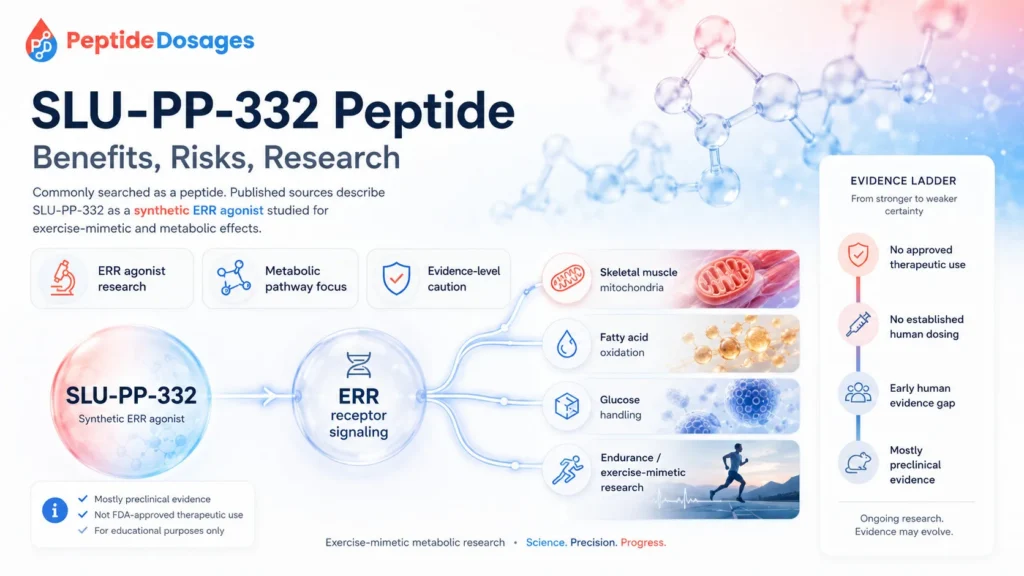
SLU-PP-332 peptide is a common search phrase for a research compound discussed in exercise-mimetic and metabolic science, but published descriptions more accurately characterize SLU-PP-332 as a synthetic estrogen-related receptor agonist rather than a conventional amino-acid peptide drug 1. This educational article reviews what is known about SLU-PP-332, how it may affect metabolic pathways, why it is linked to “exercise in a pill” claims, and where the evidence remains limited 2. It does not provide personal medical advice, dosing instructions, purchasing guidance, or a recommendation to use unapproved compounds.
- SLU-PP-332 is best understood as an experimental ERR agonist, not an FDA-approved peptide therapy or approved metabolic medication 1, 3.
- Researchers study it as an exercise mimetic because ERR signaling is involved in energy metabolism, mitochondrial function, skeletal muscle adaptation, and fat oxidation pathways 4, 5.
- Most SLU-PP-332 research appears preclinical, with mouse and mechanistic studies carrying the most weight; this does not prove human benefit 2, 6.
- Potential benefits discussed online—endurance, metabolic health, body composition, glucose handling, and energy expenditure—should be evidence-graded, because they are not established approved uses.
- Side effects, contraindications, drug interactions, and long-term safety are not well defined in humans, especially compared with approved medications that have prescribing labels 3.
- SLU-PP-332 dosing should not be converted into personal use, because available dose information comes from research settings, mainly animal models, not approved human labeling.
- Regulatory status matters: unapproved research compounds are not evaluated the same way as FDA-approved or EMA-authorized medicines for identity, manufacturing quality, safety, efficacy, and labeling 7, 8.
Related dosage pages: For vial-specific concentration, reconstitution, and measurement examples, see SLU-PP-332 (5 mg Vial) Dosage Protocol. Each linked protocol remains a separate reference because vial strength changes concentration and syringe-unit calculations.
Fast Answer: What Should Readers Know First?
SLU-PP-332 peptide is a common SEO and consumer search term for SLU-PP-332, a synthetic ERR agonist studied as an exercise mimetic in metabolic and endurance research. Published work has focused mainly on receptor activation, skeletal muscle metabolism, fatty acid oxidation, and mouse models rather than approved human therapeutic use 1, 2. It is not FDA-approved as a treatment, and study doses or administration routes should not be interpreted as personal medical advice 3.
Current Evidence Level at a Glance
The evidence for SLU-PP-332 is strongest at the mechanistic and preclinical level. Researchers have investigated how ERR activation may influence energy metabolism, mitochondrial function, endurance-related biology, and lipid use in animal or laboratory models [2], 6.
The evidence is much weaker for direct human outcomes. Searches of major regulatory and clinical-trial databases should be used to verify whether any registered human trials or approved indications exist, and current FDA drug databases do not list SLU-PP-332 as an approved medicine 3, 9.
Key Safety and Regulatory Takeaways
No approved prescribing label establishes SLU-PP-332 dosage, contraindications, adverse reactions, drug interactions, or special-population warnings. That matters because FDA-approved products go through formal review for a specific indication, dose, manufacturing standard, and safety profile 7.
Unapproved or compounded products also raise quality and safety questions. FDA materials on compounding emphasize that compounded drugs are not FDA-approved and do not undergo the same premarket review for safety, effectiveness, or manufacturing quality as approved drugs 10.
What Is the SLU-PP-332 Peptide?
SLU-PP-332 is commonly called the “SLU-PP-332 peptide” in search behavior, but that phrase can be misleading. Public scientific databases and published literature describe it as a synthetic small-molecule agonist of estrogen-related receptors, not as a conventional therapeutic peptide made from an amino-acid sequence 1, 2.
In practical terms, the article uses the phrase SLU-PP-332 peptide because readers search for it that way, while also clarifying the underlying pharmacology. This distinction is important because peptide drugs, small molecules, biologics, and research chemicals can differ in structure, absorption, metabolism, manufacturing controls, and regulatory review.
Why Is SLU-PP-332 Often Searched as a Peptide?
Many experimental metabolic compounds are discussed in the same online spaces as peptides, especially when they are marketed around endurance, fat oxidation, body composition, or “peptide therapy.” That does not mean they are approved, equivalent, or chemically the same as peptide drugs.
For SLU-PP-332, the stronger scientific framing is “ERR agonist” or “exercise-mimetic research compound.” PubChem and PubMed-indexed records are better sources for compound identity than sales pages or forum summaries [1], [2].
SLU-PP-332 Is a Synthetic ERR Agonist
ERR stands for estrogen-related receptor, a family of nuclear receptors involved in transcriptional control of energy metabolism. ERRα, ERRβ, and ERRγ are related to estrogen receptors by sequence and structure, but they are not the same as classical estrogen receptors and do not function simply as estrogen hormone receptors 4, 11.
SLU-PP-332 is discussed as an agonist because it is intended to activate ERR signaling. In metabolic research, that activation is relevant because ERRs help regulate genes involved in mitochondrial respiration, oxidative metabolism, and fuel use [4], [11].
Why Are Exercise Mimetics Therapeutically Interesting?
Exercise mimetics are compounds studied for their ability to reproduce selected molecular effects of exercise. The concept became widely discussed after research showed that pharmacologic activation of pathways such as AMPK and PPARδ could enhance endurance-related adaptations in mice 5.
That does not mean an exercise mimetic can replace physical activity. Exercise affects cardiovascular fitness, muscle, bone, insulin sensitivity, mood, inflammation, and many other systems through mechanical, metabolic, vascular, and neurologic mechanisms that a single compound is unlikely to duplicate fully 12.
How Does SLU-PP-332 Peptide Work?
SLU-PP-332 works, in theory, by activating estrogen-related receptor signaling. ERRs are nuclear receptors, meaning they help regulate gene expression rather than acting only at the cell surface like many membrane receptors [4], [11].
The proposed pathway is linked to metabolic adaptation. In skeletal muscle and other high-energy tissues, ERR activity is associated with mitochondrial genes, oxidative phosphorylation, fatty acid oxidation, and cellular respiration [4], [11].
How Researchers Propose SLU-PP-332 Works to Activate ERR Signaling
The proposed mechanism of action is receptor activation. As an ERR agonist, SLU-PP-332 is studied for its ability to increase transcriptional programs connected to oxidative metabolism and energy use [1], [6].
In plain language, this means researchers are asking whether the compound can “turn up” some cellular programs that are also active during endurance training. That hypothesis is biologically plausible, but biological plausibility is not the same as proven clinical benefit.
ERRA and Estrogen-Related Receptor Targets
ERRA, also written as ERRα, is one of the main estrogen-related receptor targets discussed in metabolic research. ERRα interacts with co-regulators such as PGC-1α, a major regulator of mitochondrial biogenesis and endurance-related adaptation [4], 13.
ERRβ and ERRγ also participate in energy metabolism, although their tissue distribution and biology differ. A compound described as a pan-ERR agonist may affect more than one ERR subtype, which could broaden both potential effects and uncertainty [11].
Why Does Receptor Activation Not Equal Proven Clinical Outcomes?
A receptor signal can look promising in cells or mice and still fail to become a useful human treatment. Human physiology, disease complexity, dose exposure, safety limits, metabolism, sex differences, age, medications, and long-term tolerability can all change the outcome.
This is why drug development separates mechanistic studies from clinical trials. FDA materials describe a staged process that includes laboratory research, animal testing, investigational new drug review, human trials, and regulatory evaluation before approval 7, 14.
SLU-PP-332 Mechanism of Action: Metabolic Pathway Effects
SLU-PP-332 research focuses on metabolic pathway effects rather than direct symptom treatment. The most relevant pathways involve mitochondrial energy production, fuel switching, fatty acid oxidation, glucose use, and skeletal muscle endurance biology [4], [6].
These pathways matter because metabolic dysfunction is a feature of obesity, insulin resistance, type 2 diabetes, metabolic syndrome, cardiovascular disease, and heart failure. However, studying a pathway does not establish that SLU-PP-332 treats any of those conditions in humans.
Metabolism and Mitochondrial Function in Skeletal Muscle
Skeletal muscle is a major site of glucose disposal and fatty acid oxidation. It is also a key tissue for endurance training adaptations, because repeated aerobic exercise increases oxidative capacity and mitochondrial function over time 13, 15.
ERR signaling is relevant because ERRs help coordinate mitochondrial gene programs. Preclinical SLU-PP-332 research is therefore often interpreted through the lens of metabolism and mitochondrial function, especially in muscle [4], [6].
Fatty Acid Oxidation, Glucose Handling, and Cellular Energy
Fatty acid oxidation describes the process of breaking down fatty acids for energy. Glucose handling describes how tissues take up, store, or use glucose, which is central to insulin sensitivity and metabolic health.
Published SLU-PP-332 research has emphasized fatty acid oxidation and endurance-related endpoints in preclinical systems [6]. Those endpoints are scientifically interesting, but they should not be translated into claims that SLU-PP-332 causes weight loss, treats diabetes, or improves body composition in humans without clinical evidence.
Why Is SLU-PP-332 Called an Exercise Mimetic?
SLU-PP-332 is called an exercise mimetic because it is studied for its ability to mimic selected molecular effects of exercise. In this context, “mimic” means activating some cellular pathways that overlap with exercise adaptation, not duplicating the full benefits of exercise.
The phrase can be useful for explaining the research goal. It can also be misleading if readers interpret it to mean that a compound provides the same health benefits as aerobic exercise, strength training, or regular physical activity.
How May It Mimic Some Effects of Aerobic Exercise?
Aerobic exercise activates energy-sensing pathways, increases mitochondrial biogenesis, improves oxidative capacity, and changes how muscle uses fuel. Exercise also affects the cardiovascular system, adipose tissue, liver, appetite regulation, insulin sensitivity, and inflammatory signaling 12, [15].
SLU-PP-332 research focuses on a narrower slice of that biology: ERR-driven metabolic gene expression. That may overlap with some effects of endurance exercise, but it does not reproduce movement, blood-flow adaptations, neuromuscular training, or the full systemic benefits of physical activity.
Exercise in a Pill: Helpful Phrase or Overstatement?
“Exercise in a pill” is a catchy phrase, but it is scientifically incomplete. The phrase may help people understand why researchers study exercise mimetics, yet it can overstate what is known.
The safest interpretation is this: SLU-PP-332 may help scientists study pathways related to endurance and metabolism. It is not an approved replacement for physical activity, and public health agencies continue to recommend regular physical activity for broad health benefits [12].
What Is SLU-PP-332 Studied or Used For?
SLU-PP-332 is studied for metabolic and exercise-mimetic research questions. It should not be described as being “used for” a medical condition in the same way as an approved drug, because no FDA-approved indication or prescribing label has been identified for SLU-PP-332 3.
The main areas of interest include endurance, oxidative metabolism, obesity-related models, insulin resistance, metabolic syndrome pathways, and possibly heart or mitochondrial dysfunction research. These are research areas, not established treatment claims.
Metabolic Disease, Obesity, and Insulin Resistance Research
Metabolic disease research often examines pathways involved in adipose tissue, liver metabolism, skeletal muscle insulin sensitivity, lipid metabolism, and energy expenditure. SLU-PP-332 is relevant because ERR activation may influence fuel use and mitochondrial function [4], [11].
Still, obesity and type 2 diabetes treatment require high-quality human outcome data. Current standards of care for diabetes and obesity rely on lifestyle interventions, approved medications, risk management, and clinician-guided care rather than unapproved research compounds 16.
Endurance, Physical Activity, and Metabolic Adaptation Models
The endurance interest comes from animal research evaluating exercise capacity and muscle metabolism. Published SLU-PP-332 literature and database records suggest that most direct evidence is preclinical rather than based on large human trials [2], [6].
Endurance training in humans involves repeated stress, recovery, cardiovascular adaptation, and neuromuscular learning. A metabolic agonist may affect parts of this system, but it cannot be assumed to produce the same outcomes.
Potential Benefits of SLU-PP-332 Peptide
Potential benefits of SLU-PP-332 peptide should be divided by evidence level. Preclinical studies may suggest metabolic effects, while human therapeutic benefits remain unproven unless supported by clinical trials and regulatory review [2], [3].
The most discussed potential benefits include endurance-related effects, increased energy expenditure, fatty acid oxidation, mitochondrial function, glucose handling, and metabolic flexibility. Each claim needs caution because mechanism and animal data do not equal approved clinical use.
What Research Suggests About Endurance and Energy Expenditure
Preclinical work has examined whether ERR activation can enhance endurance-related outcomes and energy metabolism. The SLU-PP-332 literature is often discussed alongside findings about exercise mimetics and pharmacologic activation of exercise-associated pathways in mice [5], [6].
For readers, the key point is not that SLU-PP-332 “improves endurance” in humans. The accurate statement is that researchers have studied endurance-related biology in preclinical models, and human relevance remains uncertain.
What Is Known About Fat Oxidation and Body Composition?
Fat oxidation is a metabolic process, not the same as guaranteed fat loss. A compound can increase fatty acid oxidation in a model system without producing clinically meaningful weight loss or improved body composition in humans.
Body composition outcomes require controlled human data, including diet, activity, baseline metabolic health, adverse effects, and follow-up duration. At present, claims that SLU-PP-332 reliably changes human body composition should be considered unsupported.
Why Do Metabolic Benefits Remain Unproven in Humans?
Metabolic benefits remain unproven because human trials are needed to measure clinically meaningful outcomes. These might include insulin sensitivity, hemoglobin A1c, body weight, lipid markers, exercise capacity, cardiovascular outcomes, adverse events, and quality-of-life endpoints.
ClinicalTrials.gov is the appropriate place to check for registered human trials, while Drugs@FDA and EMA databases help verify approved uses 3, 8, 9. Until such evidence exists, metabolic benefits should be described as hypotheses or preclinical findings.
What Does the Research Say About SLU-PP-332?
The research landscape is early. SLU-PP-332 appears in scientific databases and PubMed-indexed literature, but the evidence base is not comparable to approved metabolic drugs with extensive human trials and prescribing information [1], [2], [3].
A helpful way to read the literature is to separate compound identity, mechanism, animal outcomes, human trials, regulatory approval, and online claims. These categories answer different questions.
| Evidence Area | What Has Been Studied | Evidence Level | What It Can and Cannot Show |
|---|---|---|---|
| Compound identity | Database and literature records describe SLU-PP-332 as a synthetic research compound linked to ERR agonism [1], [2] | Core scientific identity | Helps define the compound, but does not prove therapeutic value |
| ERR mechanism | ERR signaling regulates mitochondrial and metabolic gene programs [4], [11] | Mechanistic / preclinical | Supports biological plausibility, not clinical efficacy |
| Endurance and fat oxidation | SLU-PP-332 has been discussed in relation to mouse endurance and fatty acid oxidation research [6] | Preclinical | Can generate hypotheses, but cannot establish human benefit |
| Human therapeutic use | No approved FDA labeling identified in Drugs@FDA for SLU-PP-332 [3] | No approved use identified | Does not support medical use or personal dosing |
| Online “exercise in a pill” claims | Consumer claims often exceed the evidence base | Unsupported / anecdotal | Should be treated cautiously unless confirmed by trials |
Are There Published Human Clinical Trials?
At the time of writing, the publicly searchable evidence base appears to be dominated by preclinical and mechanistic research rather than large human clinical trials. Readers and editors should verify the current status through ClinicalTrials.gov, PubMed, Drugs@FDA, and EMA databases because trial registration and regulatory status can change [2], [3], [8], [9].
If human trials appear in the future, the key questions will be study design, sample size, dose, route, duration, endpoints, adverse events, and whether results were peer reviewed. Early human evidence would still need replication before broad therapeutic claims are appropriate.
Mouse Studies, Diet-Induced Obesity Models, and Endurance Findings
Mouse studies are useful for studying mechanisms because researchers can control diet, genetics, activity, dosing, and tissue sampling more tightly than in human populations. SLU-PP-332 has been discussed in connection with mouse models, endurance testing, and fat oxidation research [6].
But mouse results often fail to translate directly into human medicine. Differences in metabolism, lifespan, immune response, dose scaling, behavior, and disease complexity can all limit translation.
Evidence Ladder: From Mechanism to Clinical Use
The evidence ladder for SLU-PP-332 currently starts with chemistry and receptor biology, then moves to cell or animal data. The higher rungs—human pharmacokinetics, dose-ranging trials, randomized controlled trials, approved labeling, and post-marketing safety—are either absent or not established publicly [3], [9], [14].
This ladder matters because each step answers a different question. Mechanism asks, “Can it activate a pathway?” Clinical trials ask, “Does it help people, at what dose, and with what risks?”
Side Effects and Safety Profile of SLU-PP-332
The safety profile of SLU-PP-332 is not well defined in humans. Without approved labeling or robust clinical trial data, there is no authoritative list of common adverse reactions, serious risks, contraindications, pregnancy warnings, lactation warnings, overdose information, or drug interactions [3], [9].
That uncertainty should not be interpreted as evidence of safety. It means the human risk profile is incomplete.
What Side Effects Have Been Reported in Studies?
Preclinical studies may report tolerability observations in specific animal models, but those findings do not establish human safety. Animal studies are usually too small, too short, and too controlled to detect many risks that matter in clinical practice.
For unapproved compounds, additional concerns include identity, purity, contamination, incorrect concentration, and inconsistent manufacturing. FDA materials note that compounded drugs are not FDA-approved and are not reviewed by FDA for safety, effectiveness, or quality before marketing 10, 17.
What Safety Data Remains Unknown?
Important unknowns include human pharmacokinetics, bioavailability, half-life, liver metabolism, kidney clearance, cardiovascular effects, endocrine effects, reproductive safety, carcinogenicity signals, immune reactions, and long-term metabolic consequences.
Because ERRs are involved in transcriptional regulation and energy metabolism, off-target or tissue-specific effects would need careful study. A pathway that looks beneficial in skeletal muscle could have different implications in heart, liver, adipose tissue, or other tissues.
Safety Risks, Contraindications, and Drug Interactions
There are no well-established SLU-PP-332 contraindications or drug-interaction tables comparable to an approved prescribing label. That absence reflects limited clinical evidence, not confirmation that contraindications or interactions do not exist [3], [9].
Readers with metabolic disease, cardiovascular disease, diabetes, liver disease, kidney disease, pregnancy, breastfeeding, cancer history, or complex medication regimens should not rely on online claims. Those situations require individualized medical evaluation.
Which Populations Require Extra Caution?
Extra caution is warranted for people who are pregnant or breastfeeding, adolescents, older adults, people with heart failure or cardiovascular disease, and people with diabetes or metabolic syndrome. These groups often have higher baseline risk and may be more vulnerable to unstudied metabolic or cardiovascular effects.
People using medications for glucose, blood pressure, lipids, appetite, anticoagulation, thyroid disease, or heart rhythm should be especially cautious. Metabolic pathway activation could theoretically interact with disease physiology or medication effects, but specific interaction data are not established.
Interaction Concerns With Metabolic or Cardiovascular Drugs
Interaction concerns are mainly theoretical because human drug-interaction studies are not available. Still, compounds that affect metabolism, energy expenditure, glucose handling, or lipid use could be clinically relevant in people taking insulin, GLP-1 receptor agonists, SGLT2 inhibitors, beta-blockers, statins, anticoagulants, or heart failure therapies.
This is one reason approved medicines include formal labeling. Prescribing information typically summarizes adverse reactions, contraindications, warnings, special populations, and interaction data; SLU-PP-332 does not have that approved-label framework [3], [7].
SLU-PP-332 Dosing: What Dose Has Been Used in Studies?
SLU-PP-332 dosing information should be interpreted only as research context. Published preclinical studies generally use animal-model doses, often expressed as milligrams per kilogram, with routes and schedules selected for the experiment rather than for patient care [6].
Study doses should not be interpreted as personal dosing advice. Animal doses cannot be safely converted into human self-use instructions without formal pharmacology, toxicology, human dose-ranging studies, and clinician oversight.
Published Study Doses Versus Personal Medical Advice
A published mouse dose answers a narrow experimental question: what exposure researchers chose for a specific model, route, duration, and endpoint. It does not answer whether a compound is safe, effective, legal, or appropriate for a person.
Human-equivalent dose calculations are also not enough. Drug development requires absorption, distribution, metabolism, excretion, toxicology, adverse-event monitoring, and dose-response data before a dose can be considered in clinical practice 14.
Why Is There No Approved Label Dosage?
There is no approved label dosage because SLU-PP-332 is not listed as an FDA-approved drug product in Drugs@FDA. Approved label dosing exists only after a product has been reviewed and approved for a specific indication, formulation, route, and patient population [3], [7].
This distinction is essential. “Dosing used in a study” is not the same as “dosage recommended for treatment.”
Administration of SLU-PP-332 in the Literature
Administration of SLU-PP-332 is discussed in the literature as part of experimental design. Routes in preclinical research can include approaches chosen to control exposure in animals, but those methods are not instructions for human administration.
Route matters because it affects absorption, peak concentration, metabolism, tissue exposure, and safety interpretation. A result seen after one experimental route cannot be assumed to apply to another route.
What Routes Have Been Used in Preclinical Research?
Preclinical SLU-PP-332 research has been discussed in relation to experimental administration methods such as oral-gavage or injection-based animal-study designs, depending on the protocol [6]. These routes are used to answer laboratory questions, not to guide self-administration.
No step-by-step administration, injection, mixing, or reconstitution guidance is appropriate for an unapproved research compound. Readers should interpret route information only as part of evaluating the evidence.
Oral Peptide That Mimics Exercise Claims Require Caution
The phrase “oral peptide that mimics exercise” combines two problems. First, SLU-PP-332 is more accurately described as a synthetic ERR agonist than a peptide [1]. Second, “mimics exercise” should be read as a limited research concept, not a proven human outcome.
Oral activity in a research model does not mean an orally marketed product is safe, effective, accurately dosed, or legally appropriate. Regulatory review and manufacturing controls are central to those questions [7], [10].
Is SLU-PP-332 Peptide FDA-Approved?
SLU-PP-332 peptide is not identified as an FDA-approved drug in Drugs@FDA, and it should not be described as an approved treatment for obesity, diabetes, metabolic syndrome, endurance, heart failure, or body composition 3.
EMA medicine databases should also be checked for regional authorization status. Approval status can differ by country, but absence of approval means claims should be interpreted cautiously 8.
Approval Status, Legal Status, and Quality Concerns
Regulatory status matters because approved drugs are evaluated for a defined indication, formulation, dose, labeling, manufacturing quality, and risk-benefit profile. Unapproved compounds do not carry the same assurance [7].
Legal status may vary by jurisdiction and context. However, this article does not provide legal advice, sourcing advice, or guidance on acquiring unapproved compounds.
ClinicalTrials.gov and Regulatory Source Checks
ClinicalTrials.gov can be used to check whether human studies are registered, while Drugs@FDA and EMA medicine databases can be used to verify approved drug status [3], [8], [9]. PubMed can be used to check whether peer-reviewed studies exist [2].
A responsible evidence check asks three separate questions: Is it approved? Has it been studied in humans? Are the results peer reviewed and clinically meaningful?
SLU-PP-332 Compared With Exercise Mimetics and Metabolic Therapies
SLU-PP-332 belongs in a broader discussion of exercise mimetics, metabolic therapies, and mitochondrial pathway research. It should not be positioned as “better” than exercise, approved drugs, or clinician-guided care.
Comparisons are most useful when they focus on mechanism, evidence level, approval status, safety data, and uncertainty.
Exercise, Endurance Training, and Lifestyle Interventions
Exercise remains the most evidence-supported way to obtain the broad benefits of physical activity. Public health guidance links regular physical activity with lower risk of cardiovascular disease, type 2 diabetes, some cancers, functional decline, and premature mortality [12].
Endurance training and strength training also improve fitness through mechanical and neuromuscular pathways that a receptor agonist cannot fully reproduce. SLU-PP-332 research may help scientists understand exercise biology, but it does not replace exercise guidance.
GLP-1 Drugs, MOTS-C, AOD-9604, and Related Approaches
Approved GLP-1 receptor agonist medicines have a different evidence profile because some products have completed large clinical trial programs and have regulator-reviewed prescribing information for specific indications. SLU-PP-332 does not have that same approved-label foundation [3], [16].
MOTS-C and AOD-9604 are sometimes discussed in metabolic peptide spaces, but they differ mechanistically and clinically from SLU-PP-332. Comparisons should avoid ranking compounds for personal use and should instead ask whether each has human trials, approved indications, known risks, and reliable manufacturing.
Evidence Limitations and Clinician Discussion Points
The main limitation is that SLU-PP-332 research remains early and largely preclinical. The mechanism is interesting, but the clinical meaning is uncertain.
Readers considering peptide-related medical decisions should focus on evidence quality, regulatory status, safety uncertainty, and approved alternatives. A licensed clinician can help interpret whether a claim is relevant to a person’s health history and medications.
Unsupported Claims About How SLU-PP-332 Mimics Exercise
Unsupported claims include statements that SLU-PP-332 reliably causes weight loss, replaces exercise, treats diabetes, reverses metabolic syndrome, improves heart failure, or guarantees endurance benefits in humans. Those claims go beyond the current evidence unless supported by well-designed human trials and regulatory review.
Online anecdotes can generate hypotheses, but they cannot establish safety, efficacy, dose, or appropriate medical use. The strongest conclusions come from approved labeling and well-designed human studies; weaker claims should be treated cautiously.
Questions About Metabolic Syndrome, Diabetes, or Heart Failure
People interested in SLU-PP-332 because of metabolic syndrome, diabetes, obesity, heart failure, or cardiovascular risk should discuss safer, evidence-based options with a qualified clinician. Current clinical care for these conditions relies on diagnosis, risk stratification, lifestyle support, approved medications, monitoring, and follow-up [16].
A practical clinician discussion checklist may include:
- Current diagnoses, symptoms, and treatment goals.
- Current medications, supplements, and prior adverse reactions.
- Pregnancy, breastfeeding, fertility plans, or hormone-sensitive conditions.
- Cardiovascular, liver, kidney, endocrine, or cancer history.
- Whether any human trials or approved labels exist for the compound.
- How to compare online claims with peer-reviewed evidence.
- Safer approved alternatives for metabolic health, endurance limitations, or cardiometabolic risk.
- What adverse events should prompt medical attention.
The safest way to interpret SLU-PP-332 peptide information is through evidence quality, regulatory status, safety data, and clinician-guided decision-making—not through sales claims, forum protocols, or unverified dosing advice.
Related dosage protocols and research
Use the available links to move between research context, dosage pages or comparisons, and supporting guides. When vial-size variants exist, they remain separate because concentration and syringe-unit calculations change with vial strength. Comparisons do not imply that different compounds are interchangeable.
Matching dosage protocols
Further research context
- AOD-9604 Peptide: Benefits, Uses, Side Effects, Dosage, and Research
- 5-Amino-1MQ Peptide: Benefits, Uses, Side Effects, Dosage, and Research
- Adipotide Peptide: Benefits, Uses, Side Effects, Dosage, and Research
- MOTS-c Peptide: Benefits, Uses, Side Effects, Dosage, and Research
- SS-31 Peptide: Benefits, Uses, Side Effects, Dosage, and Research
- NAD+ Peptide: Benefits, Uses, Side Effects, Dosage, and Research
REFERENCES
- National Center for Biotechnology Information. PubChem Compound Summary: SLU-PP-332. PubChem database. Accessed 2026.
- National Library of Medicine. PubMed search results for “SLU-PP-332”. PubMed database. Accessed 2026.
- U.S. Food and Drug Administration. Drugs@FDA: FDA-Approved Drugs. FDA database. Accessed 2026.
- Villena JA, Kralli A. ERRα: a metabolic function for the oldest orphan. Trends in Endocrinology & Metabolism. 2008.
- Narkar VA, Downes M, Yu RT, et al. AMPK and PPARδ agonists are exercise mimetics. Cell. 2008.
- National Library of Medicine. PubMed title search: “An ERR agonist enhances exercise endurance and fatty acid oxidation”. PubMed database. Accessed 2026.
- U.S. Food and Drug Administration. The Drug Development Process. FDA. Accessed 2026.
- European Medicines Agency. Medicines database. EMA. Accessed 2026.
- National Library of Medicine. ClinicalTrials.gov search: SLU-PP-332. ClinicalTrials.gov. Accessed 2026.
- U.S. Food and Drug Administration. Compounding and the FDA: Questions and Answers. FDA. Accessed 2026.
- Giguère V. Transcriptional control of energy homeostasis by the estrogen-related receptors. Endocrine Reviews. 2008.
- Centers for Disease Control and Prevention. Benefits of Physical Activity. CDC. Accessed 2026.
- Lin J, Handschin C, Spiegelman BM. Metabolic control through the PGC-1 family of transcription coactivators. Cell Metabolism. 2005.
- U.S. Food and Drug Administration. Investigational New Drug Application. FDA. Accessed 2026.
- Egan B, Zierath JR. Exercise metabolism and the molecular regulation of skeletal muscle adaptation. Cell Metabolism. 2013.
- American Diabetes Association Professional Practice Committee. Standards of Care in Diabetes—2024. Diabetes Care. 2024.
- U.S. Food and Drug Administration. Compounding Risk Alerts. FDA. Accessed 2026.
FAQs
What is SLU-PP-332 peptide and how does it work?
SLU-PP-332 peptide is a common search term for SLU-PP-332, a synthetic ERR agonist studied in metabolic and exercise-mimetic research. It is not best described as a conventional peptide drug; published sources characterize it as a compound that may activate estrogen-related receptor signaling [1]. Its proposed mechanism of action involves metabolic gene programs linked to mitochondrial function, fatty acid oxidation, and skeletal muscle energy use [4].
What are the potential benefits of SLU-PP-332?
Potential benefits of SLU-PP-332 remain evidence-limited and should be interpreted mainly through preclinical research. Studies and mechanistic discussions focus on metabolic effects, endurance-related biology, fatty acid oxidation, and cellular energy pathways [6]. Claims about weight loss, improved physical fitness, or restored metabolic efficiency are not established human outcomes. At this stage, the strongest wording is “research interest,” not proven therapeutic benefit.
What do clinical studies and research show about SLU-PP-332?
Clinical studies on SLU-PP-332 appear limited, and the main evidence base is preclinical or mechanistic rather than large human trials. PubMed and ClinicalTrials.gov were identified in the article as appropriate sources for checking the current research status [2], [9]. Current evidence can help explain biological plausibility, but it does not establish human efficacy, approved use, or patient outcomes for metabolic disease, endurance, or body composition.
What are the potential side effects of SLU-PP-332?
Potential side effects of SLU-PP-332 are not well characterized in humans because there is no approved prescribing label and limited public clinical evidence. This means adverse reactions, serious side effects, contraindications, allergic reaction risk, overdose information, and long-term safety remain uncertain. Preclinical safety observations should not be treated as proof of human safety, especially for unapproved or compounded products [10].
What dosage information has been reported for SLU-PP-332?
Dosage information for SLU-PP-332 should be interpreted only as study context, not personal medical advice. The article notes that available dosing discussion comes mainly from preclinical research settings, where dose, route of administration, duration, and endpoints are selected for experiments [6]. There is no approved label dosage for SLU-PP-332 in Drugs@FDA, so it should not be converted into a self-use protocol [3].
Is SLU-PP-332 FDA-approved or available for human use?
SLU-PP-332 is not identified as an FDA-approved drug in the article’s regulatory review, and it should not be described as an approved treatment for human use [3]. Availability claims should be separated from legal status, product quality, and medical supervision. Unapproved peptides or research compounds are not evaluated like approved medicines for safety, efficacy, manufacturing quality, or labeling, so regulatory status should be discussed with a qualified clinician.
Researchers Cited in This Article
The researchers below authored or co-authored publications cited in this article. Listing them here identifies sources; it does not mean they wrote, independently reviewed, sponsored, or endorsed this PeptideDosages.com article. The site author is identified in the article byline.
Ronald M. Evans
Researcher profile: Salk Institute Profile
Ronald M. Evans is recognized for published literature on nuclear receptor biology, exercise-mimetic pharmacology, and metabolic pathway regulation. His research is relevant to the scientific context around SLU-PP-332 because this article discusses how receptor-targeted compounds may influence endurance-related and metabolic signaling without assuming proven therapeutic use. His work on PPARδ and AMPK agonists provides important background for understanding how preclinical exercise-mimetic findings should be separated from human clinical evidence, safety interpretation, and regulatory status.
Selected publications:
- AMPK and PPARδ agonists are exercise mimetics — Cell, 2008. PMID: 18674809
- Regulation of muscle fiber type and running endurance by PPARδ — PLoS Biology, 2004. PMID: 15328533
Bruce M. Spiegelman
Researcher profile: Harvard Medical School Profile
Bruce M. Spiegelman is recognized for research on transcriptional coactivators, mitochondrial biology, and skeletal muscle adaptation. His publications are relevant to this article’s discussion of SLU-PP-332 peptide because ERR signaling, mitochondrial function, and exercise-associated metabolic adaptation are central themes in interpreting the compound’s proposed mechanism of action. His work helps frame why preclinical findings involving energy metabolism and endurance biology require careful interpretation before they are translated into claims about human efficacy or therapeutic use.
Selected publications:
- Metabolic control through the PGC-1 family of transcription coactivators — Cell Metabolism, 2005. PMID: 17476350
- Transcriptional coactivator PGC-1α drives the formation of slow-twitch muscle fibres — Nature, 2002. PMID: 11932863