
MOTS-C Dosage Chart
This MOTS-C dosage chart converts a 5 mg vial reconstituted with 3.0 mL of bacteriostatic water into the displayed microgram amounts, mL, and U-100 syringe markings. The numeric rows are community-reported calculations, not a validated human injection schedule.[15]
- Reconstitute: Add 3.0 mL bacteriostatic water → ~1.67 mg/mL concentration.
- Typical daily range: 500–1500 mcg once daily (gradual titration from 500 mcg).
- Easy measuring: At 1.67 mg/mL, 1 unit = 0.01 mL ≈ 16.7 mcg on a U‑100 insulin syringe.
- Storage: Lyophilized: freeze at −20 °C (−4 °F); after reconstitution, refrigerate at 2–8 °C (35.6–46.4 °F); follow documented, formulation-specific discard guidance.
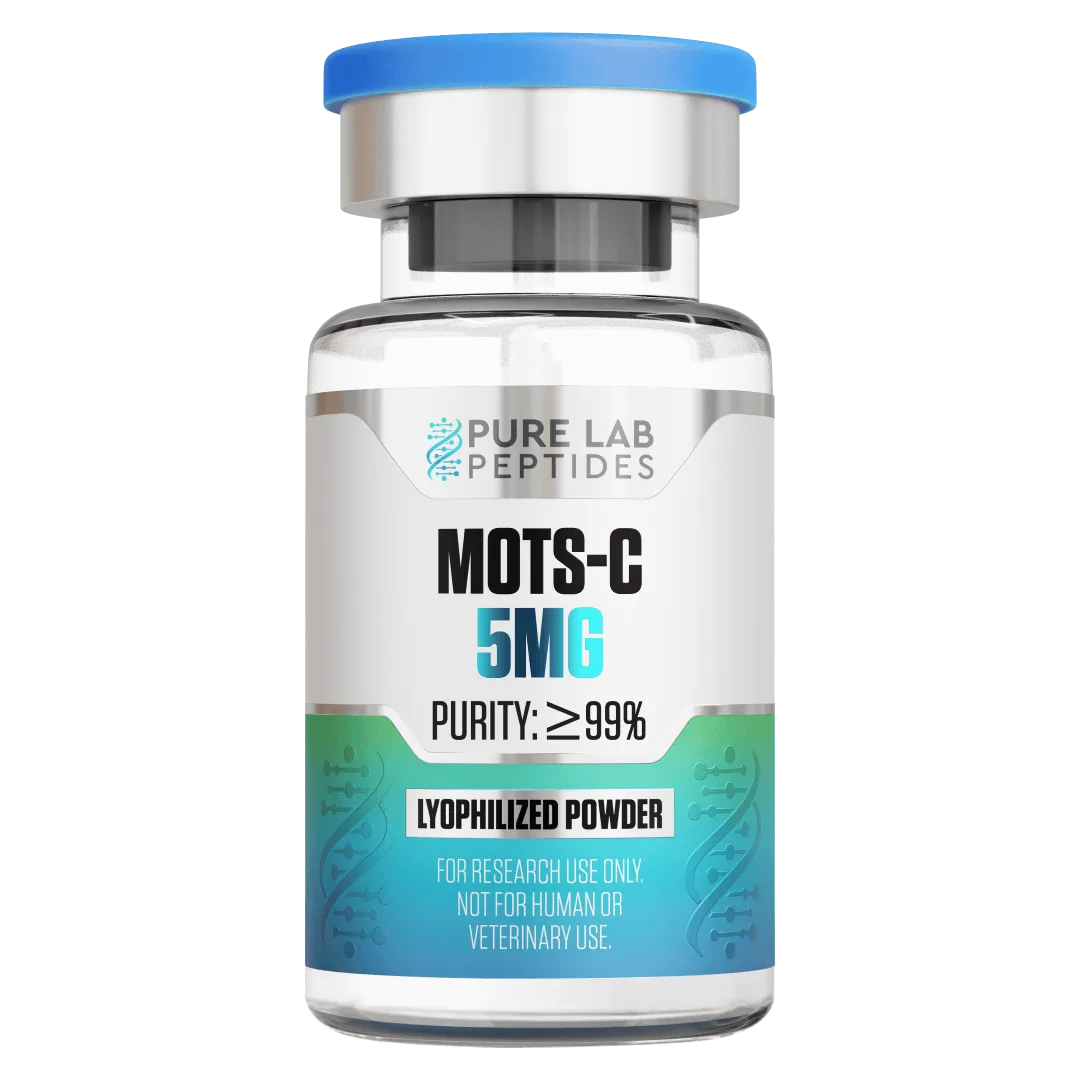
MOTS-C is a 16‑amino-acid mitochondrial‑derived peptide encoded in the mtDNA 12S rRNA region[1][2]. Discovered in 2015, it enhances metabolic homeostasis through AMPK activation[1][3], increases sharply with exercise (~12‑fold in muscle)[3], and declines with age. This educational protocol presents a once‑daily subcutaneous approach aligned with preclinical findings and emerging clinical use.
Research context: For evidence on mechanisms, human and preclinical research, limitations, and safety, read MOTS-c Peptide: Benefits, Uses, Side Effects, Dosage, and Research.
Dosing & Reconstitution Guide
5 mg vial calculations and four reconstitution checks
Community-reported use (3 mL = ~1.67 mg/mL)
| Week | Daily Dose (mcg) | Units (per injection) (mL) |
|---|---|---|
| Weeks 1–2 | 500 mcg (0.5 mg) | 30 units (0.30 mL) |
| Weeks 3–4 | 1000 mcg (1.0 mg) | 60 units (0.60 mL) |
| Weeks 5–6 | 1500 mcg (1.5 mg) | 90 units (0.90 mL) |
| Weeks 7–8 | 2000 mcg (2.0 mg) | 120 units (two 60‑unit injections)* |
Community-reported use: Online community descriptions present these rows as once-daily subcutaneous administrations with stepwise increases. Published human research has not validated the dose, frequency, or progression. The rows are shown only to make the vial concentration, U-100 units, and mL arithmetic transparent.
Reconstitution Steps
- Draw 3.0 mL bacteriostatic water with a sterile syringe.
- Inject slowly down the vial wall; avoid foaming.
- Gently swirl/roll until dissolved (do not shake vigorously).
- Label with reconstitution date and refrigerate at 2–8 °C (35.6–46.4 °F), protected from light. Follow documented, formulation-specific discard guidance[12].
Supplies Needed
Supply calculations for the displayed 8–16 week daily example; actual laboratory requirements depend on the research design.
-
Peptide Vials (MOTS-C, 5 mg each):
- 8 weeks: approximately 12 vials required (average ~1.1 mg/day)
- 12 weeks: approximately 18 vials required
- 16 weeks: approximately 24 vials required
-
Insulin Syringes (U‑100):
- Per week: 7 syringes (1/day)
- 8 weeks: 56 syringes
- 12 weeks: 84 syringes
- 16 weeks: 112 syringes
-
Bacteriostatic Water (10 mL bottles): Use ~3.0 mL per vial for reconstitution.
- 8 weeks (12 vials): 36 mL — 4 bottles required (10 mL each)
- 12 weeks (18 vials): 54 mL — 6 bottles required (10 mL each)
- 16 weeks (24 vials): 72 mL — 8 bottles required (10 mL each)
-
Alcohol Swabs: One for the vial stopper + one for the injection site each day.
- Per week: 14 swabs (2/day)
- 8 weeks: 112 swabs — 2 boxes required (100 swabs each)
- 12 weeks: 168 swabs — 2 boxes required (100 swabs each)
- 16 weeks: 224 swabs — 3 boxes required (100 swabs each)


MOTS-C 5 mg Vial and Calculation Context
A MOTS-C 5 mg vial reconstituted with 3.0 mL has a calculated concentration of approximately 1.67 mg/mL. On a U-100 insulin syringe, one unit is 0.01 mL, so one unit contains approximately 16.7 mcg. Those relationships explain the syringe markings in the chart above; they do not establish a clinically validated human MOTS-C dosage.
- Vial contents: 5 mg, or 5,000 mcg, of MOTS-C.
- Final volume: 3.0 mL after the preparation shown above.
- Concentration: 5 mg ÷ 3.0 mL = approximately 1.67 mg/mL.
- U-100 conversion: 1.67 mg/mL × 0.01 mL = approximately 0.0167 mg, or 16.7 mcg, per unit.
- Evidence boundary: Published work describes MOTS-C biology in cells, animals, and observational human research, but the FDA review found no published human exposure studies for drug products containing native MOTS-C by any route.[1][15]
What a 5 mg Vial Changes: Concentration and Vial Yield
Vial strength changes the concentration, syringe-unit conversion, and number of calculated administrations available from one container. It does not change the underlying MOTS-C evidence. For the 3.0 mL preparation used on this page, the arithmetic is:
| Chart amount | Calculated volume | U-100 marking | Nominal yield from 5 mg |
|---|---|---|---|
| 500 mcg | 0.30 mL | 30 units | 10 full amounts |
| 1,000 mcg | 0.60 mL | 60 units | 5 full amounts |
| 1,500 mcg | 0.90 mL | 90 units | 3 full amounts, with 500 mcg remaining |
| 2,000 mcg | 1.20 mL | 120 units total, displayed as two 60-unit injections | 2 full amounts, with 1,000 mcg remaining |
Nominal yield is simple vial-content arithmetic. Actual recoverable volume can be lower because of dead space, transfer loss, or product-specific handling. A larger or smaller vial does not, by itself, prove that any amount or frequency is effective or safe.
MOTS-C 5 mg Units and mL Conversion Checks
The chart can be checked with two equivalent formulas. First, divide the mass in milligrams by the concentration in mg/mL to obtain mL. Then multiply mL by 100 to obtain a U-100 marking. Alternatively, divide the requested micrograms by approximately 16.7 mcg per unit.
- 500 mcg: 0.5 mg ÷ 1.67 mg/mL ≈ 0.30 mL; 0.30 mL × 100 = 30 units.
- 1,000 mcg: 1.0 mg ÷ 1.67 mg/mL ≈ 0.60 mL; 0.60 mL × 100 = 60 units.
- 1,500 mcg: 1.5 mg ÷ 1.67 mg/mL ≈ 0.90 mL; 0.90 mL × 100 = 90 units.
- 2,000 mcg: 2.0 mg ÷ 1.67 mg/mL ≈ 1.20 mL; the chart expresses that total volume as two 0.60 mL measurements.
U-100 units are volume markings, not peptide international units. Every calculation should be rechecked against the actual vial strength, final volume, and syringe scale before it is recorded in a laboratory worksheet.
Human MOTS-C Evidence vs Injection Dosage Claims
MOTS-C is a 16-amino-acid mitochondrial-derived peptide first described as a metabolic signaling molecule. The foundational experiments connected MOTS-C with folate and purine metabolism, AICAR accumulation, AMPK signaling, and improved metabolic measurements in mice.[1] Later mechanistic work reported that MOTS-C can move to the nucleus during metabolic stress and influence nuclear gene expression through an AMPK-dependent response.[2]
Human publications do not establish a native MOTS-C injection dosage. They mainly measure endogenous circulating MOTS-C or study associations with exercise, metabolic status, aging, or disease. A 2024 systematic review and meta-analysis assembled data from 602 human participants and found that reported circulating levels varied across populations and conditions.[6] That type of evidence can inform biomarker research, but it cannot validate the community-reported injection sequence displayed above.
The FDA technical review likewise reported that it had not identified published human exposure data for drug products containing MOTS-C by any route and emphasized uncertainties involving pharmacology, immunogenicity, manufacturing, and formulation quality.[15] The dosage chart on this page therefore remains a transparent calculation model, not a prescribing standard.
Exercise, Skeletal Muscle, and Circulating MOTS-C
Research has examined how naturally occurring MOTS-C relates to skeletal muscle and physical activity. One study reported exercise-responsive MOTS-C biology in mouse experiments and measured endogenous responses in a small group of healthy young men.[4] Other human studies have evaluated circulating MOTS-C in relation to exercise or metabolic phenotypes, with results that depend on the population, assay, and study design.[3][7]
These studies concern endogenous peptide levels and physiological associations. They should not be read as proof that injecting a particular amount reproduces exercise, improves body composition, or produces the same biological response. The distinction is important because search phrases such as “MOTS-C peptide therapy,” “weight loss,” or “exercise peptide” can imply a level of clinical certainty that the published human evidence does not provide.
AMPK and Mitonuclear Stress Signaling
Mitochondria communicate with the rest of the cell through signals that respond to nutrient availability and stress. In laboratory models, MOTS-C has been linked to the folate-AICAR-AMPK pathway and to changes in glucose use and metabolic homeostasis.[1] Nuclear-translocation research adds another layer: under metabolic stress, MOTS-C was reported to enter the nucleus, interact with stress-responsive transcriptional pathways, and regulate gene expression.[2]
Reviews of mitochondrial-derived peptides describe MOTS-C as part of a broader mitonuclear communication system rather than as a conventional nutrient or replacement hormone.[10][11] Mechanistic interest does not establish an effective human dose, route, treatment duration, or long-term safety profile.
Metabolic Observations and Preclinical Findings
Cell and animal studies have investigated glucose handling, insulin sensitivity, adipose biology, physical performance, aging, bone signaling, and pancreatic islet stress. These models help researchers identify pathways and generate hypotheses. They are not substitutes for controlled human trials.
- Metabolic homeostasis: mouse studies reported effects on diet-induced metabolic dysfunction and insulin sensitivity.[1]
- Adipose biology: preclinical work examined MOTS-C in ovariectomy-associated metabolic dysfunction.[8]
- Bone and aging research: reviews and experimental studies have explored associations with bone metabolism and age-related physiology.[5][12]
- Islet-cell research: recent animal work investigated mitochondrial peptide signaling in pancreatic islet-cell senescence.[14]
- Detection and measurement: analytical work has developed methods for identifying MOTS-C in biological samples, including doping-control research.[9]
Claims about fat loss, energy, longevity, or athletic performance should be labeled according to the evidence source. A finding in mice, cultured cells, or an observational human cohort does not establish a therapeutic benefit for injected native MOTS-C.
Safety, Regulatory Status, and Product Quality
Native MOTS-C is investigational and does not have an FDA-approved human dosing regimen. The FDA review identified potential concerns related to aggregation, immune response, impurities, formulation stability, and the limited ability to predict clinical effects from the available studies.[15] Sports-governance resources also discuss MOTS-C in the context of prohibited peptide and performance-enhancement rules; laboratory and athletic-governance questions are separate from clinical validation.[13]
Product quality can affect concentration and stability. A label claim of 5 mg does not independently confirm identity, purity, sterility, endotoxin status, or post-reconstitution stability. Researchers should retain lot-specific documentation and record the exact preparation conditions used in the study.
Storage and Handling for a Reconstituted 5 mg Vial
The fourth preparation check above gives the page’s existing storage instruction. Beyond that concise step, product-specific stability should be treated as formulation-dependent. The FDA review notes reported lyophilized stability under frozen, desiccated, light-protected conditions while also explaining that reconstituted stability can depend on formulation, container, concentration, and manufacturing quality.[15]
- Record the vial strength, final volume, calculated concentration, preparation date, and lot number.
- Protect the prepared vial from light and avoid unnecessary temperature cycling.
- Do not infer a universal discard date from “5 mg” alone; use documented, formulation-specific stability information.
- Inspect the container according to the laboratory protocol and do not use material that fails the applicable acceptance criteria.
Endogenous MOTS-C Levels vs Exogenous MOTS-C
Many human papers measure endogenous MOTS-C: the peptide detected naturally in blood, plasma, or tissue. A reported association between circulating MOTS-C levels and a health measurement does not show what happens after exogenous MOTS-C administration. Those are different research questions with different sources of uncertainty.
The level of MOTS-C measured in a sample can vary with age, metabolic status, exercise, assay design, sample handling, and study population. Research on plasma MOTS-C and MOTS-C levels in skeletal muscle has helped define the peptide’s physiology, but it does not identify an injection amount. The relationship between MOTS-C and exercise is especially easy to overstate: endogenous levels can respond to exercise without proving that an injected peptide reproduces the same response.[3][4][6]
MOTS-C is a mitochondria-derived peptide, and the mitochondrial-encoded peptide MOTS-C participates in cell-signaling research. In experimental systems, MOTS-C activates AMPK-linked pathways and can influence stress-responsive gene expression.[1][2] The effect of MOTS-C in those systems should be described as a laboratory finding, not as proof of a human treatment effect.
Why MOTS-C Dosage Protocol Claims Conflict
Online peptide protocols often disagree about amount, timing, cycle length, and MOTS-C administration because no approved human protocol resolves those questions. The phrase “MOTS-C treatment” can make a community schedule sound established even when the supporting article only discusses mechanisms or animal research. MOTS-C is not FDA-approved, and no published controlled human study has established a native MOTS-C dosage protocol.[15]
Three layers should be kept separate when evaluating a MOTS-C protocol:
- Arithmetic: vial strength, water volume, concentration, mL, and syringe markings can be calculated exactly.
- Descriptive community use: reported amounts and frequencies can be summarized as unvalidated observations, as the locked chart above does.
- Academic evidence: cell, animal, and observational human studies support statements about biological research but do not convert community schedules into clinical guidance.
This separation also explains why a 5 mg vial page can provide useful conversion detail without claiming that administration of MOTS-C is effective. Researchers studying the application of MOTS-C should document formulation, route, duration, endpoints, and analytical methods rather than relying on a vial label or marketing description.
Subcutaneous Injection Technique and Sharps Safety
The chart labels the existing community-reported route as subcutaneous. General subcutaneous-injection guidance covers hand hygiene, a clean work area, single-use sterile equipment, skin preparation, site rotation, and immediate disposal of used needles in an approved sharps container.[16] This general technique reference does not validate MOTS-C itself or the amounts and timing in the chart.
Laboratory records should distinguish peptide mass from liquid volume. For this 5 mg preparation, a U-100 marking represents 0.01 mL per unit; it is not an international unit of MOTS-C. If a required volume exceeds the capacity or practical readable range of the selected syringe, that measurement constraint should be resolved in the written protocol rather than improvised during administration.
MOTS-C 5 mg Dosage Questions
How many micrograms are in one U-100 unit after adding 3 mL?
A 5 mg vial contains 5,000 mcg. Dividing 5,000 mcg by 300 U-100 units gives approximately 16.7 mcg per unit.
How many U-100 units equal 500 mcg in this chart?
At approximately 16.7 mcg per unit, 500 mcg corresponds to about 30 units, or 0.30 mL. This is a conversion check for the existing chart row, not an independent dose recommendation.
Does a 5 mg vial establish a different MOTS-C dosage?
No. Vial strength changes concentration and yield after reconstitution. It does not establish biological efficacy, safety, frequency, or treatment duration.
Is there a clinically validated human MOTS-C injection dosage?
No published controlled human exposure study has established a native MOTS-C injection dose or treatment schedule. Human research to date mainly concerns endogenous MOTS-C measurements and physiological associations.[6][15]
Why does the page distinguish community reports from academic research?
The displayed amounts are community-reported calculations, while the cited academic literature describes mechanisms, preclinical findings, or observational human evidence. Keeping those evidence types separate prevents a citation about biology from being misread as support for an unvalidated schedule.
Important Research Note
This page is an educational calculation and evidence summary. It is not medical advice, does not establish a standard of care, and does not convert community-reported use into a validated human protocol. Native MOTS-C remains investigational, and its long-term human safety, effective amount, frequency, route, and treatment duration have not been established.
References
- Lee C, et al. The mitochondrial-derived peptide MOTS-c promotes metabolic homeostasis and reduces obesity and insulin resistance. Cell Metabolism. 2015. PubMed
- Kim KH, et al. The mitochondrial-encoded peptide MOTS-c translocates to the nucleus to regulate nuclear gene expression in response to metabolic stress. Cell Metabolism. 2018. PubMed
- D’Souza RF, et al. Circulating mitochondrial-derived peptide MOTS-c is responsive to exercise. PubMed
- Reynolds JC, et al. MOTS-c is an exercise-induced mitochondrial-encoded regulator of age-dependent physical decline and muscle homeostasis. Nature Communications. 2021. PubMed
- Review of MOTS-c in bone metabolism research. 2023. PubMed
- Systematic review and meta-analysis of circulating MOTS-c in human populations. 2024. PubMed
- Human observational research involving circulating MOTS-c and metabolic or exercise-related measures. PubMed
- Preclinical research on MOTS-c and ovariectomy-associated metabolic dysfunction. PubMed
- Analytical detection research for MOTS-c in biological samples. PubMed
- Review of mitochondrial-derived peptide signaling, metabolism, and aging. PubMed
- Review of MOTS-c in human aging and age-related disease research. PubMed
- Mitochondrial-derived peptide research involving aging and metabolic physiology. PubMed
- MOTS-c research and sports-governance context. PubMed
- Experimental research on MOTS-c and pancreatic islet-cell senescence. PubMed
- U.S. Food and Drug Administration. Safety Risks Associated with Certain Bulk Drug Substances Nominated for Use in Compounding: MOTS-c. FDA technical review
- MedlinePlus Medical Encyclopedia. Subcutaneous (SQ) injections. MedlinePlus