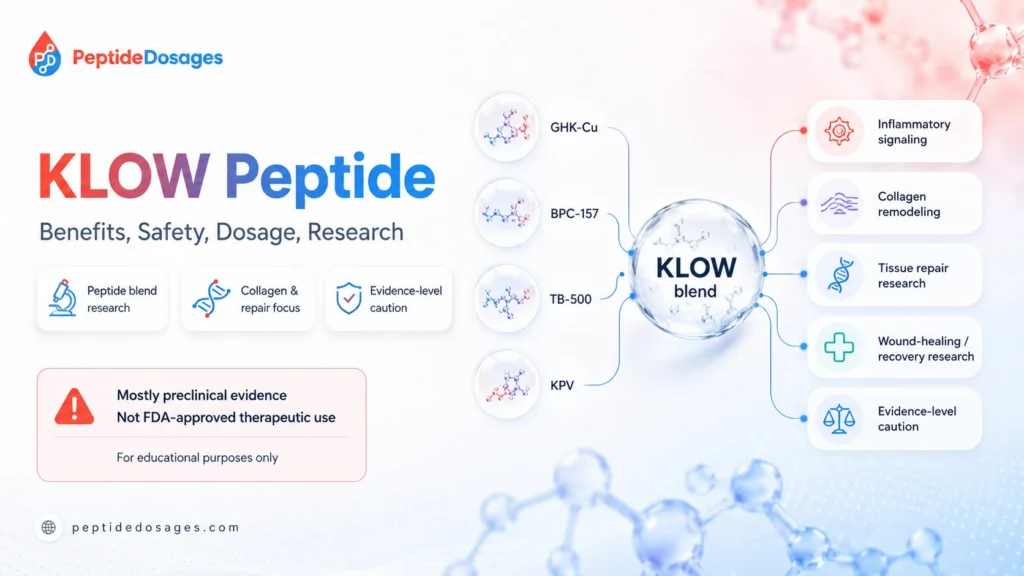
KLOW peptide is an educational search term commonly used for a proposed multi-peptide blend rather than one standardized drug molecule. This article reviews the KLOW concept through the evidence for its proposed components, often described as GHK-Cu, BPC-157, TB-500 or thymosin beta-4–related material, and KPV—while separating human evidence from preclinical and unsupported claims. It is for education only and does not provide personal dosing, injection, purchasing, or treatment instructions.
- KLOW is best understood as a proposed peptide blend, not a single peptide with a standardized public drug monograph.
- The KLOW blend is often discussed around four peptides: GHK-Cu, BPC-157, TB-500 or thymosin beta-4–related compounds, and KPV.
- The proposed rationale is regenerative and antiinflammatory, but direct clinical evidence for the combined blend appears limited.
- Component evidence varies. GHK-Cu has published skin and tissue-remodeling literature; thymosin beta-4 has wound and repair research; BPC-157 and KPV are largely discussed through preclinical or limited early research contexts 4 5 8 10 12.
- Potential benefits of KLOW should be evidence-graded, especially claims about inflammation, wound healing, tissue repair, gut health, and injury recovery.
- Safety is uncertain for the combined formulation, because combining individual peptides can change exposure, adverse-event risk, and interpretation.
- There is no general FDA-approved KLOW peptide protocol. Regulatory status should be checked through official drug databases, and study doses should not be used as personal medical advice 1 2.
Related dosage pages: For vial-specific concentration, reconstitution, and measurement examples, see KLOW (80 mg Blend) Dosage Protocol. Each linked protocol remains a separate reference because vial strength changes concentration and syringe-unit calculations.
Fast Answer
KLOW peptide is a non-standardized term for a proposed peptide blend, not an FDA-approved single peptide drug. It is searched for because of claims about inflammation control, tissue repair, wound healing, skin rejuvenation, and wellness, but direct human evidence for the full KLOW blend appears limited. The best-supported discussion separates component-level research from blend-level claims, reviews safety uncertainty, and avoids treating published study protocols as personal dosage advice 1 5 10.
What Is the KLOW Peptide?
KLOW is not best described as one chemically defined peptide. In therapeutic peptide discussions, it is usually framed as a peptide blend designed around repair, inflammatory signaling, skin biology, and cellular recovery concepts.
That distinction matters. A single approved peptide drug has a defined active ingredient, label, dosage, manufacturing standard, and adverse-reaction profile. A blend like KLOW may not have the same level of regulatory review or clinical evidence.
KLOW as a Peptide Blend Rather Than a Single Peptide
A peptide is a chain of amino acids shorter than most proteins, and peptide-based medicines can act through receptors, enzymes, transporters, or local tissue pathways. However, KLOW does not appear to correspond to a single standardized active ingredient in official drug approval databases 1.
For this article, KLOW is treated as a proposed peptide blend. That means evidence must be evaluated at two levels: evidence for the individual peptides and evidence for the exact combined formulation.
The Four Peptides Commonly Associated With KLOW
The four peptides often associated with KLOW are GHK-Cu, BPC-157, TB-500 or thymosin beta-4–related material, and KPV. These individual peptides are discussed in different research lanes: copper peptide skin biology, gastric and tissue-repair models, actin and cell migration biology, and melanocortin-related anti-inflammatory signaling 5 8 10 12.
A key limitation is that evidence for individual peptides does not automatically prove benefit, safety, or dosing for a combination product.
Why KLOW Is Discussed in Regenerative Peptide Therapy
KLOW is discussed in regenerative peptide therapy because its proposed components are linked online to inflammation, collagen, extracellular matrix remodeling, cell migration, tendon and ligament injury recovery, and wound healing. Many of those areas are supported mainly by mechanistic, animal, in vitro, or limited human literature rather than strong clinical trials for the blend itself 5 9 11.
Regenerative language should therefore be read cautiously. Biological plausibility is not the same as proven therapeutic benefit.
What Is in the KLOW Blend Peptide?
The exact composition of any KLOW blend peptide should not be assumed unless verified through clinical documentation, compounding records, or product-specific data. This matters because dose, route, purity, excipients, and sterility controls can change safety.
GHK-Cu Peptide and Copper-Binding Tripeptide Biology
GHK-Cu is a copper-binding tripeptide made of glycine, histidine, and lysine complexed with copper. PubChem lists glycyl-L-histidyl-L-lysine as a defined compound, and reviews describe GHK-Cu as involved in skin biology, tissue remodeling, collagen regulation, and gene-expression patterns relevant to repair pathways 4 5.
GHK-Cu is often called a copper peptide. Claims that it can stimulate collagen and elastin production should be tied to the specific evidence source, formulation, route, and outcome measured.
BPC-157 as a Pentadecapeptide in Tissue Repair Research
BPC-157 is commonly described in research literature as a stable gastric pentadecapeptide. Published discussions and animal studies have examined BPC-157 in gastric, tendon, ligament, muscle, vascular, and wound models, but the human evidence base remains limited compared with approved medicines 8 9.
This is why BPC-157 should be framed as investigational or evidence-limited in many therapeutic contexts, not as an established treatment.
TB-500, Thymosin Beta-4, and Cell Migration Pathways
TB-500 is often discussed in relation to thymosin beta-4, a naturally occurring peptide involved in actin binding and cell migration biology. Thymosin beta-4 has been studied for tissue repair, wound healing, angiogenesis, and inflammatory modulation, but TB-500 products sold or discussed online should not be assumed equivalent to a clinically studied thymosin beta-4 preparation 10 11.
The distinction between thymosin beta-4 and TB-500 is important for evidence quality. Similar names do not guarantee identical pharmacology, manufacturing quality, or clinical relevance.
KPV Is a Tripeptide Derived From A-MSH
KPV is a tripeptide sequence associated with the C-terminal region of alpha-melanocyte-stimulating hormone, often written as alpha-MSH or A-MSH. KPV is discussed for antiinflammatory effects in experimental models, including intestinal inflammation and inflammatory cytokine signaling 12.
KPV is a tripeptide, but that simple structure does not make its therapeutic role simple. Route, local exposure, stability, and disease context all matter.
How Does KLOW Peptide Work?
The proposed mechanism of KLOW peptide therapy is a blend-level hypothesis. It combines ideas from copper peptide biology, gastric peptide repair models, thymosin-related cell migration, and melanocortin-related inflammatory signaling.
The Proposed Synergistic Rationale Behind the KLOW Blend
The KLOW blend combines repair, copper peptide, and antiinflammatory concepts into one peptide stack. The proposed synergistic idea is that individual peptides could support tissue repair at different biological points, such as inflammation control, collagen synthesis, cell migration, and extracellular matrix remodeling.
That is plausible as a hypothesis. But synergy must be tested directly, because combining agents can also increase uncertainty, adverse effects, or unpredictable pharmacodynamics.
Inflammatory Signaling, NF-κB, and Antiinflammatory Pathways
Inflammation is regulated by cytokines, immune cells, tissue stress signals, and transcription pathways such as NF-κB. KPV and melanocortin-related peptides have been explored for inflammatory signaling in experimental contexts, while GHK-Cu and thymosin beta-4 literature also intersects with inflammatory and tissue-repair biology 5 10 12.
However, “reduce inflammation” is not a single clinical outcome. Chronic inflammation, systemic inflammation, intestinal inflammation, and local wound inflammation may involve different pathways and endpoints.
Collagen, Elastin, and Extracellular Matrix Remodeling
GHK-Cu literature is often linked to collagen, elastin, skin remodeling, and extracellular matrix biology. Reviews describe GHK-Cu as influencing gene-expression patterns and tissue-remodeling pathways, including processes relevant to fibroblast activity and repair 5 6.
Still, collagen and elastin changes in a lab or small study do not automatically establish broad clinical rejuvenation or wound-healing claims.
Why Mechanism Does Not Prove Clinical Benefit
Mechanism helps explain why researchers study a compound. It does not prove that a peptide blend improves symptoms, speeds injury recovery, or changes long-term health outcomes.
For KLOW, the science behind KLOW is best understood as a set of hypotheses drawn from component-level evidence. Direct human trials of the full blend would be needed to confirm clinical benefit, dosing, safety, and appropriate patient selection.
What Is KLOW Peptide Used For or Studied For?
KLOW is searched for in relation to wellness, skin health, inflammatory control, gut health, wound healing, and injury recovery. Those uses should be separated into studied mechanisms, preclinical models, early human research, and unsupported online claims.
Tissue Repair, Tendon Healing, and Ligament Injury Recovery Claims
BPC-157 and thymosin beta-4–related research are frequently cited in tissue repair discussions, including tendon healing and ligament or muscle injury models. Much of the BPC-157 literature in these areas is preclinical, meaning animal or cell models rather than large human trials 9.
Preclinical tissue healing results can guide research, but they should not be presented as proof that a KLOW peptide protocol treats human injuries.
Wound Healing, Skin Biology, and Cellular Renewal Research
GHK-Cu and thymosin beta-4 have both been studied in contexts related to skin, wound healing, angiogenesis, cell migration, and tissue remodeling. Reviews describe thymosin beta-4 as having roles in actin binding and repair biology, while GHK-Cu is associated with extracellular matrix and skin-repair pathways 5 10.
Terms such as cellular renewal and rejuvenation should be used carefully. They are often broader than the endpoints measured in published studies.
Gut Health, Gastric Models, and Intestinal Inflammation
BPC-157 is often discussed in gastric and gastrointestinal tract research, while KPV has been explored in intestinal inflammation models. These areas are relevant to gut health claims, but the evidence differs by peptide, model, route, and endpoint 8 12.
No claim should imply that KLOW is an established treatment for inflammatory bowel disease, psoriasis, acne, or other inflammatory diagnoses without strong clinical evidence.
Potential Benefits of KLOW Peptide
The benefits of KLOW should be described as potential, not guaranteed. The strongest statements should come from approved labels or well-designed human studies; weaker statements should be labeled as early, preclinical, mechanistic, or unsupported.
| Evidence Area | What Has Been Studied | Evidence Level | What It Can and Cannot Show |
|---|---|---|---|
| GHK-Cu and skin biology | Copper peptide effects on tissue remodeling and gene-expression pathways 5 | Clinical / mechanistic, depending on endpoint | Supports biological plausibility; does not prove all anti-aging claims |
| BPC-157 and tissue models | Gastric, tendon, ligament, vascular, and wound models 8 9 | Mostly preclinical | Suggests research interest; does not establish approved human use |
| Thymosin beta-4 pathways | Actin binding, cell migration, angiogenesis, wound research 10 11 | Preclinical / early clinical depending on formulation | Cannot be assumed equivalent to all TB-500 products |
| KPV inflammation models | Experimental antiinflammatory and intestinal inflammation research 12 | Preclinical / limited early research | Does not prove broad systemic inflammation benefit |
| Full KLOW blend | Combined formulation claims | Evidence-limited | Requires direct study of the exact blend |
What Research Suggests About Inflammation Control
Research on KPV, GHK-Cu, BPC-157, and thymosin beta-4 intersects with inflammatory signaling, cytokines, tissue stress, and repair pathways. This supports the rationale for studying inflammation control, but it does not prove that KLOW reduces inflammation in patients or treats inflammatory disease 5 10 12.
The evidence should be interpreted by condition and outcome. Local wound inflammation is different from systemic inflammation or chronic inflammatory disease.
Regenerative and Wellness Claims That Need Evidence Grading
Regenerative peptide claims often use terms such as tissue regeneration, cellular renewal, deeper metabolic and recovery benefits, and wellness. Those terms may reflect hypotheses or marketing language unless tied to specific human endpoints.
For KLOW, the safest approach to healing claims is to ask: Was the exact KLOW formulation studied? Was it a human trial? Were outcomes clinically meaningful? Were adverse events tracked?
Benefits of KLOW Versus Benefits of Individual Peptides
Benefits of individual peptides cannot be added together as if they automatically create a stronger blend. Pharmacology is not arithmetic.
A KLOW blend may expose tissues to multiple signaling effects at the same time. That could be the rationale, but it also increases uncertainty about interactions, side effects, and dose-response.
What Does Human Research Say About KLOW?
Human evidence is the most important category for therapeutic decision-making. For KLOW, the main issue is that direct clinical evidence for the full blend appears sparse or not standardized in major public evidence sources.
Is There Direct Clinical Evidence for the KLOW Peptide Blend?
The most reliable way to evaluate direct clinical evidence is to look for peer-reviewed trials, trial registry entries, and regulator-reviewed labels for the exact formulation. Official sources such as ClinicalTrials.gov and Drugs@FDA are useful for checking whether a product or formulation has public trial or approval records 1 14 15 16.
If only component studies exist, the evidence should be described as indirect.
Early Human Evidence for GHK-Cu, KPV, BPC-157, and TB-500
GHK-Cu has more human-facing cosmetic and dermatologic discussion than many experimental repair peptides, but endpoints, formulations, and study designs vary. Thymosin beta-4 has been explored clinically in wound and ocular contexts, but that does not validate every TB-500 product or blend 5 11.
For BPC-157 and KPV, much of the publicly visible therapeutic discussion remains preclinical, mechanistic, or early. That makes strong clinical claims inappropriate.
Why Blends Like KLOW Cannot Be Assumed Equivalent to Components
Blends like KLOW combine multiple active materials, but evidence for one component does not establish evidence for the combination. A combined formulation can change pharmacokinetics, immune exposure, tolerability, and monitoring needs.
This is why regulators evaluate drugs by product, indication, dose, route, manufacturing quality, and labeling, not by general category alone 1 17.
What Preclinical Research Suggests About KLOW Components
Preclinical research includes animal testing, cell models, tissue models, and mechanistic experiments. It can identify promising pathways, but it cannot establish real-world human effectiveness.
Animal and Cell Models for Inflammation and Tissue Regeneration
BPC-157, KPV, GHK-Cu, and thymosin beta-4 have all been discussed in animal or cell research related to inflammation, wound repair, or tissue regeneration. These models can show biological activity at the cellular level, but translation across multiple tissue types and species remains uncertain 5 8 10 12.
Fibroblast Activity, Angiogenesis, and Connective Tissue Models
Fibroblasts help produce extracellular matrix, and angiogenesis supports new blood vessel formation during repair. GHK-Cu and thymosin beta-4 literature intersects with these tissue-engineering and wound-healing concepts 5 10.
These mechanisms may support tissue-repair hypotheses, but they should not be treated as clinical proof of tendon, ligament, or skin outcomes.
Translational Limits Across Multiple Tissue Types
A peptide that affects one pathway in one model may not work the same way in muscle, skin, tendon, gastrointestinal tissue, or circulatory tissue. Dose, route, metabolism, and local disease biology can all change outcomes.
For KLOW, translational limits are especially important because the blend is inferred from individual peptides rather than proven as one standardized therapy.
Evidence Limitations and Unsupported Online Claims
KLOW is a topic where online claims may move faster than clinical evidence. That makes source quality essential.
The Science Behind KLOW Versus Marketing Claims
The science behind KLOW is mostly a component-based rationale. Marketing claims may describe broad wellness, anti-aging, healing, or recovery effects, but those claims need to be tested against peer-reviewed human data and regulatory status.
A responsible review should prioritize official regulators, PubMed-indexed literature, ClinicalTrials.gov, and product-specific prescribing information when available 1 14.
KLOW From Glow Peptide Naming Confusion
Some searches confuse KLOW from glow peptide, glow peptide stack, or skin-focused copper peptide products. The terms may overlap in wellness marketing, but they should not be treated as interchangeable.
If a clinician is evaluating any formulation, the exact active ingredients, route, concentration, sterility, and source documentation matter more than the nickname.
Claim Strength Matrix for KLOW Peptide Therapy
A practical claim-strength matrix looks like this:
- Strongest: approved-label claims for a specific regulated product.
- Moderate: replicated human studies using a defined formulation and clinically meaningful endpoints.
- Early: small or preliminary human studies.
- Preclinical: animal, cell, or mechanistic studies.
- Weakest: testimonials, online protocols, and uncited marketing claims.
For KLOW peptide therapy, many claims appear to fall into the indirect, preclinical, or unsupported categories unless the exact blend has been studied.
Side Effects and Safety Concerns
Safety should be assessed at the product level. A multi-peptide blend has more uncertainty than a single product with an approved label and adverse-event data.
What Side Effects Have Been Reported for Related Peptides?
Published reports and labels for peptide products vary widely by compound, route, and indication. For KLOW components, possible concerns discussed in peptide contexts include local irritation, hypersensitivity, immune reactions, skin reactions, and unexpected systemic effects, but the exact risk profile of the full KLOW blend is not established without product-specific studies 2.
Compounded or unapproved peptides can also raise quality concerns related to potency, sterility, impurities, and labeling accuracy 2 3.
Injection-Site, Immune, Skin, and Systemic Reactions to Discuss
If a peptide is administered by injection in a medical or study context, local reactions and sterility-related risks become important. This article does not provide injection instructions, because administration decisions require licensed medical oversight.
Immune system effects also matter. A blend designed to modulate inflammatory signaling may be inappropriate for some people with immune conditions, active infection, cancer history, or immunotherapy exposure unless a clinician determines otherwise.
Why Combination Formulation Safety Is Harder to Predict
A combination formulation can create new uncertainty even when each individual component has been studied. Interactions may affect absorption, degradation, receptor activity, or immune recognition.
This is one reason study doses and protocols should not be copied into personal use. Evidence must match the exact formulation, dose, route, and population.
Contraindications, Drug Interactions, and Medical Supervision
Contraindications and interactions for KLOW are not well standardized because KLOW itself is not a conventional labeled drug. That uncertainty is a safety issue, not a reassurance.
Who Should Discuss KLOW With a Health Care Provider First?
People with chronic medical conditions, inflammatory bowel disease, autoimmune disease, cancer history, active infection, pregnancy, breastfeeding, or complex medication regimens should discuss peptide-related decisions with a qualified health care provider. This is especially important when a compound is investigational, compounded, or not FDA-approved for the intended use 2.
Pregnancy, Breastfeeding, Cancer History, and Immune Conditions
Pregnancy and breastfeeding require a higher safety standard because fetal and infant exposure risks may be unknown. Cancer history and immune conditions also require caution because growth, repair, angiogenesis, and immune signaling pathways may be clinically relevant.
For KLOW, absence of evidence is not evidence of safety in these groups.
Potential Medication and Immunotherapy Interaction Concerns
Drug interaction data for the KLOW blend are not well established. Theoretical concerns may involve immune-modulating drugs, immunotherapy, anti-inflammatory medication, anticoagulants, wound-healing contexts, or therapies where angiogenesis and tissue remodeling matter.
A clinician can evaluate whether peptide exposure could complicate diagnosis, treatment monitoring, adverse-event attribution, or medication safety.
Dosage Information From Labels and Published Studies
Dosage information should be limited to approved labeling or published study contexts. Study doses should not be interpreted as personal dosing advice.
Is There an Approved Dosage for KLOW Peptide?
There is no general FDA-approved KLOW peptide dosage that can be applied as a universal peptide protocol. FDA approval is product-specific and indication-specific, and official databases should be used to verify whether any product has an approved label 1.
Because KLOW is discussed as a blend, dosing uncertainty is higher than for a labeled single-ingredient medicine.
How Study Doses for Individual Peptides Differ From Personal Advice
Published study doses for GHK-Cu, BPC-157, KPV, or thymosin beta-4–related compounds reflect research conditions. They may involve specific formulations, routes, endpoints, exclusion criteria, monitoring, and ethics review.
Those conditions do not translate into “how much to take.” Personal dosing decisions require medical evaluation and legally appropriate prescribing.
How to Interpret a KLOW Peptide Protocol Safely
A KLOW peptide protocol found online should be treated as an unverified claim unless it is tied to a peer-reviewed study, approved label, or clinician-supervised plan. Protocol language can be misleading because it may imply precision even when evidence is limited.
Key questions include: What exact formulation was used? Was it sterile? Was it studied in humans? Were adverse events tracked? Was the use legal and medically supervised?
Administration Routes Discussed in Medical Literature
Routes of administration affect absorption, bioavailability, local exposure, metabolism, and adverse-event risk. Literature on individual peptides may include topical, oral, injectable, ophthalmic, or local delivery models, depending on the peptide and study.
Routes Studied for GHK-Cu, KPV, BPC-157, and TB-500
GHK-Cu is commonly discussed in topical skin contexts and tissue-remodeling research. KPV has been studied in experimental inflammation models, including intestinal contexts, while BPC-157 and thymosin beta-4–related compounds appear in animal, cell, topical, injectable, ocular, or wound-repair literature depending on the study design 5 8 11 12.
This article does not provide procedural guidance for injection, mixing, reconstitution, or self-administration.
Why Administration Decisions Require Medical Context
The same peptide may have different effects depending on whether it is delivered to skin, gut, eye, wound tissue, or systemic circulation. Route also changes safety monitoring needs.
For KLOW, route decisions are especially complex because the blend may contain multiple individual peptides with different stability, absorption, and pharmacologic profiles.
Regulatory Status of KLOW Peptide
Regulatory status matters because approved and unapproved products are not evaluated the same way. Approved drugs are reviewed for a specific indication, manufacturing quality, labeling, dosage, and safety data 1 17.
Is KLOW Peptide FDA-Approved?
KLOW should not be assumed to be FDA-approved as a peptide blend. Readers and clinicians should verify any specific product in Drugs@FDA or other official regulator databases rather than relying on marketing claims 1.
If no approved label exists for a formulation and indication, claims about benefits, dosage, and safety should be interpreted cautiously.
Compounded, Investigational, and Unapproved Peptide Considerations
Compounded medications are regulated differently from FDA-approved drugs, and compounded products are not FDA-approved for safety, effectiveness, or manufacturing quality before marketing 2. FDA also maintains policies related to bulk drug substances used in compounding 3.
Unapproved peptides may have additional risks related to identity, purity, sterility, potency, and adverse-event reporting.
What Regulatory Status Means for Quality and Informed Consent
Regulatory status affects informed consent. Patients should know whether a therapy is approved, off-label, investigational, compounded, or unapproved.
They should also understand what evidence supports the proposed use, what is unknown, what alternatives exist, and how adverse events would be monitored.
How KLOW Compares With Related Peptide Stacks
KLOW is a peptide stack concept. Comparing it with single-peptide approaches can help clarify uncertainty, but it should not be used to choose a therapy without clinician input.
KLOW Blend Combines Repair, Copper Peptide, and Antiinflammatory Concepts
The KLOW blend combines GHK-Cu, BPC-157, TB-500 or thymosin beta-4–related biology, and KPV concepts. This gives it a broad theoretical approach to healing, inflammation, and tissue remodeling.
The tradeoff is that broader does not mean better proven. More ingredients can also mean more unknowns.
KLOW Versus Single-Peptide Approaches Like GHK-Cu or BPC-157
A single-peptide approach may be easier to evaluate because the evidence, dose, and adverse events can be linked to one active material. A blend requires evidence for the combination itself.
For example, GHK-Cu peptide evidence should not be used as proof for BPC-157, and BPC-157 animal data should not be used as proof for the full KLOW blend 5 8.
When a Peptide Stack May Increase Uncertainty and Risk
A peptide stack may increase uncertainty when components have different mechanisms, routes, degradation patterns, or immune effects. Safety monitoring may also be harder because adverse events cannot easily be attributed to one ingredient.
This is why combination use should be evaluated with a clinician, not copied from online protocols.
Practical Takeaways for Discussing KLOW With a Clinician
The safest way to interpret KLOW is through evidence quality, regulatory status, and individual medical context. A clinician can help separate therapeutic possibility from unproven claims.
Questions to Ask About Evidence, Safety, and Monitoring
Use this checklist for a clinician discussion:
- What exact peptides are in the formulation?
- Is the product FDA-approved, compounded, investigational, or unapproved?
- What human evidence supports the proposed use?
- Are claims based on preclinical studies, clinical trials, or anecdotes?
- What side effects and adverse events should be monitored?
- Could current medications, immune conditions, pregnancy, breastfeeding, cancer history, or planned surgery change risk?
- Are there approved alternatives with stronger evidence?
- How would informed consent and follow-up be handled?
How to Separate Therapeutic Possibility From Unproven Claims
Therapeutic possibility begins with biological plausibility. Medical confidence requires direct evidence, defined dosing, safety monitoring, and regulatory clarity.
For KLOW, the strongest conclusions come from component-level literature and general regulatory principles, while the weakest claims come from broad online promises about wellness, recovery, and regeneration. Readers considering peptide-related medical decisions should discuss evidence, risks, alternatives, and regulatory status with a qualified healthcare professional.
Related dosage protocols and research
Use the available links to move between research context, dosage pages or comparisons, and supporting guides. When vial-size variants exist, they remain separate because concentration and syringe-unit calculations change with vial strength. Comparisons do not imply that different compounds are interchangeable.
Matching dosage protocols
Related protocols and comparisons
Further research context
REFERENCES
- U.S. Food and Drug Administration. Drugs@FDA: FDA-Approved Drugs. Official FDA drug database. Accessed for regulatory verification context.
- U.S. Food and Drug Administration. Compounding Laws and Policies. FDA human drug compounding information. Accessed for compounded medication context.
- U.S. Food and Drug Administration. Bulk Drug Substances Used in Compounding. FDA compounding policy information. Accessed for bulk-substance and quality-context discussion.
- National Center for Biotechnology Information. Glycyl-L-histidyl-L-lysine. PubChem Compound Database. Accessed for GHK identity context.
- Pickart L, Margolina A. Regenerative and Protective Actions of the GHK-Cu Peptide in the Light of the New Gene Data. International Journal of Molecular Sciences. 2018. DOI: 10.3390/ijms19071987.
- Pickart L, et al. The human tripeptide GHK and tissue remodeling. PubMed-indexed review. 2008. PMID: 18400254.
- National Center for Biotechnology Information. PubChem search: BPC-157. PubChem database search. Accessed for compound-identity verification context.
- National Library of Medicine. PubMed search: BPC 157 pentadecapeptide gastric. PubMed literature search. Accessed for BPC-157 research-context verification.
- National Library of Medicine. PubMed search: BPC 157 tendon healing. PubMed literature search. Accessed for tendon and tissue-repair research context.
- Goldstein AL, Hannappel E, Kleinman HK. Thymosin beta4: actin-sequestering protein moonlights to repair injured tissues. Trends in Molecular Medicine. 2005. PMID: 15949723.
- National Library of Medicine. PubMed search: thymosin beta 4 wound healing clinical trial. PubMed literature search. Accessed for thymosin beta-4 clinical and wound-healing context.
- National Library of Medicine. PubMed search: KPV peptide anti-inflammatory colitis. PubMed literature search. Accessed for KPV inflammation and intestinal-model context.
- National Library of Medicine. PubMed search: alpha melanocyte stimulating hormone KPV inflammation. PubMed literature search. Accessed for melanocortin-related inflammation context.
- U.S. National Library of Medicine. ClinicalTrials.gov search: KPV. Clinical trial registry search. Accessed for public trial-record context.
- U.S. National Library of Medicine. ClinicalTrials.gov search: BPC-157. Clinical trial registry search. Accessed for public trial-record context.
- U.S. National Library of Medicine. ClinicalTrials.gov search: thymosin beta 4. Clinical trial registry search. Accessed for public trial-record context.
- U.S. Food and Drug Administration. Federal Food, Drug, and Cosmetic Act. FDA regulatory information. Accessed for drug approval and legal-context discussion.
Researchers Cited in This Article
The researchers below authored or co-authored publications cited in this article. Listing them here identifies sources; it does not mean they wrote, independently reviewed, sponsored, or endorsed this PeptideDosages.com article. The site author is identified in the article byline.
Loren Pickart
Researcher profile: PubMed Author Profile
Loren Pickart’s published work is relevant to the GHK-Cu component often discussed in the KLOW peptide blend. His publications help frame the broader pharmacology of copper-binding tripeptides, including gene-expression findings, extracellular matrix biology, and tissue-remodeling concepts. This work is useful for interpreting the difference between mechanistic evidence and clinical evidence when discussing peptide blends, skin biology, and evidence limitations.
Selected publications:
- Regenerative and Protective Actions of the GHK-Cu Peptide in the Light of the New Gene Data — International Journal of Molecular Sciences, 2018. DOI: 10.3390/ijms19071987
- The human tripeptide GHK and tissue remodeling — Journal of Biomaterials Science, Polymer Edition, 2008. PMID: 18400254
Allan L. Goldstein
Researcher profile: PubMed Author Profile
Allan L. Goldstein’s publications are relevant to thymosin beta-4 research, a literature area often discussed when evaluating TB-500-related claims in peptide blend articles. His work provides context for mechanism-of-action discussions involving actin binding, cell migration, tissue-model research, and wound-repair pathways. These publications are especially useful for distinguishing preclinical and translational findings from claims that would require stronger human evidence.
Selected publications:
- Thymosin beta4: actin-sequestering protein moonlights to repair injured tissues — Trends in Molecular Medicine, 2005. PMID: 15949723
- Thymosin beta 4 accelerates wound healing — Journal of Investigative Dermatology, 1999. PMID: 10469337