
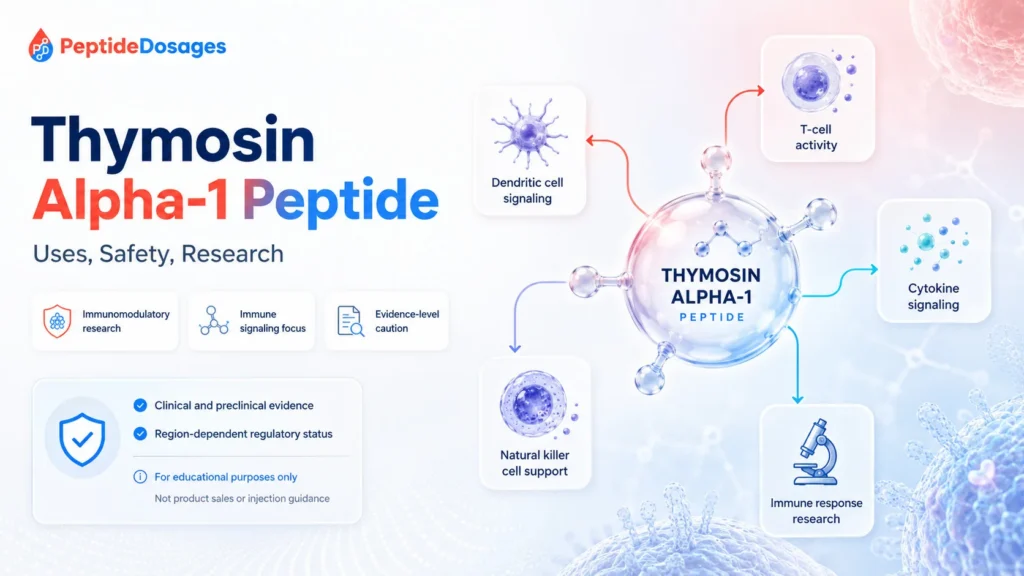
Thymosin Alpha-1 peptide is a synthetic version of thymosin alpha 1, a 28-amino acid peptide originally identified from thymic extracts and studied for immune regulation, viral illness, and inflammatory conditions 1 2. This educational article reviews what is known about thymosin, including mechanism of action, clinical studies, dosage information from labels or trials, safety, and regulatory status. It is not personal medical advice and does not provide instructions for self-treatment, self-injection, or purchasing peptides.
- Thymosin Alpha-1 peptide, also known as thymalfasin, is an immune-modulating peptide related to thymus gland biology and T-cell function [1] [2].
- It is discussed in therapeutic contexts because published research has evaluated it in chronic hepatitis B, chronic hepatitis C, sepsis, COVID-19, cancer immunotherapy settings, and other infectious diseases 3 4 5.
- Mechanistic studies suggest thymosin alpha-1 may modulate dendritic cell activity, T-cell function, natural killer cell activity, cytokine signaling, and toll-like receptor pathways, but mechanisms do not automatically prove clinical benefit 6 7.
- The best-studied clinical application is chronic viral hepatitis, especially chronic hepatitis B, but findings vary by study design, population, combination therapy, and endpoints [3] 8.
- Potential benefits should be interpreted by evidence level: approved or label-based use in some jurisdictions, clinical evidence for selected indications, early human evidence for others, preclinical findings, and unsupported online claims.
- Side effects reported in studies are often mild, but safety interpretation depends on the product, indication, immune status, other medications, and medical supervision [1] 9.
- Dosage information should be read only as label or study context. Study doses should not be interpreted as personal dosing advice.
Related dosage pages: For vial-specific concentration, reconstitution, and measurement examples, see Thymosin Alpha-1 (5 mg Vial) Dosage Protocol and Thymosin Alpha-1 (10 mg Vial) Dosage Protocol. Each linked protocol remains a separate reference because vial strength changes concentration and syringe-unit calculations.
Fast Answer
Thymosin Alpha-1 peptide is an immune-modulating 28-amino acid peptide, also called thymalfasin, studied for effects on immune function, viral infections, inflammation, sepsis, and chronic hepatitis B [1] [2] [3]. Human evidence is strongest in selected infectious-disease and hepatitis research, while many online claims about immunity, longevity, or “restoring immune function” remain less established. Safety, dosage, and administration depend on regulated medical context, and FDA approval status differs from use or approval in some other countries 10.
What Is the Thymosin Alpha-1 Peptide?
Thymosin Alpha-1 peptide is the common educational name for thymalfasin, a synthetic form of thymosin alpha 1. The molecule is described as a 28-amino acid peptide with immunomodulatory biological activities, rather than a classic antimicrobial or antiviral drug that directly kills pathogens [1] [2].
In medical literature, thymosin a1 and thymosin alpha1 are usually discussed as immune-response modifiers. That means the peptide is studied for how it may regulate immune cell signaling, not as a guaranteed way to “boost” immunity in every patient.
Peptide Classification, 28-Amino Acid Structure, and Thymosin Family Context
Thymosin alpha 1 belongs to a broader group of thymosin proteins originally associated with the thymus, an immune organ involved in T-cell development [1]. PubChem and biomedical databases identify thymalfasin as a peptide drug substance, and the NCI Drug Dictionary describes it as a synthetic peptide with immunomodulating activity [2] 11.
This matters because “thymosin” is not one compound. The term can refer to thymosin alpha-1, thymosin beta-4, thymosin fraction 5, or related thymic peptides with different structures and biological effects.
How Did Thymus Gland Extracts Lead to Synthetic Thymosin Alpha 1?
Early thymosin research began with thymic extracts, including thymosin fraction 5, which contained multiple biologically active peptides [1]. Thymosin alpha 1 was later identified as a defined peptide originally isolated from these thymic preparations, making it easier to study as a specific synthetic compound rather than as a mixture [1].
Researchers including Allan Goldstein and colleagues helped characterize thymosin peptides, while later authors such as Garaci reviewed their immunologic and clinical application history 12.
How Does Thymosin Alpha-1 Differ From Thymosin Beta and Thymosin Beta-4?
Thymosin alpha-1 and thymosin beta-4 are often confused because they share the thymosin name. They are different peptides with different research lanes: thymosin alpha-1 is mainly discussed for immune regulation, whereas thymosin beta-4 is more often studied in actin-binding, tissue-repair, and wound-healing biology 13.
This article focuses on thymosin alpha-1 peptide only. Claims about thymosin beta, thymosin β4, or TB-500 should not be assumed to apply to thymosin alpha-1.
How Does Thymosin Alpha-1 Peptide Work?
Thymosin alpha-1 is thought to work by modulating the immune system rather than simply stimulating it. Published reviews describe effects on innate and adaptive immunity, including T cells, dendritic cells, natural killer cells, and cytokine patterns [6] [7] [12].
The key point is balance. A therapy that changes immune function can be beneficial in one context and inappropriate in another, especially in autoimmune disease, transplant medicine, cancer therapy, or severe infection.
Which Immune Cells Are Involved in Thymosin Alpha-1 Activity?
Mechanistic research has examined thymosin alpha-1 effects on T lymphocytes, dendritic cells, natural killer cell activity, and antigen presentation [6] [7]. Dendritic cells are especially relevant because they help coordinate the immune response by presenting antigens and shaping T-cell activation.
Some studies suggest thymosin alpha 1 activates dendritic cells and may enhance immune response patterns against pathogens, but these findings must be interpreted in context [6]. Cell-level immune activation is not the same as proven clinical efficacy for a disease.
Toll-Like Receptor Signaling, Cytokine Balance, and Antiviral Response
One proposed pathway involves toll-like receptor signaling, which helps immune cells recognize danger signals and coordinate cytokine release [6] [7]. In plain language, thymosin alpha-1 may help immune cells communicate more effectively during certain infections or immune-deficient states.
This is why the peptide is often discussed in viral research. However, antiviral immune support does not mean it directly replaces antiviral drugs, vaccines, or disease-specific medical care.
Why Mechanism Does Not Guarantee Therapeutic Outcomes
Mechanisms can explain why a treatment is biologically plausible, but they cannot prove clinical benefit by themselves. For thymosin alpha-1, dendritic cell activation, cytokine modulation, and T-cell effects are useful hypotheses, but outcomes such as viral clearance, mortality reduction, or symptom improvement require controlled human evidence [3] [4] [5].
This distinction is especially important for online claims about immunity, longevity, sleep, fatigue, metabolism, or “immune optimization.” Many such claims are not supported by high-quality clinical trials.
Biological Activities Linked to Immunity and Inflammation
Thymosin alpha-1 has been studied for biological activities involving immune regulation, inflammation, antiviral defense, and immune-cell communication [7] [12]. These activities explain why researchers have explored it in infectious diseases, cancer immunotherapy support, hepatitis, sepsis, and immune dysfunction.
A practical evidence rule applies: the more serious the condition, the more important it is to rely on regulated products, clinical trials, and clinician-guided decisions rather than mechanistic claims.
How May Thymosin Alpha1 Modulate the Immune System?
Thymosin alpha1 may modulate the immune system by influencing T-cell maturation and function, dendritic cell signaling, and cytokine patterns [6] [7]. Reviews also describe effects on immune regulation that may vary depending on whether the person is immunocompromised, inflamed, infected, or receiving other therapies [12].
“Modulate” is a more accurate word than “boost.” In medicine, indiscriminately stimulating the immune system can be risky, especially for people with autoimmune disease or inflammatory conditions.
Effects on Immune Function During Acute and Chronic Infections
Clinical and mechanistic literature has explored thymosin alpha-1 in both acute and chronic infections. Chronic hepatitis B and chronic hepatitis C are among the better-studied viral contexts, while COVID-19 and sepsis research expanded during the pandemic and critical-care literature [3] [4] [5] 14.
In chronic infections, the research question is often whether thymosin alpha-1 can help restore immune function or enhance immune response when immune exhaustion or dysregulation is present. That remains a clinical hypothesis that depends heavily on disease, timing, and patient selection.
What Is Thymosin Alpha-1 Peptide Used or Studied For?
Thymosin alpha-1 has been studied for infectious diseases, chronic viral hepatitis, immune dysfunction, sepsis, COVID-19, and adjunctive immunotherapy settings [3] [4] [5] [12]. Some countries have marketed thymalfasin products for medical indications, but approval status and labeled uses vary by jurisdiction [10] [11].
It should not be framed as a general wellness peptide. Therapeutic claims should be tied to specific evidence, not broad online descriptions of immunity.
Clinical Application Areas in Published Research
Published clinical application areas include chronic hepatitis B, chronic hepatitis C, sepsis, severe viral illness, and oncology-related immune support [3] [4] [5] [8] [12]. Some studies evaluated thymosin alpha-1 alone, while others evaluated combination therapy of thymosin with interferon alpha or antiviral therapy.
The evidence is not uniform. Some endpoints involve viral markers, immune markers, survival, infection rates, or treatment response, and different endpoints do not carry the same clinical meaning.
Infectious Diseases, Viral Infections, and Immunodeficiency Contexts
The infectious-disease interest in thymosin alpha-1 comes from its proposed effects on T cells, dendritic cells, cytokines, and antiviral immune regulation [6] [7]. Research has included hepatitis B virus, chronic hepatitis C, severe acute respiratory syndrome-related illness, COVID-19, and sepsis-associated immune dysfunction [3] [4] [5] [14].
That does not mean thymosin alpha-1 is a stand-alone treatment for viral infections. Approved antivirals, vaccines, and guideline-directed care remain disease-specific and should not be replaced by peptide therapy without medical oversight.
What Are the Potential Benefits of Thymosin Alpha-1 Peptide?
Potential benefits discussed in the literature include immune response modulation, improved immune-cell function in selected contexts, and possible adjunctive effects in chronic viral or critical illness settings [3] [4] [5] [7]. These potential benefits are not equally supported across conditions.
A useful way to interpret claims is to separate approved or labeled medical use, clinical evidence, early human evidence, preclinical evidence, and unsupported online claims.
| Evidence Area | What Has Been Studied | Evidence Level | What It Can and Cannot Show |
|---|---|---|---|
| Chronic hepatitis B | Trials and reviews of thymosin alpha 1 in the treatment of chronic hepatitis B [3] [8] | Clinical / region-dependent regulatory context | Can evaluate viral and biochemical endpoints; does not prove broad immune benefits for healthy people |
| Chronic hepatitis C | Studies of thymosin alpha-1, often with interferon alpha or combination therapy 15 | Clinical / older treatment era | Hard to generalize because modern direct-acting antivirals changed hepatitis C care |
| Sepsis | Immunomodulatory therapy for sepsis evaluated in trials and meta-analysis [4] | Clinical / mixed certainty | May inform critical-care research; not a self-treatment model |
| COVID-19 | Observational studies and clinical trial reports in severe disease [5] [14] | Early human / clinical | Signals require caution because disease severity, timing, and confounding vary |
| General “immunity” or longevity | Common online claims | Unsupported or anecdotal | Does not establish clinical benefit without controlled human studies |
What Evidence Supports Immune Function and Immune Response Claims?
Mechanistic and clinical literature supports the idea that thymosin alpha-1 can influence immune function in selected settings [6] [7] [12]. In some studies, researchers evaluated immune-cell markers, lymphocyte counts, or infection-related outcomes [5] [14].
But “supports immune function” is not the same as “prevents disease” or “works for everyone.” The stronger claim requires stronger clinical evidence.
Antiviral and Anti-Inflammation Claims: Evidence and Limits
Antiviral claims are most relevant where thymosin alpha-1 has been studied with viral disease endpoints, such as hepatitis B, hepatitis C, and severe viral illness research [3] [5] [15]. Anti-inflammation claims are more complex because immune modulation may reduce harmful inflammation in one setting while increasing immune activity in another [7].
For this reason, broad anti-inflammatory marketing language is too simplistic. The effect of thymosin depends on the immune context, disease state, and co-treatments.
Why Online Immunity Claims Need Evidence Grading
Online claims may describe thymosin alpha-1 as a peptide for immunity, longevity, fatigue, sleep, or metabolism. Those claims often mix clinical research, preclinical hypotheses, and anecdotal reports without separating evidence quality.
A safer framework is: approved label first, human clinical studies second, preclinical mechanisms third, and unsupported claims last. This keeps potential benefits from turning into unsupported treatment promises.
What Do Human Evidence and Clinical Studies Say About Thymosin Alpha-1?
Human studies have evaluated thymosin alpha-1 in chronic hepatitis B, chronic hepatitis C, sepsis, COVID-19, and selected oncology or immune-compromised settings [3] [4] [5] [8] [15]. Evidence quality varies widely by study size, randomization, blinding, control group, population, and outcome.
The strongest conclusions come from systematic reviews and randomized controlled trial data. Even then, results may be limited by older standards of care, regional availability, and evolving treatment options.
Randomized Controlled Trial Data and Observational Studies
A controlled trial in chronic hepatitis B reported that thymosin alpha-1 was evaluated for biochemical and virologic responses, but outcomes and durability varied [8]. In COVID-19, observational research suggested possible associations with improved immune markers or mortality, but such studies are vulnerable to confounding by disease severity and treatment timing [5].
Randomized trials are more reliable than uncontrolled reports, but not all clinical trial evidence is equally strong. Small sample sizes and heterogeneous patient populations reduce certainty.
What Do Systematic Review and Meta-Analysis Findings Suggest?
A Cochrane review evaluated thymosin alpha-1 for chronic hepatitis B and concluded that evidence was limited and that more high-quality trials were needed to determine efficacy and safety [3]. A systematic review and meta-analysis of thymosin alpha-1-based immunomodulatory therapy for sepsis found signals that warranted attention but emphasized limitations in trial quality and certainty [4].
Meta-analyses can be helpful, but they inherit the weaknesses of the studies they include. If the original trials are small or biased, pooled results remain uncertain.
Where Human Evidence Is Stronger, Weaker, or Region-Specific
Human evidence is stronger where there are controlled trials, clinical endpoints, and repeated study designs, such as chronic hepatitis B and sepsis research [3] [4] [8]. Evidence is weaker for broad wellness claims, general immune enhancement, longevity, or routine use in otherwise healthy people.
Regulatory context also matters. A medicine used in one country for a specific indication should not be assumed to be FDA-approved or appropriate for off-label personal use elsewhere.
How Has Thymosin Alpha-1 Been Studied in Chronic Hepatitis B and C?
Chronic hepatitis B and C have been central to the clinical literature on thymosin alpha-1. Older studies examined whether thymosin alpha 1 treatment could improve viral or biochemical outcomes, often before today’s antiviral standards became widely available [3] [8] [15].
Because hepatitis treatment has changed, older research must be interpreted against current guideline-directed therapy. A finding from the interferon era may not apply directly to modern antiviral regimens.
Thymosin Alpha 1 in the Treatment of Chronic Hepatitis B
The treatment of chronic hepatitis B has been one of the best-known applications of thymosin alpha-1 research. The Cochrane review on thymosin alpha-1 for chronic hepatitis B found that available trials did not provide definitive evidence strong enough for broad conclusions and called for better studies [3].
This does not mean the research is irrelevant. It means claims about the efficacy of thymosin alpha 1 should be tied to trial quality, endpoints, and comparison with current standards of care.
Combination Therapy of Thymosin With Interferon Alpha
Some studies evaluated combination therapy of thymosin with interferon alpha, especially in chronic viral hepatitis contexts [15]. Interferon alpha itself affects immune and antiviral pathways, which makes it difficult to isolate the independent effect of thymosin alpha-1.
Combination studies can be clinically meaningful, but they also complicate interpretation. Improved outcomes may reflect the combination, the comparator, patient selection, or other treatment factors.
Hepatitis B Virus, Chronic Hepatitis C, and Outcome Limitations
For hepatitis B virus and chronic hepatitis C, key outcomes include viral markers, liver enzymes, sustained response, relapse, disease progression, and safety. Older studies may report biochemical or virologic signals, but the clinical relevance depends on long-term outcomes and current treatment alternatives [3] [15].
Modern hepatitis C care is dominated by direct-acting antiviral drugs with high cure rates, so older thymosin alpha-1 plus interferon research is not a substitute for current hepatitis C treatment standards.
What Does Research Say About Viral Illness, COVID-19, and Sepsis?
Research on viral illness and sepsis reflects the broader interest in immune regulation. In severe infections, the immune system may be both underactive and overactive at different stages, which makes immunomodulation scientifically plausible but clinically difficult [4] [5] [14].
The timing, patient selection, and severity of disease matter. A peptide that appears beneficial in one immune state could be ineffective or risky in another.
Severe Acute Respiratory Syndrome and COVID-19 Clinical Trial Context
During COVID-19, thymosin alpha-1 was studied in severe disease contexts where lymphopenia and immune exhaustion were concerns. One published study reported that thymosin alpha-1 use was associated with reduced mortality and changes in lymphocyte exhaustion markers in severe COVID-19, but the authors and later reviewers noted the need for careful interpretation and further trials [5] [14].
COVID-19 evidence should not be generalized to mild viral illness or routine prevention. Severe acute respiratory syndrome-related diseases involve complex immune and inflammatory patterns that require clinician-directed care.
What Is Known About Immunomodulatory Therapy for Sepsis?
Sepsis is a life-threatening syndrome involving infection, organ dysfunction, inflammation, immune suppression, and high mortality risk. A meta-analysis of thymosin alpha-1-based immunomodulatory therapy for sepsis suggested potential benefit signals, but study quality and heterogeneity limited certainty [4].
This evidence belongs in critical-care research and hospital medicine. It should not be interpreted as a home-use protocol or a replacement for antibiotics, source control, fluids, vasopressors, or sepsis guideline care.
Where Do Autoimmune Disease, Inflammation, and Cancer Claims Need Caution?
Autoimmune disease, inflammation, and cancer are high-risk topics because immune modulation can have unintended effects. A therapy that increases parts of the immune response might theoretically worsen autoimmune activity or interact with cancer immunotherapy.
Some oncology research has examined thymosin alpha-1 as an immune adjuvant or supportive therapy, but evidence varies and should not be translated into self-treatment claims [12] 16.
Autoimmune Conditions and the Risk of Over-Modulating Immunity
People with autoimmune disease, transplant history, immune deficiency, or immunosuppressive therapy require special caution. Because thymosin alpha-1 is studied for immune regulation, its use in these contexts should be evaluated by clinicians who understand the person’s diagnosis and medications.
The absence of a known interaction is not proof of safety. Immune-active therapies can have context-specific risks that may not appear in small studies.
Anti-Proliferative Effects of Thymosin: Evidence and Limits
Some reviews discuss anti-proliferative effects of thymosin alpha-1 or roles in cancer-related immune response [12] [16]. These findings are not the same as proof that thymosin alpha-1 treats cancer.
Cancer claims require high-quality clinical evidence, approved indications, and careful distinction between adjunctive immune research and disease treatment. Readers should be wary of any source that presents thymosin alpha-1 as a cancer cure.
How Should Preclinical Evidence Be Interpreted?
Preclinical evidence includes animal models, cell studies, and mechanistic experiments. These studies are useful for understanding biological activities, but they cannot prove human benefit or establish safe dosing in patients.
For thymosin alpha-1, preclinical research supports plausible immune-regulatory mechanisms. Human clinical interpretation still requires controlled trials and safety data.
Animal Models, Cell Studies, and Dendritic Cell Activation
Cell and animal studies have examined dendritic cell activation, T-cell signaling, cytokine regulation, and pathogen-response pathways [6] [7]. These findings help explain why researchers studied thymosin alpha-1 in viral and infectious diseases.
But translation from a mouse model or cell culture to a patient is uncertain. Dose, route, immune status, disease biology, and co-treatments all differ.
What Are the Translational Limits of Preclinical Thymosin Alpha1 Findings?
Preclinical findings can identify mechanisms and generate hypotheses. They cannot determine whether thymosin alpha1 will improve clinical endpoints such as hospitalization, mortality, viral clearance, autoimmune disease activity, or long-term safety.
This is one of the most common problems in peptide therapy discussions. Mechanistic plausibility is often presented online as if it were clinical proof.
What Side Effects and Adverse Events Have Been Reported?
Thymosin alpha-1 has generally been described as well tolerated in many clinical studies, but “well tolerated” does not mean risk-free or appropriate for everyone [1] [3] [4]. Reported adverse events vary by study population, dose, route, product quality, and co-administered therapies.
Safety also depends on whether the product is a regulated medicine. Unapproved or poorly characterized compounded peptides may not have the same quality controls as approved drugs.
Commonly Reported Side Effects in Clinical Studies
Reported side effects in thymosin alpha-1 studies have included local reactions, discomfort, fever-like symptoms, fatigue, nausea, and other nonspecific adverse events, although rates vary across trials and reviews [3] [4] [9]. LiverTox notes thymalfasin has not been convincingly linked to clinically apparent liver injury, but that does not eliminate other safety concerns [9].
Clinical-study safety findings apply to the studied product and population. They should not be generalized to unverified online peptide products.
Injection-Site Reactions and Subcutaneous Injection Safety Context
Many studies and product contexts describe administration by subcutaneous injection, but this article does not provide injection instructions [1] [3]. Injection-site reactions can include redness, discomfort, swelling, or irritation, depending on product formulation and administration context.
Any injectable medication also raises concerns about sterility, dosing accuracy, contamination, and training. These concerns are especially important when products are compounded or unapproved.
When Are Serious Adverse Events or Allergic Reactions a Concern?
Serious adverse events are uncommon in many thymosin alpha-1 studies, but severe allergic reactions are possible with peptide drugs in general and should be treated as a medical concern [3] [4]. People with complex immune conditions, severe infections, pregnancy, breastfeeding, cancer, transplant history, or multiple medications require individualized medical assessment.
Small trials may not detect rare risks. Long-term safety in broad wellness use is not well established.
Safety Risks, Contraindications, and Drug Interactions
The main safety issue is not only the peptide itself. It is the medical context: immune status, diagnosis, co-treatments, product quality, and whether use is approved, investigational, or unregulated.
Reliable labeling, trial protocols, and clinician assessment are more informative than wellness claims. Drug interactions and contraindications may be under-studied, especially outside approved uses.
Who Should Discuss Contraindications With a Clinician?
People should discuss contraindications with a clinician if they have autoimmune disease, immune deficiency, active cancer, transplant history, severe infection, liver disease, pregnancy, breastfeeding, or use of immunosuppressive drugs. These conditions are medically complex because changing immune response can affect disease activity or treatment response.
This is not a list of absolute contraindications. It is a risk-screening framework for clinician discussion.
Immunosuppressants, Antiviral Drugs, Vaccines, and Interaction Uncertainty
Potential interaction questions include immunosuppressants, antiviral drugs, vaccines, interferon alpha, cancer immunotherapy, corticosteroids, and biologic medications. Published studies have examined thymosin alpha-1 in combination with therapies such as interferon alpha, but that does not establish safety for all combinations [15].
Interaction uncertainty should be taken seriously. Lack of evidence is not the same as evidence of no interaction.
What Dosage Information Appears in Labels and Published Studies?
Dosage information for thymosin alpha-1 should be interpreted only as label or published-study context. Study doses should not be interpreted as personal dosing advice.
A commonly cited regimen in chronic hepatitis B research and international thymalfasin use is 1.6 mg by subcutaneous injection twice weekly for defined treatment periods, but exact labeling and indications vary by country and product [3] [8] [11]. Clinical trials and reviews have also used other schedules depending on disease area and protocol [4] [5] [15].
The 1.6 mg Dose and Other Regimens Used in Studies
The 1.6 mg dose appears frequently in chronic hepatitis B literature and thymalfasin descriptions [3] [8]. In sepsis and COVID-19 research, dosing schedules varied by trial or hospital protocol, which limits direct comparisons across studies [4] [5].
A dose used in a clinical trial is not a general recommendation. Trials involve eligibility criteria, monitoring, defined endpoints, and adverse-event reporting.
Study Dosage Versus Personalized Medical Advice
Study dosage answers the question: “What did researchers evaluate?” It does not answer: “What should a specific person take?”
Personal medical decisions depend on diagnosis, indication, regulatory status, product quality, comorbidities, current medications, pregnancy status, lab values, and clinician judgment. This article does not provide a dosage protocol.
Routes Discussed: Subcutaneous Injection and Clinician-Supervised Use
Published literature commonly describes thymosin alpha-1 administration by subcutaneous injection [3] [8]. Some hospital-based studies evaluated use in supervised inpatient settings, especially in severe infections or sepsis [4] [5].
Route of administration affects pharmacokinetics, safety monitoring, and interpretation of study findings. It should not be converted into self-injection instructions.
Is Thymosin Alpha-1 Peptide FDA-Approved or Approved Elsewhere?
Thymosin alpha-1, as thymalfasin, does not appear as an FDA-approved drug in the Drugs@FDA database, while it has been described in biomedical sources as an internationally used or marketed immunomodulatory peptide in some jurisdictions [10] [11] [12]. Regulatory status can differ by country, product, indication, and manufacturer.
FDA approval matters because approved drugs are reviewed for specific indications, manufacturing quality, labeling, dosing, safety information, and risk-benefit assessment. An unapproved or compounded peptide should not be assumed equivalent to an approved medicine.
How Approval Status Affects Safety, Quality, and Legal Interpretation
Approval status affects what can be claimed, prescribed, labeled, manufactured, and monitored. A regulated product with prescribing information is different from a research chemical, wellness-clinic compound, or online peptide product.
For readers, the key question is not simply whether thymosin alpha-1 has been studied. It is whether the exact product and intended use are legally authorized, quality-controlled, clinically appropriate, and medically supervised.
What Should Readers Discuss With a Clinician Before Considering Thymosin Alpha-1?
Readers considering peptide-related medical decisions should discuss evidence quality, regulatory status, alternatives, safety, and monitoring with a qualified healthcare professional. This is especially important for immune-active compounds.
Clinician discussion checklist:
- What diagnosis or clinical problem is being considered?
- Is there an approved, guideline-supported therapy for that condition?
- Is thymosin alpha-1 approved for this use in the relevant jurisdiction?
- What human evidence supports the proposed use?
- Are claims based on clinical trials, early human evidence, preclinical studies, or anecdote?
- What are the risks with autoimmune disease, cancer, transplant history, pregnancy, breastfeeding, or immunodeficiency?
- Could it interact with antiviral drugs, vaccines, immunosuppressants, steroids, biologics, or cancer immunotherapy?
- What adverse events should be monitored?
- Is the product regulated, quality-controlled, and prescribed through appropriate medical channels?
The safest way to interpret Thymosin Alpha-1 peptide is through evidence quality, regulatory status, safety data, and clinician-guided decision-making. The strongest conclusions come from approved labeling where available and well-designed human studies; weaker claims should be treated cautiously.
Related dosage protocols and research
Use the available links to move between research context, dosage pages or comparisons, and supporting guides. When vial-size variants exist, they remain separate because concentration and syringe-unit calculations change with vial strength. Comparisons do not imply that different compounds are interchangeable.
Matching dosage protocols
Further research context
REFERENCES
- National Library of Medicine. Thymalfasin. LiverTox, NCBI Bookshelf. Updated medical database entry.
- National Center for Biotechnology Information. PubChem Compound Summary: Thymalfasin. PubChem.
- Cochrane Library. Thymosin alpha-1 for chronic hepatitis B. Cochrane Database of Systematic Reviews.
- Wu J, Zhou L, Liu J, et al. Thymosin alpha1 based immunomodulatory therapy for sepsis: a systematic review and meta-analysis. Critical Care. 2015.
- Liu Y, Pang Y, Hu Z, et al. Thymosin alpha 1 reduces the mortality of severe COVID-19 by restoration of lymphocytopenia and reversion of exhausted T cells. Clinical Infectious Diseases. 2020.
- Romani L, Bistoni F, Gaziano R, et al. Thymosin α1 activates dendritic cells for antifungal Th1 resistance through toll-like receptor signaling. Blood. 2004.
- Matteucci C, Minutolo A, Balestrieri E, et al. Thymosin alpha 1 and immune regulation in infectious and inflammatory disease contexts. Peer-reviewed review article in PubMed Central. 2020.
- Mutchnick MG, Lindsay KL, Schiff ER, et al. Thymosin alpha1 treatment of chronic hepatitis B: randomized controlled clinical study. Hepatology / PubMed-indexed clinical trial.
- National Library of Medicine. Thymalfasin safety and liver injury summary. LiverTox, NCBI Bookshelf.
- U.S. Food and Drug Administration. Drugs@FDA: FDA-approved drug products database. FDA official database.
- National Cancer Institute. Thymalfasin. NCI Drug Dictionary.
- Goldstein AL, Badamchian M. Thymosin alpha 1: a peptide immune modulator with a broad range of clinical applications. Annals of the New York Academy of Sciences. 2010.
- Goldstein AL, Hannappel E, Sosne G, Kleinman HK. Thymosin beta-4: actin-sequestering protein and tissue-repair research context. Annals of the New York Academy of Sciences / PubMed Central.
- Frontiers in Immunology. Thymosin alpha 1 and COVID-19 immune-response research. Frontiers in Immunology. 2020.
- PubMed. Thymosin alpha-1 and interferon-based research in chronic hepatitis C. PubMed-indexed clinical literature.
- Peer-reviewed review in PubMed Central. Thymosin alpha 1 in cancer and immune-response research. PubMed Central.
Researchers Cited in This Article
The researchers below authored or co-authored publications cited in this article. Listing them here identifies sources; it does not mean they wrote, independently reviewed, sponsored, or endorsed this PeptideDosages.com article. The site author is identified in the article byline.
Allan L. Goldstein
Researcher profile: PubMed Author Search
Allan L. Goldstein is a scientific author whose publications are closely tied to the thymosin peptide family and the broader development of thymic peptide therapeutics. His work is relevant to this article because it helps frame Thymosin Alpha-1 peptide as an immune-modulating compound with a distinct research lane from other thymosin-related peptides. His publications also provide useful background for interpreting clinical evidence, mechanism-of-action discussions, and the importance of distinguishing thymosin alpha-1 from thymosin beta-4 in educational content.
Selected publications:
- Thymosin alpha 1: a peptide immune modulator with a broad range of clinical applications — Annals of the New York Academy of Sciences, 2010. PMID: 20536445
- A review relevant to thymosin beta-4 and thymosin-family differentiation — PubMed Central, 2010.
Enrico Garaci
Researcher profile: PubMed Author Search
Enrico Garaci is a published researcher whose work appears in the literature on thymosin alpha 1, immune regulation, infectious-disease models, and immunomodulatory research. His publications are relevant to this article because they help contextualize proposed mechanisms involving dendritic cells, toll-like receptor signaling, and immune-response regulation. This work is especially useful for separating mechanistic and preclinical findings from clinical interpretation, which is central to evaluating the evidence quality around Thymosin Alpha-1 peptide.
Selected publications: