
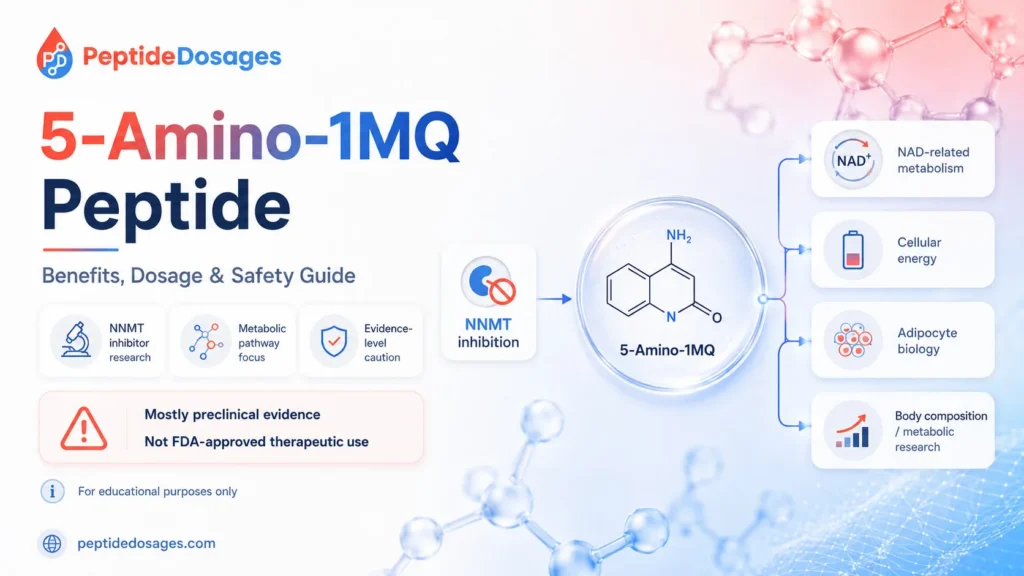
5-Amino-1MQ peptide is a common search phrase, but 5-Amino-1MQ is better described as 5-amino-1-methylquinolinium, a synthetic small molecule studied as an inhibitor of nicotinamide N-methyltransferase, or NNMT 1, 2. This educational article explains how the molecule is discussed in metabolic research, what evidence exists, what remains unknown, and why “peptide therapy” language can be misleading. It is not personal medical advice and does not provide dosing, injection, purchasing, or self-treatment instructions.
- 5-Amino-1MQ is commonly marketed or searched alongside peptides, but chemically it is not a peptide chain; peptides are short amino acid chains, while 5-Amino-1MQ is a methylquinolinium small molecule 3, [1].
- Researchers study 5-Amino-1MQ because it targets NNMT, an enzyme involved in nicotinamide metabolism, NAD-related biology, SAM-related methylation pathways, and cellular energy regulation [2], 4.
- The strongest direct evidence for 5-Amino-1MQ is preclinical, including cell, mouse, aged-muscle, and rat pharmacokinetic studies [2], 5, 6.
- Potential benefits such as fat loss, body composition change, metabolic health support, mitochondrial function, and longevity-related effects should be described as research hypotheses unless supported by human clinical trials.
- Searches of FDA drug resources should be part of regulatory verification; FDA databases describe approved drug products, and no FDA-approved label for 5-Amino-1MQ was identified in the sources reviewed for this article as of June 12, 2026 7, 8.
- Dosage information in this article refers only to published study contexts, mainly animal or pharmacokinetic studies, and should not be interpreted as personal dosing advice.
- Safety data are limited; absence of reported harm in short preclinical studies does not establish human safety, especially for pregnancy, breastfeeding, chronic disease, cancer, medication interactions, or compounded/unapproved products.
Related dosage pages: For vial-specific concentration, reconstitution, and measurement examples, see 5-Amino-1MQ (10 mg Vial) Dosage Protocol and 5-Amino-1MQ (50 mg Vial) Dosage Protocol. Each linked protocol remains a separate reference because vial strength changes concentration and syringe-unit calculations.
Fast Answer
5-Amino-1MQ peptide is a search term for 5-amino-1-methylquinolinium, a small-molecule NNMT inhibitor studied mainly in preclinical metabolic and muscle research, not an FDA-approved peptide drug [1], [2], [7]. People search for it because NNMT inhibition may affect fat metabolism, NAD-related cellular energy pathways, and body composition in animal models [2], [5]. Human efficacy, long-term safety, approved dosage, and therapeutic use remain unestablished, so claims about weight loss, longevity, or “peptide therapy” need caution.
What Is the 5-Amino-1MQ Peptide?
5-Amino-1MQ is the shorthand name for 5-amino-1-methylquinolinium. It is usually discussed as an NNMT inhibitor in metabolic research, not as an approved therapeutic peptide [1], [2].
The phrase “5-Amino-1MQ peptide” is therefore SEO-common but chemically imprecise. A safer article should explain the phrase while correcting the identity early.
Is 5-Amino-1MQ Actually a Peptide?
No. A peptide is generally a short chain of amino acids connected by peptide bonds, while 5-Amino-1MQ is a small molecule listed as 5-amino-1-methylquinolinium in chemical databases [3], [1].
This distinction matters because peptide drugs, small-molecule drugs, research chemicals, and compounded substances are regulated and evaluated differently. Treating the word “peptide” as a marketing category can blur these differences.
Chemical Identity: Small Molecule, NNMT Inhibitor, and 5 Amino Naming Variants
Published research describes methylquinolinium analogues such as 5-Amino-1MQ as selective, membrane-permeable small molecule inhibitors of nicotinamide N-methyltransferase [2]. PubChem lists 5-amino-1-methylquinolinium as a compound record, and FDA’s GSRS also maintains a substance record for 5-amino-1-methylquinolinium [1], 9.
Naming variants include 5-Amino-1MQ, 5-amino-1-methylquinolinium, 5-AMQ, 5A-1MQ, and sometimes “5 amino 1MQ.” These names should be normalized in medical content so readers understand they refer to the same research molecule unless a specific salt form is being discussed.
Why Does It Appear in Peptide Therapy Searches?
It appears in peptide therapy searches because online body-composition and longevity content often groups metabolic research compounds with peptides. That does not make 5-Amino-1MQ a peptide drug.
For a therapeutic information site, the safer framing is: “5-Amino-1MQ is commonly searched in peptide therapy contexts, but chemically it is a small-molecule NNMT inhibitor.” That phrasing serves search intent without endorsing inaccurate product claims.
How Does 5-Amino-1MQ Peptide Work?
5-Amino-1MQ work is usually explained through NNMT inhibition. NNMT is involved in the methylation of nicotinamide, a form of vitamin B3, and is linked to NAD-related and methyl-donor metabolism [4].
In preclinical models, inhibiting NNMT has been associated with changes in intracellular 1-methylnicotinamide, NAD+, SAM, lipogenesis, adipose tissue, and energy metabolism [2]. These are mechanism findings, not proof of clinical benefit.
What Is NNMT and Nicotinamide N-Methyltransferase?
NNMT stands for nicotinamide N-methyltransferase. It is an enzyme that transfers a methyl group from S-adenosylmethionine, or SAM, to nicotinamide, forming 1-methylnicotinamide and S-adenosylhomocysteine [4].
NNMT is not simply “good” or “bad.” It has tissue-specific roles in metabolism, liver biology, adipose tissue, skeletal muscle, cancer biology, and redox balance, which is why broad claims about blocking NNMT can be misleading [4], 10.
How Is Inhibiting NNMT Thought to Affect Metabolic Pathways?
The main hypothesis is that inhibiting NNMT may alter the balance of nicotinamide, NAD-related pathways, SAM-related methylation, and cellular energy metabolism. In the 2018 Biochemical Pharmacology study, NNMT inhibitors reduced intracellular 1-MNA, increased intracellular NAD+ and SAM, and suppressed lipogenesis in cultured adipocytes [2].
A separate Nature study found that genetic knockdown of NNMT in white adipose tissue and liver protected mice from diet-induced obesity and increased cellular energy expenditure 11. That study supports NNMT as a biologically plausible target, but it used genetic knockdown, not 5-Amino-1MQ as a human therapy.
Why Doesn’t Mechanism Prove Clinical Benefit?
Mechanism explains a possible pathway. Clinical benefit requires human outcomes, safety monitoring, dose-response data, and comparison with placebo or standard care.
For 5-Amino-1MQ, most direct claims about fat loss, metabolic health, muscle regeneration, mitochondrial function, or longevity come from animal and cell research [2], [5], 12. Preclinical findings can guide research, but they cannot establish that a molecule is safe or effective for people.
Mechanism of Action at the Cellular Level
At the cellular level, 5-Amino-1MQ targets NNMT activity. Researchers have used it to study how NNMT inhibition affects adipocytes, skeletal muscle, NAD-related metabolites, and body composition in animal models [2], [12].
A useful way to read the mechanism is: enzyme target first, metabolic pathway second, clinical outcome last. The final step is the least established.
How Do NAD, Nicotinamide, and Cellular Energy Fit Together?
Nicotinamide adenine dinucleotide, or NAD, is central to cellular energy metabolism and redox reactions. NNMT can influence nicotinamide availability and related NAD salvage pathway biology, which is one reason NNMT has been studied in obesity, ageing, and muscle models [4], [12].
Some online sources say 5-Amino-1MQ “boosts NAD.” A more accurate statement is that preclinical NNMT-inhibition studies have reported changes in NAD-related metabolites, but clinical NAD increases in humans taking 5-Amino-1MQ have not been established [2], [12].
Fat Cell Biology, Fat Storage, and Fat Metabolism
In cultured adipocytes, NNMT inhibitors reduced 1-MNA, increased NAD+ and SAM, and suppressed lipogenesis, suggesting a possible effect on fat cell metabolism [2]. In diet-induced obese mice, systemic NNMT inhibitor treatment reduced body weight, white adipose mass, adipocyte size, and plasma total cholesterol in a short preclinical study [2].
These findings are why 5-Amino-1MQ for weight loss is discussed online. The limitation is that mouse fat cell and adipose tissue results do not automatically translate into human fat loss or long-term metabolic benefit.
Mitochondrial Function, ATP, and Oxidative Stress
NNMT research intersects with mitochondrial function because NAD biology, redox balance, and cellular respiration are closely linked to energy production. In aged skeletal muscle research, NNMT inhibition has been connected to NAD salvage pathway changes and improved muscle regeneration in mice [12].
Oxidative stress and mitochondrial health claims should be handled cautiously. The mechanism is plausible, but 5-Amino-1MQ has not been established as a treatment for mitochondrial disease, fatigue, ageing, or oxidative-stress-related conditions.
What Is 5-Amino-1MQ Used For or Studied For?
5-Amino-1MQ is studied mainly as a research tool and possible drug-development lead for NNMT-related metabolic biology. Published work has focused on diet-induced obesity models, adipose tissue, skeletal muscle, rat pharmacokinetics, and exercise-related aged-mouse models [2], [5], [6], [12], 13.
It should not be described as an approved treatment for obesity, diabetes, cardiovascular disease, cancer, ageing, or any chronic condition.
Weight Management and Body Composition Research
In mice, NNMT inhibition has been associated with reduced body weight, lower fat mass, smaller adipocytes, and altered adipose tissue metabolism [2], [5]. A 2021 mouse study reported that NNMT inhibitor treatment combined with a lean diet substitution improved body weight and fat loss, increased lean-mass-to-body-weight ratio, and improved liver adiposity relative to diet change alone [5].
This supports further study of body composition, not a personal weight management protocol. Human weight loss claims remain evidence-limited.
Metabolic Health, Insulin Sensitivity, and Glucose Context
NNMT has been investigated as a target in obesity, insulin resistance, metabolic syndrome, and type 2 diabetes biology [11], 14. Reviews describe NNMT as a possible therapeutic target for metabolic syndrome, but the field remains largely translational and preclinical for NNMT inhibitors such as 5-Amino-1MQ [14].
For readers, the key point is that metabolic health is not one marker. Glucose, insulin sensitivity, lipids, blood pressure, liver health, body composition, medication history, diet and exercise, and cardiovascular risk all matter.
Longevity, Ageing, and Biomarkers of Aging Claims
Longevity claims are especially evidence-sensitive. NNMT inhibition has been studied in aged mice and skeletal muscle models, including work on muscle stem cells and exercise-mediated muscle function [12], [13].
Those studies do not prove that 5-Amino-1MQ slows the effects of aging in humans. They do show that NNMT is a biologically interesting target in ageing-related research.
Potential Benefits of 5-Amino-1MQ Peptide
The potential benefits of 5-Amino-1MQ should be grouped by evidence level. The most defensible wording is “preclinical studies suggest” rather than “5-Amino-1MQ causes” or “5-Amino-1MQ may help everyone.”
| Evidence Area | What Has Been Studied | Evidence Level | What It Can and Cannot Show |
|---|---|---|---|
| Compound identity | 5-amino-1-methylquinolinium as a small molecule compound [1] | Database / chemical identity | Shows identity, not therapeutic benefit |
| NNMT mechanism | Inhibition of NNMT, changes in 1-MNA, NAD+, SAM, and lipogenesis [2] | Preclinical / mechanistic | Supports pathway plausibility, not human efficacy |
| Body composition | Diet-induced obese mouse models and lean diet substitution [2], [5] | Preclinical | Suggests research potential, not personal weight-loss advice |
| Oral and IV pharmacokinetics | Rat LC-MS/MS, IV and oral administration, bioavailability estimates [6] | Preclinical pharmacokinetics | Helps interpret animal exposure, not human dosing |
| Muscle and ageing | Aged mouse muscle regeneration and exercise-related function [12], [13] | Preclinical | Supports further research, not longevity claims |
| FDA-approved therapeutic use | FDA approval databases and Orange Book resources [7], [8] | Regulatory verification | No approved-label dosage was identified in reviewed FDA sources |
Benefits of 5-Amino-1MQ: Evidence-Graded Overview
The strongest evidence-supported benefits are research-model outcomes: reduced adipose mass in mice, changes in adipocyte metabolism, altered metabolomic signatures, and improved aged-mouse muscle parameters [2], [5], [12]. These are not the same as proven clinical benefits.
Unsupported or weakly supported online claims include guaranteed fat loss, “metabolism optimization,” anti-aging results, disease treatment, and 5-Amino-1MQ synergy stacks. Those claims need human studies before they can be treated as therapeutic conclusions.
What Evidence Exists for Fat Loss, Fat Mass, and Fat Oxidation?
The fat loss and fat mass evidence is preclinical. In diet-induced obese mice, 5-Amino-1MQ treatment reduced body weight and white adipose mass without reducing total food intake in the reported study [2].
A separate study found that NNMT inhibitor treatment plus a lean diet substitution improved body composition and liver adiposity in obese mice compared with diet substitution alone [5]. This supports the idea that NNMT activity is relevant to fat metabolism, but it does not establish that people can safely use the compound to burn fat.
Could 5-Amino-1MQ Help Cellular and Metabolic Health?
5-Amino-1MQ may help researchers understand cellular metabolism because NNMT links nicotinamide metabolism, NAD-related pathways, methylation biology, and adipose tissue function [2], [4]. The molecule’s role as an NNMT inhibitor makes it useful for probing these pathways.
Clinical translation is the unresolved question. A cellular or animal change is not the same as improved health outcomes in humans.
What Does Human Research Show About 5-Amino-1MQ?
Human research is the major gap. The evidence reviewed here is dominated by cell studies, mouse studies, rat pharmacokinetics, and mechanistic reviews rather than completed randomized human efficacy trials for 5-Amino-1MQ [2], [5], [6], [12], [13], [14].
That means readers should treat clinical claims as unproven unless a future human trial, approved label, or regulator-reviewed product information supports them.
Are There Published Human Studies or Clinical Trials?
The published sources used for this article do not establish human efficacy, human dosage, or long-term human safety for 5-Amino-1MQ. Human observational data exist for NNMT-related markers and metabolic disease associations, but that is different from testing 5-Amino-1MQ as an intervention [14].
Editors should verify ClinicalTrials.gov, PubMed, FDA databases, and international trial registries before publication updates. As of the sources reviewed for this article, the evidence basis remains preclinical.
Why Do Personalized 5-Amino-1MQ Therapy Claims Need Caution?
Personalized 5-Amino-1MQ therapy claims often imply that a clinician can tailor or optimize use based on metabolism, NAD status, or body composition. Without validated human dosing, adverse-event data, contraindication data, and regulatory labeling, personalization is speculative.
A more responsible framing is that any medical decision involving an unapproved metabolic compound should be discussed with a licensed clinician who can compare evidence-based alternatives, risk factors, current medications, and regulatory status.
What Do Preclinical Studies Suggest About NNMT Inhibition?
Preclinical studies suggest that NNMT inhibition can affect adipose tissue, body weight, liver fat, muscle regeneration, and aged-muscle function in animal models [2], [5], [12], [13]. These findings are hypothesis-generating.
They also show why overstatement is easy. A strong mouse finding can become a weak human claim if evidence level is not clearly labeled.
Diet-Induced Obesity and Adipose Tissue Models
Diet-induced obesity models are central to 5-Amino-1MQ research. In one mouse study, systemic 5-Amino-1MQ reduced body weight, white adipose mass, adipocyte size, and plasma cholesterol, with no reported effect on total food intake [2].
The diet context matters. Mouse diet-induced obesity models do not capture the full complexity of human obesity, including genetics, medication exposure, sleep, social factors, endocrine disease, and long-term adherence to lifestyle or medical therapy.
Skeletal Muscle, Mitochondrial Health, and Energy Metabolism
In aged mice, NNMT inhibitor treatment has been studied for muscle stem cell activation and regenerative capacity after injury [12]. Another 2024 mouse study evaluated whether NNMT inhibition could mimic or add to exercise-mediated muscle improvements in aged mice [13].
These studies support a muscle-function research lane, not a claim that 5-Amino-1MQ improves muscle tone, performance, fatigue, or recovery in humans.
Where Do Animal Models Stop Short of Patient Care?
Animal models help identify mechanisms, dose ranges for research, pharmacokinetic behavior, and biological signals. They do not establish a safe human dose, long-term adverse effects, drug interactions, contraindications, or patient outcomes.
This is especially important for metabolic compounds. A mouse can lose fat mass over weeks, while human metabolic care often requires years of safety monitoring.
Evidence Limitations and Unsupported Online Claims
The main evidence limitation is that direct human therapeutic evidence for 5-Amino-1MQ remains limited or absent in the reviewed sources. Most benefits of 5-Amino-1MQ are preclinical, mechanistic, or anecdotal.
Online claims should be graded by source quality. Peer-reviewed animal data are stronger than influencer claims, but still weaker than human randomized trials or approved labeling.
Can 5-Amino-1MQ Boost Metabolism or Burn Fat?
“Boost metabolism” and “burn fat” are common claims, but they are too broad. Preclinical studies show effects on adipocyte metabolism, lipogenesis, adipose mass, and body composition in mice [2], [5].
A medically responsible article should say: “Preclinical research suggests NNMT inhibition may affect fat metabolism and adiposity in animal models.” It should not say that 5-Amino-1MQ burns stored fat in humans.
How Should 5-Amino-1MQ Synergy and Combination Claims Be Read?
5-Amino-1MQ synergy claims often refer to diet, exercise, NAD precursors, or other metabolic therapies. Mouse studies have explored combinations with diet substitution and exercise-like interventions, but these are not personal stacking instructions [5], [13].
Any 5-Amino-1MQ combination claim should answer four questions: Was it tested in humans? Was there a control group? Were adverse events measured? Was the endpoint clinically meaningful?
Online Claims About Reversing Aging or Treating Disease
Claims about reversing ageing, treating type 2 diabetes, healing injury, improving cancer outcomes, or curing metabolic disorders should be considered unsupported unless backed by high-quality human evidence. NNMT has complex roles in cancer and metabolism, and its role can vary by tissue and disease context [10].
A molecule that changes NNMT activity is not automatically safe in every setting. This is one reason cancer history, chronic conditions, and medication use belong in clinician discussions.
Side Effects and Adverse Effects Reported or Unknown
Side effects for 5-Amino-1MQ are not well characterized in humans. The 2018 mouse study reported no observable adverse effects in that study context, but short animal studies cannot establish human safety [2].
Unknowns include dose-related toxicity, liver or kidney effects, cardiovascular effects, neuroendocrine effects, pregnancy and breastfeeding safety, immunologic effects, and long-term metabolic consequences.
What Potential Side Effects Should Be Considered?
Potential side effects should be framed as unknown rather than assumed. Because NNMT is tied to nicotinamide metabolism, methylation pathways, adipose tissue, skeletal muscle, liver biology, and cancer biology, off-target or tissue-specific effects are plausible research concerns [4], [10], [14].
Readers should not interpret “no major side effects reported online” as evidence of safety. Lack of surveillance is not the same as absence of harm.
What Safety Data Can and Cannot Establish
Preclinical safety observations can identify obvious toxicity signals in a narrow model. They cannot establish safety for people with hypertension, diabetes, cardiovascular disease, cancer history, liver disease, kidney disease, pregnancy, breastfeeding, or multiple medications.
Compounded and unapproved products add a separate quality risk. FDA states that compounded drugs are not FDA-approved and are not reviewed for safety, effectiveness, or quality before marketing 15.
When Should Symptoms Prompt Medical Evaluation?
Any unexpected symptoms after using an unapproved research compound should prompt medical evaluation, especially chest pain, shortness of breath, fainting, severe abdominal pain, jaundice, allergic symptoms, neurologic changes, severe vomiting, infection signs, or mood changes.
This article does not diagnose adverse events. It encourages readers to treat new symptoms seriously and to bring product details, dose claims, ingredient lists, and timing to a clinician or poison-control professional.
Safety Risks, Contraindications, and Drug Interactions
There are no FDA-approved contraindications or drug-interaction sections for 5-Amino-1MQ because no approved FDA label was identified in the reviewed FDA approval resources [7], [8]. That absence does not mean there are no risks.
It means the usual label-based safety framework is missing.
Which Contraindications Should Be Reviewed With a Medical Doctor?
A clinician would reasonably review pregnancy, breastfeeding, age, cancer history, liver or kidney disease, cardiovascular disease, metabolic disorders, diabetes medications, hypertension medications, psychiatric medications, supplement use, and prior adverse drug reactions.
Cancer history deserves special caution because NNMT has been studied in tumor biology and may have context-dependent roles in cancer progression and metabolism [10]. That does not mean 5-Amino-1MQ causes or treats cancer; it means the pathway is medically sensitive.
Medication Interactions and Chronic Condition Considerations
Formal human drug interaction studies for 5-Amino-1MQ were not identified in the reviewed sources. That is a data gap, not reassurance.
Metabolic drugs, glucose-lowering medications, lipid-lowering medications, weight-loss medications, hormones, stimulants, NAD-related supplements, and experimental compounds could create overlapping effects or monitoring problems. A licensed clinician should evaluate these risks before any medical decision.
What Dosage Information Exists for 5-Amino-1MQ?
There is no approved-label 5-Amino-1MQ dosage in the FDA sources reviewed for this article [7], [8]. Published dosage information is mainly from animal or pharmacokinetic studies.
For example, a diet-induced obese mouse study reported systemic subcutaneous dosing of 20 mg/kg three times daily in the research setting [2]. A later diet-switch mouse study used subcutaneous 5A-1MQ at 32 mg/kg active pharmaceutical ingredient after switching mice from a Western diet to a lean diet 16.
How Should Study Dosage Be Separated From Personal Medical Advice?
Study doses should not be interpreted as personal dosing advice. Animal doses are not converted into safe human doses without pharmacology, toxicology, clinical trials, route-of-administration data, and regulatory review.
This distinction is especially important because 5-Amino-1MQ dosage claims online often blend mouse data, rat pharmacokinetic data, and anecdotal human use. That blending is not evidence-based dosing.
Missing Approved-Label Dosage Information
An approved label usually includes indication, patient population, route, strength, dose adjustments, contraindications, warnings, adverse reactions, and drug interactions. No such FDA-approved 5-Amino-1MQ label was identified in the reviewed FDA drug approval resources [7], [8].
This leaves clinicians and readers without a regulator-reviewed dosing framework. That is why any “protocol” language should be avoided in an educational article.
Administration Routes Discussed in Medical Literature
Published research discusses routes such as subcutaneous administration in mouse studies and oral or intravenous administration in rat pharmacokinetic work [2], [6], [16]. These are literature contexts, not instructions.
Route matters because absorption, bioavailability, half-life, tissue exposure, and safety may differ across species and delivery methods.
How Do Route of Administration and Bioavailability Affect Interpretation?
A rat pharmacokinetic study found that 5-AMQ could be measured after oral and intravenous administration and reported oral bioavailability in rats [6]. A mouse study noted that subcutaneous injection was chosen because 5A-1MQ had poor oral bioavailability in mice, a species-specific issue not seen in rats in the cited pharmacokinetic work [16].
This shows why route data should not be simplified into self-use advice. A route that works in a study model does not establish a safe or effective route for people.
Regulatory Status: Is 5-Amino-1MQ Peptide FDA-Approved?
No FDA-approved 5-Amino-1MQ drug product or approved-label dosage was identified in the FDA drug approval resources reviewed for this article as of June 12, 2026 [7], [8]. The phrase “5-Amino-1MQ is banned” is too broad because legal status depends on product claims, jurisdiction, compounding status, and intended use.
The safer statement is: 5-Amino-1MQ should be treated as an unapproved research compound unless a specific regulator-reviewed product and indication can be verified.
Food and Drug Administration Status and Compounding Cautions
FDA explains that Drugs@FDA contains information about most FDA-approved prescription, generic, and over-the-counter drug products, and the Orange Book identifies FDA-approved products based on safety and effectiveness [7], [8]. FDA also states that compounded drugs are not FDA-approved and are not reviewed for safety, effectiveness, or quality before marketing [15].
For 503A compounding, FDA says bulk drug substances generally must comply with an applicable USP/NF monograph, be components of FDA-approved drug products, or appear on FDA’s 503A bulks list when no monograph exists and the substance is not a component of an approved product 17. Readers should not assume that a compound sold online, labeled “research use,” or marketed as a peptide is legally or medically appropriate for human use.
How 5-Amino-1MQ Compares With Related Metabolic Therapies
The main comparison is evidence level. FDA-approved metabolic therapies have regulator-reviewed labeling for defined indications, while 5-Amino-1MQ does not have an approved therapeutic label in the reviewed FDA resources [7], [8].
For example, FDA approved tirzepatide injection for chronic weight management in adults with obesity or overweight with at least one weight-related condition, in addition to reduced-calorie diet and increased physical activity 18. FDA also approved Wegovy for cardiovascular risk reduction in adults with cardiovascular disease and obesity or overweight 19.
NNMT Inhibitor 5-Amino-1MQ Versus Peptide Therapy Options
5-Amino-1MQ targets NNMT and is a small molecule. GLP-1 or GIP/GLP-1 metabolic drugs work through incretin hormone receptors and have regulator-reviewed indications when used as approved products [18], [19].
That does not mean approved drugs are right for every person or that investigational compounds have no future. It means evidence level, mechanism, approval status, safety monitoring, and dosage certainty differ sharply.
What Should Readers Discuss With a Clinician?
Readers considering peptide-related or metabolic-compound decisions should discuss evidence quality, safer approved alternatives, medical history, medications, pregnancy or breastfeeding, chronic conditions, and product quality concerns with a qualified healthcare professional.
A practical clinician-discussion checklist:
- What evidence level supports the claim: approved label, human trial, animal model, cell model, or anecdote?
- Is the compound actually a peptide, a small molecule, a supplement, a compounded drug, or an unapproved research chemical?
- Are there approved alternatives for the health goal being discussed?
- Could current medications or chronic conditions increase risk?
- Are liver, kidney, cardiovascular, glucose, lipid, or hormone factors relevant?
- Is there any verified regulatory status, label, batch quality, adverse-event monitoring, or pharmacovigilance pathway?
- What symptoms would require medical evaluation?
How Clinicians Personalize and Tailor Risk-Benefit Decisions
Clinicians personalize care by matching evidence to the patient’s diagnosis, risks, alternatives, goals, and monitoring needs. For 5-Amino-1MQ, personalization is limited by the lack of approved labeling, unclear human efficacy, and incomplete long-term safety data.
The safest way to interpret 5-Amino-1MQ is through evidence quality, regulatory status, safety uncertainty, and clinician-guided decision-making—not through online protocols, synergy claims, or vendor-driven benefit lists.
Researchers Cited in This Article
The researchers below authored or co-authored publications cited in this article. Listing them here identifies sources; it does not mean they wrote, independently reviewed, sponsored, or endorsed this PeptideDosages.com article. The site author is identified in the article byline.
Harshini Neelakantan
Researcher profile: ORCID
Harshini Neelakantan’s peer-reviewed publications are directly relevant to this article’s discussion of 5-Amino-1MQ, NNMT inhibition, and preclinical research. Her work helped frame the compound as a small-molecule NNMT inhibitor rather than a true peptide, with studies examining membrane permeability, adipocyte lipogenesis, diet-induced obesity models, and aged skeletal muscle models. This literature is useful for interpreting mechanism of action, dosage context, and evidence limitations without extending animal or cell findings into unproven human therapeutic claims. It also provides background for why 5-Amino-1MQ peptide searches should be handled with careful chemical-identity and evidence-quality framing.
Selected publications:
- Selective and membrane-permeable small molecule inhibitors of nicotinamide N-methyltransferase reverse high fat diet-induced obesity in mice — Biochemical Pharmacology, 2018. DOI: 10.1016/j.bcp.2017.11.007.
- Small molecule nicotinamide N-methyltransferase inhibitor activates senescent muscle stem cells and improves regenerative capacity of aged skeletal muscle — Biochemical Pharmacology, 2019. DOI: 10.1016/j.bcp.2019.02.008.
Stanley J. Watowich
Researcher profile: UTMB Health Research Expert Profile
Stanley J. Watowich’s published work is relevant to the NNMT mechanism and pharmacology context discussed in this article. His publications include assay-development and structure-activity research that help explain how NNMT activity can be measured, how small-molecule inhibitors are characterized, and why compound identity matters when interpreting 5-Amino-1MQ literature. These studies provide useful background for evaluating preclinical research, mechanism-of-action claims, and the limitations of translating NNMT inhibitor findings into human clinical conclusions. His work also supports the article’s distinction between biochemical target validation and evidence needed for approved therapeutic use.
Selected publications:
- Structure-Activity Relationship for Small Molecule Inhibitors of Nicotinamide N-Methyltransferase — Journal of Medicinal Chemistry, 2017. DOI: 10.1021/acs.jmedchem.7b00389. PMID: 28548833.
- Noncoupled Fluorescent Assay for Direct Real-Time Monitoring of Nicotinamide N-Methyltransferase Activity — Biochemistry, 2017. DOI: 10.1021/acs.biochem.6b01215. PMID: 28121423.
Related dosage protocols and research
Use the available links to move between research context, dosage pages or comparisons, and supporting guides. When vial-size variants exist, they remain separate because concentration and syringe-unit calculations change with vial strength. Comparisons do not imply that different compounds are interchangeable.
Matching dosage protocols
Further research context
REFERENCES
- National Center for Biotechnology Information. PubChem Compound Summary: 5-Amino-1-methylquinolinium. PubChem. Accessed 2026.
- Neelakantan H, Vance V, Wetzel MD, Wang HYL, McHardy SF, Finnerty CC, Hommel JD, Watowich SJ. Selective and membrane-permeable small molecule inhibitors of nicotinamide N-methyltransferase reverse high fat diet-induced obesity in mice. Biochemical Pharmacology. 2018;147:141–152. DOI: 10.1016/j.bcp.2017.11.007.
- National Human Genome Research Institute. Peptide. NHGRI Genetics Glossary. Accessed 2026.
- Pissios P. Nicotinamide N-Methyltransferase: More Than a Vitamin B3 Clearance Enzyme. Trends in Endocrinology & Metabolism. 2017;28(5):340–353. DOI: 10.1016/j.tem.2017.02.004.
- Sampson CM, Dimet AL, Neelakantan H, Ogunseye KO, Stevenson HL, Hommel JD, Watowich SJ. Combined nicotinamide N-methyltransferase inhibition and reduced-calorie diet normalizes body composition and enhances metabolic benefits in obese mice. Scientific Reports. 2021;11:5637. DOI: 10.1038/s41598-021-85051-6.
- Awosemo O, Neelakantan H, Watowich S, Ma J, Wu L, Chow DSL, Liang D. Development & validation of LC–MS/MS assay for 5-amino-1-methyl quinolinium in rat plasma: Application to pharmacokinetic and oral bioavailability studies. Journal of Pharmaceutical and Biomedical Analysis. 2021;204:114255. DOI: 10.1016/j.jpba.2021.114255.
- U.S. Food and Drug Administration. Drugs. FDA official drug information and database portal. Accessed 2026.
- U.S. Food and Drug Administration. Approved Drug Products with Therapeutic Equivalence Evaluations: Orange Book. FDA. Accessed 2026.
- U.S. Food and Drug Administration. Global Substance Registration System: 5-Amino-1-methylquinolinium. FDA GSRS. Accessed 2026.
- Wang W, Yang S, He J, et al. Complex roles of nicotinamide N-methyltransferase in cancer progression. Cell Death & Disease. 2022;13:267. DOI: 10.1038/s41419-022-04713-z.
- Kraus D, Yang Q, Kong D, et al. Nicotinamide N-methyltransferase knockdown protects against diet-induced obesity. Nature. 2014;508:258–262. DOI: 10.1038/nature13198.
- Neelakantan H, Brightwell CR, Graber T, et al. Small molecule nicotinamide N-methyltransferase inhibitor activates senescent muscle stem cells and improves regenerative capacity of aged skeletal muscle. Biochemical Pharmacology. 2019;163:481–492. DOI: 10.1016/j.bcp.2019.02.008.
- Dimet-Wiley AL, Latham CM, Brightwell CR, et al. Nicotinamide N-methyltransferase inhibition mimics and boosts exercise-mediated improvements in muscle function in aged mice. Scientific Reports. 2024;14:15554. DOI: 10.1038/s41598-024-66034-9.
- Sun WD, Zhang X, et al. Nicotinamide N-methyltransferase: a novel therapeutic target for metabolic syndrome. Frontiers in Pharmacology. 2024. DOI: 10.3389/fphar.2024.1410479.
- U.S. Food and Drug Administration. Understanding the Risks of Compounded Drugs. FDA. 2026.
- Dimet-Wiley A, Wu Q, Wiley JT, et al. Reduced calorie diet combined with NNMT inhibition establishes a distinct microbiome in DIO mice. Scientific Reports. 2022;12:484. DOI: 10.1038/s41598-021-03670-5.
- U.S. Food and Drug Administration. Bulk Drug Substances Used in Compounding Under Section 503A of the FD&C Act. FDA. 2026.
- U.S. Food and Drug Administration. FDA Approves New Medication for Chronic Weight Management. FDA News Release. 2023.
- U.S. Food and Drug Administration. FDA Approves First Treatment to Reduce Risk of Serious Heart Problems Specifically in Adults with Obesity or Overweight. FDA News Release. 2024.