
On this page
GHK-Cu Quick Reference (50 mg Vial)
- Vial contents
- 50 mg GHK-Cu
- Final volume
- 3 mL
- Concentration
- 16.67 mg/mL
- One U-100 unit
- 166.67 mcg in 0.01 mL
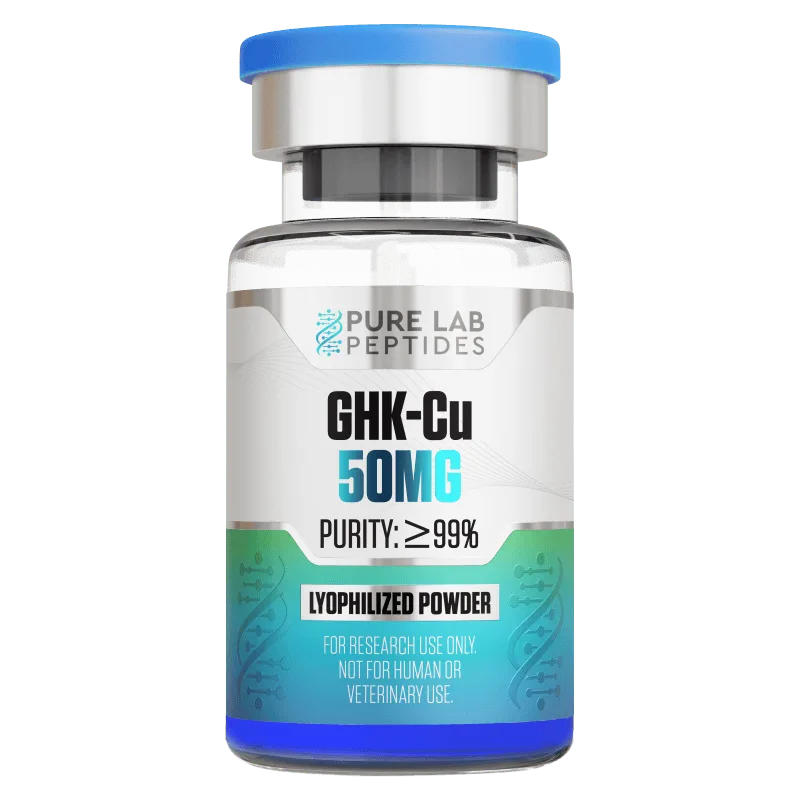
Research context: For evidence on mechanisms, human and preclinical research, limitations, and safety, read GHK-Cu Peptide: Benefits, Uses, Side Effects, Dosage, and Research.
GHK-Cu Dosage Chart
Dosing & Reconstitution Guide
Educational guide for reconstitution and common dosing patterns
Standard / Conservative Approach (3 mL = 16.67 mg/mL; 5 days/week)
| Week/Phase | Dose per Injection | Units (per injection) (mL) |
|---|---|---|
| Weeks 1-4 | 1.0 mg (1000 mcg) | 6 units (0.06 mL) |
| Weeks 5-8 | 1.5 mg (1500 mcg) | 9 units (0.09 mL) |
| Weeks 9-12+ | 2.0 mg (2000 mcg) | 12 units (0.12 mL) |
Frequency: Once daily, 5 days per week, progressing from 1.0 mg to 1.5 mg and then 2.0 mg as shown above. At 16.67 mg/mL, those doses equal 6, 9, and 12 U-100 units[18]. Use a U-100 syringe with markings that clearly display every value in the table.
Reconstitution Steps
- Draw 3.0 mL of the protocol-specified sterile diluent with a sterile syringe.
- Add it slowly down the vial wall to reduce foaming.
- Gently swirl or roll until dissolved. Do not shake.
- Label the vial with the 16.67 mg/mL concentration, preparation date, and storage instructions.
Alternative Protocol (3 mL = 16.67 mg/mL; 3 times weekly)
| Week/Phase | Dose per Injection | Units (per injection) (mL) |
|---|---|---|
| Weeks 1-12+ | 2.0 mg (2000 mcg) | 12 units (0.12 mL) |
Frequency: 2.0 mg three times per week, such as Monday, Wednesday, and Friday. At 16.67 mg/mL, each injection equals 12 U-100 units (0.12 mL), for approximately 6 mg per week[18].
Supplies Needed
Plan based on an 8-16 week protocol. Calculations are shown for both the 5 days/week and 3 times/week schedules.
-
Peptide Vials (GHK-Cu, 50 mg each):
- 5 days/week (1.0-2.0 mg/day):
- 8 weeks (~50 mg total): 1 vial
- 12 weeks (~90 mg total): 2 vials
- 16 weeks (~130 mg total): 3 vials
- 3 times/week (2 mg each):
- 8 weeks (~48 mg total): 1 vial
- 12 weeks (~72 mg total): 2 vials
- 16 weeks (~96 mg total): 2 vials
-
Insulin Syringes (U-100, 29-31 gauge):
- 5 days/week:
- Per week: 5 syringes
- 8 weeks: 40 syringes
- 12 weeks: 60 syringes
- 16 weeks: 80 syringes
- 3 times/week:
- Per week: 3 syringes
- 8 weeks: 24 syringes
- 12 weeks: 36 syringes
- 16 weeks: 48 syringes
-
Sterile or Bacteriostatic Water (10 mL bottles): Use 3.0 mL per vial for the displayed calculation.
- 1 vial: 3 mL
- 2 vials: 6 mL
- 3 vials: 9 mL
-
Alcohol Swabs: Two administration swabs per injection: one for the vial stopper and one for the injection site.
- 5 days/week:
- Per week: 10 swabs
- 8 weeks: 80 swabs or 1 x 100-count box
- 12 weeks: 120 swabs or 2 x 100-count boxes
- 16 weeks: 160 swabs or 2 x 100-count boxes
- 3 times/week:
- Per week: 6 swabs
- 8 weeks: 48 swabs or 1 x 100-count box
- 12 weeks: 72 swabs or 1 x 100-count box
- 16 weeks: 96 swabs or 1 x 100-count box
Planning note: Peptide and water totals are arithmetic minimums based on the listed schedule. Follow the handling and discard limits for the exact products used.


PeptideDosages has no affiliation with Pure Lab Peptides and receives no commission from these Pure Lab links. Supplier pages are not scientific evidence or proof of suitability for human use.
GHK-Cu Vial and Research Context
- Reconstitute: Prepare the 50 mg vial to a final volume of 3.0 mL for a concentration of 16.67 mg/mL.
- Research protocol range: The tables below cover 1.0 mg, 1.5 mg, and 2.0 mg using the standard and alternative research-use schedules.
- Easy measuring: At 16.67 mg/mL, 1 U-100 unit = 0.01 mL = approximately 166.7 mcg.
- Quick conversions: 1.0 mg = 6 units, 1.5 mg = 9 units, and 2.0 mg = 12 units.
GHK-Cu, or glycyl-L-histidyl-L-lysine copper complex, is a naturally occurring copper peptide studied for collagen-related pathways, tissue remodeling, antioxidant defense, and skin repair[7][8]. This educational GHK-Cu dosage protocol presents the same research-use schedule for the 50 mg vial, with calculations adjusted for its concentration.
Protocol Overview
Concise summary of the GHK-Cu dosage protocol and 50 mg vial calculations.
- Goal: Present GHK-Cu research dosage, reconstitution, supplies, and measurement context in one consistent protocol.
- Schedule: The standard table uses 5 days per week; the alternative table uses 3 times per week.
- Amount Range: 1.0 to 2.0 mg per administration within the research protocol examples.
- Reconstitution: A final volume of 3.0 mL produces 16.67 mg/mL.
- Measurement: 1.0 mg equals 6 units, 1.5 mg equals 9 units, and 2.0 mg equals 12 units.
Dosing Protocol
Research-use protocol examples with verified 50 mg vial conversions.
- Standard model: Weeks 1 to 4 use 1.0 mg or 6 units; weeks 5 to 8 use 1.5 mg or 9 units; weeks 9 to 12+ use 2.0 mg or 12 units.
- Alternative model: 2.0 mg or 12 units, three times per week.
- Route context: The tables present subcutaneous research-use calculations.
- Cycle context: The main table covers 8 to 12+ weeks, while the Supplies Needed section also provides totals through 16 weeks.
- Protocol source: These schedules reflect practice conventions summarized by a compounding source[18]. Published evidence is summarized lower on the page.
Storage Instructions
Storage requirements should match the exact GHK-Cu preparation.
- Dry material: Follow the vial and batch documentation for temperature, moisture, and light protection[13].
- Prepared solution: Stability depends on concentration, pH, diluent, sterility, container, preservatives, and temperature.
- Handling: Minimize unnecessary light, moisture exposure, and repeated freeze-thaw cycles[13][14].
- Recordkeeping: Record the preparation date, concentration, storage temperature, and applicable disposal date.
Important Notes
Practical considerations for consistent research preparation and recordkeeping.
- Use new sterile equipment for each preparation or administration and use a suitable sharps container[17].
- Follow the written protocol for site selection and rotation[15].
- Use aseptic technique and allow skin antiseptic to dry before administration[16].
- Document the amount, date, preparation identifier, and site used.
Research Evidence Context
Published human GHK-Cu research has primarily evaluated topical and wound-care formulations[1][2][3][4][5], while local administration in an animal wound model provides additional preclinical context[6]. The subcutaneous schedules above are research-use practice conventions[18], so findings should be interpreted according to route and formulation. Current clinical-trial and FDA materials provide additional topical, compounding, and regulatory context[9][10][11][12].
How This Works
GHK-Cu is a naturally occurring copper-binding tripeptide studied in extracellular-matrix signaling, collagen-related pathways, antioxidant defense, and tissue remodeling[7][8]. Human studies provide topical and wound-care context[1][2][3][4][5], while an animal wound model provides local-administration context[6].
Potential Benefits & Observed Effects
Findings reported in the GHK-Cu research literature.
- Supports research into collagen-related signaling, extracellular-matrix remodeling, and tissue repair[6][7][8].
- Human topical and wound-care studies have examined skin and tissue outcomes in formulation-specific settings[1][2][3][4].
- Human-skin penetration research provides additional topical-delivery context[5].
- Observed findings depend on route, formulation, concentration, and study design; the supporting context is summarized in Important Notes above.
Lifestyle Factors
Complementary approaches to support tissue health and regeneration.
- Maintain adequate protein intake to support collagen synthesis and tissue repair processes.
- Ensure sufficient hydration and micronutrient status (particularly copper, zinc, vitamin C) for optimal connective tissue metabolism.
- Prioritize sleep quality and stress management to support regenerative biological processes.
- Consider combining with appropriate skincare or wound-care protocols as relevant to individual goals.
Injection Technique
General subcutaneous technique references are included for preparation and measurement context[15][16][17].
- Follow aseptic technique and use new sterile equipment for each administration.
- Use the protocol-specified site, angle, and device; the CDC job aid illustrates general subcutaneous technique[16].
- Rotate sites systematically and document each administration[15].
- Dispose of used sharps immediately in an appropriate container[17].
Important Note
This content is intended for therapeutic educational purposes only and does not constitute medical advice, diagnosis, or treatment.
References
Research References
- 1Mulder GD, et al. Wound Repair and Regeneration. Human diabetic-ulcer study of topical glycyl-L-histidyl-L-lysine copper.
- 2Miller TR, et al. Archives of Facial Plastic Surgery. 2006. Topical copper tripeptide complex after carbon-dioxide laser resurfacing.
- 3Abdulghani AA, et al. 1998. Comparative topical-cream study including a copper-binding peptide preparation.
- 4Badenhorst T, et al. 2016. Split-face GHK-Cu nano-serum study of collagen, elastin, and wrinkle-related outcomes.
- 5Hostynek JJ, et al. Inflammation Research. 2010. Final human-skin penetration paper for a GHK-Cu preparation.
- 6Maquart FX, et al. Journal of Clinical Investigation. 1993. Local GHK-Cu exposure in a rat wound-chamber model.
- 7Pickart L, Margolina A. International Journal of Molecular Sciences. 2018. Review of regenerative and gene-expression research involving GHK-Cu.
- 8Maquart FX, et al. 2000. GHK-related modulation of matrix metalloproteinase-2 expression.
- 9ClinicalTrials.gov. NCT07437586. Ongoing Phase 2 study of topical GHK-Cu gel for acute skin-wound healing.
- 10U.S. Food and Drug Administration. Compounding safety-risk information that includes injectable GHK-Cu.
- 11U.S. Food and Drug Administration. 503A Categories Update. Route-specific bulk-substance evaluation context for GHK-Cu.
- 12U.S. Food and Drug Administration. 510(k) K953853. Iamin Gel topical wound-dressing device record.
- 13Mulder GD, et al. Wound Repair and Regeneration. Human diabetic-ulcer study of topical glycyl-L-histidyl-L-lysine copper.
- 14Miller TR, et al. Archives of Facial Plastic Surgery. 2006. Topical copper tripeptide complex after carbon-dioxide laser resurfacing.
- 15Abdulghani AA, et al. 1998. Comparative topical-cream study including a copper-binding peptide preparation.
- 16Badenhorst T, et al. 2016. Split-face GHK-Cu nano-serum study of collagen, elastin, and wrinkle-related outcomes.
- 17Hostynek JJ, et al. Inflammation Research. 2010. Final human-skin penetration paper for a GHK-Cu preparation.
- 18Maquart FX, et al. Journal of Clinical Investigation. 1993. Local GHK-Cu exposure in a rat wound-chamber model.
- 19Pickart L, Margolina A. International Journal of Molecular Sciences. 2018. Review of regenerative and gene-expression research involving GHK-Cu.
- 20Maquart FX, et al. 2000. GHK-related modulation of matrix metalloproteinase-2 expression.
- 21ClinicalTrials.gov. NCT07437586. Ongoing Phase 2 study of topical GHK-Cu gel for acute skin-wound healing.
- 22U.S. Food and Drug Administration. Compounding safety-risk information that includes injectable GHK-Cu.
- 23U.S. Food and Drug Administration. 503A Categories Update. Route-specific bulk-substance evaluation context for GHK-Cu.
- 24U.S. Food and Drug Administration. 510(k) K953853. Iamin Gel topical wound-dressing device record.
- 25GenScript. General peptide storage and handling guidance.
- 26Tocris Bioscience. General stability and storage guidance for laboratory materials.
- 27Roswell Park Comprehensive Cancer Center. General self-injection preparation, site rotation, and disposal guidance.
- 28Centers for Disease Control and Prevention. Current subcutaneous injection technique job aid.
- 29World Health Organization, NCBI Bookshelf. Best practices for injections and related procedures.
- 30Salhab Pharmacy. Practice-convention source for commonly published GHK-Cu schedules. This is not a controlled human dose-ranging trial.
Additional Technical and Protocol Sources
- 13GenScript. General peptide storage and handling guidance.
- 14Tocris Bioscience. General stability and storage guidance for laboratory materials.
- 15Roswell Park Comprehensive Cancer Center. General self-injection preparation, site rotation, and disposal guidance.
- 16Centers for Disease Control and Prevention. Current subcutaneous injection technique job aid.
- 17World Health Organization, NCBI Bookshelf. Best practices for injections and related procedures.
- 18Salhab Pharmacy. Practice-convention source for commonly published GHK-Cu schedules. This is not a controlled human dose-ranging trial.
Related research, protocols, and guides
Explore the available research context, protocol variants or comparisons, and practical guides. When vial-strength variants exist, they remain separate because vial strength, concentration, and syringe-unit calculations can differ. Related compounds and blends are comparisons only, not interchangeable.
Research overview
Other vial-strength protocols
Related protocols and comparisons