
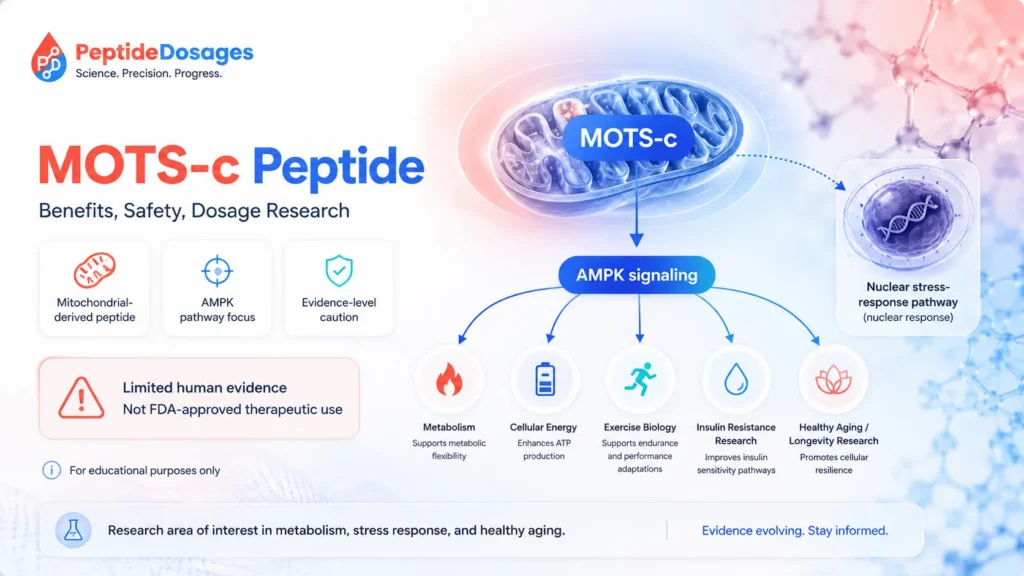
MOTS-c peptide is a small mitochondrial-derived peptide studied for its possible role in metabolism, cellular energy sensing, exercise adaptation, and age-related metabolic stress responses 1. This educational article reviews what researchers know, what remains uncertain, and why claims about longevity, type 2 diabetes, weight loss, or therapeutic use should be interpreted through evidence quality rather than marketing language. It does not provide personal dosing, injection, or treatment advice.
- MOTS-c is a mitochondrial-derived peptide encoded within the mitochondrial 12S ribosomal RNA region, often discussed as part of a newer group of mitochondrial signaling peptides 1, 2.
- The main research focus is metabolism. Preclinical studies suggest links with AMPK signaling, glucose handling, insulin sensitivity, and metabolic homeostasis, but human evidence remains limited 1, 3.
- Longevity and healthy aging claims need caution. MOTS-c has been studied in age-related muscle and exercise models, but it is not established as an anti-aging therapy in humans 3.
- There are no FDA-approved MOTS-c products or labeled indications identifiable through FDA drug approval resources as of this writing; regulatory status may vary by country and product category 4.
- Dosage information is research-context only. Published animal and experimental studies are not personal dosing instructions and should not be converted into self-use protocols 1, 3.
- Safety data are incomplete. Because MOTS-c is not an approved medicine with prescribing information, long-term adverse effects, contraindications, and drug interactions are not well defined 4, 5.
- Clinician-guided interpretation matters. People with diabetes, cardiovascular disease, pregnancy, breastfeeding, chronic illness, or medication use should not interpret peptide research as treatment advice.
Related dosage pages: For vial-specific concentration, reconstitution, and measurement examples, see MOTS-C (5 mg Vial) Dosage Protocol, MOTS-C (10 mg Vial) Dosage Protocol, MOTS-C (20 mg Vial) Dosage Protocol, and MOTS-C (40 mg Vial) Dosage Protocol. Each linked protocol remains a separate reference because vial strength changes concentration and syringe-unit calculations.
Fast Answer
MOTS-c peptide is a mitochondrial-derived peptide encoded in mitochondrial DNA and studied mainly for metabolism, AMPK signaling, exercise adaptation, and metabolic stress biology 1, 2. Interest in MOTS-c comes from animal, cell, and early human research, but it is not an FDA-approved drug and does not have approved therapeutic uses or labeled dosing 4. Claims about longevity, blood sugar, weight loss, or performance remain evidence-limited and should be discussed with a qualified clinician.
What Is the MOTS-c Peptide?
MOTS-c is a short peptide originally described as a mitochondrial-derived peptide involved in metabolic regulation 1. The name is commonly written as MOTS-c, meaning “mitochondrial open reading frame of the 12S rRNA-c,” because it is encoded within a small open reading frame inside the mitochondrial 12S ribosomal RNA region 1, 2.
Unlike many peptide therapies that act through well-defined cell-surface receptors, MOTS-c is studied as a signaling molecule connected to mitochondrial function, nuclear gene expression, and stress-response pathways 2. That makes it scientifically interesting, but it also means the research is complex and not yet equivalent to approved medication evidence.
Peptide Classification and Basic Structure
MOTS-c is described in the literature as a peptide composed of 16 amino acids 1. It belongs to the broader category of mitochondrial-derived peptides, a group that also includes related peptide molecules such as humanin and small humanin-like peptides 6.
Mitochondrial-derived peptides are unusual because mitochondria are best known for producing cellular energy, not for encoding small signaling peptides 7, 8. Research on these molecules has expanded the view of the mitochondrial genome from a compact energy-production genome to a source of potential cell signaling regulators 6.
Amino Acid Sequence, MT-RNR1, and the Mitochondrial Open Reading Frame
The original MOTS-c paper reported that the peptide is encoded within the mitochondrial 12S rRNA region, also known as MT-RNR1 1, 9. MT-RNR1 is part of mitochondrial DNA, which is separate from nuclear DNA and has its own compact gene organization 7, 8.
This is why the phrase mitochondrial-encoded peptide MOTS-c appears in scientific discussions. It reflects the proposed translation of MOTS-c from a mitochondrial open reading frame rather than a conventional nuclear gene.
Endogenous MOTS-c Levels and Why They Are Measured in Research
Endogenous MOTS-c refers to MOTS-c produced within the body. Researchers have measured MOTS-c expression and plasma MOTS-c levels in studies exploring metabolic state, age, exercise, and disease-associated physiology 3, 10.
These measurements are exploratory. A MOTS-c level is not currently an approved diagnostic test for metabolic disease, healthy aging, or mitochondrial disease, and changes in levels of MOTS-c should not be interpreted as proof that a person needs MOTS-c treatment.
Why MOTS-c Represents a Mitochondrial-Derived Peptide
MOTS-c represents a mitochondrial-derived peptide because it is proposed to originate from mitochondrial DNA and act as a signaling molecule beyond the mitochondrion 1, 2. That idea is important because it links mitochondrial genetics, cellular energy regulation, and whole-body metabolism.
How Mitochondrial DNA Can Encode Signaling Peptides
Human mitochondrial DNA is a circular genome that encodes key components of oxidative phosphorylation, mitochondrial rRNAs, and mitochondrial tRNAs 7, 8. MOTS-c research proposes that small open reading frames within mitochondrial rRNA regions may also encode bioactive peptides 1.
This idea remains an active research area. The biological role of MOTS-c is plausible based on mechanistic and preclinical findings, but clinical translation requires stronger human data.
MOTS-c, Humanin, and the Related Peptide Family
Humanin is another mitochondrial-derived peptide studied for cytoprotective, metabolic, and stress-response biology 6. MOTS-c and humanin are often discussed together because both are peptide derived from mitochondrial genetic regions, although they differ in sequence, mechanisms, and research focus 6, 10.
This related peptide context helps explain why peptides such as MOTS-c are interesting to researchers. It does not mean they share the same therapeutic status, safety profile, or clinical evidence.
How Does MOTS-c Peptide Work?
MOTS-c work is proposed to involve cellular energy sensing, metabolic pathway regulation, and communication between mitochondria and the nucleus 1, 2. In simple terms, researchers are studying whether MOTS-c acts as a metabolic stress-response regulator.
How MOTS-c Work Is Proposed to Begin in Mitochondria
Mitochondria produce adenosine triphosphate, regulate redox balance, and help coordinate carbohydrate metabolism and fat metabolism 11, 12. MOTS-c research adds a signaling layer: the mitochondrial genome may encode small peptides that influence broader cellular physiology 1.
In early studies, MOTS-c activated AMPK-related pathways and influenced metabolic homeostasis in animal and cell models 1. These findings suggest that MOTS-c could affect how cells respond to nutrient availability, glucose, and metabolic stress, but this remains a mechanistic hypothesis for many human applications.
MOTS-c Translocates to the Nucleus During Metabolic Stress
A key mechanistic study reported that MOTS-c translocates to the nucleus under metabolic stress and can regulate nuclear gene expression 2. This supports the idea of mitochondrial-to-nuclear communication, sometimes called retrograde signaling.
That mechanism is scientifically meaningful because nuclear gene expression controls many metabolic and stress-response pathways. Still, the observation that MOTS-c acts in cell signaling does not establish that exogenous MOTS-c therapy improves human outcomes.
Why Mechanism Does Not Prove Therapeutic Benefit
Many compounds show interesting mechanisms in cells or mice but fail to become effective medicines. For MOTS-c, the gap between mechanism and clinical use is especially important because much of the strongest evidence remains preclinical 1, 2.
A biologically plausible mechanism can guide clinical research. It should not be treated as proof that MOTS-c treatment prevents disease, reverses aging, or improves metabolic health in people.
Mechanism of Action: Metabolism, AMPK, and Cell Signaling
The proposed mechanism of action centers on metabolism, AMPK activation, glucose use, and cellular stress responses 1. AMPK is a protein kinase that helps cells respond when energy is low, making it a major regulator of metabolic homeostasis 11, 12.
AMP-Activated Protein Kinase and Cellular Energy Sensing
AMP-activated protein kinase is often described as an energy sensor because it responds to changes in ATP, AMP, and ADP balance 11. When activated, AMPK can shift cells toward energy-generating processes and away from energy-consuming processes 11, 12.
MOTS-c activated AMPK-related signaling in the original metabolic study, which is one reason the peptide is discussed in relation to glucose metabolism and insulin resistance 1. This does not make it a diabetes medication.
Folate-Methionine Pathways, Purine Metabolism, and Glucose Use
The original MOTS-c study linked the peptide to folate-methionine metabolism and de novo purine biosynthesis, pathways that intersect with cellular energy balance and glucose use 1. Researchers reported that MOTS-c inhibited parts of this pathway and increased AMPK activity in experimental models 1.
These details matter because they show that the effects of MOTS-c are not limited to a single receptor or hormone-like pathway. The mechanism appears network-based, which can make both therapeutic potential and safety prediction more complicated.
Skeletal Muscle, Insulin Signaling, and Metabolic Homeostasis
Skeletal muscle is a major site of glucose disposal and exercise-related metabolic adaptation 13. MOTS-c in skeletal muscle has been studied in relation to age-dependent physical decline, exercise response, and metabolic flexibility 3.
In animal and cell models, MOTS-c improved some markers related to insulin sensitivity and glucose handling 1. These findings are promising for research, but they do not prove clinical benefit for type 2 diabetes.
What Is MOTS-c Peptide Used For or Studied For?
MOTS-c peptide is studied, not approved, for metabolic and age-related biology. The main application of MOTS-c in published literature involves research into obesity models, insulin resistance, exercise physiology, metabolic stress, and mitochondrial signaling 1, 3.
There are no approved medical uses for MOTS-c listed in FDA drug approval databases 4. Any claim that MOTS-c is an established therapeutic treatment should therefore be treated cautiously.
Metabolic Disorders, Insulin Resistance, and Type 2 Diabetes Research
Preclinical studies have examined MOTS-c in models relevant to obesity, insulin resistance, and glucose metabolism 1. In that context, mice treated with MOTS-c showed improvements in diet-induced metabolic abnormalities, including measures related to insulin sensitivity and weight gain 1.
Type 2 diabetes is a complex chronic condition involving insulin resistance, beta-cell dysfunction, liver glucose production, adipose tissue biology, inflammation, and other pathways 14. MOTS-c research may be relevant to this biology, but it is not an approved substitute for diabetes medication, glucose monitoring, diet, exercise, or clinician-directed care.
Exercise Physiology, Endurance Models, and Healthy Aging
A later study described MOTS-c as an exercise-induced mitochondrial-encoded regulator connected with age-dependent physical decline and muscle homeostasis 3. The study included animal work and human exercise-related observations, supporting interest in MOTS-c as a molecule involved in exercise physiology 3.
The phrase “MOTS-c interacts synergistically with exercise” should be interpreted carefully. It suggests a research relationship between exercise signaling and MOTS-c biology, not a validated performance-enhancing or longevity therapy.
Potential Benefits of MOTS-c Peptide
The potential benefits of MOTS-c depend heavily on the evidence category. The strongest mechanistic and preclinical evidence relates to metabolism, AMPK signaling, insulin sensitivity models, and exercise-related muscle biology 1, 3.
| Evidence Area | What Has Been Studied | Evidence Level | What It Can and Cannot Show |
|---|---|---|---|
| Metabolism and glucose handling | Obesity and insulin resistance models involving MOTS-c administration 1 | Preclinical | Supports biological plausibility; does not establish diabetes treatment efficacy in humans |
| Exercise and skeletal muscle | Exercise-induced MOTS-c changes and age-related muscle studies 3 | Early human plus preclinical | Suggests relevance to exercise biology; does not prove performance benefits |
| Nuclear stress response | MOTS-c movement into the nucleus during metabolic stress 2 | Mechanistic/preclinical | Explains possible signaling; does not establish clinical outcomes |
| Longevity and healthy aging | Age-related physical decline models 3 | Preclinical with limited human context | Supports research interest; does not prove anti-aging therapy |
| Weight loss claims | Online claims often extrapolate from obesity models 1 | Unsupported for clinical use | Animal weight findings cannot be converted into personal weight-loss claims |
What Research Suggests About Metabolism and Blood Sugar
Preclinical research suggests that MOTS-c regulates aspects of metabolism through AMPK and related pathways 1. In the original study, MOTS-c treatment significantly affected metabolic outcomes in mouse models of diet-induced obesity and insulin resistance 1.
For humans, this should be read as a reason for further research, not as evidence that MOTS-c treats high blood sugar. Blood sugar management requires validated medical strategies and individualized clinical care.
What Is Known and Unknown About Longevity Claims
Longevity claims are common online because MOTS-c is linked to mitochondrial function, ageing biology, and exercise-related muscle health 3. The same study suggested that systemic MOTS-c could influence physical capacity in aged mice, while human observations remained limited 3.
What remains unknown is whether MOTS-c therapy improves lifespan, healthspan, age-related diseases, or functional outcomes in humans. At present, claims about anti-aging or guaranteed healthy aging are unsupported.
Benefits of MOTS-c Versus Unsupported Online Claims
Evidence-supported discussion of MOTS-c should focus on studied mechanisms, animal models, and early human observations. Unsupported online claims often go further, suggesting weight loss, disease prevention, cognitive enhancement, or anti-aging results without adequate clinical evidence.
The safer interpretation is that MOTS-c may be a useful research molecule for understanding mitochondrial signaling and metabolism. That is different from saying it is a proven therapeutic peptide for patients.
What Human Research Says About MOTS-c
Human research on MOTS-c is early and limited compared with approved metabolic medications. Existing human evidence includes observational measurements and exercise-related studies rather than large randomized clinical trials showing disease-treatment efficacy 3, 15.
Plasma MOTS-c Levels in Observational Studies
MOTS-c in plasma has been measured in human research to explore relationships with age, exercise, and metabolic physiology 3. Such measurements can generate hypotheses about the role of MOTS-c, but they cannot prove that increasing MOTS-c levels will improve health outcomes.
Observational biomarkers can be influenced by age, tissue biology, illness, medication, exercise, diet, and laboratory methods. That is why plasma MOTS-c levels should not be treated as a standalone therapeutic target.
Early Clinical Research and Small Human Datasets
ClinicalTrials.gov is an official U.S. registry for clinical studies, and public searches for MOTS-c can help identify whether interventional trials are registered 15. A limited or absent clinical-trial footprint means evidence should be described as preliminary rather than established.
Early human evidence is useful when it is transparent about sample size, endpoints, and safety monitoring. It cannot replace large, well-controlled trials that evaluate efficacy, adverse events, dose-response, and long-term risk.
Where Human Evidence Is Stronger or Weaker
Human evidence is stronger when it measures MOTS-c as part of exercise physiology or metabolic biomarker research 3. It is weaker for claims that exogenous MOTS-c prevents disease, produces weight loss, treats insulin resistance, or extends lifespan.
That distinction is the core evidence issue. Measuring endogenous MOTS-c is not the same as proving that administration of a cell-penetrating MOTS-c analogue or exogenous MOTS-c improves clinical outcomes.
Preclinical Evidence for the Effects of MOTS-c
Most detailed effects of MOTS-c come from preclinical research. These studies can reveal pathways and generate hypotheses, but findings in cells or animals often do not translate directly into safe and effective human therapies.
Animal Models of Obesity, Glucose Control, and Metabolic Stress
The original MOTS-c study reported that peptide administration in mice affected diet-induced obesity and insulin resistance models 1. Mice treated with MOTS-c showed changes in body weight, glucose handling, and insulin sensitivity markers under experimental conditions 1.
Animal models are valuable, but they are controlled systems. Human obesity, metabolic syndrome, and type 2 diabetes involve diverse genetics, behavior, diet, medications, and comorbidities.
Cell Studies on Mitochondrial Function and Inflammation
Cell studies suggest that MOTS-c acts through metabolic signaling, AMPK activity, and stress-response pathways 1, 2. Some preclinical research has explored inflammatory pathways, oxidative stress, and mitochondrial function in models relevant to disease biology 10.
These findings support a possible protective effect of MOTS-c in experimental settings. They do not prove that MOTS-c prevents inflammatory disease, mitochondrial disease, or cardiovascular disease in people.
What Preclinical Findings Cannot Tell Us About Patients
Preclinical studies cannot define routine human dosage, long-term safety, contraindications, or drug interactions. They also cannot prove that a peptide will work in people with chronic conditions.
The main value of preclinical MOTS-c research is mechanistic. Clinical claims require clinical evidence.
Evidence Limitations and Claim Strength
The evidence base for MOTS-c is strongest for mechanistic biology and preclinical metabolic models. It is much weaker for therapeutic use in humans, especially for claims involving weight loss, longevity, cognitive enhancement, diabetes treatment, or disease prevention.
Evidence Ladder for MOTS-c Treatment Claims
A practical evidence ladder for MOTS-c looks like this: cell signaling studies at the bottom, animal models above that, small or observational human studies above that, randomized clinical trials above that, and approved prescribing information at the top. MOTS-c currently sits mainly in the mechanistic, preclinical, and early human categories 1, 2, 3, 4.
Because there is no approved label, there is no regulator-reviewed therapeutic indication, standard dosage, contraindication list, or adverse-reaction table for MOTS-c 4.
How to Weigh Mechanistic, Animal, and Human Findings
Mechanistic findings explain how MOTS-c may act. Animal findings suggest what could happen in a living system. Human studies are needed to determine whether the same effect is clinically meaningful, safe, and reproducible.
For MOTS-c, the mechanism is biologically plausible, but clinical confirmation is limited. That is why strong claims should be avoided.
Side Effects and Safety Considerations
Side effects of MOTS-c are not well characterized in approved-drug labeling because no FDA-approved MOTS-c medicine has such labeling 4. Published research provides useful safety signals, but it does not provide the same safety database as an approved medication.
What Side Effects Have Been Reported or Remain Unknown?
Because human interventional data are limited, common and rare adverse events are not well established. Unknowns include long-term immune effects, effects on blood sugar in people using diabetes medications, cardiovascular effects, reproductive safety, and risks in chronic illness.
A lack of reported side effects in small or preclinical studies is not proof of safety. Rare adverse events often require larger clinical datasets to detect.
Safety Signals From Human and Preclinical Studies
Preclinical studies can identify toxicity concerns and biological effects, but they cannot fully predict human adverse events 1, 3. Human exercise-related and observational work helps place MOTS-c in physiology, but it does not define a full safety profile for exogenous MOTS-c administration 3.
Safety interpretation should therefore remain conservative. This is especially true for products marketed outside regulated drug pathways.
Safety Risks With Unapproved Peptide Therapies
Unapproved peptide therapies can raise risks that are separate from the biology of the peptide itself. These include uncertain identity, sterility, concentration, contaminants, storage conditions, and lack of regulator-reviewed labeling 5, 16.
Quality, Sterility, and Dosing Uncertainty With Unapproved Products
FDA explains that compounded drugs are not FDA-approved, meaning they are not reviewed by FDA for safety, effectiveness, or quality before marketing 5. This matters for peptides because small differences in purity, dose, sterility, or formulation could affect risk.
Research peptides sold online should not be assumed to be equivalent to prescription medicines. Product sourcing and self-use are outside the scope of responsible medical education.
Why Medical Supervision Matters for Experimental Peptides
Medical supervision matters because metabolic peptides may interact with existing diseases, medications, and monitoring plans. People with diabetes, insulin use, kidney disease, liver disease, cardiovascular disease, immune disorders, pregnancy, or breastfeeding may face additional uncertainty.
A clinician can also discuss approved alternatives. For metabolic disease, approved therapies have regulator-reviewed evidence, labeling, adverse-event information, and dosing instructions.
Contraindications and Drug Interaction Questions
There are no FDA-approved MOTS-c prescribing instructions that define formal contraindications or drug interactions 4. The absence of a label should be interpreted as an evidence gap, not a sign that contraindications do not exist.
Diabetes Medications, Insulin, and Blood Sugar Monitoring Concerns
Because MOTS-c is studied in pathways related to glucose metabolism and insulin sensitivity, drug interaction questions are especially relevant for people taking insulin or diabetes medication 1, 14. Any compound that could affect blood sugar biology may complicate monitoring or hypoglycemia risk, especially when combined with glucose-lowering medication.
This is a clinician-discussion topic, not a self-experimentation prompt. Medication changes should be made only through licensed medical care.
What Dosage Information Exists From Published Studies?
There is no approved MOTS-c dosage from FDA labeling because MOTS-c is not an FDA-approved drug 4. Published studies describe research doses in animals or experimental settings, but study dosage is not personal medical advice.
How Animal Doses Differ From Human Research Context
Animal studies have used MOTS-c administration under controlled experimental conditions to evaluate metabolic outcomes 1, 3. These doses depend on species, body weight, route, formulation, endpoints, and study design.
Animal doses should not be converted into human self-dosing. Dose translation requires pharmacokinetics, toxicology, clinical monitoring, and regulatory review.
Why Study Dosage Is Not Personal Medical Advice
Study doses answer research questions; they do not tell an individual what to take. In approved medications, dosage is developed through phased trials and reviewed in prescribing information, but MOTS-c does not have that regulator-reviewed framework 4.
For readers, the safest interpretation is simple: published MOTS-c dosage information belongs in the context of the study that used it.
What Administration Routes Are Discussed in the Literature?
MOTS-c administration in research has generally been discussed in experimental contexts, including injection-based delivery in animal studies 1, 3. This article does not provide injection, reconstitution, preparation, storage, or self-administration instructions.
Injection-Based Research Routes Versus Nonclinical Delivery Models
Injection-based research routes allow investigators to control exposure in animal models. They do not establish a safe or appropriate route for personal use.
Route of administration affects pharmacokinetics, bioavailability, immune exposure, and local tolerability. Without approved labeling or robust human trials, administration details should remain research context only.
Is MOTS-c Peptide FDA-Approved?
MOTS-c peptide is not listed as an FDA-approved drug with labeled indications in FDA drug approval resources as of this writing 4. That means there is no FDA-approved MOTS-c indication, no FDA-approved dosage, and no FDA-reviewed safety label.
Regulatory Status, Investigational Use, and Country-by-Country Variation
Regulatory status can differ by jurisdiction, product category, and intended use. In the United States, FDA-approved drugs are evaluated for specific indications, manufacturing quality, labeling, safety, and effectiveness 4.
EMA medicine searches provide a similar regulatory-checking function for Europe, but approval status must be verified by product and indication 17. If a peptide is sold as “research use only,” compounded, or otherwise unapproved, that status should not be interpreted as proof of safety or therapeutic effectiveness 5.
How MOTS-c Compares With Related Peptide Therapies
MOTS-c differs from many better-known peptide therapies because it is a mitochondrial-derived peptide focused on metabolic stress biology rather than a receptor-targeting hormone analog with approved labeling. For example, approved GLP-1 receptor agonist drugs have specific metabolic indications and regulator-reviewed prescribing information, while MOTS-c remains investigational and evidence-limited 4, 18.
Humanin is a related peptide in the mitochondrial-derived peptide family, but it is not interchangeable with MOTS-c 6. Comparing related peptides should focus on mechanism, evidence level, approved status, and safety data—not on which peptide is “best.”
A practical clinician-discussion checklist may include:
- Current diagnoses, especially diabetes, metabolic syndrome, cardiovascular disease, liver disease, kidney disease, or mitochondrial disease.
- Current medications, including insulin, diabetes medication, blood pressure drugs, anticoagulants, immune therapies, and supplements.
- Pregnancy, breastfeeding, fertility plans, or pediatric use, where safety data are especially limited.
- Whether a claim is supported by approved labeling, clinical evidence, early human evidence, preclinical evidence, or unsupported online reports.
- Whether the product is approved, investigational, compounded, or unapproved.
- What safer, approved alternatives exist for the health goal being considered.
- What adverse events or lab changes would require monitoring in a supervised clinical context.
The safest way to interpret MOTS-c is through evidence quality, regulatory status, safety data, and clinician-guided decision-making. The strongest conclusions come from well-designed human studies and approved labeling; weaker claims, especially online claims about longevity, weight loss, or disease treatment, should be treated cautiously.
Related dosage protocols and research
Use the available links to move between research context, dosage pages or comparisons, and supporting guides. When vial-size variants exist, they remain separate because concentration and syringe-unit calculations change with vial strength. Comparisons do not imply that different compounds are interchangeable.
Matching dosage protocols
Related protocols and comparisons
Further research context
- SLU-PP-332 Peptide: Benefits, Uses, Side Effects, Dosage, and Research
- AOD-9604 Peptide: Benefits, Uses, Side Effects, Dosage, and Research
- 5-Amino-1MQ Peptide: Benefits, Uses, Side Effects, Dosage, and Research
- SS-31 Peptide: Benefits, Uses, Side Effects, Dosage, and Research
- NAD+ Peptide: Benefits, Uses, Side Effects, Dosage, and Research
REFERENCES
- Lee C, Zeng J, Drew BG, et al. The mitochondrial-derived peptide MOTS-c promotes metabolic homeostasis and reduces obesity and insulin resistance. Cell Metabolism. 2015. DOI: 10.1016/j.cmet.2015.02.009.
- Kim SJ, Xiao J, Wan J, Cohen P, Yen K. Mitochondrially derived peptides as novel regulators of metabolism / MOTS-c nuclear translocation research. Cell Metabolism. 2018. DOI: 10.1016/j.cmet.2018.06.008.
- Reynolds JC, Lai RW, Woodhead JST, et al. MOTS-c is an exercise-induced mitochondrial-encoded regulator of age-dependent physical decline and muscle homeostasis. Nature Communications. 2021. DOI: 10.1038/s41467-021-22735-7.
- U.S. Food and Drug Administration. Drugs@FDA: FDA-Approved Drugs. FDA official database. Accessed 2026.
- U.S. Food and Drug Administration. Compounding and the FDA: Questions and Answers. FDA official resource. Updated by FDA.
- Cobb LJ, Lee C, Xiao J, et al. Naturally occurring mitochondrial-derived peptides are age-dependent regulators of apoptosis, insulin sensitivity, and inflammatory markers. Aging. 2016.
- Anderson S, Bankier AT, Barrell BG, et al. Sequence and organization of the human mitochondrial genome. Nature. 1981. DOI: 10.1038/290457a0.
- Taanman JW. The mitochondrial genome: structure, transcription, translation and replication. Biochimica et Biophysica Acta. 1999. DOI: 10.1016/S0005-2728(98)00161-3.
- National Center for Biotechnology Information. MT-RNR1 mitochondrially encoded 12S rRNA. NCBI Gene database.
- Lee C, Kim KH, Cohen P. MOTS-c: A novel mitochondrial-derived peptide regulating muscle and fat metabolism. Free Radical Biology and Medicine. 2016. DOI: 10.1016/j.freeradbiomed.2016.05.015.
- Hardie DG, Ross FA, Hawley SA. AMPK: a nutrient and energy sensor that maintains energy homeostasis. Nature Reviews Molecular Cell Biology. 2012. DOI: 10.1038/nrm3311.
- Herzig S, Shaw RJ. AMPK: guardian of metabolism and mitochondrial homeostasis. Nature Reviews Molecular Cell Biology. 2018. DOI: 10.1038/nrm.2017.95.
- Hawley JA, Hargreaves M, Joyner MJ, Zierath JR. Integrative biology of exercise. Cell. 2014. DOI: 10.1016/j.cell.2014.10.029.
- DeFronzo RA. From the triumvirate to the ominous octet: a new paradigm for the treatment of type 2 diabetes mellitus. Diabetes. 2009. DOI: 10.2337/db09-9028.
- U.S. National Library of Medicine. ClinicalTrials.gov search: MOTS-c. ClinicalTrials.gov official registry.
- U.S. Food and Drug Administration. Human Drug Compounding. FDA official resource.
- European Medicines Agency. Medicines: European public assessment reports and medicine search. EMA official database.
- U.S. Food and Drug Administration. Drugs@FDA Data Files. FDA official drug approvals database.
Researchers Cited in This Article
The researchers below authored or co-authored publications cited in this article. Listing them here identifies sources; it does not mean they wrote, independently reviewed, sponsored, or endorsed this PeptideDosages.com article. The site author is identified in the article byline.
Changhan Lee
Researcher profile: USC Leonard Davis School Faculty Profile
Changhan Lee is a scientific author whose published work is central to the MOTS-c peptide literature. His research helped define MOTS-c as a mitochondrial-derived peptide and provided important preclinical context for how this molecule is studied in relation to metabolic pathway regulation, AMPK signaling, insulin resistance models, and skeletal-muscle biology. These publications are especially relevant for interpreting the article’s distinction between mechanism-focused peptide research, early human context, and evidence limitations around clinical evidence.
Selected publications:
- The mitochondrial-derived peptide MOTS-c promotes metabolic homeostasis and reduces obesity and insulin resistance — Cell Metabolism, 2015. DOI: 10.1016/j.cmet.2015.02.009. PMID: 25738459
- MOTS-c: A novel mitochondrial-derived peptide regulating muscle and fat metabolism — Free Radical Biology and Medicine, 2016. DOI: 10.1016/j.freeradbiomed.2016.05.015. PMID: 27216708
Pinchas Cohen
Researcher profile: USC Leonard Davis School Faculty Profile
Pinchas Cohen is a published researcher whose work is closely connected to mitochondrial-derived peptides, including MOTS-c and humanin. His publications provide useful scientific background for understanding how small peptides encoded within mitochondrial DNA are discussed in relation to metabolism, aging biology, and model-specific findings. This body of work is relevant to the article’s focus on mechanism of action, preclinical research, human evidence limitations, and cautious interpretation of therapeutic claims.
Selected publications:
- The mitochondrial-derived peptide MOTS-c promotes metabolic homeostasis and reduces obesity and insulin resistance — Cell Metabolism, 2015. DOI: 10.1016/j.cmet.2015.02.009. PMID: 25738459
- Naturally occurring mitochondrial-derived peptides are age-dependent regulators of apoptosis, insulin sensitivity, and inflammatory markers — Aging, 2016. PMID: 27534507