
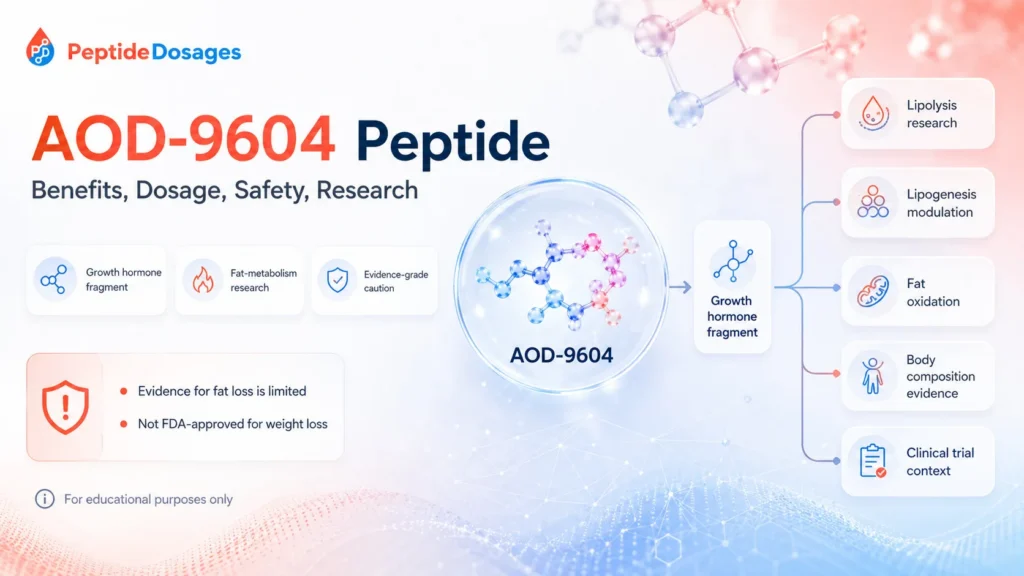
AOD-9604 peptide is a synthetic growth hormone fragment studied mainly for obesity, fat metabolism, and metabolic safety, not an FDA-approved weight-loss drug 1, 2. This educational guide explains what has been tested in humans and animals, how the mechanism is proposed to work, and why claims about fat loss and wellness need careful evidence grading. It is not personalized medical advice, and dosage or administration decisions should be discussed with a licensed clinician.
- AOD-9604, also written AOD9604 or AOD 9604, is a modified C-terminal fragment of human growth hormone with an added tyrosine residue and a 16-amino acid peptide structure [2], 3.
- It was developed for obesity and body-weight research, but a later large Phase 2B study did not show significant weight loss versus placebo at the primary endpoint [1].
- Its proposed mechanism centers on fat metabolism, lipolysis, lipogenesis, and fat oxidation, but the exact receptor-level mechanism remains uncertain 4, 5.
- Human studies have mainly evaluated oral and intravenous routes; FDA reviewers reported no human information for proposed subcutaneous or transdermal use [1], [2].
- Safety data from six randomized trials suggested good tolerability in those study settings, but FDA has also raised concerns about compounded AOD-9604, immunogenicity, peptide-related impurities, and limited route-specific safety information [2], 11.
- Study dosage information should not be converted into a personal peptide protocol; there is no approved AOD-9604 prescription label with a therapeutic dose [1], 12.
- For athletes, WADA’s 2026 Prohibited List names growth hormone fragments including AOD-9604 and hGH 176-191 in the prohibited category 15.
Related dosage pages: For vial-specific concentration, reconstitution, and measurement examples, see AOD-9604 (2 mg Vial) Dosage Protocol and AOD-9604 (5 mg Vial) Dosage Protocol. Each linked protocol remains a separate reference because vial strength changes concentration and syringe-unit calculations.
Fast Answer
AOD-9604 peptide is a synthetic growth hormone fragment studied for obesity, fat metabolism, and body composition, but it is not an FDA-approved fat loss therapy [1], [2]. Early human studies and preclinical models explored lipolysis, fat oxidation, IGF-1 effects, and safety, while a larger Phase 2B obesity study failed to show significant weight-loss benefit versus placebo [1], [5]. Safety, dosage, route, compounding quality, and regulatory status remain central concerns [11], [12].
What Is the AOD-9604 Peptide?
AOD-9604 is a synthetic peptide fragment derived from the C-terminal region of human growth hormone, often described in the literature as Tyr-hGH177-191 [2]. It was studied as an obesity drug candidate because researchers wanted to separate possible fat-metabolism effects of human growth hormone from the broader growth-promoting and glucose-related effects of full HGH therapy [2], 13.
AOD9604, AOD 9604, and Growth Hormone Fragment Naming
The names AOD-9604, AOD9604, and AOD 9604 generally refer to the same growth hormone fragment discussed in obesity and metabolism research [2], [3]. PubChem lists Aod-9604 as C78H123N23O23S2, and FDA’s compounding review discusses AOD-9604 free base and AOD-9604 acetate as related but chemically distinct bulk drug substances [1], [3].
A 16-Amino Acid Synthetic Peptide Derived From Human Growth Hormone
AOD-9604 is described as a 16-amino acid peptide with an additional tyrosine residue at the N-terminus and a sequence reported in the human trial literature as YLRIVQCRSVEGSCGF [2]. FDA reviewers also characterized AOD-9604 free base as a peptide containing 16 amino acids with a disulfide bond between two cysteine residues [1].
How It Differs From Full HGH and Full Growth Hormone Therapy
Full human growth hormone activates the growth hormone receptor and can increase IGF-1 signaling, while AOD-9604 was designed as a smaller peptide fragment intended to avoid full HGH-like growth effects [2]. Somatropin products have FDA-approved medical uses in specific growth disorders and adult growth hormone deficiency, but they also carry warnings and monitoring requirements related to glucose tolerance, neoplasia risk, fluid retention, and other effects [13]. AOD-9604 should not be treated as equivalent to approved growth hormone therapy or as a safer substitute for it.
Can AOD-9604 Peptide Support Fat Loss and Wellness?
The strongest responsible answer is cautious: AOD-9604 has been studied for weight loss and fat metabolism, but clinical support is limited and inconsistent [1], 8. Earlier summaries reported modest weight-loss signals at certain oral doses, but FDA reviewers concluded that most identified studies failed to show benefit compared with placebo and that the larger 536-person obesity study failed at the primary endpoint [1], [8].
What Readers Can Safely Take Away
AOD-9604 is best understood as an investigational metabolic peptide, not a proven fat-burning peptide for personal use [1], [2]. The evidence includes preclinical fat-metabolism findings, summarized human trials, and a failed late-stage obesity development program [1], [4]. That means “fat loss” claims should be read as research-context claims unless supported by well-designed clinical outcomes.
Why Wellness Claims Need Evidence Grading
Wellness claims often combine body composition, stubborn fat, metabolic health, energy, and anti-aging language. For AOD-9604, the published human record is too limited to support broad wellness promises, and FDA reviewers noted marketing claims across many conditions beyond the obesity research base [1]. Claims about better results, optimal results, target fat, or metabolic benefits should be separated from what human trials actually measured.
How Does AOD-9604 Peptide Work?
AOD-9604 is thought to affect lipid metabolism through pathways related to lipolysis, lipogenesis, and fat oxidation, but the exact mechanism is not settled [4], 7. The mechanism is biologically plausible because the C-terminal portion of growth hormone was investigated as a lipid-mobilizing domain, but mechanistic plausibility does not prove clinical fat loss [2], [5].
Proposed Lipolytic Effects in Fat Metabolism
In preclinical studies, AOD-9604 and related human growth hormone fragments were associated with increased lipolytic sensitivity and changes in body weight or adipose tissue metabolism in obese rodent models [5], 6. These findings support a research hypothesis about fat metabolism, not a clinical guarantee for people.
Lipolysis, Inhibiting Lipogenesis, and Fat Oxidation
Rodent studies have reported effects consistent with increased lipolysis, reduced lipogenesis, and increased fat oxidation [5], [6]. FDA’s review summarized nonclinical pharmacology as showing that AOD-9604 reduced lipogenesis and increased lipolysis and fatty acid oxidation in preclinical models [1]. Translation is uncertain because animal dosing, animal metabolism, and human obesity trials do not produce interchangeable conclusions.
IGF-1 Levels, HGH Signaling, and Receptor Uncertainty
Human safety studies monitored IGF-1 levels, glucose tolerance, and anti-AOD-9604 antibodies because AOD-9604 resembles a portion of human growth hormone [2]. In the summarized trials, researchers reported no clinically relevant IGF-1 increase and no anti-AOD-9604 antibodies in selected tested subjects [2]. Mechanistic studies also suggested AOD-9604 does not compete with full hGH for the growth hormone receptor, but receptor uncertainty remains part of the evidence limitation [2], [7].
What Is AOD-9604 Used or Studied For?
AOD-9604 was developed by Metabolic Pharmaceuticals for obesity research, and by 2004 it had moved into Phase IIa clinical development 10. FDA’s later review evaluated AOD-9604-related substances for obesity and weight-loss compounding nominations, then concluded the available information did not support effectiveness for obesity [1].
Obesity, Body Weight, and Body Composition Research
Human studies evaluated body weight, waist measures, body composition, safety, tolerability, glucose handling, and IGF-1-related concerns [1], [2]. The most important negative finding is the later 24-week OPTIONS study, which enrolled more than 500 adults with obesity and did not show a statistically significant difference in weight loss versus placebo at the 12-week primary endpoint [1].
Metabolic Health, Fat Reduction, and Weight Management Questions
Metabolic health claims should be interpreted carefully because AOD-9604 has not shown approved-drug-level evidence for obesity treatment [1], [12]. Some safety-focused studies did not show worsening of glucose tolerance or IGF-1 changes in trial contexts, but that is not the same as proving metabolic benefits, fat reduction, or effective weight loss in routine care [2].
Potential Benefits of AOD-9604 Peptide
Potential benefits should be described by evidence level. Preclinical studies support a mechanistic hypothesis around fat metabolism, early human studies reported some exploratory signals, and later evidence did not establish meaningful weight-loss efficacy [1], [5], [8].
What Does Research Suggest About Fat Loss Potential?
The most favorable human signal came from earlier Phase II work summarized in reviews, including a 12-week trial in which 1 mg/day was reported to produce greater mean weight loss than placebo [8], 9. FDA reviewers emphasized that these early data were available only in limited summaries or abstracts and that the larger 24-week trial failed to show significant benefit versus placebo [1]. The clinical evidence does not support a guaranteed fat loss claim.
Targeted Fat Metabolism Versus Target Fat and Stubborn Fat Claims
AOD-9604 is sometimes described online as targeting fat cells or stubborn fat, but published evidence does not establish selective regional fat loss in patients. Preclinical work involved adipose tissue and lipid metabolism, while human trials mainly assessed body weight and related endpoints [1], [5]. A safer framing is “targeted fat metabolism has been hypothesized,” not “AOD-9604 targets stubborn fat.”
Human Clinical Trial Evidence for AOD-9604
Human evidence exists, but much of it is summarized in secondary papers, regulatory reviews, or company-linked reports rather than full, independently replicated clinical trial publications [1], [2]. The safety paper summarized six randomized, double-blind, placebo-controlled trials involving 893 adults, while FDA reviewers noted limitations in published details and lack of a ClinicalTrials.gov listing for AOD-9604 [1], [2].
What Did Randomized Human Studies Evaluate?
The human program evaluated intravenous single-dose studies, oral single-dose or short-term studies, a 12-week oral study, and a 24-week oral study in adults, mostly with obesity [2]. The table below separates evidence level from interpretation.
| Evidence Area | What Has Been Studied | Evidence Level | What It Can and Cannot Show |
|---|---|---|---|
| Compound identity | AOD-9604 as a 16-amino acid synthetic growth hormone fragment [2], [3] | Database / clinical literature | Defines the compound; does not establish clinical benefit |
| Early IV and oral studies | Single-dose IV studies and oral dose-escalation studies with safety and metabolic monitoring [2] | Early human evidence | Useful for tolerability signals; too small for outcome claims |
| 12-week obesity study | Oral 1, 5, 10, 20, or 30 mg/day in 300 adults with obesity [1], [2] | Clinical evidence with limitations | Reported signals require caution due to limited published detail |
| 24-week OPTIONS study | Oral 0.25, 0.5, or 1 mg/day versus placebo with diet and exercise [1], [2] | Clinical evidence | Did not show significant weight-loss difference at the primary endpoint |
| Rodent metabolism | Lipolysis, lipogenesis, fat oxidation, and body-weight findings in obese rodents [5], [6], [7] | Preclinical evidence | Supports mechanism hypotheses; cannot prove human fat loss |
| Online wellness claims | Anti-aging, performance, muscle loss prevention, and broad wellness claims [1] | Unsupported / anecdotal | Not established by high-quality human evidence |
Safety and Tolerability Findings in Human Trials
In the summarized trials, AOD-9604 did not show clinically meaningful changes in IGF-1, glucose tolerance, vital signs, ECGs, or routine safety labs, and no drug-related serious adverse events were reported by the study authors [2]. However, FDA reviewers later noted serious adverse events reported in available human information, including diarrhea, chest tightness, and cancers, while also stating that the reports did not provide enough information to assess causality [1]. Both points matter: study authors reported favorable tolerability, while regulators still found safety information insufficient for compounding evaluation.
Why Clinical Trial Design Affects Interpretation
The later trial included a broader population, formal diet and exercise program, and Phase 3-like conditions; under those conditions, the AOD-9604 treatment arms did not show the required weight-loss effect [1]. This is why early weight-loss signals should not be treated as proof. Diet and exercise context, sample size, endpoint selection, duration, and publication completeness all change how the findings should be interpreted.
Preclinical Evidence on AOD-9604 and Metabolic Effects
Preclinical studies are important for mechanism, but they are not the same as clinical evidence. AOD-9604 has been studied in obese Zucker rats, obese mice, and beta-3 adrenergic receptor knockout mice to explore lipid metabolism, fat oxidation, and lipolytic response [5], [6], [7].
Animal Models of Adipose Tissue and Lipid Metabolism
In obese Zucker rats, a synthetic analogue of the lipolytic domain of human growth hormone was studied for metabolic actions, including body-weight and insulin-sensitivity-related endpoints [5]. In obese mice, human growth hormone and AOD-9604 reduced weight gain and affected fat oxidation and lipolysis, but AOD-9604 did not reproduce the full hyperglycemia-related profile associated with hGH in that model [6]. A beta-3 adrenergic receptor knockout mouse study suggested the pathway may contribute to lipolytic sensitivity without proving a direct beta-3 receptor mechanism [7].
What Can Preclinical Results Not Establish for Patients?
Animal studies cannot establish an effective weight-loss dose, safety profile, or benefit-risk balance for humans. FDA reviewers noted uncertainty in pharmacokinetic and bioavailability data and found the nonclinical studies too limited to support safety conclusions for proposed oral, subcutaneous, and transdermal uses in compounded products [1]. Preclinical findings are best used to explain why AOD-9604 was studied, not to justify unsupervised therapy.
Evidence Limitations and Unsupported AOD 9604 Claims
The evidence base has three major limitations: incomplete publication of clinical data, mixed human efficacy findings, and limited route-specific safety information [1]. Another limitation is conflict-of-interest context, because key safety publications and trial summaries are linked to the original developer or related sponsors [2], [4].
What Claims About Rapid Fat Burning Need Caution?
Claims about rapid fat burning, targeted fat, or stubborn fat reduction are stronger than the available evidence. FDA’s evaluation concluded that available data showed a lack of evidence to support AOD-9604 effectiveness for obesity for any route of administration [1]. The safest language is that AOD-9604 has been studied for fat metabolism and obesity, with no established approved therapeutic role.
Muscle Loss, Anti-Aging, and Performance Claims
Muscle loss prevention, anti-aging, performance enhancement, skin rejuvenation, or broad wellness claims are not established by high-quality AOD-9604 human trials. FDA reviewers noted marketing for conditions such as osteoarthritis, osteoporosis, diabetes, depression, anti-aging, skin care, boosting metabolism, and supporting weight loss, while their evaluation focused on the lack of evidence for obesity [1]. These broader claims should be classified as unsupported unless future trials test them directly.
Side Effects and Adverse Effects Reported With AOD-9604
AOD-9604 side-effect interpretation depends on the source. Human trial authors described the side effect profile as similar to placebo across most study contexts, but regulators raised concerns about limited safety information and potential risks from compounded peptide products [1], [2], [11].
What Potential Side Effects Have Been Reported?
In IV studies, headache was common, and one severe chest-tightness event was deemed possibly related to AOD-9604 in an obese-subject study [2]. Mild to moderate euphoria was reported in some subjects during AOD-9604 administration periods in one IV study, with no comparable reports during placebo periods [2]. In oral studies, headache and digestive-system events were reported, and one diarrhea serious adverse event was deemed possibly related to high-dose oral AOD-9604 [2].
Gastrointestinal Side Effects, Headache, and Local Reaction Concerns
The 54 mg oral dose was associated with a higher incidence of gastrointestinal adverse events in the human safety summary [2]. FDA’s compounding review also highlighted concerns about peptide aggregation, peptide-related impurities, and immunogenicity, especially for injectable routes [1], [11]. These are product-quality and route-related risks, not just compound-identity questions.
Safety Profile, Risks, and Contraindications
There is no FDA-approved AOD-9604 label that defines contraindications, warnings, approved dosage, or monitoring instructions [1], [12]. The absence of a label makes clinician review more important, not less, because contraindication and interaction decisions must be based on medical history, available studies, and regulatory status.
Why Does the Safety Profile Depend on Route and Product Quality?
Human trials mainly studied IV and oral administration, while FDA reviewers did not find human information for subcutaneous or transdermal AOD-9604 products [1], [2]. The FDA has also stated that compounded AOD-9604 may pose risks related to immunogenicity, peptide impurities, and active pharmaceutical ingredient characterization [11]. A study-grade oral tablet is not the same as an unapproved injectable compounded product.
What Contraindications Should Be Discussed With a Clinician?
Because no approved AOD-9604 prescribing label exists, contraindications are not formally defined the way they are for approved drugs. Reasonable clinician-discussion areas include pregnancy, breastfeeding, active cancer or cancer history, endocrine disorders, diabetes or impaired glucose tolerance, obesity medications, and use in competitive athletes, because these areas overlap with hormone biology, metabolic monitoring, or anti-doping rules [1], [2], [15].
Immunogenicity, Peptide Impurities, and Compounding Risks
FDA specifically identified concerns that peptide length, aggregation, impurities, formulation, concentration, and storage conditions could affect immunogenicity risk for AOD-9604-related compounded products [1], [11]. The human safety paper reported no anti-AOD-9604 antibodies in tested subjects, but that finding came from specific trial products and routes, not from all possible compounded formulations [2].
Drug Interactions and Medical Supervision Considerations
Formal AOD-9604 drug-interaction studies are not available in an approved label. Interaction concerns are therefore indirect and clinical: overlapping effects or monitoring issues may matter with diabetes medications, approved weight-loss medications, growth hormone therapy, glucocorticoids, or other hormone-related therapies [1], [13].
What Interactions May Matter With Diabetes, Weight Loss, or Hormone Therapies?
Human trials monitored glucose, insulin, oral glucose tolerance, and IGF-1 because of AOD-9604’s relationship to hGH structure [2]. Full somatropin therapy can affect insulin sensitivity and may require glucose monitoring in susceptible patients, so combining unapproved peptide therapies with endocrine or diabetes treatment should not be treated casually [13]. AOD-9604 did not show the same IGF-1 or glucose-tolerance effects in those trials, but that does not eliminate interaction concerns in real-world patients [2].
What Should Readers Discuss With a Clinician Before Therapy?
A practical clinician discussion should cover: current diagnosis, weight-management goals, medication list, diabetes risk, hormone history, pregnancy or breastfeeding status, cancer history, athlete status, product source, regulatory status, adverse events, and approved alternatives. FDA noted that multiple FDA-approved drug products exist for weight management in obesity, which matters when comparing evidence-backed options with unapproved peptides [1].
Dosage Information From Published Studies
There is no approved AOD-9604 drug label with an approved dosage for fat loss, obesity, or wellness [1], [12]. The dosage information below is study context only and should not be interpreted as personal dosing advice.
What Dosage Has Been Used in Human Research?
Published and regulatory summaries describe IV and oral study doses, not a recommended personal protocol [1], [2].
| Study Context | Route Discussed | Dose Information Reported | Interpretation |
|---|---|---|---|
| Phase I safety study | Intravenous | 25 to 400 µg/kg as single IV infusion doses [2] | Early safety context, not personal use guidance |
| Phase IIa IV study | Intravenous | 25, 50, and 100 µg/kg single IV doses [2] | Small study; not an approved dosage |
| Phase IIa oral studies | Oral capsules | 9, 27, and 54 mg single or short-term oral dosing [2] | High-dose oral testing; GI events noted at 54 mg [2] |
| 12-week Phase IIb study | Oral capsules | 1, 5, 10, 20, or 30 mg/day [1], [2] | Limited published detail; exploratory efficacy signals |
| 24-week OPTIONS study | Oral tablets | 0.25, 0.5, or 1 mg/day versus placebo [1], [2] | Failed to show significant weight loss at the primary endpoint |
How Study Dosage Differs From Personal Peptide Protocols
A study dose is tied to inclusion criteria, product manufacturing, route, monitoring, endpoints, and ethics review. It is not the same as a clinic protocol, online peptide protocol, cycle, stack, or self-directed dosage plan. FDA’s review also found limited pharmacokinetic and bioavailability information, which further limits the translation of study doses into routine decisions [1].
Administration Routes Discussed in the Literature
Administration route is one of the biggest safety and evidence issues for AOD-9604. Human studies discussed in the safety paper used IV infusion and oral capsules or tablets, while the FDA review noted nominated compounded forms including subcutaneous injection, oral capsules, and topical/transdermal cream [1], [2].
Oral, Intravenous, and Subcutaneous Administration Context
Oral and IV routes have human-study context, but subcutaneous and transdermal routes do not have the same published human evidence base. FDA reviewers stated they did not find information on products containing AOD-9604 free base or acetate administered by the subcutaneous or transdermal routes in humans [1]. This article does not provide injection, mixing, reconstitution, or self-administration instructions.
How Does Route of Administration Change Safety Interpretation?
Route affects absorption, exposure, immunogenicity risk, product-quality requirements, and adverse-event interpretation. FDA highlighted injectable-route concerns related to immunogenicity and peptide aggregation, and also noted limited route-specific safety information for AOD-9604 [1], [11]. An oral trial finding cannot be assumed to apply to a subcutaneous compounded product.
Regulatory Status of AOD-9604 Peptide
Regulatory status is central to interpreting AOD-9604. FDA’s PCAC materials state that AOD-9604 free base and AOD-9604 acetate were evaluated for compounding, that neither was a component of an FDA-approved drug, and that the criteria weighed against placing them on the 503A Bulks List [1]. FDA’s current compounding safety page lists AOD-9604 among nominated-but-withdrawn substances and states that compounded drugs containing AOD-9604 may pose significant safety risks [11].
Is AOD-9604 Peptide FDA-Approved?
AOD-9604 peptide does not have an FDA-approved therapeutic indication or FDA-approved prescribing label for fat loss, obesity, or wellness [1], [12]. The FDA Orange Book identifies drug products approved on the basis of safety and effectiveness under the Federal Food, Drug, and Cosmetic Act, while AOD-9604 appears in FDA compounding-risk discussions rather than as an approved drug product [11], [12].
How Does GRAS Food-Use Status Differ From Prescription Drug Approval?
Some AOD-9604 publications report a GRAS conclusion for intended food, drink, or dietary supplement uses, and FDA’s GRAS Notice Inventory explains that GRAS notices relate to food ingredient safety under specified conditions [2], [4], 14. GRAS concepts are not the same as FDA approval of a prescription drug for obesity, fat loss, or any therapeutic outcome [12]. Treating GRAS language as “FDA-approved peptide therapy” would be misleading.
What Do Compounded Peptides and Legal Status Mean for Quality?
Compounding status matters because compounded products do not go through the same premarket approval process as FDA-approved drugs. FDA has specifically cited AOD-9604-related concerns about immunogenicity, peptide-related impurities, API characterization, limited safety information, and possible serious adverse events with unclear causality [1], [11]. Legal status can also differ by country, use, route, and sports-governing body rules.
How AOD-9604 Compares With Related Peptide Therapies
AOD-9604 belongs in the growth hormone fragment literature, not in the same evidence category as approved obesity medications. Comparisons should use mechanism, evidence level, regulatory status, and safety data rather than “best peptide” claims.
How Does AOD-9604 Compare With HGH, GH Secretagogues, and GLP-1 Medications?
Full HGH products such as somatropin are approved for specific growth-related indications and adult growth hormone deficiency, but they carry formal labeling, contraindications, warnings, and clinician-supervised dosing requirements [13]. GH secretagogues act upstream on the growth hormone axis and are mechanistically different from a growth hormone fragment. GLP-1 and GLP-1/GIP medications have FDA-approved obesity indications in specific products, while FDA’s AOD-9604 review found lack of evidence supporting AOD-9604 for obesity and noted available approved alternatives [1].
For athletes, AOD-9604 also has a different risk category: WADA’s 2026 Prohibited List names growth hormone fragments including AOD-9604, and drug-testing literature has described detection and metabolism methods for AOD-9604 [15], 16. The safest way to interpret AOD-9604 peptide is through evidence quality, regulatory status, route-specific safety, and clinician-guided decision-making—not marketing claims or personal protocols.
Researchers Cited in This Article
The researchers below authored or co-authored publications cited in this article. Listing them here identifies sources; it does not mean they wrote, independently reviewed, sponsored, or endorsed this PeptideDosages.com article. The site author is identified in the article byline.
Frank M. Ng
Researcher profile: ResearchGate Author Record
Frank M. Ng is recognized for published work on growth-hormone-derived peptide fragments and lipid-metabolism models that formed part of the scientific background for AOD-9604. His publications are relevant to the article’s discussion of preclinical research, mechanism of action, and the distinction between model-specific metabolic findings and clinical evidence. The papers below helped frame how researchers initially evaluated synthetic C-terminal human growth hormone fragments in obese rodent models, adipose tissue assays, and metabolic endpoints. This work provides useful context for understanding why AOD-9604 entered clinical development while also recognizing that preclinical findings do not establish therapeutic effectiveness in humans.
Selected publications:
- Metabolic Studies of a Synthetic Lipolytic Domain (AOD9604) of Human Growth Hormone — Hormone Research, 2000. PMID: 11146367. DOI: 10.1159/000053183.
- Effects of oral administration of a synthetic fragment of human growth hormone on lipid metabolism — American Journal of Physiology-Endocrinology and Metabolism, 2000. PMID: 10950816. DOI: 10.1152/ajpendo.2000.279.3.E501.
Mark Heffernan
Researcher profile: ResearchGate Author Record
Mark Heffernan is recognized for first-author publications examining C-terminal hGH fragments in animal and tissue models relevant to AOD-9604 pharmacology. His work is central to the article’s mechanism discussion, including receptor-related questions, fat oxidation, and the need to separate preclinical outcomes from human clinical evidence. The selected publications helped inform the article’s cautious treatment of mechanistic plausibility, route and model limitations, and why rodent or in vitro findings cannot be converted into personal-use claims. They are also relevant to the broader published literature on AOD-9604 and related synthetic growth hormone fragments.
Selected publications:
- Increase of fat oxidation and weight loss in obese mice caused by chronic treatment with human growth hormone or a modified C-terminal fragment — International Journal of Obesity and Related Metabolic Disorders, 2001. PMID: 11673763. DOI: 10.1038/sj.ijo.0801740.
- The effects of human GH and its lipolytic fragment (AOD9604) on lipid metabolism following chronic treatment in obese mice and beta(3)-AR knock-out mice — Endocrinology, 2001. PMID: 11713213. DOI: 10.1210/endo.142.12.8522.
Related dosage protocols and research
Use the available links to move between research context, dosage pages or comparisons, and supporting guides. When vial-size variants exist, they remain separate because concentration and syringe-unit calculations change with vial strength. Comparisons do not imply that different compounds are interchangeable.
Matching dosage protocols
Related protocols and comparisons
Further research context
REFERENCES
- U.S. Food and Drug Administration. December 4, 2024 Pharmacy Compounding Advisory Committee Meeting: AOD-9604 Evaluation. FDA. 2024.
- Stier H, Vos E, Kenley D. Safety and Tolerability of the Hexadecapeptide AOD9604 in Humans. Journal of Endocrinology and Metabolism. 2013;3(1-2):7-15. DOI: 10.4021/jem157w.
- National Center for Biotechnology Information. Aod-9604 | PubChem Compound CID 71300630. PubChem. Accessed 2026.
- Moré MI, Kenley D. Safety and Metabolism of AOD9604, a Novel Nutraceutical Ingredient for Improved Metabolic Health. Journal of Endocrinology and Metabolism. 2014.
- Ng FM, Sun J, Sharma L, Libinaka R, Jiang WJ, Gianello R. Metabolic studies of a synthetic lipolytic domain (AOD9604) of human growth hormone. Hormone Research. 2000;53(6):274-278. PMID: 11146367.
- Heffernan MA, et al. Increase of fat oxidation and weight loss in obese mice caused by chronic treatment with human growth hormone or a modified C-terminal fragment. International Journal of Obesity and Related Metabolic Disorders. 2001. PMID: 11673763.
- Heffernan M, Summers RJ, Thorburn A, Ogru E, Gianello R. The effects of human GH and its lipolytic fragment (AOD9604) on lipid metabolism following chronic treatment in obese mice and beta(3)-AR knock-out mice. Endocrinology. 2001;142(12):5182-5189. PMID: 11713213.
- Misra M. Obesity pharmacotherapy: current perspectives and future directions. Current Cardiology Reviews. 2013. PMID: 23092275.
- Valentino MA, Lin JE, Waldman SA. Central and Peripheral Molecular Targets for Antiobesity Pharmacotherapy. Clinical Pharmacology & Therapeutics. 2010;87(6):652-662. DOI: 10.1038/clpt.2010.57.
- Wilding J. AOD-9604 Metabolic. Current Opinion in Investigational Drugs. 2004. PMID: 15134286.
- U.S. Food and Drug Administration. Certain Bulk Drug Substances for Use in Compounding that May Present Significant Safety Risks. FDA. Content current as of 2026.
- U.S. Food and Drug Administration. Approved Drug Products with Therapeutic Equivalence Evaluations | Orange Book. FDA. Content current as of 2026.
- U.S. Food and Drug Administration. GENOTROPIN® (somatropin) Prescribing Information. Official prescribing information.
- U.S. Food and Drug Administration. GRAS Notices. FDA GRAS Notice Inventory. Content current as of 2026.
- World Anti-Doping Agency. The 2026 Prohibited List: World Anti-Doping Code. WADA. 2026.
- Cox HD, Smeal SJ, Hughes CM, Cox JE, Eichner D. Detection and in vitro metabolism of AOD9604. Drug Testing and Analysis. 2015. PMID: 25208511.