
Epithalon, also spelled Epitalon, is an experimental peptide studied for telomere biology, aging and circadian rhythms. The most convincing findings concern changes in cells. They do not establish that the peptide extends human life, reverses aging or treats insomnia.
The studies don’t all test the same question or preparation. Some examine isolated human cells, others mice, and one small human study measured melatonin-related biomarkers rather than improved sleep. Calling all of that “anti-aging” hides those differences.
What is Epithalon peptide?
Epithalon is a synthetic tetrapeptide: four amino acids arranged as Ala–Glu–Asp–Gly, abbreviated AEDG. It is associated with research into pineal-gland peptides. Epithalamin, by contrast, is a mixture extracted from the pineal gland, not simply another spelling for the same four-amino-acid molecule. A paper examining one preparation cannot automatically validate the other. [1]
That distinction helps when reading longevity claims. Before looking at a result, check whether the researchers used Epithalon, Epithalamin or a combination of preparations.
Epithalon benefits: a quick evidence map
| Claim or research area | What the studies address | What remains unproven |
|---|---|---|
| Longer telomeres | Telomerase activity and telomere length in cultured cells. [2] [3] | A resulting improvement in human health or lifespan. |
| Longevity | Survival measures in selected mouse experiments. [4] | A reliable human life-extension effect. |
| Sleep and body-clock support | Melatonin-related biomarkers and circadian gene expression. [5] | Effective treatment of insomnia or better day-to-day sleep. |
| Safety with repeated use | Limited clinical information and regulatory safety concerns. [6] | A well-characterized long-term risk profile. |
How Epithalon affects telomeres and telomerase
Telomeres are protective structures at chromosome ends. Telomerase is an enzyme involved in maintaining them. These are important parts of cell biology, but “longer” is not a universal synonym for “healthier.”
The original cell-culture finding
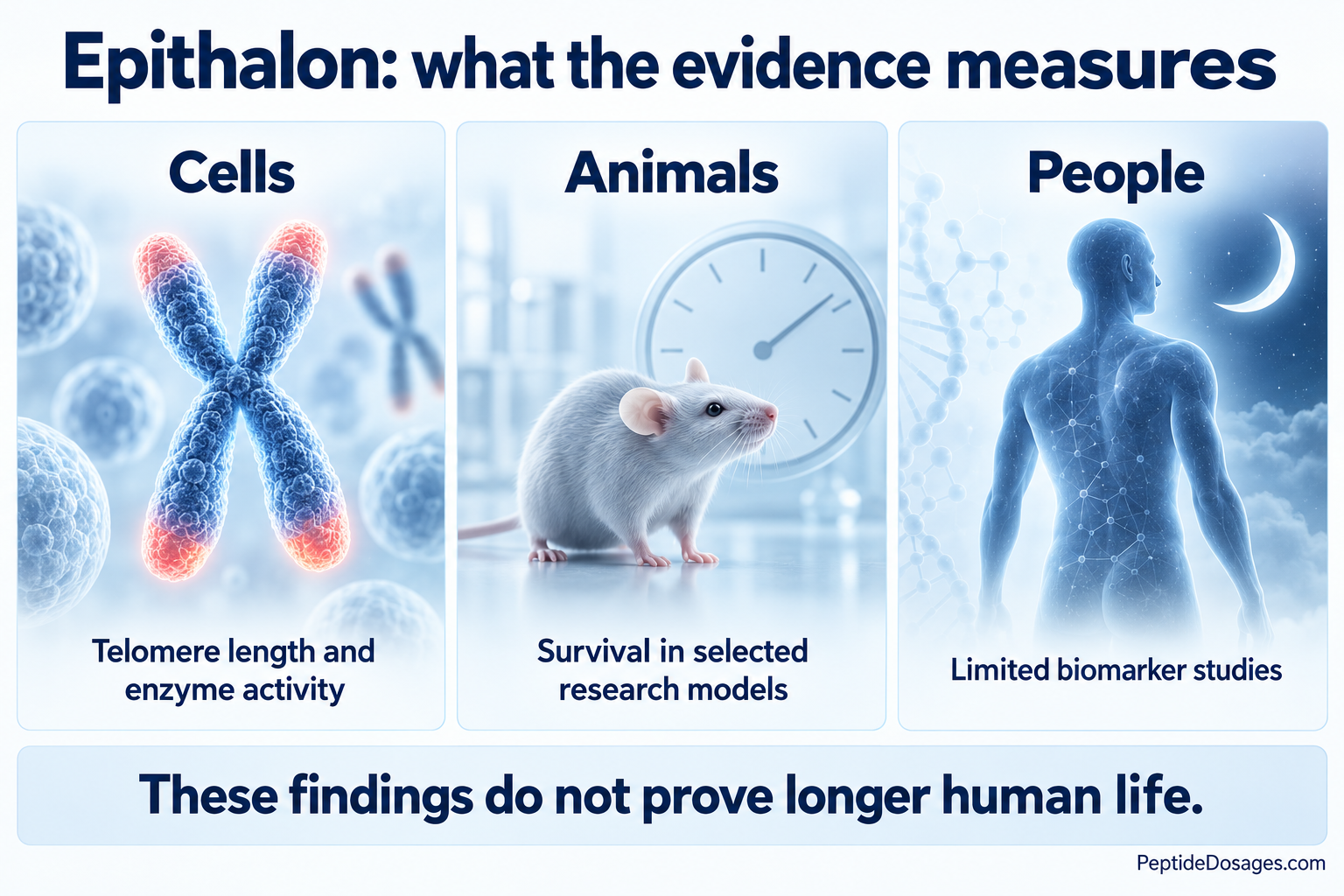
A 2003 study added Epithalon to human fetal fibroblast cultures that lacked measurable telomerase activity. Researchers reported expression of the enzyme’s catalytic component, increased activity and telomere elongation. It was an experiment on cells outside the body, not a trial showing rejuvenation in adults. [2]
The distinction is easy to miss in a headline containing the words “human cells.” It tells you where the cells came from, not that volunteers received the peptide or experienced a clinical benefit.
What a newer study adds
A 2025 study examined normal human cell lines and breast-cancer cell lines. It reported telomere extension associated with telomerase upregulation in normal cells, while cancer cells showed changes involving alternative lengthening of telomeres, or ALT. The journal subsequently published a correction replacing figures; the corrected record is linked in the references. [3]
This adds mechanistic evidence, not a human longevity result. It also gives researchers a reason to examine safety carefully. Findings in cancer cells do not prove that Epithalon causes cancer in people, but they cannot be presented as reassurance that long-term use is harmless.
Does Epithalon extend lifespan?
Animal findings need to be read by endpoint. In a 2003 study of female Swiss-derived SHR mice, Epitalon did not change mean lifespan. The authors nevertheless reported improvements in other survival measures, including survival among the longest-lived animals. Describing that as a straightforward increase in average lifespan would misrepresent the experiment. [4]
Other work in senescence-accelerated mice also found effects that depended on the strain and survival measure. [7] A promising outcome in a particular mouse model does not establish how an otherwise healthy adult would respond, or whether any benefit would outweigh long-term risk.
A meaningful human longevity study would need years of follow-up and outcomes such as disability, disease or survival. A change in a laboratory marker alone cannot answer those questions.
Epithalon for sleep: biomarkers are not sleep outcomes
The human circadian research is worth acknowledging. An Ivko and colleagues study reported changes in a urinary melatonin metabolite and expression of clock-related genes. The work involved middle-aged women, primarily night-shift workers. It supports further research into circadian biology, not a claim that everyone taking Epithalon will sleep better. [5]
FDA’s 2026 review describes 75 participants overall, with 40 women who had reduced melatonin-metabolite levels divided between sublingual peptide and placebo groups. Twenty received the peptide for 20 days. The study did not evaluate sleep outcomes, and FDA highlighted the short duration, small sample and unclear blinding. [6]
An earlier publication also reported melatonin changes in older people and monkeys, but its abstract does not supply enough clinical detail to establish an insomnia treatment. [1]
If persistent sleep trouble is the issue, a clinical assessment can identify contributing conditions and treatments with clearer evidence. Cognitive behavioral therapy for insomnia, or CBT-I, is commonly the first treatment recommended for long-term insomnia. [8]
Epithalon side effects and safety
There is no dependable side-effect frequency to quote from the evidence summarized here. The FDA review found inadequate clinical safety information, including no reported safety data in the small sublingual study. A statement that an early report observed no side effects is not equivalent to a rigorous safety assessment. [6]
FDA also identifies potential immune-reaction risks related to peptide aggregation and impurities in compounded Epitalon products. [9] These concerns involve the finished preparation as well as the proposed active ingredient. A purity claim does not by itself establish sterility, clinical effectiveness or safety.
Medication interactions, pregnancy and breastfeeding safety, and the effects of repeated long-term exposure remain insufficiently characterized for routine self-treatment. People with a cancer history should discuss any telomere-directed experimental product with their treating specialist rather than assuming an “anti-aging” label implies protection.
Dosage, cycles and routes of administration
The research does not establish a standard anti-aging dose or a best cycle to recommend. Cell-culture concentrations, animal doses and short human biomarker studies answer different questions. Changing from a sublingual spray to an injection also changes the exposure; it is not a simple numerical substitution.
Readers comparing vial amounts can consult the separate Epitalon/Epithalon 10 mg reference chart. It provides measurement context, not proof of an effective longevity regimen.
Be cautious with statements that a particular number of days “resets” the body clock or that a yearly cycle has been shown to add years of life. Neither conclusion follows from the evidence described above.
Is Epithalon FDA approved?
FDA’s July 2026 evaluation states that neither Epitalon free base nor Epitalon acetate is a component of an FDA-approved drug. A compounding review is a separate process from drug approval; it does not establish an approved anti-aging indication. [6] More generally, compounded medicines are not FDA approved. [10]
Frequently asked questions
Are Epitalon and Epithalon the same?
They are commonly used spellings for the AEDG tetrapeptide. Epithalamin is the different, broader pineal peptide preparation.
Does Epithalon make you look younger?
The cited telomere and circadian studies do not establish visible skin rejuvenation. A cellular-aging mechanism is not evidence for a predictable cosmetic result.
How quickly does it work?
There is no validated time-to-benefit for longevity or insomnia. The duration of an experiment tells you how long researchers observed a particular endpoint, not when a reader should expect to feel a change.
What is the practical takeaway?
Epithalon is an interesting research peptide, particularly for telomere and circadian biology. Its biological activity deserves careful study. Claims of proven human life extension, reliable sleep improvement or established long-term safety go beyond the available evidence.
References
- Korkushko OV, et al. Normalizing effect of the pineal gland peptides on the daily melatonin rhythm in old monkeys and elderly people. Adv Gerontol. 2007. PubMed.
- Khavinson VK, et al. Epithalon peptide induces telomerase activity and telomere elongation in human somatic cells. Bull Exp Biol Med. 2003. PubMed.
- Al-Dulaimi S, et al. Epitalon increases telomere length in human cell lines through telomerase upregulation or ALT activity. Biogerontology. 2025. Full study; published figure correction.
- Anisimov VN, et al. Effect of Epitalon on biomarkers of aging, life span and spontaneous tumor incidence in female Swiss-derived SHR mice. Biogerontology. 2003. PubMed.
- Ivko OM, et al. AEDG peptide regulates human circadian rhythms genes expression during pineal gland accelerated aging. Adv Gerontol. 2020; English-language version 2021. PubMed; English publication.
- U.S. Food and Drug Administration. Epitalon-related bulk drug substances: staff evaluation, July 24, 2026. FDA presentation, pages 70–103.
- Anisimov VN, et al. Effect of epitalon and melatonin on life span and spontaneous carcinogenesis in senescence accelerated mice. Vopr Onkol. 2005. PubMed.
- National Heart, Lung, and Blood Institute. Insomnia: Treatment. NHLBI.
- U.S. Food and Drug Administration. Certain bulk drug substances for use in compounding that may present significant safety risks. Epitalon entry. FDA.
- U.S. Food and Drug Administration. Human Drug Compounding. FDA.