

IGF-1 DES is a shortened form of insulin-like growth factor 1, usually written des(1-3)IGF-I in research papers. It interacts differently with IGF-binding proteins and can be more potent than native IGF-1 in some laboratory experiments. That does not establish a safe bodybuilding treatment or prove targeted muscle growth in people.1,2
A cell experiment, an animal growth study and a human treatment result answer different questions. Keep the experimental setting attached to each IGF-1 DES finding.
What is IGF-1 DES?
The “des(1-3)” name means the first three amino acids, Gly-Pro-Glu, are absent from the beginning of the IGF-1 molecule. This truncated form has been isolated from biological tissues, including human brain tissue.1 Finding a molecule in tissue is not the same as proving that an injected product is safe or useful.
IGF-1 DES is also different from the separate three-amino-acid fragment Gly-Pro-Glu. One is the larger molecule remaining after truncation; the other is the removed fragment. Similar names can lead to studies being assigned to the wrong substance.
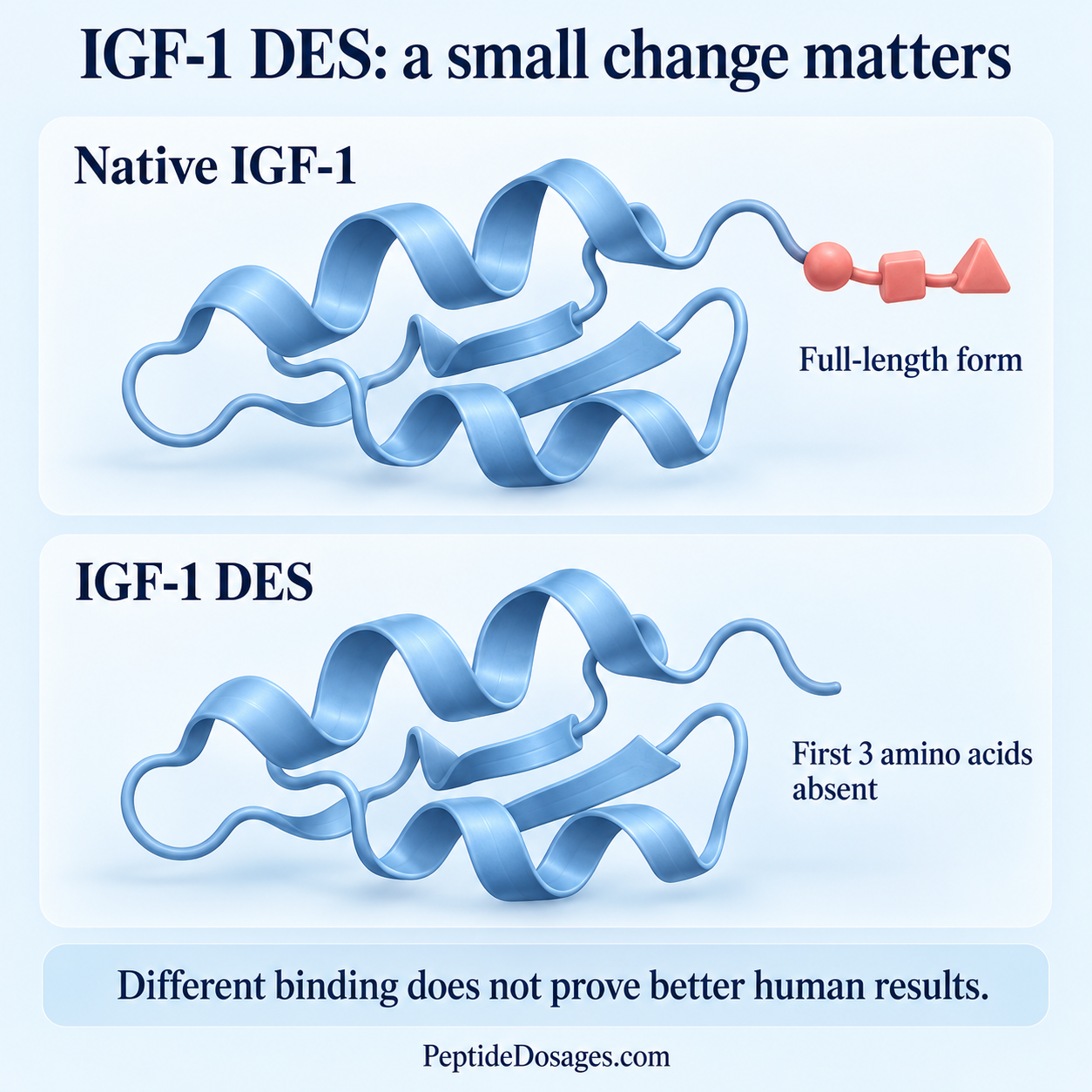
How does IGF-1 DES work?
IGF-binding proteins help determine how IGF molecules behave around cells. DES has substantially less affinity for these binding proteins while retaining activity at the IGF-1 receptor. In a 1995 rat muscle-cell experiment, that difference was associated with stronger stimulation of muscle-cell differentiation than native IGF-1 under the tested conditions.2
This explains why researchers use DES to investigate growth-factor signaling. It does not mean the molecule selectively finds an injured muscle or produces more muscle without other effects.
A frequently repeated “10 times stronger” claim comes from laboratory potency comparisons summarized in a 1996 review.1 Potency describes how much substance produces a particular response in a particular test. It is not a multiplier for human strength gains, recovery speed or safety.
Muscle growth and recovery: what was tested?
In a 1992 study, researchers examined IGF-1 and variants in rats made catabolic with dexamethasone, meaning the experimental treatment promoted tissue breakdown. IGF peptides improved measures including nitrogen retention and protein metabolism. DES and LR3 were approximately 2.5 times as potent as native IGF-1 in that setting.3
Several details matter: these were rats in a drug-induced catabolic state, treatment used implanted delivery pumps, and effects were not limited to skeletal muscle. Gut growth was also prominent. The study does not validate a pre-workout injection schedule or a promise of localized hypertrophy in a healthy person.
| Common claim | What the evidence actually supports |
|---|---|
| Builds muscle | Muscle-cell and catabolic-animal findings, not established bodybuilding outcomes. |
| Targets one muscle group | The cited studies do not demonstrate dependable site-specific growth in people. |
| Produces much faster recovery | No validated human recovery timeline follows from these experiments. |
| More potent means better | Potency depends on the measured outcome and can also apply to unwanted effects. |
IGF-1 DES vs. IGF-1 LR3
DES and LR3 are different IGF-1 variants. DES is shortened at the beginning of the molecule. LR3 has an extension and an arginine substitution at position 3. Both have reduced binding to IGF-binding proteins in the research discussed here.3
That is not enough to rank one as better for a person’s goals. A comparison needs the same route, population, outcome and formulation. Online summaries often assign DES a “local” role and LR3 a “systemic” role, but those labels do not establish a reliable human treatment distinction.
The site’s separate IGF-1 LR3 research reference concerns a different material. Its vial calculations should not be transferred to DES. Likewise, MGF and PEG-MGF have their own identity and evidence questions.
Half-life: short circulation does not mean short risk
A 1991 tracer study found faster removal of DES from rat blood than native IGF-1, along with a larger distribution volume and different tissue distribution.4 This supports a pharmacokinetic difference in that experiment, not a precise human half-life for an online research product.
There is also a useful counterpoint. In experiments with pigs and marmoset monkeys, IGF variants including DES produced more sustained blood-glucose suppression than native IGF-1 despite their faster clearance. DES was particularly potent for glucose lowering among the variants tested.5
The practical lesson is simple: leaving the bloodstream faster does not guarantee that a biological effect ends at the same moment. A “short half-life” claim should not be used as a safety shortcut.
IGF-1 DES safety and potential side effects
Low blood glucose is a serious concern. The animal experiments demonstrate insulin-like glucose-lowering effects, not just theoretical growth signaling.5 Combining experimental growth-factor products with insulin or other glucose-lowering treatments adds uncertainty rather than establishing a safe stack.
There are no dependable human side-effect rates for DES in the evidence reviewed here. Long-term effects, interactions, formulation quality and the consequences of growth-factor signaling outside the intended tissue remain important unanswered questions.
Approved recombinant IGF-1, mecasermin, provides relevant context but is not DES. Its U.S. prescribing information warns about severe hypoglycemia, allergic reactions and intracranial hypertension, among other risks. It also includes malignancy-related contraindications and warnings.6 These establish that IGF-related treatment is not risk-free; they do not provide DES-specific incidence rates or prove identical risks for every analogue.
Severe confusion, a seizure or loss of consciousness after any suspected glucose-lowering exposure needs emergency medical help. Do not assume that a rapidly cleared peptide makes those symptoms harmless.
Is IGF-1 DES the approved IGF-1 medicine?
No. Increlex contains mecasermin, recombinant human IGF-1, and has specific pediatric growth indications. That product’s approval and prescribing instructions do not extend to DES or LR3.6 A research vial bearing an IGF-related name is not interchangeable with an approved medicine.
IGF-1 DES dosage and bodybuilding claims
The sources reviewed here do not establish a validated human DES dose for muscle gain, injury recovery or anti-aging. Animal amounts, cell-culture concentrations and forum schedules answer different questions and should not be combined into a personal-use recommendation.
Be particularly cautious about instructions based on injecting a “target muscle.” A local injection does not prove that effects stay local, and the cited tissue-distribution research does not support that guarantee.4 Persistent weakness, muscle loss or recovery problems deserve assessment of the cause.
Is it prohibited in sport?
WADA prohibits IGF-1 and its analogues at all times under its growth-factor category.7 A research-use label does not create an exemption. Athletes should consult their anti-doping organization about applicable rules.
Frequently asked questions
Is IGF-1 DES a growth-hormone peptide?
It is an IGF-1 variant, not growth hormone and not a peptide whose primary purpose is to stimulate growth-hormone release. Related signaling pathways do not make the compounds identical.
Does it create new muscle fibers?
The laboratory findings do not establish clinically meaningful creation of new muscle fibers in people using DES. Cell proliferation, cell differentiation and measurable human muscle growth are different outcomes.
What is the bottom line?
IGF-1 DES is a useful research molecule with meaningful biological activity. Claims of easy, targeted muscle growth run ahead of the human evidence, while glucose-lowering findings argue against treating it as a low-risk shortcut. Discuss muscle or hormone concerns with a qualified clinician.
References
- Ballard FJ, et al. Des(1-3)IGF-I: a truncated form of insulin-like growth factor-I. International Journal of Biochemistry & Cell Biology. 1996.
- Silverman LA, et al. Skeletal muscle cell-derived IGF-binding proteins inhibit IGF-I-induced myogenesis in rat L6E9 cells. Endocrinology. 1995.
- Tomas FM, et al. IGF-I and especially IGF-I variants are anabolic in dexamethasone-treated rats. Biochemical Journal. 1992.
- Ballard FJ, et al. Plasma clearance and tissue distribution of labelled IGF-I, IGF-II and des(1-3)IGF-I in rats. Journal of Endocrinology. 1991.
- Tomas FM, et al. IGF-I variants show more potent and prolonged hypoglycaemic action than native IGF-I in pigs and marmoset monkeys. Journal of Endocrinology. 1997.
- DailyMed. Increlex (mecasermin) prescribing information. This label concerns mecasermin, not IGF-1 DES.
- World Anti-Doping Agency. The Prohibited List. Section S2.3; checked October 2026.