
PE-22-28 is an experimental seven-amino-acid peptide studied as a blocker of the TREK-1 potassium channel. It comes from work on spadin, a peptide linked to the sortilin protein. Its appeal is a different approach to antidepressant drug research, not established proof that it improves mood in people. [1]
PE-22-28 has antidepressant-like findings in animal tests. The research discussed here doesn’t establish it as an effective depression treatment.
What is PE-22-28 peptide?
PE-22-28 was developed while researchers investigated shorter versions of spadin. The number identifies a fragment in the sequence, not a dose, cycle length or GLP-1 medicine. Chemically different spadin analogs also need to be evaluated separately. [1]
Spadin itself comes from the propeptide released during maturation of sortilin, also called NTSR3. An influential 2010 mouse study connected spadin’s effects to TREK-1 inhibition and helped establish the research direction. That study examined spadin, not a marketed PE-22-28 product. [2]
Mechanism of action: why TREK-1 matters
TREK-1 is a potassium channel involved in the electrical behavior of nerve cells. Targeting an ion channel is a different starting point from blocking serotonin reuptake, the familiar mechanism of many antidepressants. The original spadin experiments included changes in neuronal activity and antidepressant-like behavior in mice. [2]
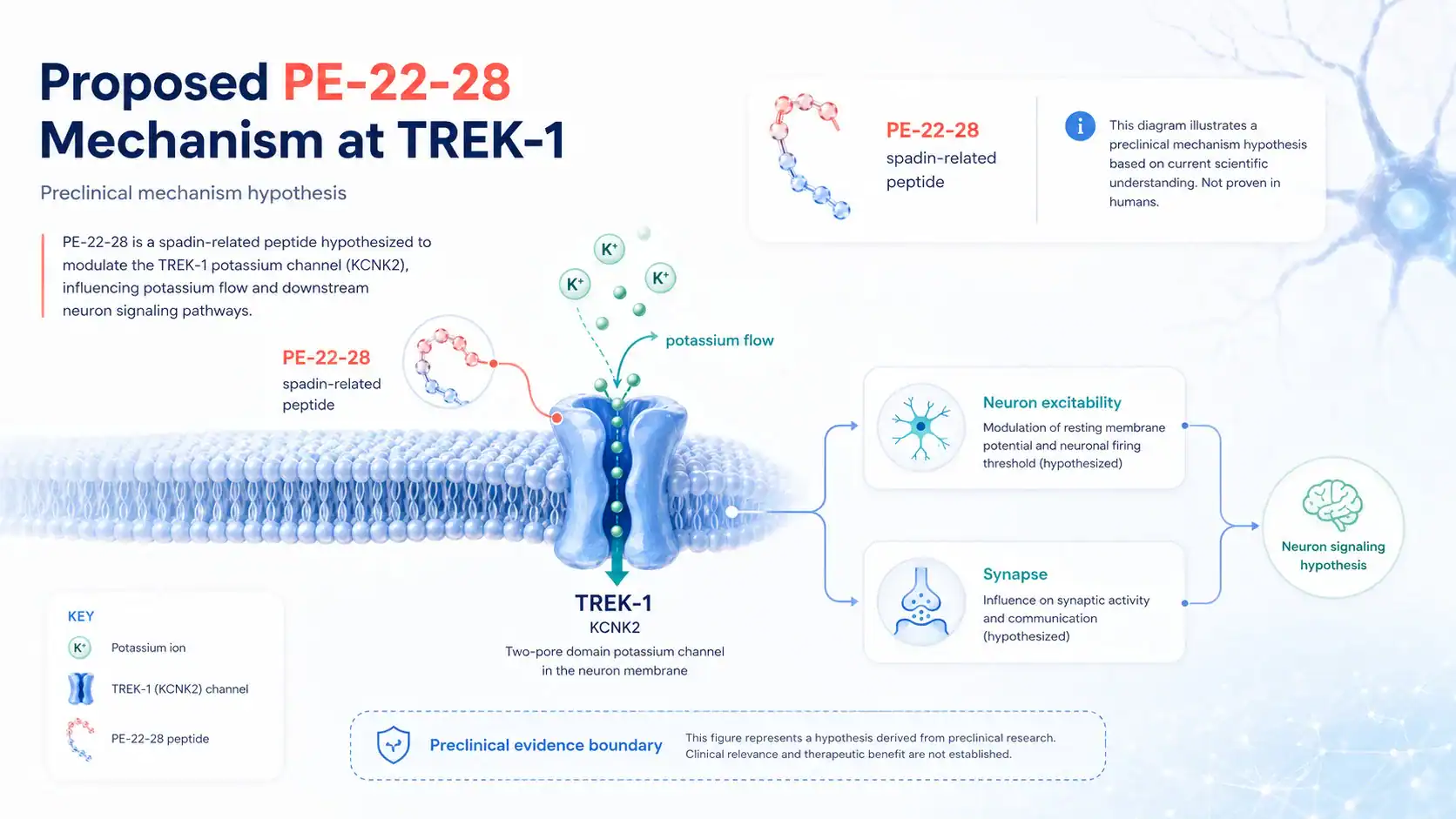
The mechanism is still being investigated. A 2020 study of spadin in a different experimental system found selective antagonism of arachidonic-acid activation of TREK-1, rather than uniform blockade under every tested condition. This does not directly test PE-22-28, but it cautions against describing all spadin-related peptides as having one completely settled action in every setting. [3]
What the PE-22-28 research found
A 2017 study reported strong TREK-1 inhibition in laboratory assays. PE-22-28 and related analogs also produced antidepressant-like responses in mouse behavioral tests. Additional experiments examined neurogenesis and the synaptic marker PSD-95. The authors reported longer-lasting activity than spadin for the tested analogs. These were cellular and animal findings, not clinical trial outcomes. [1]
It is reasonable to call that promising drug-discovery work. It is not reasonable to translate a change in mouse behavior into a promised improvement in a reader’s depression, memory or concentration.
| Phrase you may encounter | What it does and does not mean |
|---|---|
| Potent TREK-1 inhibitor | Activity at a biological target does not establish an effective or safe human dose. |
| Fast antidepressant-like action | A response in a short animal experiment is not a validated human treatment timeline. |
| Neurogenesis | A cellular research endpoint is not proof of better cognition or recovery from brain disease. |
| Longer-lasting analog | Results for a particular molecular variant do not establish the behavior of every product using a similar name. |
Potential benefits versus demonstrated treatment
The main research interest is depression-related biology. Claims about cognitive enhancement, anxiety relief, brain repair or replacing an antidepressant require their own evidence. A peptide can engage an interesting target without becoming a useful medicine.
Some supporting work is about other members of the spadin family. For example, researchers studied retroinverso spadin analogs to improve target affinity and duration of action. Those results help explain why the field explores modified peptides, but cannot simply be assigned to PE-22-28. [4]
For a practical treatment claim, the missing information matters: who benefits, which symptoms change, how large the benefit is, how it compares with existing care, and what harms emerge. The papers cited here do not provide those answers for patients taking PE-22-28.
Side effects, interactions and safety gaps
Human side effects and medication interactions are not adequately characterized in the evidence reviewed here. It would be misleading to give a reassuring percentage for nausea, fatigue or other reactions without an appropriate clinical dataset.
An earlier rodent study found that spadin did not interfere with several other TREK-1-related functions in the tested models. That is a limited preclinical finding about a related peptide, not evidence that PE-22-28 has no side effects in people. [5]
There is also no established basis here for combining PE-22-28 with antidepressants, mood stabilizers or other experimental peptides. A different proposed mechanism does not rule out an interaction. Bring the exact product and medication list to a qualified clinician rather than assuming a research compound is compatible with an existing prescription.
Dosage and how quickly it works
The reviewed research does not establish a routine clinical dose, preferred administration route or dependable onset of benefit. Experimental doses used in mice cannot be copied into a personal protocol, and online reports cannot define a safe schedule.
The separate PE-22-28 10 mg reference chart provides vial-specific measurement context. That does not supply the missing clinical evidence for treating depression.
If you are looking for help with depression
Curiosity about a new mechanism is understandable, especially when previous treatment has been frustrating. Depression is treatable, and there are evidence-based options beyond simply continuing an approach that has not helped. Treatment may include psychotherapy, medication or a combination, selected with a mental health professional. [6]
Do not stop a prescribed antidepressant or change its dose on your own. Abrupt changes can cause problems, and a clinician can help plan a safer adjustment. [7]
Frequently asked questions
Is PE-22-28 the same as spadin?
No. They are related peptides, but PE-22-28 is a shorter molecule. Evidence should be matched to the exact compound used in each experiment.
Is it proven to work within a few days?
Not in people. A short animal-testing period does not establish when a person with depression would respond.
Is PE-22-28 a nootropic?
It may be discussed that way online, but the studies summarized here do not establish reliable memory, focus or learning benefits in people.
What is the bottom line?
PE-22-28 is a research lead with an interesting TREK-1 mechanism. It should not be described as a clinically validated mood treatment or a safe substitute for established care.
Related PE-22-28 dosage protocols
Continue with the vial-strength-specific research protocol that matches the material being evaluated. Each page keeps its own concentration, reconstitution, and syringe-unit calculations.
Practical measurement and handling guides
References
- Djillani A, et al. Shortened Spadin Analogs Display Better TREK-1 Inhibition, In Vivo Stability and Antidepressant Activity. Front Pharmacol. 2017. PubMed.
- Mazella J, et al. Spadin, a sortilin-derived peptide, targeting rodent TREK-1 channels: a new concept in the antidepressant drug design. PLoS Biol. 2010. PubMed.
- Ma R, Lewis A. Spadin Selectively Antagonizes Arachidonic Acid Activation of TREK-1 Channels. Front Pharmacol. 2020. PubMed.
- Veyssiere J, et al. Retroinverso analogs of spadin display increased antidepressant effects. Psychopharmacology. 2015. PubMed.
- Moha ou Maati H, et al. Spadin as a new antidepressant: absence of TREK-1-related side effects. Neuropharmacology. 2012. PubMed.
- National Institute of Mental Health. Depression. NIMH.
- National Institute of Mental Health. Mental Health Medications. NIMH.