

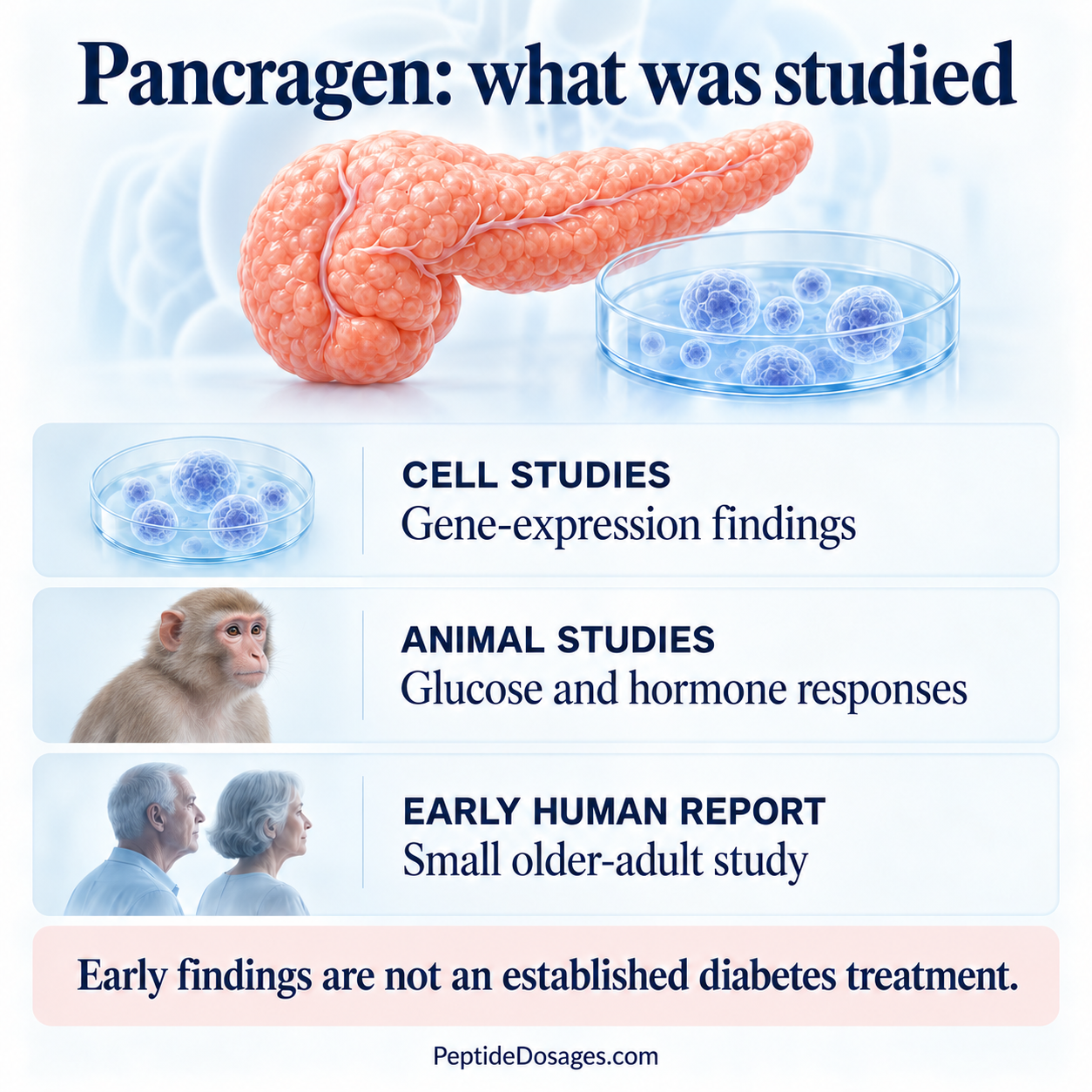
Pancragen is a four-amino-acid peptide studied for pancreatic function and age-related changes in glucose metabolism. Its research includes cell experiments, studies in rhesus monkeys and a small report involving older adults. That makes it interesting, but not an established treatment for diabetes or a demonstrated way to regenerate a damaged pancreas.1,2
Pancragen does have research behind it. The question is whether those findings support the claims being made, and how far they can be applied.
What is Pancragen peptide?
Pancragen is described in the research as the tetrapeptide Lys-Glu-Asp-Trp, abbreviated KEDW. It belongs to the group commonly called peptide bioregulators. Researchers have investigated its effects on the endocrine function of the pancreas, including responses involving glucose, insulin and C-peptide.2
It is not insulin, a pancreatic enzyme replacement or a GLP-1 medicine. Calling a molecule a bioregulator describes a research concept; it does not establish that it restores normal organ function in a patient.
Benefits of Pancragen: what has actually been reported?
A small human study in older adults
A 2011 paper examined 30 healthy older people and 33 older patients with type 2 diabetes. The authors reported lower fasting and glucose-tolerance-test glucose levels, lower plasma insulin and an improved insulin-resistance index among patients receiving Pancragen. They reported no corresponding carbohydrate-metabolism changes in patients who did not receive it.1
Those results deserve attention, but the accessible abstract does not establish the treatment-group sizes, randomization or blinding, or give enough detail to judge the magnitude and durability of benefit. The 33 patients should not be described as 33 confirmed Pancragen recipients. This is an early clinical signal, not proof that it prevents complications or replaces standard care.
Glucose regulation in old rhesus monkeys
A 2014 study reported faster glucose clearance and changes in insulin and C-peptide responses after Pancragen treatment in older female rhesus monkeys. Some effects persisted for three weeks after treatment stopped.2 That observation concerns this animal experiment, not a predictable duration of benefit in people.
A separate 2015 comparison involved just nine older female monkeys: five received Pancragen and four received glimepiride. Both groups showed lower baseline blood glucose, with different hormone-response patterns.3 It was not a human trial demonstrating that Pancragen is better or safer than a diabetes medicine.
Pancreatic cell research
Researchers have also studied KEDW in pancreatic cell cultures as the cultures aged. A 2015 paper described changes in gene expression and patterns of DNA methylation, including findings involving PDX1, PAX6 and NGN3.4 These genes help researchers investigate pancreatic cell identity and differentiation.
Gene activity is not the same as rebuilding a working pancreas. The experiment did not show that a person grew new functional beta cells, recovered normal insulin production or became free of diabetes.
| Research setting | Main observation | Important limit |
|---|---|---|
| Pancreatic cell cultures | Gene-expression and methylation changes | Not evidence of organ regeneration in patients |
| Older rhesus monkeys | Glucose and hormone-response changes | Small animal experiments do not establish a human treatment |
| Older-adult report | Improved metabolic measurements reported | Limited accessible methods and no established long-term clinical benefit |
Does Pancragen support metabolic health?
The studies provide a rationale for further investigation of glucose regulation. They do not establish Pancragen as a general metabolic-health supplement, a weight-loss therapy or a way to reverse biological aging.
Blood sugar is also only one part of care. A useful treatment needs a defined formulation, reproducible benefit, meaningful safety information and evidence about how it fits alongside other medicines. A short-term change in a laboratory measurement does not answer all of those questions.
Safety, side effects and medicine interactions
The cited Pancragen literature is too limited to provide a dependable list of common side effects or to establish long-term safety. A small study without a prominent harm signal cannot rule out uncommon problems. Safety in pregnancy, breastfeeding and combinations with other experimental peptides is not established by these papers.
For someone taking insulin or another glucose-lowering medicine, adding an experimental product warrants particular caution. Some established diabetes treatments can already cause low blood glucose.5 Whether and how Pancragen changes that risk in combination is not adequately characterized here. Do not reduce prescribed medication or substitute Pancragen on the basis of a seller’s claim.
If you have persistent thirst, frequent urination or concerns about abnormal glucose readings, seek medical assessment. An unproven peptide should not delay diagnosis or a treatment plan with your clinician.
What about Pancragen dosage?
The studies reviewed here do not establish a broadly applicable human dosing schedule. An amount used in a monkey experiment cannot be treated as a personal-use recommendation. Neither an online cycle nor a vial concentration calculation resolves the missing clinical evidence.
Readers learning the terminology can use our peptide glossary. Understanding the units is useful, but it is separate from deciding whether a substance is an appropriate treatment.
Frequently asked questions
Can Pancragen replace insulin?
No evidence reviewed here supports that substitution. People with type 1 diabetes need insulin because their pancreas does not make it; treatment decisions must stay with their diabetes care team.5
Does it help pancreatitis?
The glucose and cell-culture findings discussed above do not establish a treatment for pancreatitis. Pancreatic inflammation is a different clinical question from an age-related hormone-response experiment.
Is Pancragen the same as digestive enzymes?
No. Pancragen is an experimental short peptide. Pancreatic enzyme products address a different function: helping digest food. Similar references to the pancreas do not make the products interchangeable.
What is the bottom line?
Pancragen’s pancreatic and metabolic research is preliminary, including its small human report. These sources don’t demonstrate reversal of diabetes, pancreas regeneration or lasting anti-aging benefits. A qualified healthcare professional can help evaluate metabolic concerns.
References
- Korkushko OV, et al. Prospects of using pancragen for correction of metabolic disorders in elderly people. Bulletin of Experimental Biology and Medicine. 2011.
- Goncharova ND, et al. Impact of tetrapeptide pancragen on endocrine function of the pancreas in old monkeys. Advances in Gerontology. 2014.
- Goncharova ND, et al. Correction of impaired glucose tolerance using tetrapeptide Pancragen in old female rhesus monkeys. Advances in Gerontology. 2015.
- Ashapkin VV, et al. Epigenetic mechanisms of peptidergic regulation of gene expression during aging of human cells. Biochemistry (Moscow). 2015.
- National Institute of Diabetes and Digestive and Kidney Diseases. Insulin, medicines and other diabetes treatments.