

PEG-MGF is a pegylated form of mechano growth factor peptide discussed in muscle-repair and recovery research. The key limitation is that studies of MGF-related biology do not automatically establish what PEG-MGF injections do in people. FDA specifically identifies major human-safety gaps for PEG-MGF.1
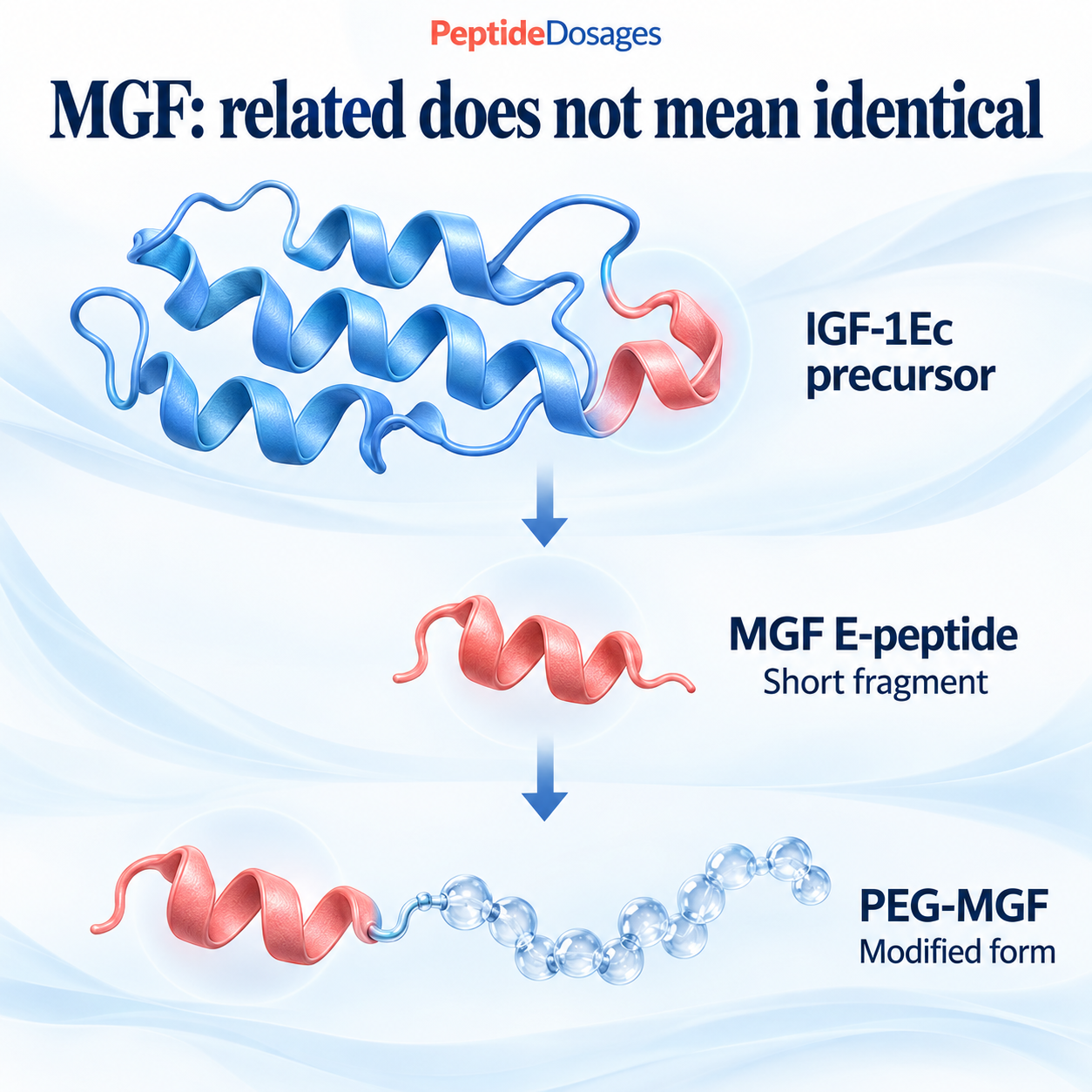
“MGF” can refer to several related materials. Before comparing muscle-growth, duration or recovery claims, check which one the study actually tested.
PEG-MGF vs. MGF: what is the difference?
The MGF name comes from the insulin-like growth factor 1 (IGF-1) system. It can mean an IGF-1 splice variant or a short synthetic peptide corresponding to part of that variant’s E-domain. The full-length protein and the short E-peptide aren’t identical materials. 2
PEG stands for polyethylene glycol. PEGylation attaches this polymer to a molecule, with the aim of changing properties such as stability and circulation time. It does not turn preliminary research into a proven treatment. Nor does the name alone establish a particular product’s half-life in humans.
What does the muscle-repair research show?
A 2011 experiment tested an MGF E-peptide in muscle-cell cultures from human donors of different ages. The researchers reported effects on satellite-cell proliferation, aging and fusion, with age-dependent differences.3 Satellite cells are muscle stem cells involved in repair. This was a cell-culture experiment, not a trial showing bigger or stronger muscles after PEG-MGF treatment.
Importantly, the findings have not been uniformly positive. A 2014 study from researchers at two pharmaceutical companies attempted to reproduce proposed MGF effects. It found no significant increase in proliferation or inhibition of differentiation in the tested muscle-cell systems, including primary human cells. Mature IGF-1 or full-length IGF-1Eb produced responses where the tested MGF peptides did not.4
The disagreement matters. A useful explanation includes the negative study rather than presenting muscle regeneration as a settled result.
| Claim | What the cited evidence supports |
|---|---|
| Activates muscle stem cells | Some MGF E-peptide cell experiments reported effects; other experiments did not reproduce them. |
| Builds muscle in people | These experiments do not establish clinical muscle growth from PEG-MGF. |
| Speeds recovery after an injury | A proposed research application, not a demonstrated human treatment outcome. |
| Lasts longer than MGF | A rationale for chemical modification, not a verified human half-life for every product. |
A common mix-up: PEG delivery is not necessarily PEG-MGF
A mouse heart-injury study delivered an MGF E-domain peptide from tiny polymeric rods made with a polyethylene-glycol-based hydrogel. The researchers reported improvements in several cardiac outcomes in that model.5
Here, PEG was part of a delivery material. That is not the same as demonstrating the effects of a commercially described PEG-MGF molecule administered systemically. Delivery method, chemical structure, study species and target tissue all matter. A promising result from one preparation cannot simply be reassigned to another.
PEG-MGF safety and side effects
FDA’s compounding-safety page says the agency has not identified human exposure data for PEG-MGF drug products through any route. It highlights possible immune reactions, peptide-related impurities and difficulties characterizing the active ingredient.1
That does not provide a predictable list of “common mild side effects.” It means important questions remain unanswered. A seller’s purity claim or a forum account of uneventful use cannot establish clinical safety, interactions or the risks of repeated exposure.
The cited studies also do not establish safety during pregnancy, breastfeeding or use alongside other experimental growth-factor products. Talk with a qualified clinician about injury or unexplained muscle loss rather than delaying diagnosis for an unproven peptide.
Dosage, timing and half-life claims
The evidence reviewed here does not establish a human PEG-MGF treatment dose or a validated post-workout schedule. Precise-looking numbers can be misleading when they are not linked to a pharmacokinetic or clinical study of the same formulation.
Our separate PEG-MGF 2 mg research reference covers the site’s vial-specific measurement context. It is different from the MGF 5 mg reference. Neither concentration math nor a descriptive schedule proves a clinical benefit.
Is PEG-MGF allowed in sport?
WADA lists mechano growth factors under its prohibited growth-factor category, which applies at all times.6 Athletes should check the rules with their anti-doping organization. Being available as a research chemical does not make a substance permitted in competition or training.
Frequently asked questions
Is PEG-MGF the same as IGF-1?
No. The research names are related to IGF-1 biology, but a modified E-domain peptide is not mature IGF-1. Evidence and effects should not be assumed to be interchangeable.
Is PEG-MGF better than MGF?
The cited evidence does not establish clinical superiority. Longer persistence, even if demonstrated for a specific preparation, would not by itself prove better recovery or safety.
What is the bottom line?
PEG-MGF is an experimental research subject with substantial gaps. The most important distinction is between interesting muscle biology and a product shown to improve recovery in people. Current claims often cross that gap without the necessary evidence.
Related PEG MGF dosage protocols
Continue with the vial-strength-specific research protocol that matches the material being evaluated. Each page keeps its own concentration, reconstitution, and syringe-unit calculations.
Practical measurement and handling guides
References
- U.S. Food and Drug Administration. Compounding substances that may present significant safety risks. PEG-MGF entry; checked October 2026.
- Thevis M, et al. Mass spectrometric characterization of a biotechnologically produced full-length mechano growth factor relevant for doping controls. Growth Hormone & IGF Research. 2014.
- Kandalla PK, et al. MGF E-peptide effects on human muscle progenitor cells of different ages. Mechanisms of Ageing and Development. 2011.
- Fornaro M, et al. Mechano-growth factor peptide has no apparent effect on myoblasts or primary muscle stem cells. American Journal of Physiology: Endocrinology and Metabolism. 2014.
- Localized delivery of MGF E-domain peptide via polymeric microstructures improves cardiac function following myocardial infarction. Biomaterials. 2015. Mouse study.
- World Anti-Doping Agency. The Prohibited List. Section S2.3; checked October 2026.