
How to reconstitute peptides depends on the exact product, diluent, vial size, and manufacturer or laboratory instructions. The basic calculation is consistent: add a specified volume of compatible diluent to a lyophilized peptide vial, determine the resulting concentration, and convert the required mass or activity into a measurable liquid volume. This step-by-step guide explains that math, clean handling, U-100 syringe markings, storage questions, and common errors without treating one method as universal.
Start with the label: a peptide formulation’s validated instructions control the diluent, volume, mixing method, storage temperature, and discard period. United States Pharmacopeia guidance likewise emphasizes following the product label, certificate, or monograph rather than assuming that every freeze-dried peptide is prepared the same way.[1]
Educational scope: This page explains research calculations and general handling concepts. It is not medical advice, a prescription, or a substitute for product-specific instructions.
What Is Reconstitution?
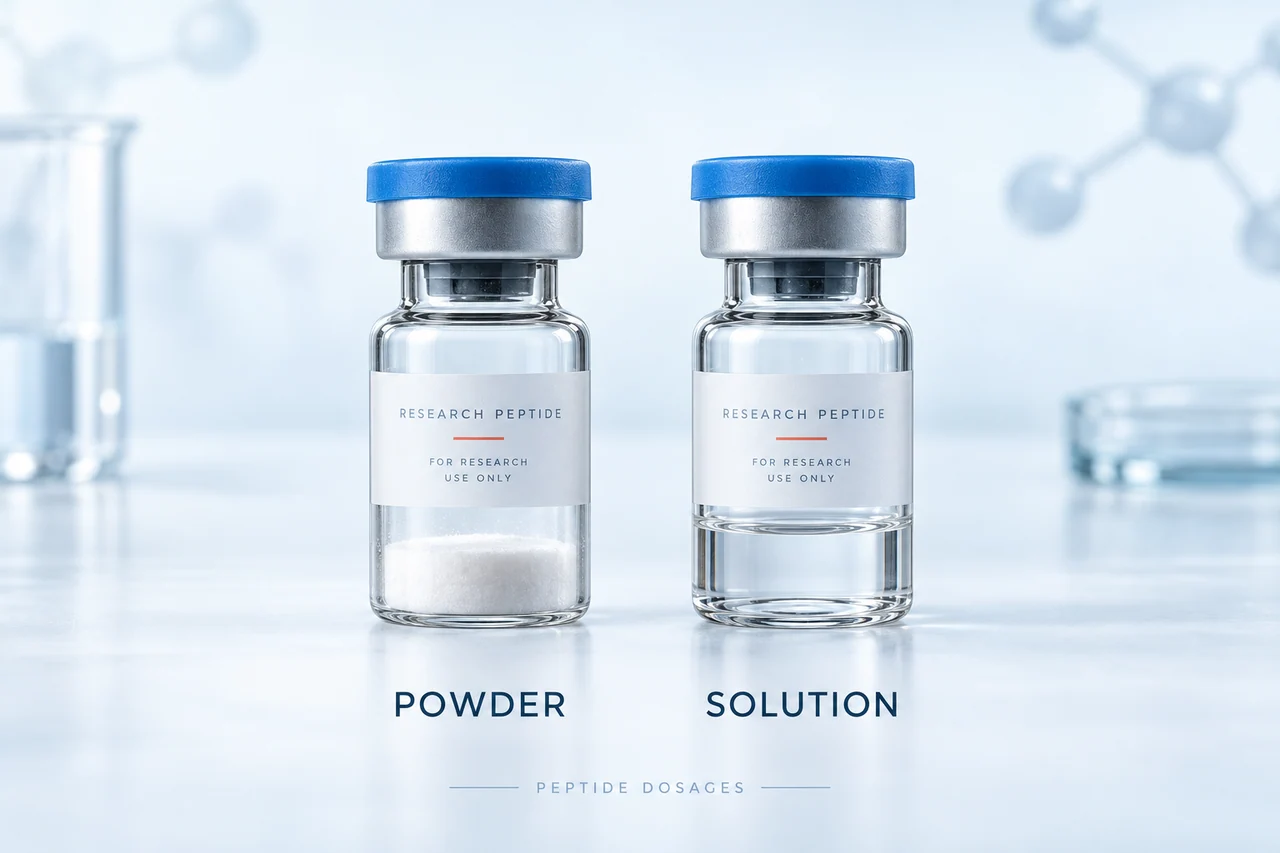
Peptide reconstitution is the process of adding a compatible liquid to a lyophilized (freeze-dried) peptide formulation. Lyophilization removes water to improve stability during storage, but stability after reconstitution varies with the peptide, excipients, pH, diluent, temperature, light exposure, and container system.[2][3] A clear solution is not proof of potency or sterility, so appearance cannot replace the label or validated stability data.
The arithmetic begins with two known values: the amount in the vial and the volume added. Their ratio gives the concentration. A target amount can then be divided by that concentration to obtain the liquid volume. On a U-100 syringe, 100 units represent 1 mL; those markings measure volume and are not the same as International Units of biological activity.[6]
Supplies You’ll Need
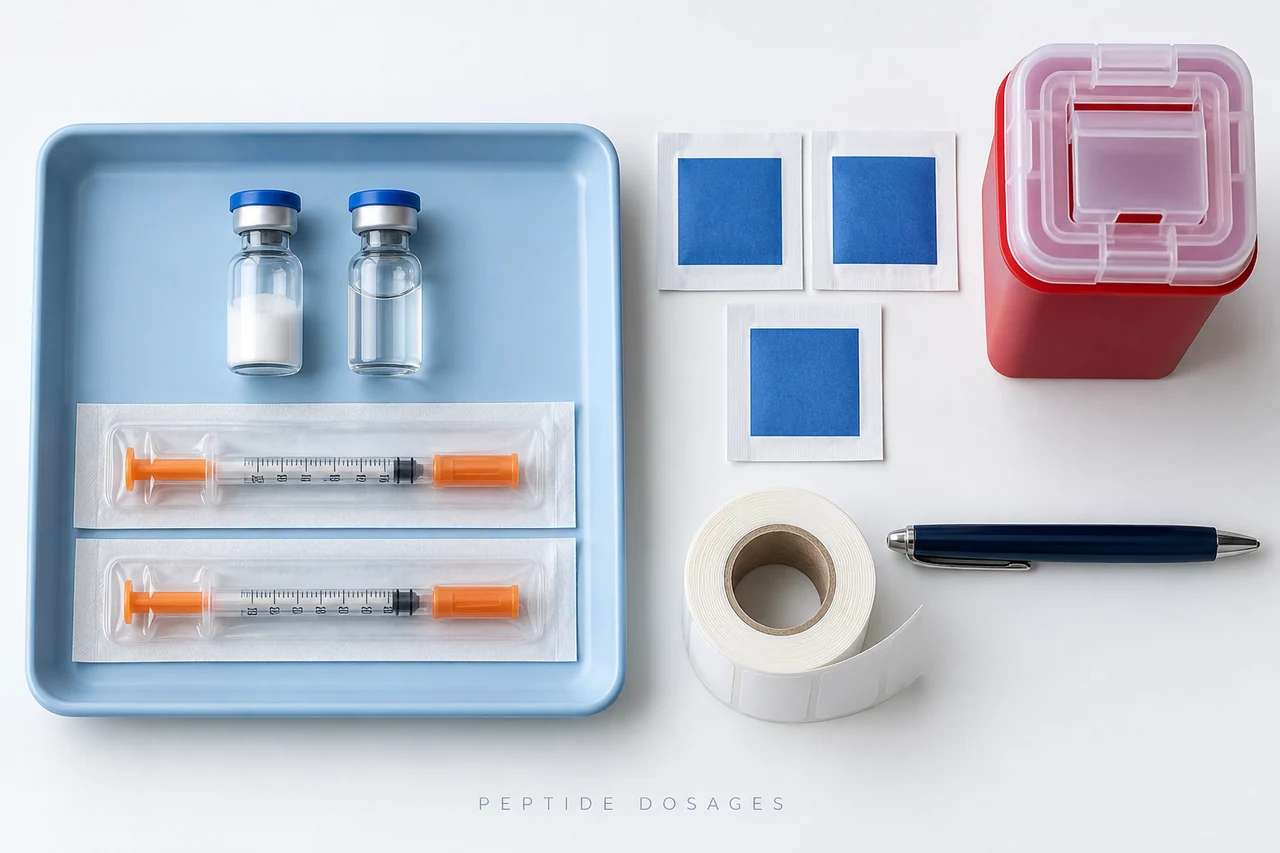
Prepare a clean, uncluttered work area before opening sterile supplies. CDC injection-safety guidance recommends aseptic technique, a new sterile needle and syringe for each entry, and preparation away from potential contamination sources.[4]
The peptide vial
Confirm the compound name, vial content, lot information, expiration date, container integrity, and any printed reconstitution instructions. Do not rely on vial strength alone to choose a diluent or storage period. If the label is incomplete or the powder, stopper, or seal appears compromised, stop and obtain qualified product-specific guidance.
Bacteriostatic water (BAC water)
Bacteriostatic Water for Injection is sterile water containing a bacteriostatic preservative, commonly benzyl alcohol. The current DailyMed label describes a multiple-dose diluent containing 0.9% or 1.1% benzyl alcohol, depending on the marketed product.[5] It is not automatically compatible with every peptide. Use bacteriostatic water only when the peptide’s label or other qualified instructions identify it as compatible.
Insulin syringes
Use the syringe type and capacity appropriate for the volume being measured. A U-100 syringe uses 100 volume markings per milliliter: 10 units = 0.10 mL, 25 units = 0.25 mL, and 50 units = 0.50 mL. Smaller-capacity syringes may have wider spacing between markings, but the printed scale must always be read directly. Never interpret U-100 volume markings as peptide mass or biological IU.[6]
Alcohol swabs
CDC guidance calls for disinfecting the rubber septum with alcohol before piercing it and allowing the surface to dry.[4][7] Use a fresh swab as needed and avoid touching the cleaned stopper before the needle enters.
Sharps container
Place the connected needle and syringe into an appropriate sharps container immediately after use. Do not bend, break, recap, or reuse the needle. CDC/NIOSH guidance recommends placing sharps containers close to the work area so disposal is immediate.[8]
Choosing Your Diluent
The correct diluent is formulation-specific. Bacteriostatic water, sterile water, and 0.9% sodium chloride are not interchangeable by default. Compatibility can depend on pH, tonicity, preservative sensitivity, solubility, and the intended container-use period. When instructions are unavailable or ambiguous, do not improvise.
Bacteriostatic water (BAC water) — the default choice
Bacteriostatic water is frequently discussed for multi-entry vials because it contains a preservative, but it should not be described as the universal default. To reconstitute peptides with bacteriostatic water, first verify that the specific formulation permits it and use the stated volume and handling conditions.[5]
Sterile water — single-use only
Sterile Water for Injection does not contain an antimicrobial preservative. Its permitted use and any post-entry time limit come from the product and preparation instructions, not from a universal 24- or 48-hour rule. Do not convert a single-use preparation into a multi-dose container simply by storing it in a refrigerator.
Sodium chloride 0.9% (normal saline)
Some labeled peptide or protein products specify 0.9% sodium chloride, while others do not. Saline changes ionic strength and may affect solubility or stability. Use it only when the formulation instructions identify the appropriate sodium-chloride product and volume.
What about other liquids?
Tap water, consumer distilled water, and other non-sterile liquids are not suitable diluents. Never substitute one liquid for another based on appearance. The diluent must be sterile, compatible, in date, and identified for the intended preparation.
How Much BAC Water to Add
The water volume controls concentration, not the total peptide mass in the vial. More liquid produces a lower concentration and a larger draw volume for the same target mass; less liquid produces a higher concentration and a smaller draw volume. The chosen volume must fit both the vial’s physical capacity and the product-specific instructions.
The concentration formula
Concentration (mg/mL) = total peptide in the vial (mg) ÷ diluent added (mL)
Calculation example: a 5 mg vial plus 2 mL of compatible diluent equals 2.5 mg/mL. This example demonstrates arithmetic only; it does not establish that 2 mL is appropriate for a particular 5 mg product.
Why the amount of BAC water matters
If the example concentration is 2.5 mg/mL, a 0.25 mg calculation amount occupies 0.10 mL. On a U-100 syringe, 0.10 mL aligns with the 10-unit volume marking. Changing the water volume changes the concentration and therefore changes the marking for the same mass.
Common BAC water volumes and why they’re chosen
Volumes such as 1 mL, 2 mL, or 3 mL appear in research calculations because they can produce readable decimal concentrations. They are not universal recommendations. Before selecting any water volume, confirm:
- the compatible diluent and volume stated for the formulation;
- the vial’s total peptide mass or labeled biological activity;
- the final concentration and required draw volume;
- the smallest readable graduation on the selected syringe; and
- the product-specific storage and discard instructions.
The peptide reconstitution calculator can check concentration and U-100 volume conversions. It does not determine product compatibility, a dose, or a stability period.
Step-by-Step Reconstitution Process
This general sequence shows how to properly reconstitute a labeled research formulation. If the product instructions differ, follow the product instructions.
Step 1: Prepare your workspace
Read the label from start to finish. Gather the sealed peptide vial, specified diluent, sterile syringe and needle, alcohol swabs, label, and sharps container. Clean the work surface and wash and dry your hands. If instructions require a cold vial to equilibrate before opening, follow that instruction; USP notes that allowing a lyophilized peptide to reach ambient temperature before opening can reduce condensation risk.[1]
Step 2: Sterilize the vial stoppers
Inspect each stopper, disinfect the rubber septum with a new alcohol swab, and allow it to dry. Do not touch the cleaned surface. Use a new sterile needle and syringe for every vial entry.[4][7]
Step 3: Draw BAC water into the syringe
If bacteriostatic water is the specified diluent, draw the labeled volume using the syringe scale. For volumes larger than the syringe capacity, use multiple fresh sterile syringes rather than pulling beyond the marked scale. Remove large air bubbles and confirm the liquid level at eye height before leaving the diluent vial.
Step 4: Inject BAC water into the peptide vial
Insert the needle into the peptide vial without touching the shaft or stopper area. Add the diluent slowly and direct the flow as the product instructions specify. Aiming toward the inside wall may reduce splashing for some vials, but it is not a universal formulation requirement. Avoid forceful agitation.
Step 5: Let the powder dissolve
Allow the formulation to dissolve using the labeled mixing method. Many lyophilized proteins are handled with gentle swirling or rolling rather than vigorous shaking because mixing stresses can contribute to particle formation, but the correct method remains product-specific.[9] Do not impose a universal one-, three-, or ten-minute dissolution time.
Step 6: Inspect the solution
Inspect the reconstituted solution under good lighting for visible particles, unexpected cloudiness, color change, leakage, or stopper damage. Compare appearance with the product description. Do not assume a solution is acceptable merely because it is clear, and do not attempt to filter or salvage a questionable vial without qualified instructions.
Step 7: Label and refrigerate
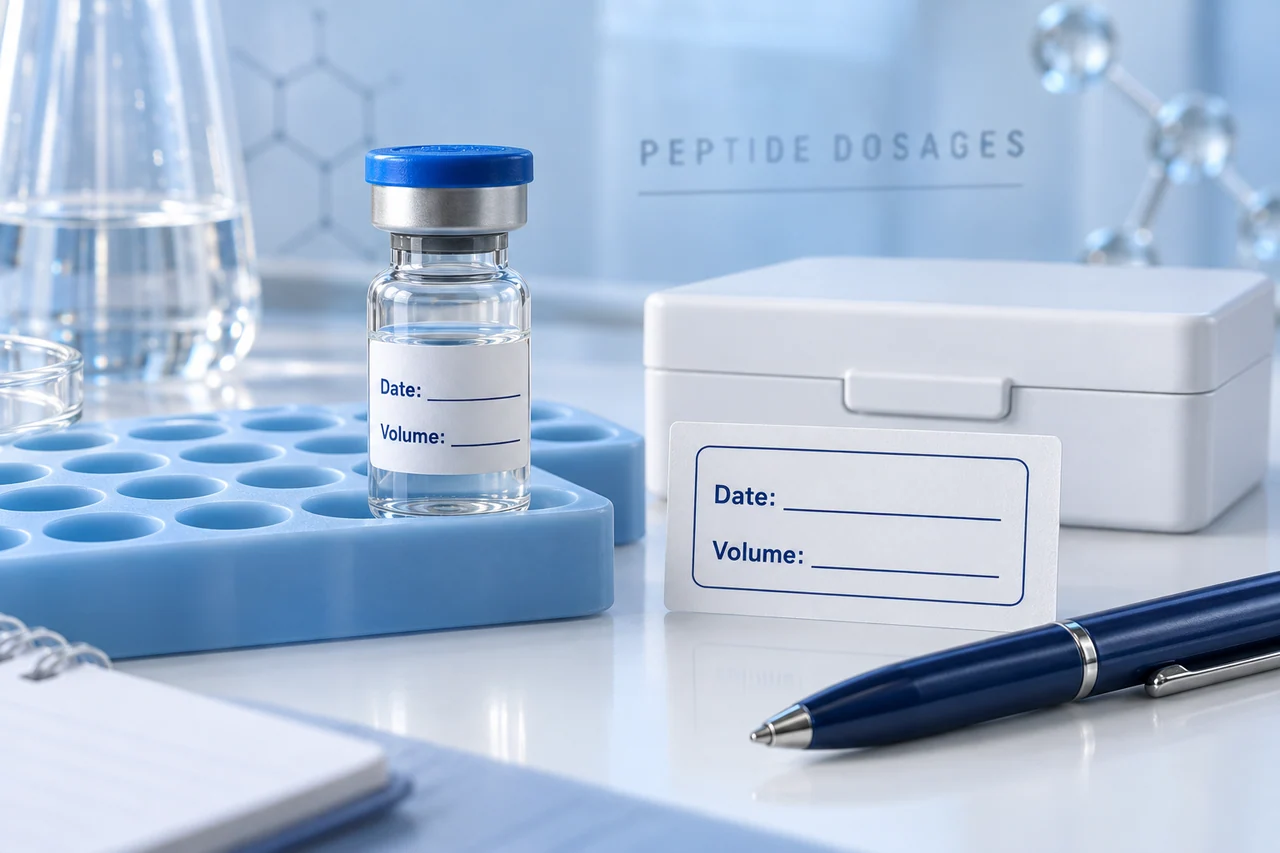
Label the vial with the preparation date, time if relevant, diluent, and volume added. Store it exactly as the product instructions require. Refrigeration is common for many reconstituted peptide products but is not universal; the validated temperature, light protection, and discard period must come from the specific formulation.
Peptide Reconstitution Simulator
The Peptide Reconstitution Simulator is the easiest way to learn how to reconstitute peptides on Peptide Dosages. It is the closest on-site experience to hands-on practice while remaining a guided educational simulation. Choose a peptide, work through the complete preparation sequence, and receive immediate feedback at each step.
Drawing a Dose from the Reconstituted Vial
Only draw from a vial that has a verified concentration and acceptable appearance. If a clinician or approved protocol provides an amount, convert it independently before touching the vial.
- Confirm the calculation: verify vial content, diluent volume, concentration, target amount, and syringe scale.
- Inspect and disinfect: inspect the vial, wipe the rubber stopper with alcohol, and allow it to dry.
- Use new sterile equipment: use a new needle and syringe for every entry.[4]
- Insert the needle: enter the stopper without touching the cleaned surface or needle shaft.
- Draw slowly: keep the needle tip in the liquid and pull the plunger to the calculated volume marking.
- Check the marking: remove large air bubbles as appropriate and recheck the liquid level at eye height.
- Dispose safely: place the connected needle and syringe directly into a sharps container after use.[8]
Concentration Math: Worked Examples
These worked examples explain concentration and volume only. They are not recommended doses, injection schedules, or product-specific preparation instructions.
Dose volume (mL) = calculation amount (mg) ÷ concentration (mg/mL)
U-100 volume marking = dose volume (mL) × 100
Example 1: BPC-157 5mg vial
A hypothetical 5 mg vial with 2 mL of compatible diluent has a concentration of 2.5 mg/mL. A 0.25 mg calculation amount would occupy 0.10 mL, which corresponds to 10 units on a U-100 syringe. The example does not validate a BPC-157 dose or imply human use.
Example 2: Semaglutide 3mg vial
A hypothetical 3 mg vial with 3 mL of the labeled diluent has a concentration of 1 mg/mL. A 0.25 mg calculation amount would occupy 0.25 mL, corresponding to 25 U-100 volume units. Actual semaglutide products must be prepared and used according to their approved labeling and care instructions.
Example 3: CJC-1295/Ipamorelin 10mg blend
A hypothetical blend containing 10 mg total peptide with 2 mL of compatible diluent has a total concentration of 5 mg/mL. A 0.30 mg total calculation amount would occupy 0.06 mL, or 6 U-100 volume units. Because a premixed blend has a fixed component ratio, total concentration alone does not describe the mass of each component.
Example 4: HGH 191AA 10 IU vial
If a label states 10 IU of biological activity and the specified final volume is 1 mL, the concentration is 10 IU/mL. A calculation amount of 2 IU would occupy 0.20 mL, or 20 U-100 volume units. Do not convert IU to mg unless an authoritative product-specific potency relationship is provided.
Don’t want to do the math?
Use the peptide dosage calculator to verify the arithmetic, then compare the result with the product instructions or approved protocol. The calculator can convert mg, mcg, mL, and U-100 markings; it cannot establish clinical suitability.
 Peptide mass1 mg = 1,000 mcgAmount of peptide
 U-100 volume markings100 units = 1 mLVolume of solution
 Biological activityIU is differentNot a syringe volume marking
Special Cases
Reconstituting blends
A premixed blend contains multiple components in one vial. The total concentration equals total mass divided by final volume, but each component also has its own concentration. For example, a 5 mg + 5 mg blend in 2 mL contains 5 mg/mL total and 2.5 mg/mL of each component. Confirm both values before interpreting a chart.
Peptides dosed in IU
International Units describe biological activity defined for a particular substance. U-100 syringe units describe liquid volume. They are different systems. First calculate IU per mL from the labeled activity and final volume; then convert the required liquid volume to the syringe marking.
Very small vials (1–2 mg)
Small vial contents can produce very small draw volumes at high concentrations. Do not solve that problem by choosing an arbitrary diluent volume. Use the allowed volume, check whether the calculated draw can be measured on the available syringe, and seek qualified guidance when the required precision exceeds the device scale.
Large vials (20 mg+)
Large mass does not automatically mean that more diluent is permitted. Check vial capacity and labeled instructions. If a calculation produces a volume greater than the syringe capacity, divide the transfer into accurately measured portions using new sterile equipment as appropriate.
Common Mistakes to Avoid
Shaking the vial
Do not shake unless the label specifically calls for it. Mechanical agitation, interfaces, and mixing can promote protein aggregation or visible and subvisible particles in susceptible formulations.[9]
Squirting BAC water directly onto the powder
A forceful stream can create foam and unnecessary agitation. Add the approved diluent slowly and follow any stated direction for contacting the powder or vial wall. Do not claim that one injection angle protects every peptide structure.
Using the wrong BAC water volume
An incorrect volume changes concentration and can also violate formulation instructions. Do not assume the vial remains suitable. Record what occurred, isolate the vial, and obtain qualified product-specific guidance before using or discarding it.
Reusing syringes
Never reuse a needle or syringe. Reuse increases contamination risk and can damage both the stopper and needle. CDC guidance requires a new sterile needle and syringe for each injection and each vial entry.[4]
Skipping the alcohol swab
Disinfect the rubber stopper before every entry and allow it to dry. A clean-looking stopper is not necessarily disinfected.[7]
Forgetting to equalize pressure
Pressure behavior varies with vial design and technique. Do not automatically inject air into every container; follow the product and device instructions. If resistance, leakage, or uncontrolled movement occurs, stop rather than forcing the plunger.
Storing at room temperature after reconstitution
Do not infer storage conditions from the diluent. Some reconstituted products require refrigeration, while others have different limits. Record how long the vial was outside its allowed range and follow the product’s excursion and discard instructions.
Troubleshooting
The powder won’t dissolve
Check the diluent, volume, temperature condition, and mixing instructions. Continue only with the permitted gentle mixing method. Do not add extra liquid merely to make the powder dissolve, because that changes the concentration and may not correct incompatibility.
The solution looks cloudy
Compare the solution with the label’s appearance description. Persistent cloudiness can indicate incomplete dissolution, particles, aggregation, contamination, or incompatibility. Set the vial aside and obtain qualified guidance; do not assume cloudiness is harmless.[10]
The solution has a color
Some formulations have a labeled color range and others should be clear and colorless. Unexpected color change is a reason to stop. Appearance alone cannot identify the cause or establish safety.
I added the wrong amount of BAC water
You can calculate the concentration created by the actual volume, but correct arithmetic does not prove the formulation remains suitable. Record the compound, lot, intended volume, actual volume, and time of the error, then follow qualified product-specific instructions.
There’s foam or bubbles on top
Foam is not automatically harmless. Stop shaking or agitating the vial, allow it to stand as permitted, and compare it with the product instructions. Persistent foam or visible particles may reflect formulation stress.[9]
The rubber stopper is getting torn up from repeated punctures
Visible rubber fragments or stopper damage require caution. Coring risk is influenced by stopper and needle characteristics; one study found more coring with larger-bore needles, while insertion angle was not an independent predictor in that setting.[11] Do not rely on repeatedly puncturing the same point or using a 45-degree angle as a universal prevention method.
Post-Reconstitution Storage
How to store peptides after reconstitution is a product-specific question. The label or qualified stability documentation should define temperature, light protection, container orientation if relevant, permitted room-temperature excursions, and discard date.[1][3]
- Temperature: use the stated range; do not assume every reconstituted peptide belongs at 2–8°C.
- Duration: do not apply a universal 25-, 28-, or 30-day period. Preservative presence alone does not establish chemical stability.
- Light: protect from light when the product instructions require it.
- Freezing: freeze only when validated instructions permit it; freeze-thaw stress can destabilize protein formulations.[3]
- Labeling: record preparation date, time where relevant, diluent, volume, concentration, and the product-specific discard date.
- Excursions: if the vial leaves its allowed range, document the time and temperature and obtain qualified guidance.
Quick-Reference Checklist
- Read the complete product label or qualified instructions.
- Confirm compound, vial content, diluent, volume, and expiration dates.
- Prepare a clean workspace with a sharps container nearby.
- Disinfect each rubber stopper and allow it to dry.
- Use a new sterile needle and syringe for every vial entry.
- Measure the specified diluent volume at eye height.
- Add the diluent slowly using the labeled technique.
- Use only the permitted mixing method; avoid unnecessary agitation.
- Inspect the solution against the product description.
- Calculate concentration, mL, and U-100 markings separately.
- Label the vial and follow its exact storage and discard instructions.
- Dispose of the connected needle and syringe immediately in a sharps container.
Next Steps
Use the Peptide Dosage Calculator to check concentration and syringe-volume math, the Syringe Measurement Guide to review U-100 markings, and the Peptide Dosage Chart to find the applicable research page. Calculators support arithmetic; they do not replace a label, validated protocol, or professional judgment.
References
- United States Pharmacopeia. Best Practices for Reconstitution of USP Peptide Reference Standards.
- Wang W. Lyophilization and development of solid protein pharmaceuticals. International Journal of Pharmaceutics. 2000.
- Cheng W, et al. Practical advice for developing lyophilized protein drug products. 2025.
- Centers for Disease Control and Prevention. Preventing Unsafe Injection Practices.
- DailyMed. Bacteriostatic Water for Injection, USP — labeling.
- U.S. Food and Drug Administration. Guidance for Piston Syringes.
- Centers for Disease Control and Prevention. Injection Safety Checklist.
- CDC/NIOSH. Strategies for Sharps Disposal Container Use.
- Kiese S, et al. Mixing-induced protein particle formation and mitigation. 2020.
- Review of protein instability, formulation stress, and aggregation. 2021.
- Study of vial-stopper coring and the effects of needle size and insertion angle. 2022.
Educational disclaimer: This guide is for research and educational purposes only. It is not medical advice, diagnosis, treatment guidance, or authorization for human consumption.