
Pinealon is a three-amino-acid research peptide, also called EDR or Glu-Asp-Arg. Its appeal comes from research on stressed nerve cells, learning and aging. The important distinction is that a protective effect in a laboratory is not the same as a proven treatment for memory problems or poor sleep.1,2
Pinealon does have human reports, so “never studied in people” isn’t accurate. But those reports don’t establish the broad brain-health benefits often claimed for it. The sections below separate that evidence from the laboratory work.
What is Pinealon?
Pinealon is one of the short synthetic peptides investigated as bioregulators. It contains glutamic acid, aspartic acid and arginine. EDR is shorthand for those amino acids, not a blend of different peptides. 1
It is different from Epithalon, also spelled Epitalon. Similar names and a shared research tradition do not make the compounds interchangeable. A study of one should not be used to promise the effects of the other.
How might Pinealon work?
In a 2011 laboratory study, Pinealon limited the accumulation of reactive oxygen species and reduced cell death in several cell preparations exposed to oxidative stress. The researchers also observed changes in cellular signaling and proliferation.2 These are mechanistic findings, not evidence that taking Pinealon improves concentration during a normal working day.
Another study used fluorescently labeled peptides in HeLa cells and examined interactions with DNA. Pinealon was among the peptides investigated.3 That supports further investigation of cellular activity. It does not demonstrate targeted delivery to the human brain, a predictable oral absorption rate or safe long-term gene regulation.
What does the human research show?
A Russian-language occupational-health report described changes in biological-age and adaptation measures among locomotive workers after a short course of Pinealon capsules.4 The indexed abstract does not provide enough detail to establish a reliable effect size or to separate a treatment effect from other influences.
A second report studied Pinealon and Vesugen in people with multiple chronic conditions and organic brain syndrome in remission. It reported favorable changes in some measures, but also pro-oxidant activity and a reduction in circulating CD34-positive cell markers.5 Those less favorable findings matter. This small report cannot support an uncomplicated “antioxidant with no downsides” description.
| Evidence | What was measured | What remains uncertain |
|---|---|---|
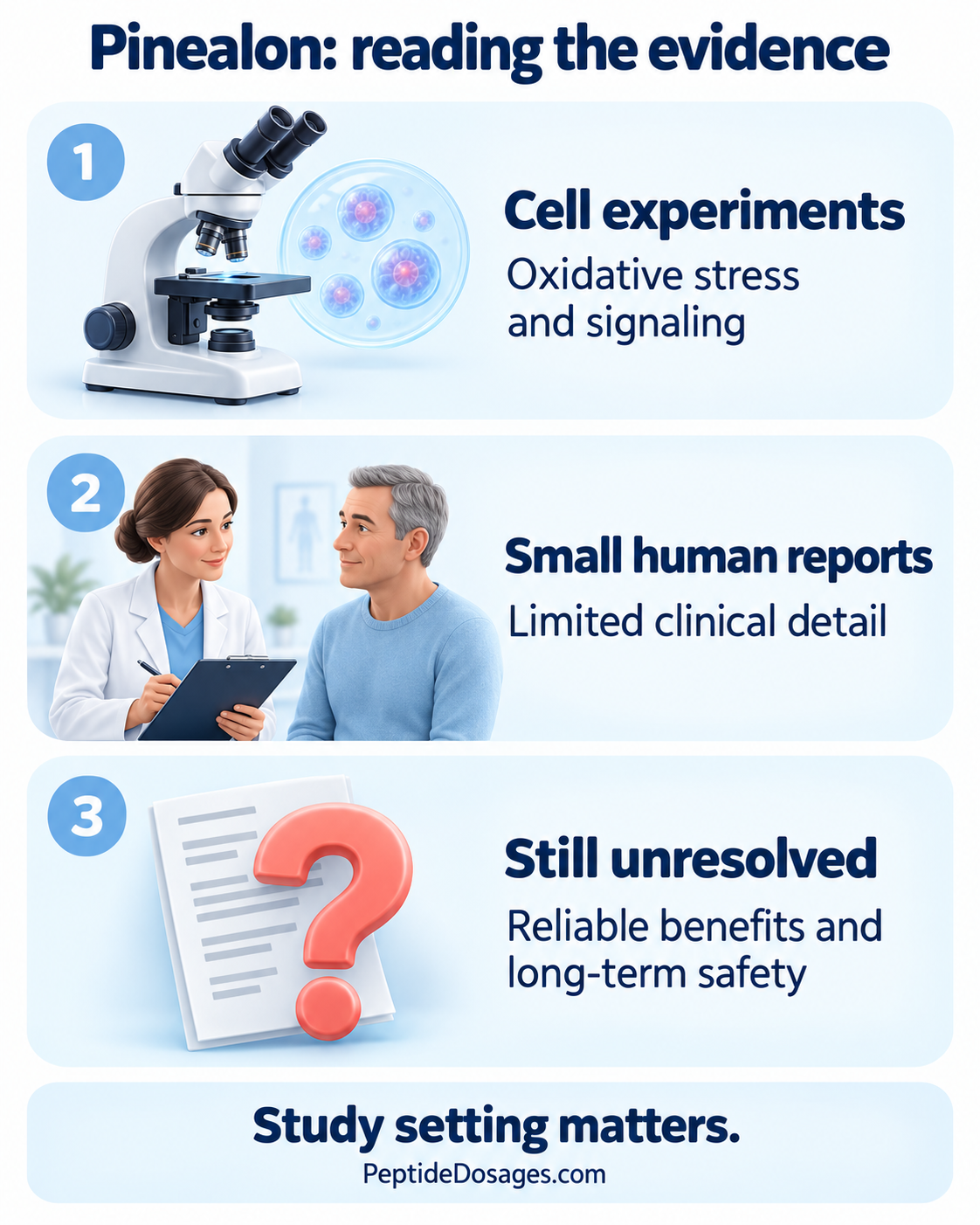
| Cell experiments | Oxidative stress, cell death and signaling | Whether those changes produce a useful clinical benefit |
| Occupational-health report | Adaptation and biological-age indicators | Reliable benefit beyond expectation and other influences |
| Small clinical report | Biological and cellular markers in people with chronic illness | Long-term safety and relevance to otherwise healthy adults |
This is a summary of different study settings, not a ranking of treatment options.2,4,5
Pinealon for sleep, brain fog and memory
These are common reasons people search for Pinealon, but they are different outcomes. An experiment measuring cell survival does not measure sleep quality. A change in a biological-age score does not necessarily mean better memory.
The sources above do not establish Pinealon as an effective insomnia treatment or a reliable answer to brain fog. They also do not establish how quickly someone should notice a benefit. “Two weeks in a report” is a study duration, not a promise that a person will feel better in two weeks.
Persistent problems with sleep, memory or concentration deserve assessment rather than being assumed to reflect a peptide deficiency. A clinician can help distinguish symptoms that share a label but have different causes.
Side effects and safety gaps
A short research record makes it difficult to estimate how often side effects occur, which interactions matter or whether repeated courses are safe. The cellular changes in the small clinical report are reasons for more investigation, not proof of a specific injury in every user.5
Claims that a tiny peptide is automatically harmless are not justified. Neither a short amino-acid sequence nor a favorable laboratory result replaces a clinical safety study. Product identity, purity and preparation introduce additional uncertainties outside controlled research.
What about Pinealon dosage?
The available papers use different experimental settings and preparations. They do not establish one validated human dose, injection schedule or repeated cycle for cognitive enhancement. The Pinealon 20 mg research reference provides separate measurement context; a reconstitution calculation is not evidence that a regimen works.
Frequently asked questions
Is Pinealon the same as Semax or Selank?
No. They are different peptides with different research records. The Semax and Selank guides cover those compounds separately. A combination should not be assumed safe or more effective just because each has a proposed brain-related mechanism.
Does an oral study validate an injectable product?
No. A change in route or formulation can change exposure. A capsule report cannot establish the efficacy, equivalence or safety of an injected research vial.
What is the practical takeaway?
Pinealon has a research rationale and a limited human literature. It does not yet have the kind of clear, replicated clinical evidence needed to promise better sleep, sharper memory or slower aging. Discuss symptoms and treatment choices with a qualified healthcare professional.
Related Pinealon dosage protocols
Continue with the vial-strength-specific research protocol that matches the material being evaluated. Each page keeps its own concentration, reconstitution, and syringe-unit calculations.
Practical measurement and handling guides
References
- PubChem. Glu-Asp-Arg (Pinealon): compound identity.
- Khavinson V, et al. Pinealon increases cell viability by suppression of free radical levels and activating proliferative processes. Rejuvenation Research. 2011.
- Fedoreyeva LI, et al. Penetration of short fluorescence-labeled peptides into the nucleus in HeLa cells and in vitro interaction with DNA. Biochemistry (Moscow). 2011.
- Analysis of biological-age and adaptation measures in locomotive workers. Advances in Gerontology. 2012. Russian-language report.
- Meshchaninov VN, et al. Effect of synthetic peptides on aging indicators in patients with chronic polymorbidity and organic brain syndrome. Advances in Gerontology. 2015. Russian-language report.