Tri-Heal is a research-blend name for TB-500, BPC-157 and KPV. The three ingredients are discussed in repair and inflammation research, but the finished blend does not inherit a proven clinical benefit from those separate research programs.
Read the vial label alongside the studies: which ingredients are listed, which substance did researchers test, and was the exact combination studied?
What is in Tri-Heal?
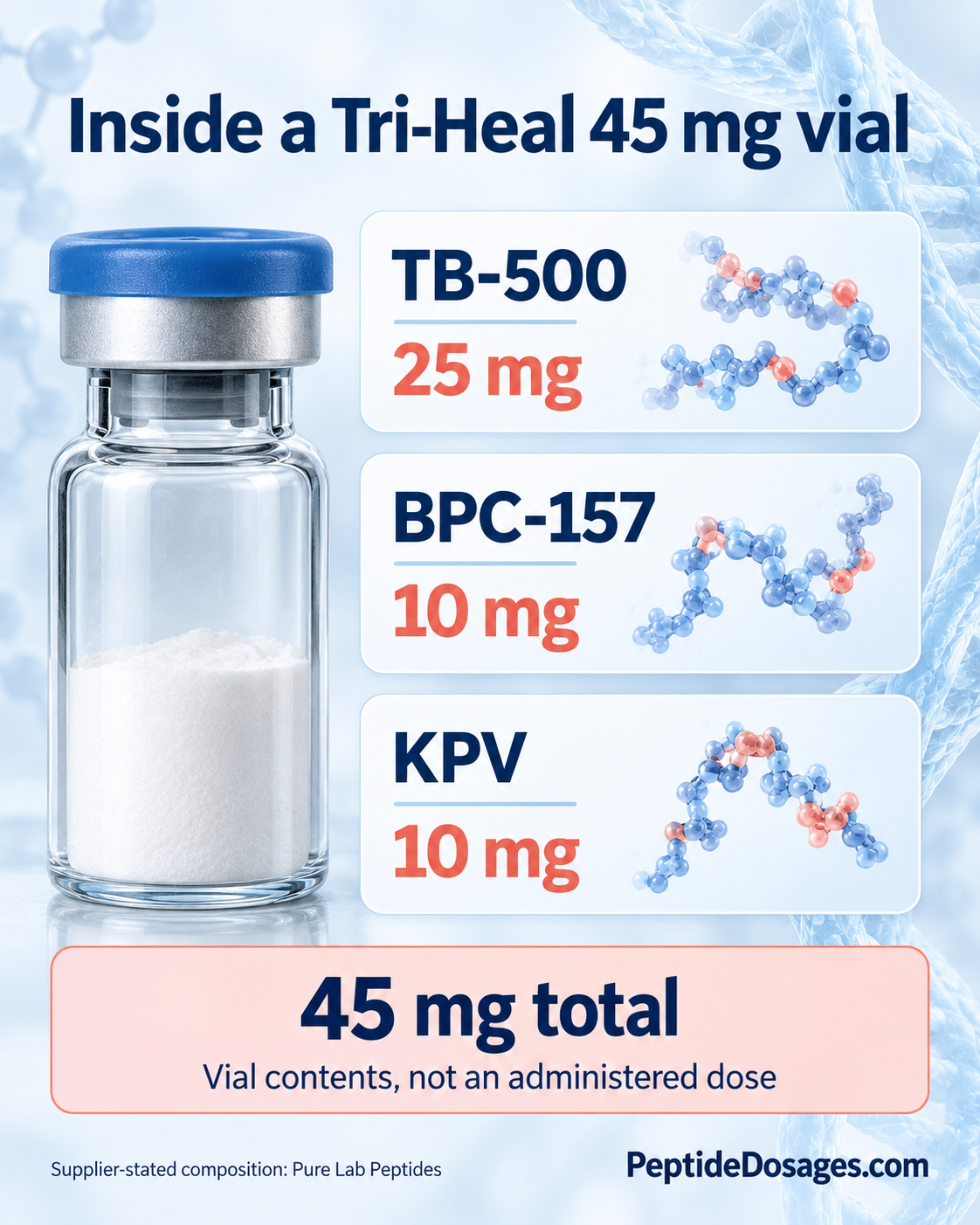
The Pure Lab Peptides listing identifies its 45 mg product as 25 mg TB-500, 10 mg BPC-157 and 10 mg KPV. That listing establishes the supplier’s stated composition, not clinical effectiveness.1
| Ingredient | Stated amount per vial | Evidence question |
|---|---|---|
| TB-500 | 25 mg | Does a cited paper test the same molecular material? |
| BPC-157 | 10 mg | Is the finding from cells, animals or a clinical trial? |
| KPV | 10 mg | Does the route and disease model match the claim? |
| Total blend | 45 mg | Has the combination itself been tested? |
Supplier-stated composition only. These are vial contents, not administered amounts.1
What does the ingredient research show?
BPC-157 and tissue-repair research
A tendon-fibroblast study reported increased growth-hormone receptor expression after BPC-157 exposure. This was experimental cell work, not a trial showing that Tri-Heal repairs an injured tendon in a person.2
Cell behavior can suggest a mechanism worth investigating. It cannot tell a reader when pain will improve, whether structural healing occurs or whether surgery can be avoided.
TB-500 versus thymosin beta-4
A widely cited thymosin beta-4 study reported improved repair in experimental rat skin wounds.3 FDA separately identifies a thymosin beta-4 fragment, LKKTETQ, under TB-500-related safety concerns.4
The practical lesson is to check molecular identity before transferring a result. A full-length peptide, a fragment and a supplier’s product name should not be assumed identical just because they appear together in online discussions.
KPV and intestinal inflammation
In a 2008 study, KPV uptake through PepT1 affected inflammatory signaling in intestinal and immune-cell systems. Oral KPV also reduced inflammation in two mouse colitis models.5
That is a specific preclinical finding. It does not establish an injectable blend as a treatment for inflammatory bowel disease, a sports injury or general “systemic inflammation.” Route and disease model are part of the evidence, not minor footnotes.
Does Tri-Heal provide proven synergy?
This review did not identify a controlled human trial of the stated TB-500/BPC-157/KPV combination. Claims that it produces three-way synergy therefore remain unestablished.
A direct test would need the same defined ingredients and meaningful comparison groups. Otherwise, an apparent improvement could reflect natural recovery, rehabilitation, another treatment or changes unrelated to the blend.
“Healing” can mean pain relief, better movement, an imaging change or greater tissue strength. These aren’t interchangeable outcomes. Look for the one a study actually measured.
Side effects and safety limitations
A dependable human adverse-effect rate is not established for Tri-Heal. FDA notes limited safety information for KPV and concerns involving BPC-157 and the thymosin beta-4 fragment.4
That uncertainty does not mean that every exposure will cause harm. It means reassuring claims about a predictable safety profile are not supported. Combining ingredients also makes it harder to identify the cause of a reaction.
Persistent pain, loss of function or gastrointestinal symptoms deserve a proper medical assessment. A research blend should not delay diagnosis or displace an established treatment plan.
Understanding dosage and preparation references
The 45 mg total cannot be read as 45 mg of each component. Nor does knowing the vial contents establish a clinically appropriate amount, frequency or duration.
The site’s Tri-Heal preparation reference separates ingredient quantities and concentration calculations. It is a different resource from evidence that a treatment improves a clinical outcome.
Frequently asked questions
Is Tri-Heal one peptide?
No. In the supplier formulation discussed here, it is a three-ingredient blend. The name alone is not a molecular identity.
Does KPV make the blend a proven gut treatment?
No. Oral mouse-colitis findings cannot establish benefit from an injectable human combination.
How quickly does it work?
A reliable clinical timeline has not been established for this blend. Rapid changes in symptoms would not, by themselves, prove tissue repair.
Is a certificate of analysis enough to prove safety?
Product testing and clinical safety answer different questions. Identity or purity information cannot substitute for controlled studies of benefits and harms.
References
- Pure Lab Peptides. Tri-Heal 45 mg product composition. Supplier identity source only.
- Chang CH, et al. BPC-157 and growth-hormone receptor expression in tendon fibroblasts. 2014.
- Malinda KM, et al. Thymosin beta-4 and experimental wound healing. 1999.
- FDA. Compounding substances with potential significant safety risks.
- Dalmasso G, et al. PepT1-mediated KPV uptake and intestinal inflammation. Gastroenterology. 2008.