

Semax is a synthetic peptide studied for effects on the nervous system, including brain signaling and stroke recovery. Evidence that it changes a laboratory measurement is stronger than evidence that it reliably improves everyday focus or treats ADHD. That distinction is the most useful starting point for understanding the research. [1][2]
Semax has a clinical history in Russia, but this should not be confused with US approval or with validation of every nasal spray and injectable product sold online. FDA’s 2026 evaluation identified neither Semax free base nor its acetate form as a component of an FDA-approved drug. [4]
Related dosage pages: The Semax 5 mg and 10 mg vial references explain concentration calculations. They do not establish an effective ADHD treatment or an approved injection schedule.
What is Semax peptide?
Semax is a seven-amino-acid peptide developed from a fragment of adrenocorticotropic hormone (ACTH). Researchers study its nervous-system effects, not its use as an ACTH replacement. Much of the proposed mechanism comes from animal experiments. [1]
One frequently cited rat study found changes in hippocampal BDNF and TrkB signaling alongside changes in a learning task. BDNF is a protein involved in nerve-cell function; TrkB is a receptor through which it acts. This is a plausible research pathway, but a higher BDNF measurement in a rat is not proof of improved human memory. [1]
What do human studies actually show?
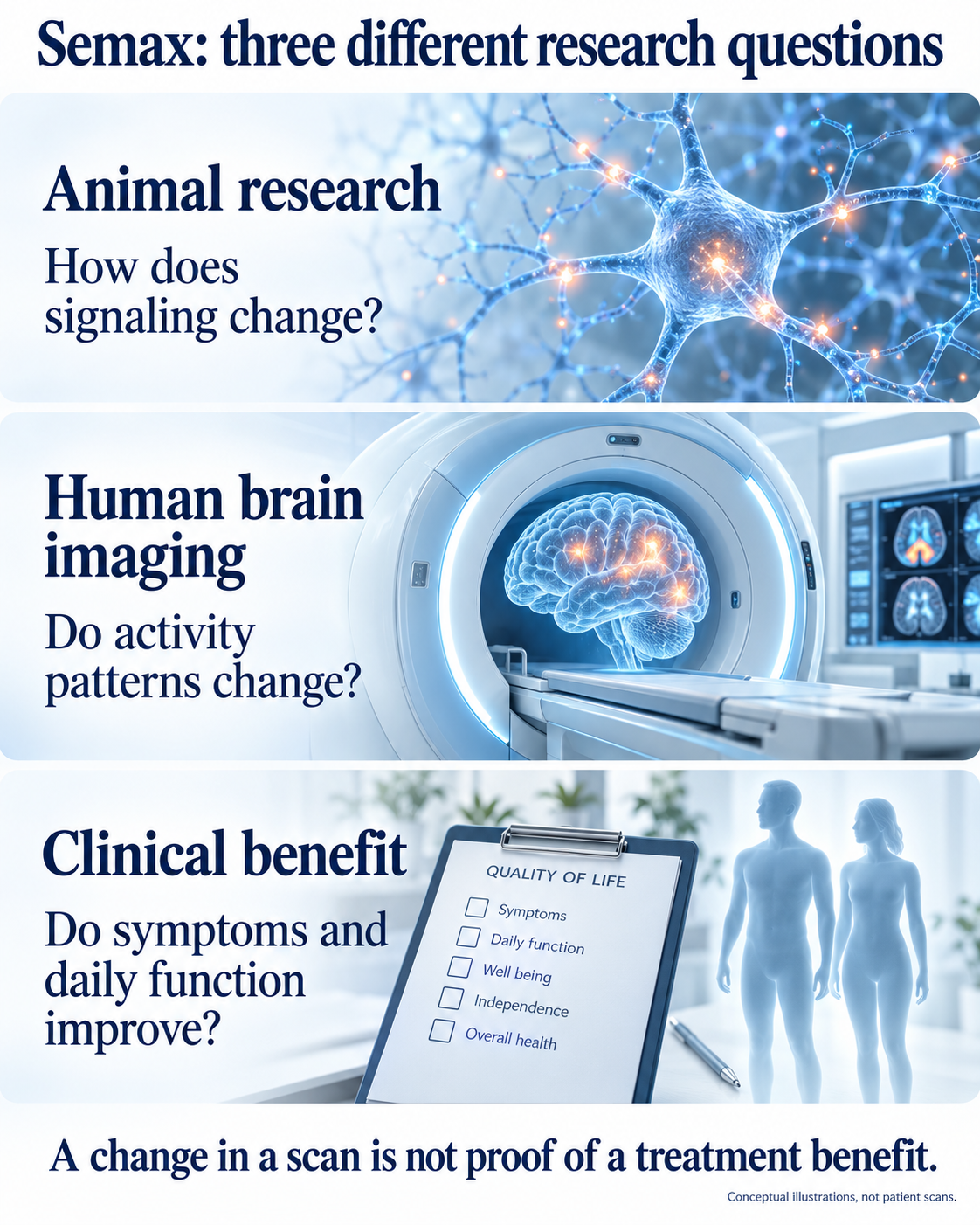
The answer depends on the population and outcome. A brain scan in a healthy volunteer, a blood marker after stroke and a change in daily functioning are not interchangeable results.
| Research | What it can tell us |
|---|---|
| 2018 brain-imaging study | Fourteen healthy volunteers received intranasal Semax and ten received placebo. Investigators observed a difference in part of the brain’s default mode network. This was an imaging endpoint, not an ADHD treatment trial. [2] |
| 2020 connectivity study | A study of 52 healthy participants compared Semax, Selank and placebo and reported functional-connectivity differences. The total includes different groups, not 52 Semax recipients. It did not establish lasting improvements in attention. [3] |
| Stroke rehabilitation research | A study of 110 people after ischemic stroke reported changes in blood BDNF and functional recovery measures. Rehabilitation timing and study design matter, and these findings cannot be transferred directly to healthy people seeking better concentration. [5] |
The imaging papers are small and exploratory. FDA also noted possible participant overlap between the 2018 and 2020 reports, so they should not automatically be counted as fully independent confirmations. [4]
Does Semax improve focus or treat ADHD?
The research above does not establish Semax as an effective ADHD treatment. In particular, a change on a resting-state scan does not show that someone completes tasks more reliably, makes fewer errors or functions better at work or school.
ADHD assessment looks at a persistent pattern of symptoms and impairment, including the person’s history. NIMH describes established treatments including medication and psychological or behavioral approaches. Semax should not be presented as an evidence-equivalent alternative to that care. [6]
If concentration has recently become a problem, that is also different from assuming lifelong ADHD. Sleep problems, stress and other health conditions deserve consideration during assessment. A nootropic label does not identify the cause. [6]
How quickly does Semax work?
The 2018 study collected scans five and twenty minutes after intranasal exposure. Those time points describe when researchers looked for an imaging change, not a proven onset of better focus or memory. They cannot support a promise that a person will feel sharper within twenty minutes. [2]
There is similarly no dependable duration-of-benefit figure from these studies for everyday cognitive enhancement. A short-lived subjective feeling is not the same as a sustained, measurable improvement.
Side effects and safety: what is known?
FDA’s safety-risk page highlights potential immune reactions linked to aggregation and peptide-related impurities, alongside limited safety information for proposed routes. That is an uncertainty warning, not a measured side-effect rate. [7]
Its 2026 review found inadequate information to characterize intranasal safety and no safety data for the proposed subcutaneous route. It also noted one report of eye pain and burning after an online nasal product. A spontaneous report cannot establish causation or how often a problem occurs, but it should not be ignored. [4]
Claims such as “no side effects,” “safe every day” or “non-addictive” are stronger than the available evidence. Brief studies and incomplete adverse-event reporting cannot establish long-term safety, interactions or safety during pregnancy.
Nasal spray vs injections: can the evidence be transferred?
No. Route, formulation and delivery device affect exposure. A result with nasal drops does not validate an injected preparation, and a vial’s total milligrams do not identify the amount delivered by a spray pump. FDA specifically raised questions about selecting and qualifying nasal containers and pumps. [4]
The studies discussed here do not provide a validated self-injection schedule or a universal cognitive-enhancement dose. Medical supervision does not erase the underlying evidence gaps.
Is Semax the same as Selank?
No. They are different peptides. The 2020 imaging study compared separate Semax, Selank and placebo groups; it was not a trial showing that a combined Semax-plus-Selank product improves symptoms. Similar marketing categories do not make the compounds interchangeable. [3]
Is a peptide that changes BDNF automatically good for the brain?
No. Biological signals depend on location, timing and context. A useful therapy needs evidence that the overall effect improves outcomes with acceptable risks, not just evidence that one marker changes.
The link between Semax’s effects on neural signaling and reliable everyday cognitive benefit remains unproven. A qualified clinician can discuss established assessment and treatment for persistent attention problems or stroke recovery.
Related Semax dosage protocols
Continue with the vial-strength-specific research protocol that matches the material being evaluated. Each page keeps its own concentration, reconstitution, and syringe-unit calculations.
Practical measurement and handling guides
References
- Dolotov OV, et al. Semax regulates BDNF and TrkB expression in the rat hippocampus. Brain Research. 2006.
- Effects of Semax on the default mode network of the brain. Bulletin of Experimental Biology and Medicine. 2018.
- Panikratova YaR, et al. Functional connectomic approach to studying Selank and Semax effects. Doklady Biological Sciences. 2020.
- FDA. July 24, 2026 Pharmacy Compounding Advisory Committee materials. Semax evaluation, presentation pages 104 onward. Staff evaluation, not a drug approval.
- The efficacy of Semax in patients at different stages of ischemic stroke. 2018. Article in Russian; English abstract.
- NIMH. ADHD in adults: four things to know.
- FDA. Certain bulk drug substances for use in compounding that may present significant safety risks. Semax entry.