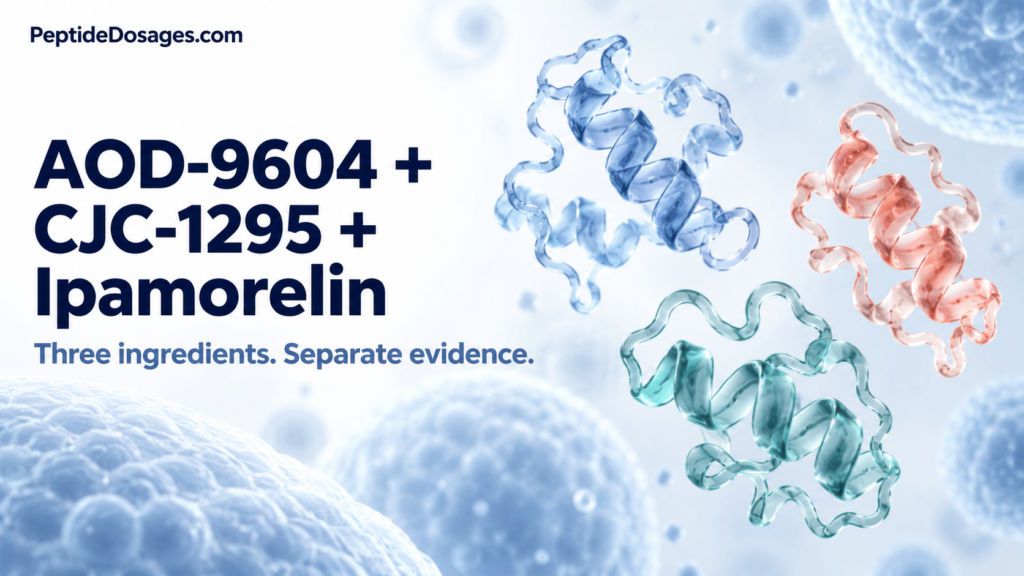
AOD-9604, CJC-1295 and ipamorelin form a three-ingredient research combination often discussed for fat loss and body composition. The components have different research histories. Putting them together does not combine those histories into a proven treatment.
Identify the ingredients first. Then check whether the study tested that exact combination, rather than one component on its own.
What is the AOD-9604, CJC-1295 and ipamorelin blend?
AOD-9604 is a modified fragment related to human growth hormone. CJC-1295 is discussed as a GHRH analogue, while ipamorelin is a growth-hormone secretagogue. AOD-9604 is not simply a smaller interchangeable dose of growth hormone.1,2,3
| Ingredient | Research focus | Main interpretation limit |
|---|---|---|
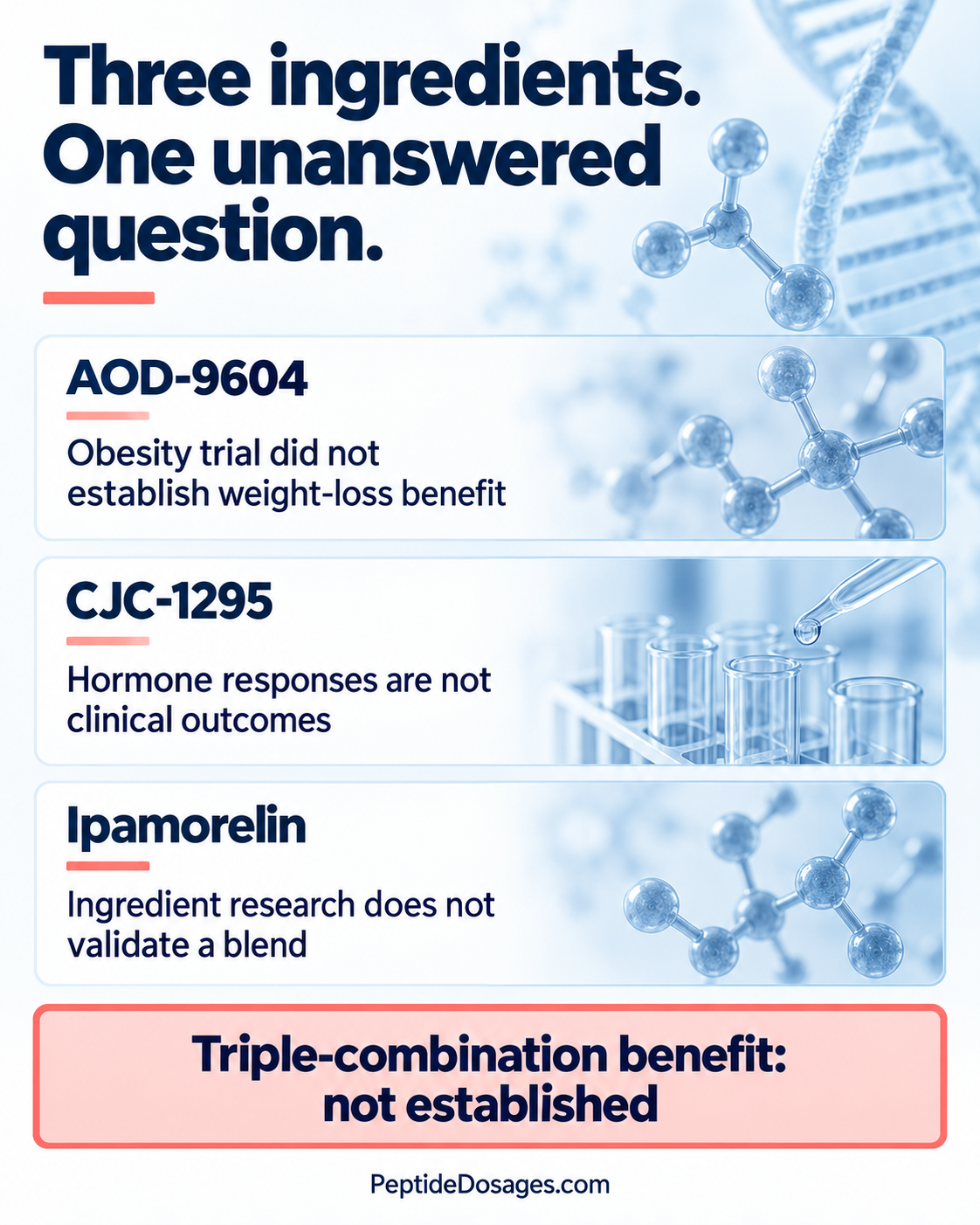
| AOD-9604 | Obesity development program | A large oral trial missed its primary weight-loss endpoint |
| CJC-1295 | GH and IGF-1 responses | Hormone changes do not establish body-composition benefits |
| Ipamorelin | Growth-hormone release | Ingredient pharmacology does not validate a triple blend |
The exact substance, route and study population matter.1,2,3
What did AOD-9604 research show?
FDA’s review describes the OPTIONS study, which randomized 502 participants to oral AOD-9604 or placebo alongside lifestyle measures. It did not show a significant difference at the primary 12-week weight-loss endpoint. The obesity development program was subsequently discontinued.1
That negative result matters. It does not prove every possible formulation ineffective, but it prevents the oral program from being used as straightforward proof of fat-loss efficacy. It also does not validate a subcutaneous three-peptide product.
What about CJC-1295 and ipamorelin?
The long-acting CJC-1295 human study measured growth hormone and IGF-1. It did not test this triple combination.2 Ipamorelin’s foundational animal study likewise cannot establish the blend’s human outcomes.3
It helps to distinguish a biomarker from a benefit. A laboratory hormone result is not a measurement of strength, sustained weight loss, sleep quality or reduced disease risk. Each of those claims requires its own evidence.
DAC versus No DAC is not a minor detail
The DAC modification changes albumin binding. Evidence for a long-acting CJC-1295 substance should not be automatically assigned to a product labeled No DAC.4
Keep the exact ingredient identity attached to each research result. A label that says only “CJC” leaves the form unclear. Matching the total milligrams doesn’t answer that question.
Is there evidence for the triple combination?
This review did not identify a controlled human trial establishing the safety or effectiveness of AOD-9604 plus CJC-1295 plus ipamorelin for fat loss, muscle gain or recovery.
A rationale for combining mechanisms can be worth investigating. Demonstrating benefit would require defined ingredients, appropriate comparison groups and outcomes assessed over time. It would also require a credible explanation of harms and discontinuations, not only favorable before-and-after photographs.
The claim that one ingredient “targets fat” while the others “preserve muscle” therefore goes beyond what the cited studies establish for this product.
Side effects and unresolved safety questions
FDA’s AOD-9604 assessment discusses incomplete safety information, including uncertainty about subcutaneous exposure and nonclinical findings requiring interpretation.1 A short or negative efficacy trial does not provide a blanket safety endorsement.
The combination also raises an attribution problem: if a symptom occurs, it may not be clear which ingredient, contaminant or other factor caused it. Changes to several variables at once make both research and clinical interpretation harder.
Someone considering hormone-related treatment should discuss the goal, medical history and established alternatives with a qualified clinician. Online descriptions do not determine whether an endocrine intervention is appropriate.
Reading a 12 mg blend label
“12 mg” describes a total mass, not 12 mg of each ingredient. The individual amounts and the exact CJC form must be identified separately. A blend and three separate vials are different preparation contexts.
The AOD-9604/CJC-1295/ipamorelin 12 mg reference is a preparation-calculation resource. It does not establish a clinically validated cycle or an expected result.
Frequently asked questions
Does adding AOD-9604 make CJC-1295 and ipamorelin work better?
The reviewed studies do not establish an added benefit from that third ingredient. More ingredients can mean more unanswered questions.
How long before results appear?
No dependable timeline is established for the triple blend. A hormone response or a seller’s photograph is not a validated forecast of fat loss.
Is the oral AOD-9604 trial the same as an injectable blend?
No. Route, formulation and additional ingredients differ. Evidence should remain attached to the intervention that was actually studied.
References
- FDA. AOD-9604 substances: clinical and nonclinical compounding advisory review. 2024.
- Teichman SL, et al. Long-acting CJC-1295 and hormone responses in healthy adults. 2006.
- Raun K, et al. Ipamorelin growth-hormone secretagogue experiments. 1998.
- FDA. CJC-1295 substances: identity and clinical review. 2024.