

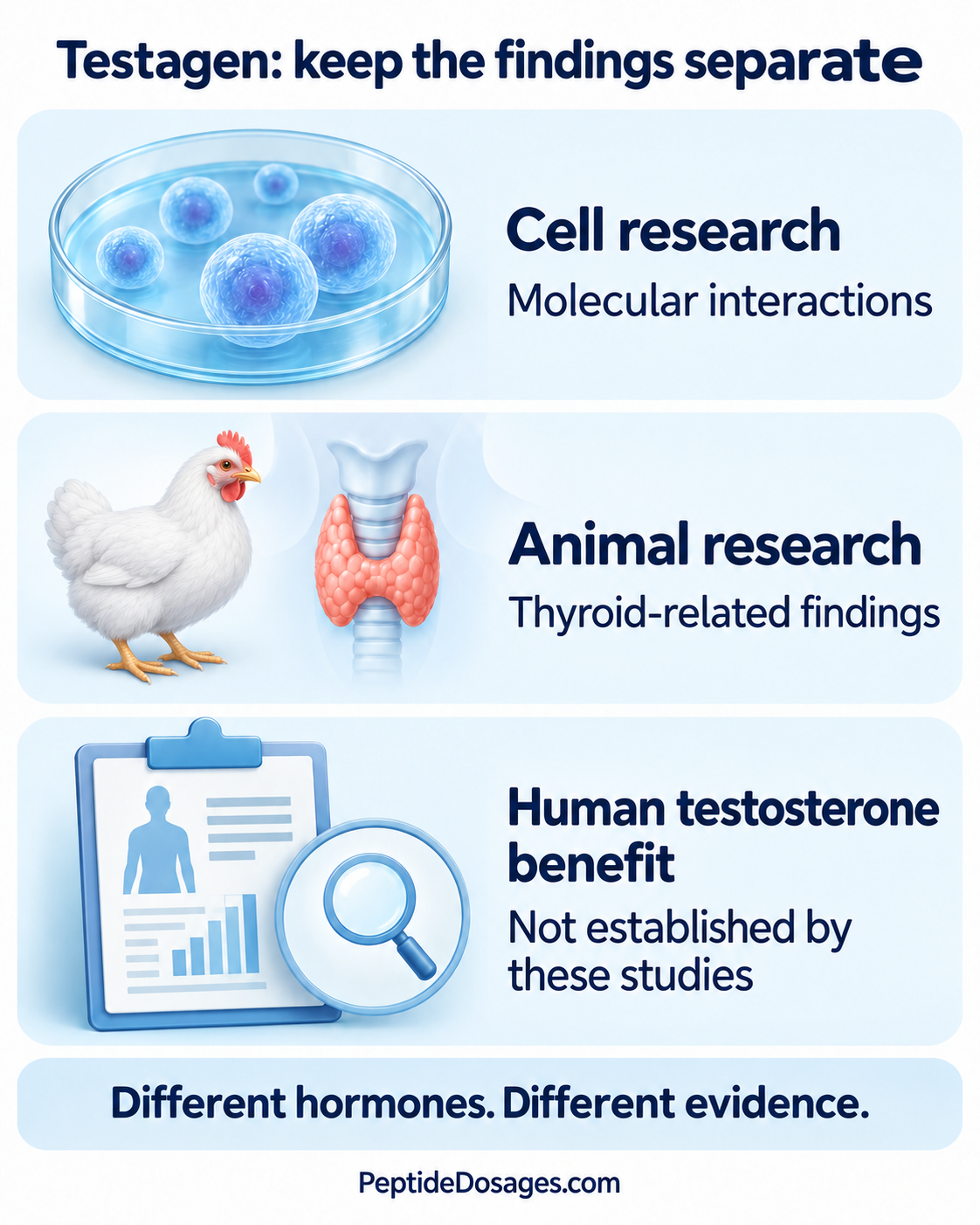
Testagen is a synthetic four-amino-acid peptide, Lys-Glu-Asp-Gly, abbreviated KEDG. It appears in research on cellular activity and hormonal regulation. Despite the name, the most identifiable experimental hormone studies concern thyroid function in birds, not a demonstrated testosterone treatment in men.1,2
If you’re looking for evidence of a testosterone benefit, the bird studies don’t answer that question. A proposed mechanism also can’t establish improved fertility or a replacement for prescribed treatment.
What is Testagen and how might it work?
The KEDG sequence contains lysine, glutamic acid, aspartic acid and glycine. Research with fluorescently labeled Testagen examined its entry into cultured HeLa cells and interactions with DNA.1 The experiment helps explain interest in short peptides as biological regulators, but it did not measure a clinical benefit.
Entering a cell nucleus in a laboratory preparation is not proof that a product selectively restores a person’s endocrine system. It also does not establish oral absorption, injectable exposure or a reliable human half-life.
What did the thyroid studies find?
A 2008 study gave KEDG and another tetrapeptide to chickens whose pituitary glands had been removed. After 40 days, researchers reported increased thyroid-stimulating hormone and thyroid hormone concentrations, with improvements in thyroid structure.2
A later study examined related effects in mature and older birds after the same type of surgery. It also reported changes in thyroid morphology and hormone activity.3 These highly specific animal models are not equivalent to ordinary fatigue, age-related symptoms or clinically diagnosed low testosterone.
| Research setting | What it can tell us | What it cannot establish |
|---|---|---|
| Labeled peptide in cultured cells | Cellular entry and molecular interactions | Human hormone benefits or a safe dose |
| Birds after pituitary removal | Thyroid-related effects in that model | Testosterone or fertility outcomes in men |
| A product sharing the Testagen name | Evidence only for its documented formulation | Automatic equivalence to a KEDG research vial |
Based on the molecular and animal studies and the formulation-identification limits below.1,2,3,4
Does Testagen increase testosterone?
The KEDG papers above do not establish that outcome in people. They did not demonstrate a predictable increase in human testosterone, better sperm measures or improved sexual function.
A small 2011 report with “Testagen” in its title describes men receiving treatment for chronic abacterial prostatitis and reports a rise in testosterone.4 The accessible abstract does not establish that its preparation is equivalent to a purified KEDG research vial, and concurrent treatment makes attribution difficult. It should not be converted into a confident efficacy claim for today’s peptide products.
This is why the exact molecule and formulation matter more than a matching product name. A paper can be real and still be the wrong evidence for the claim being made.
Testagen versus testosterone replacement therapy
They are not equivalent interventions. Testagen is not testosterone. Its proposed regulatory effects cannot be assumed to reproduce the effects, monitoring requirements or evidence of prescribed hormone treatment.
If low testosterone is a concern, symptoms alone do not settle the diagnosis. Discuss appropriate testing, possible causes and treatment options with a qualified clinician. A peptide marketed for “support” should not replace that process.
Side effects and safety questions
The small experimental literature does not provide a reliable human adverse-event rate or a long-term safety profile for KEDG. It also does not establish which medicines or other peptides can be combined safely.
A compound investigated for hormonal effects should not be assumed harmless to other hormone systems. The animal thyroid findings are a reason to ask better safety questions, not a reason to use Testagen as an unsupervised thyroid treatment.2,3
What about Testagen dosage and cycles?
The research discussed here does not establish a validated human cycle for testosterone, fertility, energy or anti-aging. An animal course cannot simply be scaled into a personal regimen.
The Testagen 20 mg research reference provides separate measurement context. Vial concentration and clinical suitability are different questions.
Frequently asked questions
How long does Testagen take to work?
A reliable time to benefit has not been established for KEDG in people. The 40-day animal experiment is not a validated human response timeline.
Is Testagen a fertility peptide?
Its name and marketing do not establish a fertility benefit. Testosterone concentration, sperm production and the chance of pregnancy are separate outcomes; none can be inferred merely from thyroid changes in birds.
Can it be stacked with hCG or gonadorelin?
The mechanisms and evidence differ. Read the separate hCG and gonadorelin guides for context, but do not treat combining them with Testagen as a studied or automatically safe strategy.
Related Testagen dosage protocols
Continue with the vial-strength-specific research protocol that matches the material being evaluated. Each page keeps its own concentration, reconstitution, and syringe-unit calculations.
Practical measurement and handling guides
References
- Fedoreyeva LI, et al. Penetration of short fluorescence-labeled peptides into the nucleus in HeLa cells and in vitro interaction with DNA. Biochemistry (Moscow). 2011.
- Kuznik BI, et al. Effect of Lys-Glu-Asp-Gly and Ala-Glu-Asp-Gly on thyroid structure and function in neonatally hypophysectomized chickens. Bulletin of Experimental Biology and Medicine. 2008.
- Kuznik BI, et al. Effects of Lys-Glu-Asp-Gly and Ala-Glu-Asp-Gly on hormonal activity and thyroid morphology in mature and old birds. 2011.
- Rossikhin VV, et al. Efficacy of a preparation named Testagen in patients with chronic abacterial prostatitis. Problems of Endocrine Pathology. 2011. Abstract-level record; equivalence to purified KEDG not established.