
On this page
- Quick reference
- Dosage chart and four steps
- Supplies needed
- Vial and research context
- Protocol Overview
- Dosing Protocol
- Storage Instructions
- Important Notes
- How This Works
- Potential Benefits & Side Effects
- Research Context Factors
- Injection Technique
- Recommended Source
- Important Note
- References
- Related research, strength variants, and guides
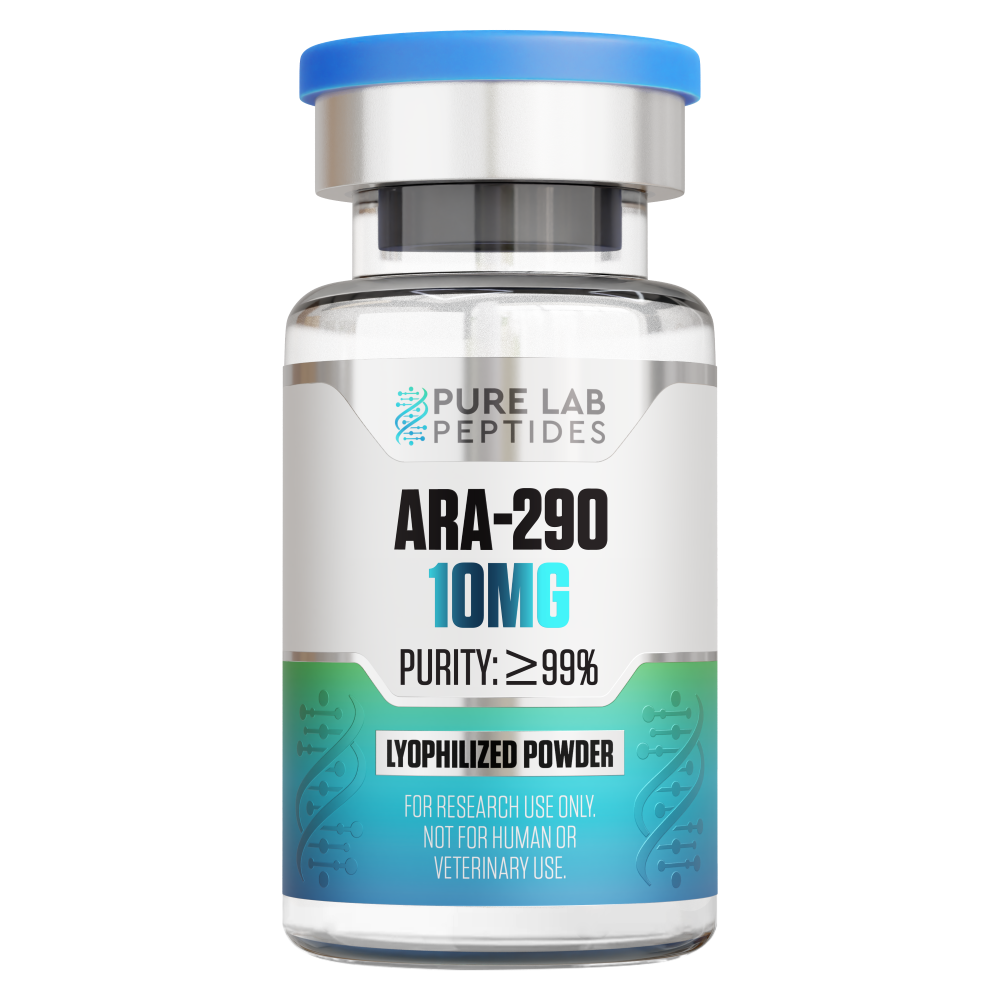
ARA-290 Quick Reference (10 mg Vial)
- Vial contents
- 10 mg ARA-290
- Final volume
- 2 mL
- Concentration
- 5 mg/mL
- One U-100 unit
- 50 mcg in 0.01 mL
Research context: For identity, mechanisms, human findings, limitations, and safety, read ARA-290 Peptide: Benefits, Uses, Side Effects, Dosage, and Research.
ARA-290 Dosage Chart
Dosing & Reconstitution Guide
10 mg vial math anchored to a published human study schedule
Human Study Calculation (2.0 mL = 5 mg/mL)
| Period | Amount per Administration | U-100 Units (mL) |
|---|---|---|
| Days 1–28 | 4 mg (4,000 mcg) | 80 units (0.80 mL) |
Frequency: Once daily by subcutaneous administration in the cited phase 2 study.[3] A separate pilot used 2 mg intravenously three times weekly for four weeks; that route and schedule should not be converted into this subcutaneous U-100 table.[5]
Research reference only: This table converts a published study amount into vial concentration and syringe volume. It is not a prescribing recommendation, and the manufactured clinical-trial formulation is not interchangeable with a third-party research vial.
Reconstitution Steps
- Clean the peptide-vial stopper and diluent-vial stopper with alcohol, then allow both to dry.
- Draw exactly 2.0 mL of bacteriostatic water with a new sterile syringe and inject it slowly down the inside wall of the peptide vial.
- Gently swirl or roll the vial until the contents are dissolved. Do not shake.
- Label the vial with the compound, 5 mg/mL concentration, and preparation date. Store it according to verified product-specific instructions.
Supplies Needed
This worked quantity plan mirrors the 28-day, 4 mg once-daily subcutaneous schedule used in the cited phase 2 study. It is an arithmetic example, not a purchasing or treatment recommendation.[3]
-
Peptide Vials (ARA-290, 10 mg each):
- 28 days at 4 mg/day = 112 mg total
- 112 mg ÷ 10 mg/vial = 11.2, so the calculation requires 12 vials when rounded up to whole vials
-
Insulin Syringes (U-100):
- One new syringe per administration
- 28 days: 28 syringes
-
Bacteriostatic Water (10 mL bottles): Use 2.0 mL per vial for this calculation.
- 12 vials × 2.0 mL = 24 mL total
- Round up to 3 × 10 mL bottles
-
Alcohol Swabs: One for the vial stopper and one for the administration site each day.
- 28 days × 2 = 56 swabs
- Round up to 1 × 100-count box


PeptideDosages has no affiliation with Pure Lab Peptides and receives no commission from these Pure Lab links. Supplier pages are not scientific evidence or proof of suitability for human use.
ARA-290 Vial and Research Context
- Reconstitute: Add 2.0 mL bacteriostatic water for a 5 mg/mL concentration.
- Human study context: 4 mg once daily by subcutaneous administration for 28 days was evaluated in a phase 2 trial.[3]
- U-100 conversion: At 5 mg/mL, 1 unit = 0.01 mL = 50 mcg; 4 mg equals 80 units (0.80 mL).
- Storage: Follow the exact product label and laboratory stability instructions. Do not infer a universal use-by period from vial strength alone.
ARA-290, also called cibinetide, is an investigational 11-amino-acid peptide derived from erythropoietin.[1][2] Researchers have examined innate repair receptor signaling and small-fiber neuropathy outcomes in diabetes and sarcoidosis, but the evidence remains preliminary and condition-specific.[3][4][10]
Protocol Overview
This 10 mg vial page keeps the clinical-study amount separate from the concentration and syringe-volume calculation.
- Compound: ARA-290, also called cibinetide, is an investigational erythropoietin-derived peptide.[1][2]
- Study schedule: A phase 2 trial evaluated 4 mg subcutaneously once daily for 28 days in participants with type 2 diabetes and painful neuropathy.[3]
- 10 mg calculation: Adding 2.0 mL produces 5 mg/mL; 4 mg equals 0.80 mL or 80 U-100 units.
- Route distinction: Other ARA-290 studies used different routes, populations, and amounts and should not be merged into one generalized schedule.[5][6]
- Status: ARA-290 is not FDA-approved, and the available human evidence remains condition-specific.[10]
Dosing Protocol
Published human studies used distinct research designs rather than one universal ARA-290 regimen.
- Type 2 diabetes with painful neuropathy: 4 mg subcutaneously once daily for 28 days.[3]
- Sarcoidosis pilot: 2 mg intravenously three times weekly for four weeks.[5]
- Sarcoidosis dose-ranging study: 1, 4, and 8 mg subcutaneous arms administered for 28 consecutive days.[6]
- Calculation scope: The primary table converts only the cited 4 mg subcutaneous study amount for this 10 mg vial.
The diabetes study record and published report document the 4 mg, 28-day schedule, while the sarcoidosis review, published outcomes, and European trial record describe separate condition-specific designs and endpoints.[7][11][18][19][20]
Storage Instructions
Storage conditions and use-by periods depend on formulation, container, sterility controls, and validated product data.
- Follow the exact product label and supplier documentation for the unopened lyophilized vial.
- After reconstitution, refrigerate only when supported by the product’s validated instructions.
- Protect the vial from light and avoid repeated temperature cycling.
- Do not use a vial that is cloudy, discolored, damaged, or contains unexpected particles.
General references on lyophilized formulations and compounding explain why stability and beyond-use dating must be formulation-specific; neither source establishes a product-specific shelf life.[21][22]
Important Notes
These checks keep the mass, concentration, route, and evidence source from being confused.
- A 10 mg vial contains 10 mg total; it does not define the amount used per administration.
- At 5 mg/mL, one U-100 unit represents 50 mcg. Recalculate whenever vial mass or final liquid volume changes.
- U-100 units are volume markings, not peptide international units.
- Intravenous and subcutaneous research schedules are not interchangeable through simple unit conversion.
- Short trials cannot establish long-term safety or general effectiveness.[3][5]
How This Works
ARA-290 is an 11-amino-acid peptide designed to study tissue-protective signaling without erythropoietin’s classical red-blood-cell response.[1][2] Researchers propose activity at the innate repair receptor, a complex involving the erythropoietin receptor and the beta-common receptor CD131.[8][16]
Preclinical research has examined inflammatory signaling, neuropathic pain, and TRPV1-related mechanisms, while early human studies have focused on small-fiber neuropathy in diabetes and sarcoidosis.[3][4][9] These findings do not establish a general treatment recommendation.
Additional tissue-protection and neuropathy reviews discuss the injury-response context and innate repair receptor rationale, while a preclinical study examined TRPV1-related pain signaling.[9][16][17][24]
Potential Benefits & Side Effects
Human findings are preliminary, short-term, and limited to specific research populations.
- Diabetic neuropathy research: A phase 2 study examined metabolic measures, neuropathic symptoms, and corneal nerve fiber density after 28 days.[3]
- Sarcoidosis-associated neuropathy: Small studies reported changes in symptoms and corneal or cutaneous nerve-fiber measures.[4][5][6]
- Non-erythropoietic design: ARA-290 was engineered to separate tissue-protective signaling from erythropoietin’s red-blood-cell-stimulating activity.[1][2]
- Tolerability limits: The cited studies were too small and short to establish long-term safety.
- Guideline uncertainty: The European Respiratory Society found insufficient evidence to recommend ARA-290 for sarcoidosis-related small-fiber neuropathy.[10]
Corneal nerve-fiber outcomes were also reported in ophthalmic research involving sarcoidosis-associated small-fiber neuropathy.[25]
Research Context Factors
Results should be interpreted within the population, route, duration, formulation, and outcome measures used in each study.
- Diabetic and sarcoidosis-associated neuropathy studies addressed different participant groups.
- Subcutaneous and intravenous schedules cannot be treated as equivalent.
- Clinical-trial material was manufactured and administered under controlled research conditions.
- A third-party research vial cannot be assumed to match a clinical formulation in identity, purity, sterility, excipients, bioavailability, or stability.
Injection Technique
The primary calculation represents subcutaneous administration under the conditions of the cited phase 2 study. General injection literature describes technique and absorption considerations but does not validate a specific research product.[12][13][14][15]
- Use a new sterile syringe and needle for every administration.
- Clean the vial stopper and selected site with alcohol and allow both to dry.
- Use an appropriate subcutaneous site and rotate sites systematically.
- Keep syringe-volume calculations separate from decisions about route, amount, and schedule.
- Place used needles immediately in an approved sharps container.
General subcutaneous-delivery reviews and patient guidance from Cleveland Clinic and Johns Hopkins, together with CDC route guidance, describe technique considerations; these sources do not validate ARA-290 or a specific research product.[14][15][23][26][27]
Recommended Source
Pure Lab Peptides is the site’s research-product supplier. The supplier button opens the current peptide catalog. A research peptide vial should not be assumed equivalent to clinical-trial material.
Supplier Link Scope
- The supplier card is separate from the academic evidence references.
- Confirm the product label, batch documentation, and storage instructions before relying on vial-specific information.
- Clinical-trial material should not be assumed equivalent to a commercial research vial.
Important Note
ARA-290 is investigational and is not FDA-approved. This page is for research education and transparent calculation only. It does not provide medical advice, diagnosis, treatment, or a direction for human use.
References
- 11IUPHAR/BPS Guide to Pharmacology: Cibinetide (ARA-290) ligand profile, structure, and pharmacology
- 22Hand and Brines, Journal of Investigative Medicine (2011): Promises and pitfalls in erythropoietin-mediated tissue protection
- 33Brines et al., Molecular Medicine (2015): Phase 2 study of 4 mg subcutaneous ARA-290 daily for 28 days in type 2 diabetes with painful neuropathy
- 44Dahan et al., Molecular Medicine (2013): Symptoms and corneal nerve fiber density in sarcoidosis-associated small nerve fiber loss
- 55Heij et al., Molecular Medicine (2012): Randomized pilot using 2 mg intravenous ARA-290 three times weekly for four weeks in sarcoidosis
- 66ClinicalTrials.gov NCT02039687: Sarcoidosis dose-ranging study with 1 mg, 4 mg, and 8 mg subcutaneous arms for 28 days
- 77van Velzen et al., Expert Opinion on Investigational Drugs (2014): Review of ARA-290 research in sarcoidosis-related small-fiber neuropathy
- 88Davis et al., Pain Reports (2017): Review of innate repair receptor targeting for neuropathy
- 99Zhang et al., Peptides (2016): Preclinical study of ARA-290 and TRPV1-related pain signaling
- 1010European Respiratory Society Clinical Practice Guideline (2021): Insufficient evidence to support a recommendation for sarcoidosis-related small-fiber neuropathy
- 1111ClinicalTrials.gov NCT01933529: Study record for 4 mg ARA-290 daily for 28 days in impaired glucose tolerance or type 2 diabetes
- 1212Annersten and Willman, Worldviews on Evidence-Based Nursing (2005): Literature review of the evidence base for subcutaneous injection technique
- 1313McLennan et al., Drug Discovery Today: Technologies (2005): Review of subcutaneous drug delivery and lymphatic absorption
- 1414Usach et al., Advanced Drug Delivery Reviews (2019): Pharmacologic considerations for subcutaneous drug delivery
- 1515Bittner et al., BioDrugs (2018): Review of the challenges and opportunities in subcutaneous administration of biotherapeutics
- 1616Collino et al., Pharmacology & Therapeutics (2015): Review of ARA-290 pharmacology and innate repair receptor signaling
- 1717
Journal of Internal Medicine (2008)
– Brines & Cerami: Erythropoietin-mediated tissue protection: reducing collateral damage from the primary injury response - 1818
Molecular Medicine (2014)
– Brines M. et al.: ARA 290 improves metabolic control and neuropathic symptoms in patients with type 2 diabetes - 1919
Molecular Medicine (2013)
– Dahan A. et al.: ARA 290 improves symptoms in sarcoidosis-associated small nerve fiber loss and increases corneal nerve fiber density - 2020EU Clinical Trials Register, EudraCT 2013-003016-45 Posted results for 1 mg, 4 mg, and 8 mg ARA-290 subcutaneous arms administered for 28 consecutive days.
- 2121
NCBI Bookshelf
– Stability and storage considerations for lyophilized peptide formulations - 2222
USP General Chapters
– Pharmaceutical compounding with bacteriostatic water: stability and beyond-use dating - 2323
Cleveland Clinic
– Subcutaneous injections: where and how to administer at home - 2424
Pain Reports (2017)
– Davis T. et al.: Targeting the innate repair receptor to treat neuropathy (review of ARA-290 mechanisms) - 2525
Investigative Ophthalmology & Visual Science (2016)
– Cibinetide improves corneal nerve fiber abundance in patients with sarcoidosis-associated small fiber neuropathy - 2626
Johns Hopkins Arthritis Center
– How to give a subcutaneous injection: patient guide - 2727
CDC
– Vaccine administration: subcutaneous route (angle, site, and technique guidance)
Related research, strength variants, and guides
Use the research overview for the evidence summary and the strength-variant page for its own concentration and syringe-unit calculations. Vial strengths are not interchangeable without recalculation.