

Selank is a synthetic peptide studied mainly for anxiety. Small human studies have reported improvements, but they do not settle whether it is a dependable long-term treatment. It is not an FDA-approved anxiety medicine, and claims of effortless focus, permanent calm or no side effects go beyond the evidence. [1][7][9]
Start with the human studies if you’re weighing Selank’s anxiety claims. Proposed brain mechanisms help frame the research, but a laboratory change doesn’t necessarily mean feeling or functioning better in daily life.
Related dosage pages: For vial-specific concentration, reconstitution, and measurement examples, see Selank (5 mg Vial) Dosage Protocol and Selank (10 mg Vial) Dosage Protocol. Each linked protocol remains a separate reference because vial strength changes concentration and syringe-unit calculations.
What is Selank peptide?
Selank is a seven-amino acid peptide, also called a heptapeptide. Researchers developed it from tuftsin, a naturally occurring immune-system peptide, by adding three amino acids. Its sequence is Thr-Lys-Pro-Arg-Pro-Gly-Pro. That origin explains the interest in both nervous-system and immune effects; it does not make the manufactured compound a natural supplement. [4]
You may see it described as an anxiolytic, meaning a substance intended to reduce anxiety, or a nootropic, meaning something proposed to improve cognition. Those labels describe the questions being investigated. They do not tell you how strong the supporting evidence is.
Does Selank help with anxiety?
Published clinical reports offer preliminary support, mostly from relatively small Russian-language studies. English abstracts describe comparisons with benzodiazepines rather than a large, independently replicated program of placebo-controlled trials. [1][2][3]
| Study | What was reported |
|---|---|
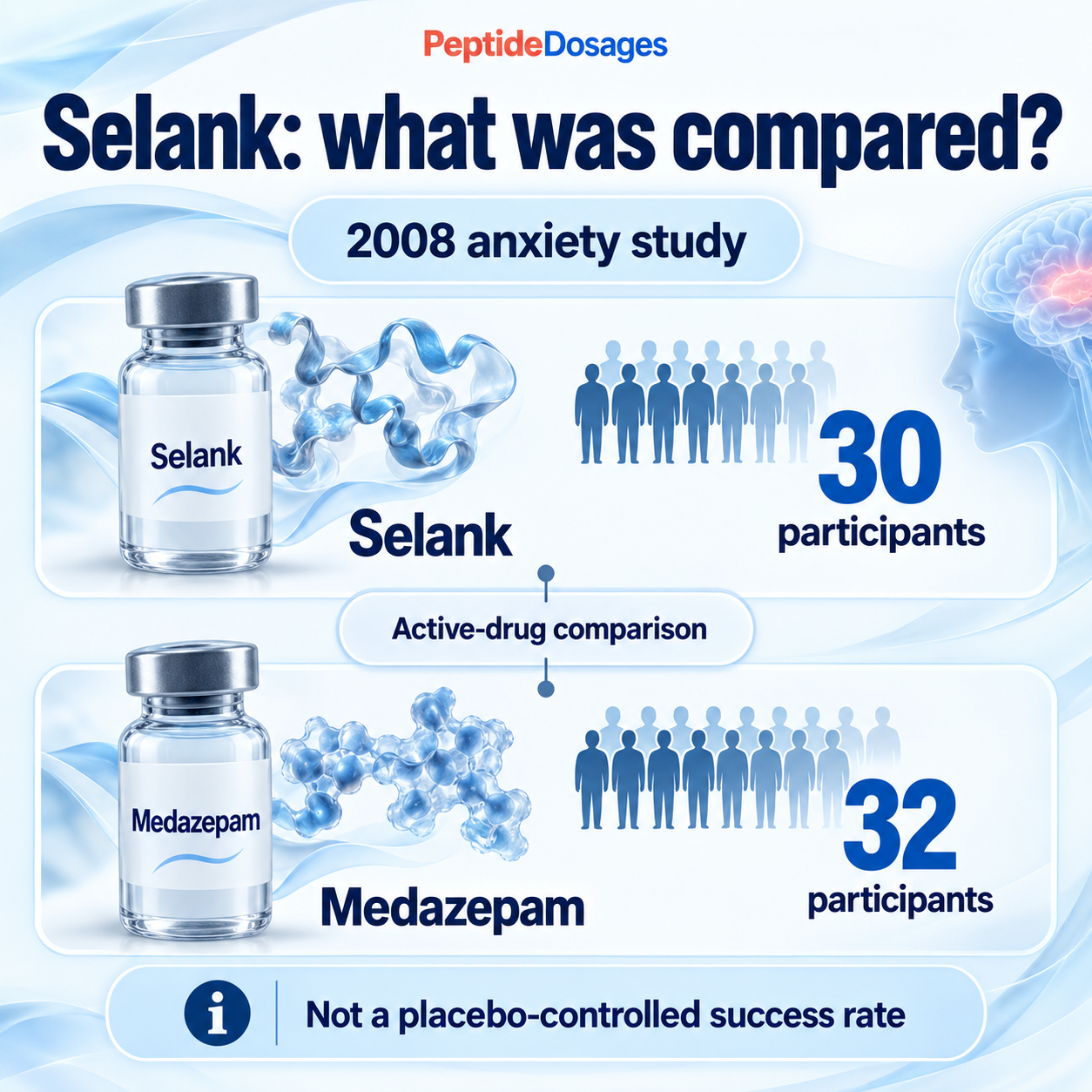
| Generalized anxiety disorder and neurasthenia, 2008 | Sixty-two patients were studied: 30 received Selank and 32 medazepam. The authors reported similar anxiety improvement. This active-drug comparison does not, by itself, establish equivalence or the size of a benefit over placebo. [1] |
| Anxiety and somatoform disorders, 2014 | A 60-patient comparison with phenazepam reported anxiety improvement and an effect continuing for a week after treatment. The abstract does not give enough detail to calculate a reliable individual success rate. [2] |
| Add-on treatment, 2015 | Thirty patients received phenazepam alone and 40 received phenazepam plus Selank. The authors reported earlier improvement and fewer unwanted phenazepam effects with the combination. This was not a test of Selank alone. [3] |
The distinction between an active comparator and a placebo matters. If two groups improve, that can be useful evidence, but the interpretation depends on allocation, blinding, follow-up and how improvement was measured. An abstract saying the effects were similar is not enough to conclude that Selank is just as effective as an established medicine.
These findings justify further research. They do not establish a universal response rate, a predictable onset time, or lasting benefit after repeated courses. The short reports also cannot answer how well an online nasal spray or injectable product would match the preparations used in the studies.
How might Selank work?
One proposed mechanism involves GABA, a neurotransmitter that helps regulate inhibitory signaling in the brain. A 2016 experiment examined gene expression in rat frontal cortex after intranasal Selank or GABA. The researchers found overlapping patterns and proposed an effect on GABA-related signaling. This was a rat tissue experiment, not a measurement of anxiety relief in people. [4]
A later experiment in human-derived neuroblastoma cells adds an important wrinkle: Selank alone did not change the measured gene-expression levels, although combinations with GABA or olanzapine changed the response. Human-derived cells are still a laboratory model, not human patients. Together, these studies suggest a complex mechanism rather than a proven ability to simply “increase GABA” or reset brain chemistry. [5]
Other work examined enzymes that break down enkephalins, small signaling peptides. Selank inhibited these enzymes in human serum samples. That is a biochemical observation, not proof of an antidepressant effect or a recommendation to combine it with psychiatric medication. [6]
What are the side effects and safety concerns?
The long-term safety picture is incomplete. Favorable tolerability descriptions in small studies should not be translated into “side-effect free.” Uncommon reactions, interactions and problems arising after prolonged exposure need larger and longer studies to characterize.
FDA specifically identifies concerns with compounded Selank acetate, also called TP-7. These include potential immune reactions associated with peptide aggregation or impurities, alongside insufficient information about human safety. This is a concern about the substance and its preparation, not a measured percentage risk for every product. [7]
There is no well-established, general interaction guide covering Selank with antidepressants, sleep medicines, alcohol or other peptides. The 2015 phenazepam combination study cannot clear every such combination as safe. If you already take medication, a pharmacist or prescribing clinician needs the complete list before any change is considered. [3]
Is Selank non-addictive?
The evidence here does not support a blanket guarantee about dependence or withdrawal across long-term use. It also does not support abruptly replacing a prescribed benzodiazepine with Selank. Benzodiazepines can require a supervised taper; stopping or switching treatment should be planned with the prescriber. [10]
What about pregnancy or breastfeeding?
The studies summarized above do not establish safety during pregnancy or breastfeeding. Nor do they provide a reliable pediatric treatment framework. Lack of a documented problem is not evidence that exposure is safe in these settings. [1][2][7]
Nasal spray, injection and dosage claims
Intranasal administration appears in the Selank research literature, but the route alone does not validate a consumer product. The concentration, ingredients and delivered amount matter. An injectable vial and a nasal preparation should not be treated as interchangeable, and rat doses cannot be converted into a personal schedule by simple arithmetic. [4]
There is no FDA-approved Selank dosing label for anxiety. A protocol found online is not evidence that the schedule works or that taking it daily is safe. That is why the useful question is not simply “how much?” It is whether there is dependable evidence for the exact preparation, route, condition and length of treatment being discussed. [7][9]
Selank vs Semax: are they the same?
No. They are different seven-amino acid peptides. A laboratory study examined both compounds against enzymes in human serum, but it did not compare relief of anxiety, attention or brain fog in patients. The fact that both appear in nootropic discussions does not establish that one is better, or that taking them together improves results. [6]
For the separate compound’s research background, see the Semax overview. A comparison should keep each study’s compound and outcome separate rather than combining them into a general claim about brain enhancement.
What does this mean if you are looking for anxiety relief?
You do not need to wait for experimental peptide research to get help. Anxiety that disrupts sleep, work or relationships deserves an assessment. Established options include cognitive behavioral therapy and, when appropriate, medication chosen around your symptoms, medical history and preferences. [8]
Useful questions for that appointment include:
- Could another health condition or a medicine be contributing to these symptoms?
- Which treatments have evidence for my particular anxiety problem?
- How will we measure improvement, and when should we reassess?
- What should I do if side effects or worsening symptoms occur?
Quick check: does a study in human cells count as a human treatment trial?
No. Human-derived cells can help researchers test a mechanism, but they do not experience anxiety or report daily functioning. A clinical trial studies people, with outcomes and safety monitoring suited to the treatment question.
Bottom line: Selank is an interesting research candidate, not a proven shortcut to lasting calm or mental clarity. Its early clinical findings deserve careful study, while its safety gaps deserve equal attention. Discuss persistent anxiety and any proposed treatment changes with a qualified healthcare professional.
References
- Zozulia AA, et al. Efficacy and possible mechanisms of action of a new peptide anxiolytic Selank in generalized anxiety disorders and neurasthenia. 2008;108:38-48. Russian article; English abstract.
- Medvedev VE, et al. A comparison of the anxiolytic effect and tolerability of Selank and phenazepam in anxiety disorders. 2014;114:17-22. Russian article; English abstract.
- Medvedev VE, et al. Optimization of the treatment of anxiety disorders with Selank. 2015;115:33-40. Russian article; English abstract.
- Volkova A, et al. Selank Administration Affects the Expression of Some Genes Involved in GABAergic Neurotransmission. Frontiers in Pharmacology. 2016;7:31.
- Filatova E, et al. GABA, Selank, and Olanzapine Affect the Expression of Genes Involved in GABAergic Neurotransmission in IMR-32 Cells. Frontiers in Pharmacology. 2017;8:89.
- Kost NV, et al. Semax and Selank inhibit the enkephalin-degrading enzymes from human serum. Bioorganicheskaia Khimiia. 2001;27:180-183.
- U.S. Food and Drug Administration. Certain bulk drug substances for use in compounding that may present significant safety risks. Selank acetate entry.
- National Institute of Mental Health. Generalized Anxiety Disorder: What You Need to Know. Treatment and support information.
- U.S. Food and Drug Administration. Nicholasville compounding pharmacy and its owner plead guilty to unlawful distribution of prescription drugs. Historical enforcement notice identifying Selank among unapproved drugs.
- National Institute of Mental Health. Mental Health Medications. Anti-anxiety medication and withdrawal guidance.
Related dosage protocols and research
Explore related research, dosage references and guides below. Vial strengths have separate references because concentration and syringe-unit calculations differ. A comparison does not mean the compounds are interchangeable.
Matching dosage protocols
Related protocols and comparisons
Further research context