
Tesamorelin and ipamorelin affect growth-hormone signaling in different ways. That’s why they’re sometimes paired. It doesn’t tell us whether the combination works better.
Tesamorelin has clinical evidence for reducing excess abdominal fat in adults with HIV-associated lipodystrophy. The studies below do not show that adding ipamorelin improves that result, sleep or recovery.1,2,3
What are tesamorelin and ipamorelin?
Tesamorelin is a growth hormone-releasing hormone analogue. Ipamorelin is a growth-hormone secretagogue studied through ghrelin-receptor signaling. Neither is simply another name for growth hormone.1,2
In the United States, the tesamorelin product EGRIFTA WR is indicated for excess abdominal fat in adults with HIV-associated lipodystrophy. Its label explicitly separates that use from general weight-loss treatment.1
What the studies tested
| Research question | What was studied | What remains unproven |
|---|---|---|
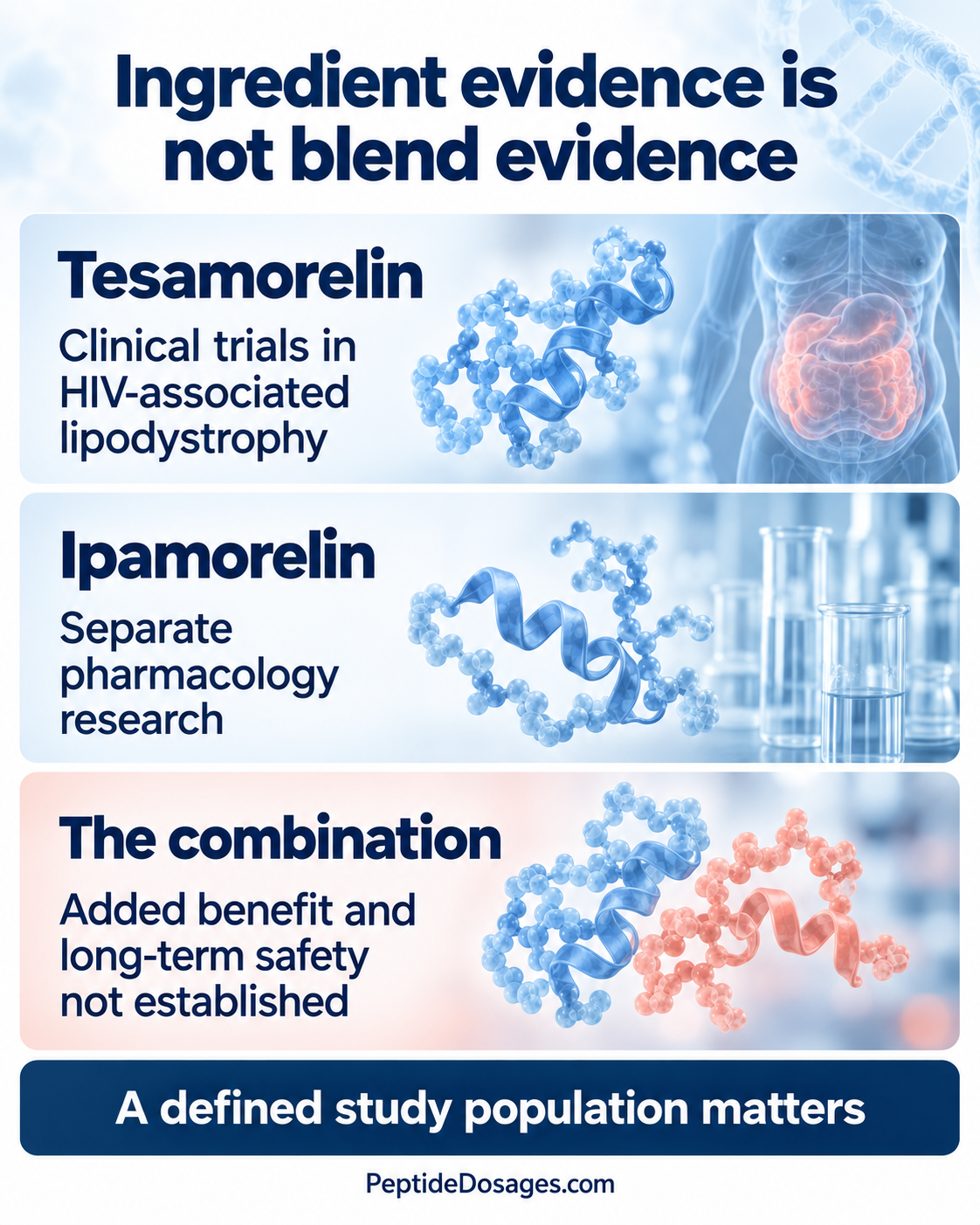
| Tesamorelin and abdominal fat | Controlled trials in HIV-associated lipodystrophy | The same benefit in every weight-loss population |
| Ipamorelin and GH release | Foundational animal pharmacology | Long-term wellness benefits |
| Tesamorelin + ipamorelin | The studies below tested the ingredients separately | Added benefit, optimal exposure and long-term safety |
The distinction is between evidence for an ingredient and evidence for the pairing.2,3,4
What did the tesamorelin clinical trial find?
A randomized trial involving 404 adults with HIV and abdominal-fat accumulation reported a 10.9% reduction in visceral adipose tissue after six months with tesamorelin, compared with 0.6% with placebo. Abdominal subcutaneous fat did not significantly change.3
Participants continuing treatment through the extension had further visceral-fat improvement; the benefit was lost in those switched to placebo. This was a monitored study of tesamorelin, not tesamorelin plus ipamorelin.3
Visceral fat sits around internal organs. The 10.9% figure describes a reduction in that fat compartment, not a 10.9% loss of body weight. Keeping those measurements separate makes the result much easier to interpret.
Does adding ipamorelin improve results?
The studies discussed here cannot answer that. The early ipamorelin experiments measured hormone release in animals; they did not test whether adding it to tesamorelin improved outcomes.2
To find out, researchers would need to compare the ingredients alone with the combination, track meaningful outcomes and monitor harms. A stronger hormone signal, by itself, would not settle whether people benefit.
Side effects and safety
The tesamorelin label warns about elevated IGF-1, fluid retention and glucose intolerance or diabetes. Active malignancy, pregnancy and disruption of the hypothalamic-pituitary axis are among its contraindications. These risks need medical assessment; they also cannot tell us the full safety profile of a blend.1
The human ipamorelin trial cited here examined intravenous treatment for gut recovery after surgery. Its setting and route differ from repeated subcutaneous use of a wellness blend, so the results cannot settle that blend’s safety.4
Adding a second ingredient complicates identifying the cause of an adverse effect. Research-product purity and sterility also need separate consideration from the biological mechanism.
Why preparation instructions differ
EGRIFTA WR and EGRIFTA SV have different preparations and are not interchangeable. Instructions for a licensed tesamorelin product should not be copied to a mixed research vial.1
The tesamorelin/ipamorelin blend reference explains the component amounts and preparation calculations. It is a calculation reference, not a clinically validated treatment schedule.
Frequently asked questions
Is this combination FDA-approved?
Approval of a tesamorelin medicine does not extend to a tesamorelin/ipamorelin blend. The product and its approved use both matter.1
How long does the blend take to work?
The six-month tesamorelin trial does not give a reliable timeline for the blend. It tested a different formulation, without ipamorelin, in a defined patient group.3
Can it replace an assessment for low growth hormone?
No. Suspected endocrine disease requires clinical evaluation. Symptoms such as fatigue or body-composition changes do not identify a hormone deficiency by themselves.
References
- DailyMed. EGRIFTA WR prescribing information.
- Raun K, et al. Ipamorelin growth-hormone secretagogue experiments. 1998.
- Falutz J, et al. Tesamorelin in HIV-associated abdominal-fat accumulation: randomized trial and extension. 2010.
- Beck DE, et al. Ipamorelin in postoperative ileus: randomized clinical trial. 2014.