
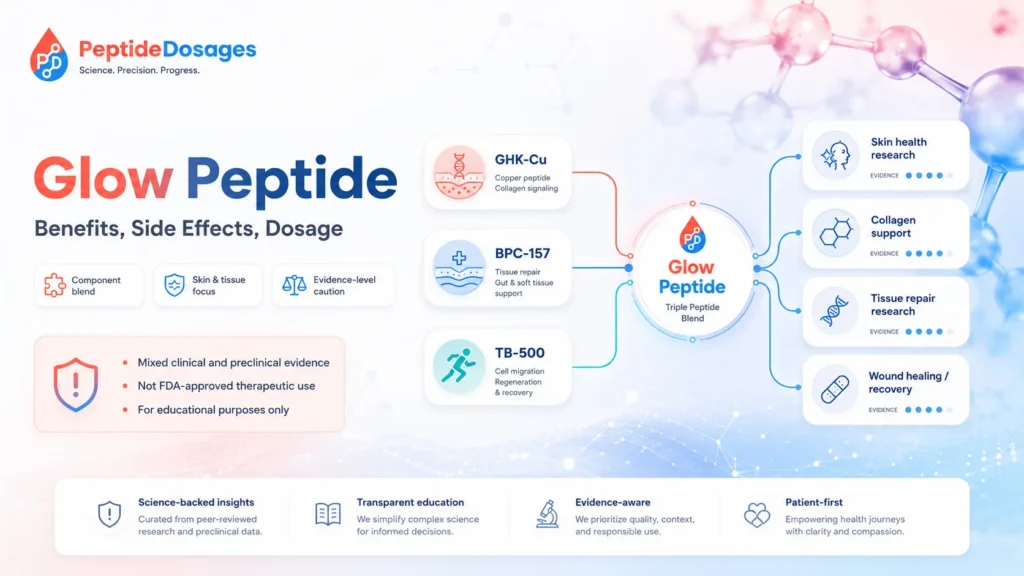
Glow peptide is a wellness-market term most often used for a peptide stack that includes GHK-Cu, BPC-157, and TB-500 rather than a single FDA-approved drug product. This educational article reviews the proposed mechanisms, potential benefits, research evidence, safety issues, dosage context, administration routes, and regulatory status of the glow peptide blend using evidence-graded language. It is not personal medical advice and should not be used as a peptide protocol, injection guide, or recommendation to use any unapproved peptide therapy.
- Glow peptide is usually a blend, not one peptide. The term commonly refers to a peptide stack built around GHK-Cu, BPC-157, and TB-500, but “Glow peptide” is not listed as an FDA-approved drug product in FDA drug databases 1.
- GHK-Cu has the most direct skin-related rationale. GHK-Cu is a naturally occurring copper-binding peptide studied in skin biology, extracellular matrix signaling, collagen-related pathways, and wound-repair models 6.
- BPC-157 and TB-500 claims are more evidence-limited. BPC-157 and thymosin beta-4/TB-500-related research is largely preclinical or investigational, and animal or cell findings should not be interpreted as proven human benefits 10, 13.
- Potential benefits are evidence-graded. Skin quality, collagen signaling, wound healing, tissue repair, inflammation, hair growth, and faster recovery claims vary widely in evidence strength.
- Safety is not fully characterized for the stack. Possible side effects may include injection site reactions, irritation, bruising, edema, allergic reactions, and unknown risks from compounded or unapproved peptide blends 2.
- There is no approved Glow peptide dose. Dosage information should be limited to approved labeling or published-study context, and study doses should not be interpreted as personal dosing advice [1].
- Regulatory status matters. Approved drugs, compounded products, investigational compounds, and unapproved online products are not evaluated the same way for quality, safety, labeling, or effectiveness [2], 19.
Related dosage pages: For vial-specific concentration, reconstitution, and measurement examples, see GLOW (70 mg Blend) Dosage Protocol. Each linked protocol remains a separate reference because vial strength changes concentration and syringe-unit calculations.
Fast Answer
Glow peptide is a nonstandard term for a peptide stack commonly discussed for skin health, collagen support, tissue repair, and wellness. It often includes GHK-Cu, BPC-157, and TB-500, but the blend itself is not an FDA-approved drug, and evidence differs by component [1], [6], [10]. GHK-Cu has skin-biology research, while BPC-157 and TB-500 claims rely heavily on preclinical or investigational data. Safety, dosage, injection, and regulatory questions require clinician review.
What Is the Glow Peptide?
Glow peptide is best understood as a branded or descriptive wellness term, not as a single standardized peptide with one chemical identity. In many discussions, the glow peptide blend combines three peptides: GHK-Cu, BPC-157, and TB-500, each with different proposed mechanisms and different evidence limitations [6], [10], [13].
The phrase can be confusing because “peptide” normally refers to a defined chain of amino acids, while “Glow peptide” usually refers to a mixture or peptide stack. Peptide therapeutics as a field includes approved drugs, investigational compounds, and research-only molecules, but these categories should not be treated as interchangeable 16, 17.
Why Glow Peptide Is Usually Described as a Peptide Stack
A peptide stack means more than one peptide is combined in a proposed wellness or therapeutic approach. The glow peptide stack is usually discussed for skin rejuvenation, collagen production, inflammation modulation, and tissue repair, but these claims need to be separated by evidence level.
The key point is that evidence for one component does not automatically validate the entire blend. For example, GHK-Cu skin-biology data cannot prove that an injectable combination with BPC-157 and TB-500 improves skin quality or accelerates recovery in humans.
How GHK-Cu, BPC-157, and TB-500 Are Commonly Discussed
GHK-Cu is a copper peptide found in human plasma and biological fluids, and it has been studied for gene expression, skin remodeling, and wound-related pathways [6], 8. BPC-157 is a synthetic peptide derived from a gastric protein sequence and is often discussed in tissue repair and tendon research, but much of the indexed literature is preclinical [10], 11.
TB-500 is commonly described as a synthetic fragment or analog related to thymosin beta-4, a peptide involved in actin binding, cell migration, and repair biology [13]. However, TB-500 products marketed online should not be assumed to be equivalent to regulated thymosin beta-4 investigational products.
Why a Blend Is Different From an Approved Peptide Drug
An approved peptide drug has a defined active ingredient, indication, manufacturing standard, prescribing information, dose instructions, and safety labeling reviewed by a regulator. Glow peptide does not have that status as a named FDA-approved product in Drugs@FDA [1].
This distinction matters because compounded or unapproved peptide products may differ in identity, purity, sterility, labeling, and clinical evidence. FDA states that compounded drugs are not FDA-approved and are not reviewed by FDA for safety, effectiveness, or quality before marketing [2].
Glow Peptide Blend Components and Their Proposed Roles
The proposed roles of the glow blend are usually built from component-level biology. The stack is often framed as synergistic, but synergy is a hypothesis unless tested in well-designed human studies using the exact formulation, dose, route, and population.
| Evidence Area | What Has Been Studied | Evidence Level | What It Can and Cannot Show |
|---|---|---|---|
| GHK-Cu skin biology | Gene expression, extracellular matrix, collagen-related pathways, and skin-regeneration mechanisms [6], 7 | Early human / mechanistic / preclinical | Supports biological plausibility, not guaranteed skin outcomes from a stack |
| BPC-157 tissue repair | Animal and cell studies involving tendon, ligament, gut, and injury models [10], [11] | Preclinical | Cannot establish routine human effectiveness |
| TB-500 / thymosin beta-4 | Cell migration, actin-related repair biology, and investigational wound or ocular research [13], 14 | Preclinical / investigational | Does not prove that commercial TB-500 blends are clinically effective |
| Glow peptide stack | Combined use of GHK-Cu, BPC-157, and TB-500 | Unsupported as a standardized blend | Needs formulation-specific clinical trials |
GHK-Cu Peptide and Copper Peptide Skin Biology
GHK-Cu is a naturally occurring copper-binding peptide made of glycine, histidine, and lysine complexed with copper. It has been studied for extracellular matrix remodeling, collagen and elastin-related signaling, antioxidant-response pathways, and wound-repair biology [6], [7].
This is why peptides such as GHK-Cu are often discussed as peptides for skin. Still, topical GHK-Cu, cosmetic copper peptide products, and injectable glow peptide therapy are different contexts and should not be treated as interchangeable.
BPC-157 Peptide in Tissue Repair Research
BPC-157 peptide is often discussed for tissue repair, tendon injury, ligament models, gastrointestinal injury models, and inflammation-related pathways. PubMed-indexed BPC-157 literature includes many animal and mechanistic studies, but human clinical evidence remains limited compared with approved therapeutics [10], 15.
Preclinical findings can help researchers generate hypotheses. They do not prove that people will experience faster recovery, reduced inflammation, or improved musculoskeletal outcomes.
How Does Glow Peptide Therapy Work?
Glow peptide therapy is usually proposed to work through multiple pathways rather than one receptor target. The most common proposed pathways include copper peptide signaling, fibroblast activity, collagen and elastin remodeling, cell migration, angiogenesis, and modulation of inflammation [6], [7], [13].
Peptides Are Short Chains That Act as Biological Signals
Peptides are short chains of amino acids, and many act as biological signals in the body. Modern peptide therapeutics include hormones, receptor agonists, antagonists, antimicrobial peptides, and other molecules designed for specific medical targets [16], [17].
That general principle does not mean every wellness peptide is clinically proven. A peptide may have interesting cellular activity but still lack adequate human safety or efficacy data.
Proposed Cellular Pathways for Collagen, Inflammation, and Regeneration
GHK-Cu research suggests effects on genes and pathways related to tissue remodeling, collagen synthesis, anti-inflammatory signaling, and skin regeneration [6], [7]. Thymosin beta-4 research supports a role in actin dynamics and cell migration, which are relevant to wound healing and tissue repair biology [13].
BPC-157 has been explored in preclinical models involving blood vessels, tendon, gastrointestinal tissue, and injury repair, but these remain translational findings rather than established treatment effects [10], [11].
Why Peptides Work Differently Depending on Route and Context
A topical peptide, oral peptide, subcutaneous injection, intravenous therapy, and laboratory cell exposure can produce very different pharmacologic conditions. Route of administration can affect absorption, bioavailability, tissue exposure, metabolism, and safety interpretation [16], [17].
This is one reason published study findings should not be converted into a personal peptide protocol. A dose or route used in a study is not a recommendation for self-use.
Potential Benefits of Glow Peptide
The potential benefits of glow peptide are best described as hypotheses based on component-level evidence. The strongest rationale is skin-focused and tied to GHK-Cu; broader claims about systemic tissue repair, faster recovery, anti-aging benefits, and hair growth require more caution.
Benefits for Skin Quality, Texture, and Firmness
The benefits for skin most often discussed include skin quality, skin texture, firmness, fine lines, and skin elasticity. These claims are biologically plausible for GHK-Cu because copper peptide research involves fibroblasts, collagen and elastin pathways, and extracellular matrix remodeling [6], [7].
However, improvements in skin from topical or cosmetic research cannot prove that an injectable glow peptide blend improves skin appearance. The evidence should be interpreted by product type, formulation, route, and study design.
Collagen and Elastin Support: What Is Plausible?
GHK-Cu has been studied for collagen production, collagen synthesis, elastin-related signaling, and tissue remodeling pathways [6], [7]. These mechanisms support the idea that a copper peptide may influence skin biology at the cellular level.
But mechanism is not the same as clinical outcome. A collagen peptide signal in cells does not guarantee visible skin rejuvenation, improved skin elasticity, or durable anti-aging benefits in humans.
What Is Known and Unknown About Hair Growth Claims
Hair growth claims appear frequently in wellness discussions about GHK-Cu and glow peptide therapy. Some mechanistic literature links GHK-Cu to skin and follicle biology, but high-quality clinical evidence for a glow peptide stack as a hair growth therapy is not established [6], 9.
Hair loss can have hormonal, autoimmune, nutritional, medication-related, inflammatory, and genetic causes. Readers considering peptide-related decisions for skin and hair should discuss diagnosis and evidence-based options with a licensed clinician.
What Is Glow Peptide Used For or Studied For?
Glow peptide is most often discussed for wellness, skin rejuvenation, support skin health, recovery from injuries, and tissue repair. These uses range from plausible skin-biology hypotheses to unsupported online claims.
Approach to Skin Health and Skin Rejuvenation
As an approach to skin health, the most evidence-aligned component is GHK-Cu. Research has explored GHK-Cu as a naturally occurring peptide found in human biology and as a copper-binding peptide involved in skin regeneration pathways [6], [8].
For skin rejuvenation, the evidence should be framed as early, formulation-dependent, and not equivalent to approved dermatologic treatments. Sunscreen, retinoids, procedural dermatology, wound care, and treatment of underlying skin disease have separate evidence bases and regulatory pathways.
Tissue Repair, Wound Healing, Tendon, and Ligament Research
BPC-157 and TB-500 are often promoted for tissue repair, wound healing, tendon injury, and ligament recovery. Published research includes preclinical BPC-157 injury models and thymosin beta-4 repair biology, but these do not establish routine clinical use for recovery from injuries [10], [11], [13].
The term regenerative is often used online, but regenerative medicine claims require careful evidence review. Biological plausibility does not replace controlled human trials.
What Does Human Research Say About GHK-Cu?
Human evidence for GHK-Cu is more relevant to skin-related questions than to systemic tissue repair. Reviews describe GHK-Cu as a copper-binding tripeptide involved in tissue remodeling, skin repair, and gene-expression effects, but the quality and applicability of human evidence varies [6], [7].
Human Evidence for Topical GHK-Cu and Skin Health
Topical and cosmetic contexts are the most common human-facing use cases for copper peptide GHK-Cu. Published reviews describe studies and mechanisms related to improved skin appearance, collagen-related remodeling, and skin regeneration, but these sources also rely heavily on mechanistic and smaller clinical evidence rather than large drug-approval trials [6], [7].
The practical interpretation is narrow: GHK-Cu has a skin-biology rationale, especially as a topical ingredient, but that does not validate every claim made for a glow peptide injection.
Limits of Applying GHK-Cu Data to Injectable Glow Peptide Therapy
A topical peptide acts mainly at or near the skin surface, depending on formulation and penetration. An injectable peptide therapy has different exposure, sterility, pharmacokinetic, and safety questions.
Therefore, clinical or cosmetic data on topical GHK-Cu should not be used as proof that an injectable glow peptide blend is safe or effective. FDA’s compounding guidance also emphasizes that compounded drugs are not FDA-approved and are not evaluated by FDA before marketing for safety, effectiveness, or quality [2].
What Preclinical Evidence Suggests About BPC-157 and TB-500
The evidence base for BPC-157 and TB-500 is mainly preclinical, investigational, or indirect. This does not mean the research is irrelevant; it means the claims should be limited to what the research can show.
Animal and Cell Models for BPC-157 and Tissue Repair
Animal and cell studies have examined BPC-157 in relation to tissue repair, tendon models, wound healing, gastrointestinal injury, angiogenesis, and inflammation-related pathways [10], [11]. These models can identify possible mechanisms and guide future research.
They cannot prove human outcomes such as faster recovery, reduced pain, improved tendon strength, or safe long-term use. Human clinical trials are needed before strong therapeutic claims can be made.
TB-500, Thymosin Beta-4, and Cell Migration Pathways
Thymosin beta-4 is an actin-binding peptide involved in cell migration and repair-related biology [13]. TB-500 is commonly discussed as a synthetic thymosin beta-4-related peptide, but commercial TB-500 claims often go beyond the evidence available for regulated investigational products.
ClinicalTrials.gov lists investigational studies involving thymosin beta-4-related products, including ocular or wound-related contexts, but this does not establish approved use for TB-500 peptide stacks [14].
Why Preclinical Recovery Findings May Not Predict Patient Outcomes
Preclinical studies use controlled models, defined injury types, and species-specific biology. Human patients vary by age, diagnosis, medications, immune function, nutrition, circulatory system health, and coexisting disease.
This is why claims about recovery, healing, tissue repair, and reduced inflammation should be framed as investigational unless supported by well-designed human studies. Translational gaps are especially important for injectable or compounded peptide blends.
Evidence Limits and Unsupported Online Claims
A major information gap is that “Glow peptide” is not a standardized drug name, study product, or approved formulation. Without a defined formulation, researchers cannot easily compare results across studies or assess safety across populations.
Separating Mechanism Claims From Clinical Outcomes
Mechanism claims describe what might happen at the cellular level. Clinical outcome claims describe what actually happened in humans under controlled conditions.
For example, GHK-Cu may influence collagen-related gene expression, but that does not prove clinically meaningful skin rejuvenation from a glow peptide stack [6]. BPC-157 may show repair effects in animals, but that does not prove treatment benefit in people [10].
Claims About Faster Recovery and Anti-Aging Benefits That Need Caution
Online claims about faster recovery, anti-aging benefits, improved skin, energy, and performance are often anecdotal. Anecdotal reports can generate questions, but they cannot establish safety, efficacy, dose-response, contraindications, or long-term risks.
The most responsible way to evaluate benefits of glow peptide is to ask: Is the claim based on approved labeling, human clinical evidence, early human evidence, preclinical evidence, or unsupported reports?
Potential Side Effects and Safety Concerns
Potential side effects depend on the peptide, dose, route, formulation, sterility, individual health history, and whether the product is approved, compounded, or unapproved. For glow peptide therapy, safety is difficult to characterize because the blend is not standardized and does not have FDA-approved labeling [1], [2].
Possible Side Effects Reported With Peptide Therapy
Possible side effects discussed with peptide therapy include local irritation, rash, headache, nausea, fatigue, allergic reaction, and injection site reactions, although the exact risk profile depends on the specific peptide and product. For unapproved blends, adverse event frequency is often unknown because there may be no large controlled safety database.
FDA encourages reporting adverse events through MedWatch, which is relevant when unexpected reactions occur with drugs, biologics, or compounded products 18.
Injection Site Reactions, Edema, Bruising, and Irritation
Injection site reactions may include pain, redness, swelling, bruising, edema, or irritation. These risks are not unique to glow peptide; they can occur with injectable medicines and compounded preparations, especially when sterility, handling, or formulation quality is uncertain [2].
This article does not provide injection instructions. Any injectable therapy should be discussed with a licensed clinician who can assess medical need, sterile technique, adverse events, and alternatives.
Copper, Immune Response, and Allergy-Related Safety Questions
Because GHK-Cu is a copper peptide, clinicians may consider copper metabolism, allergy history, skin sensitivity, and concurrent topical or systemic exposures. The published GHK-Cu literature describes broad biological activity, but broad activity is not the same as a complete safety profile for every route or formulation [6], [7].
Immune response, contamination, incorrect concentration, or product substitution are additional concerns with unapproved peptide products. FDA notes that compounded drugs can pose quality risks when not made under appropriate conditions [2].
Contraindications, Drug Interactions, and Medical Screening
There are no FDA-approved glow peptide prescribing instructions that define formal contraindications or drug interactions. That absence should not be interpreted as proof of safety.
Health History Factors Clinicians May Review
A clinician may review health history, current medications, allergies, immune system conditions, cancer history, wound-healing disorders, kidney or liver disease, pregnancy status, breastfeeding, and prior reactions to injections or topical ingredients. This is especially relevant because safety evidence for the combined glow peptide blend is limited.
Clinicians may also consider whether a skin or injury concern has an established diagnosis. Treating a symptom without diagnosis can delay evidence-based care.
Pregnancy, Breastfeeding, Cancer History, and Complex Medical Conditions
Pregnancy and breastfeeding are special populations because many drugs and biologically active compounds lack adequate safety data in these groups. Cancer history and complex immune conditions also require caution because growth, repair, angiogenesis, and immune signaling pathways can be clinically sensitive.
For these groups, the absence of evidence is not evidence of safety. Decisions should be clinician-guided and based on approved alternatives whenever possible.
Dosage Information From Labels and Published Studies
There is no FDA-approved Glow peptide dose because Glow peptide is not an FDA-approved drug product [1]. Study doses should not be interpreted as personal dosing advice.
Why There Is No Approved Glow Peptide Dose
Approved dosage information comes from labeling for a specific approved drug, indication, formulation, route, and population. Glow peptide does not have that approved-label framework [1].
Because the glow blend may contain different concentrations of GHK-Cu, BPC-157, and TB-500 depending on source, a “dose” reported online may not correspond to a verified formulation. This creates safety, quality, and interpretation problems.
How Study Doses Differ From Personal Medical Advice
Published studies may use specific doses in animals, cell models, topical preparations, or investigational protocols. Those doses are chosen for research purposes and are not general instructions for personal use.
Dose interpretation also depends on body size, route, formulation, absorption, disease state, adverse-event monitoring, and study endpoints. This is why dosage decisions belong in a medical context, not in a generalized wellness protocol.
Injection, Topical, and Other Administration Routes in Literature
Administration routes discussed around glow peptide include topical use, injectable use, and investigational routes in preclinical or clinical research. The route matters because it changes exposure, risk, and what evidence can be applied.
Topical Versus Injectable Use of the Glow Peptide Blend
Topical GHK-Cu is most closely connected to skin care and skin health discussions. Injectable glow peptide therapy, by contrast, raises systemic exposure, sterility, compounding, adverse event, and regulatory questions [2], [6].
Evidence for topical copper peptide activity should not be used as a direct substitute for evidence on subcutaneous injection or injectable peptide blends. Route-specific data are needed.
Why Subcutaneous Injection Requires Medical Supervision
Subcutaneous injection is a medical route of administration. It can involve risks such as infection, bruising, edema, dosing errors, allergic reactions, and adverse events from the active ingredient or excipients.
This article does not explain how to inject, mix, reconstitute, or self-administer peptides. Those topics require licensed clinical oversight and should not be guided by general online content.
Regulatory Status: Is Glow Peptide FDA-Approved?
Glow peptide is not listed as an FDA-approved drug product in Drugs@FDA as a named therapy [1]. FDA-approved status is product-specific, indication-specific, and label-specific.
Compounding, Prescription Use, and Unapproved Peptide Blends
Compounding can be lawful in specific medical contexts, but compounded drugs are not FDA-approved and are not reviewed by FDA for safety, effectiveness, or quality before marketing [2]. FDA also maintains information about bulk drug substances used in compounding under section 503A of the FD&C Act 3.
Unapproved peptide blends sold outside appropriate medical and regulatory channels may create additional risks. FDA’s unapproved-drugs resources explain that unapproved products may lack adequate evidence, labeling, or manufacturing review [19].
How Regulatory Status Affects Product Quality and Safety
Regulatory status affects identity, potency, sterility, labeling, adverse-event tracking, and manufacturing controls. Approved products are evaluated for specific uses; unapproved or compounded products are not evaluated in the same way [2], [19].
The EMA medicines database and FDA databases are examples of official sources for checking whether a medicine has regulator-reviewed status in a given jurisdiction [1], 4.
Comparing the Glow Peptide Stack With Related Therapies
The glow peptide stack is best compared by mechanism, evidence level, route, regulatory status, and safety data. It should not be compared as “best” or “strongest” for personal use.
GHK-Cu Versus Other Peptides for Skin and Hair
GHK-Cu has a more direct skin-biology rationale than BPC-157 or TB-500 because it has been studied in relation to extracellular matrix remodeling, collagen, elastin, and skin regeneration pathways [6], [7]. Other peptides for skin may have cosmetic, dermatologic, or investigational uses, but evidence varies by molecule and formulation.
For hair growth, evidence is less established. Claims should be considered preliminary unless supported by high-quality clinical trials in defined hair-loss conditions.
BPC-157 and TB-500 Compared With Conventional Recovery Care
BPC-157 and TB-500 are often discussed in recovery and tissue repair contexts, but conventional care for injuries may include diagnosis, physical therapy, load management, anti-inflammatory strategies when appropriate, surgery in selected cases, and evidence-based rehabilitation. Peptide research does not replace standard evaluation of tendon, ligament, wound, or musculoskeletal injury.
A careful comparison should ask whether the peptide has human evidence, approved status, known adverse events, and a clearly defined formulation. For BPC-157 and TB-500, those questions remain important evidence gaps [10], [14], [15].
Practical Questions Before Considering Glow Peptide Wellness Therapy
Before considering glow peptide wellness therapy, the safest approach is to focus on evidence quality, medical context, and regulatory status. The decision should not be based on online claims alone.
What to Discuss With a Clinician About Evidence, Safety, and Goals
Use this checklist as a discussion guide with a qualified healthcare professional:
- What condition, symptom, or goal is being addressed?
- Is there an established diagnosis?
- What approved or guideline-supported options exist?
- Is the proposed peptide approved, compounded, investigational, or unapproved?
- What evidence supports the specific peptide, route, formulation, and dose?
- What are the possible side effects and adverse events?
- Are there concerns related to pregnancy, breastfeeding, cancer history, immune disease, medications, allergies, or prior injection reactions?
- How would benefits and harms be monitored?
- What would be the plan if symptoms worsen or an adverse event occurs?
The safest way to interpret Glow peptide is through evidence quality, regulatory status, safety data, and clinician-guided decision-making. Strong conclusions require approved labeling or well-designed human studies; weaker claims should be treated cautiously.
Related dosage protocols and research
Use the available links to move between research context, dosage pages or comparisons, and supporting guides. When vial-size variants exist, they remain separate because concentration and syringe-unit calculations change with vial strength. Comparisons do not imply that different compounds are interchangeable.
Matching dosage protocols
Related protocols and comparisons
Further research context
REFERENCES
- U.S. Food and Drug Administration. Drugs@FDA: FDA-Approved Drugs Database. FDA official database. Accessed 2026.
- U.S. Food and Drug Administration. Compounding and the FDA: Questions and Answers. FDA. Updated resource.
- U.S. Food and Drug Administration. Bulk Drug Substances Used in Compounding Under Section 503A of the FD&C Act. FDA. Updated resource.
- European Medicines Agency. EMA Medicines Database. EMA official database. Accessed 2026.
- ClinicalTrials.gov. Search results for “Glow peptide”. U.S. National Library of Medicine. Accessed 2026.
- Pickart L, Margolina A. Regenerative and Protective Actions of the GHK-Cu Peptide in the Light of the New Gene Data. International Journal of Molecular Sciences. 2018.
- Pickart L, Vasquez-Soltero JM, Margolina A. GHK Peptide as a Natural Modulator of Multiple Cellular Pathways in Skin Regeneration. BioMed Research International. 2015.
- Pickart L, Thaler MM. Tripeptide in human serum which prolongs survival of normal liver cells and stimulates growth in neoplastic liver. Nature New Biology. 1973.
- National Library of Medicine. PubMed search: GHK-Cu and hair growth. PubMed database. Accessed 2026.
- National Library of Medicine. PubMed search: BPC-157 preclinical literature. PubMed database. Accessed 2026.
- National Library of Medicine. PubMed search: BPC-157 tendon rat literature. PubMed database. Accessed 2026.
- National Library of Medicine. PubMed search: BPC-157 human clinical literature. PubMed database. Accessed 2026.
- Goldstein AL, Hannappel E, Kleinman HK. Thymosin beta4: actin-sequestering protein moonlights to repair injured tissues. Trends in Molecular Medicine. 2005.
- ClinicalTrials.gov. Search results for thymosin beta 4 studies. U.S. National Library of Medicine. Accessed 2026.
- ClinicalTrials.gov. Search results for BPC-157 studies. U.S. National Library of Medicine. Accessed 2026.
- Lau JL, Dunn MK. Therapeutic peptides: Historical perspectives, current development trends, and future directions. Bioorganic & Medicinal Chemistry. 2018.
- Fosgerau K, Hoffmann T. Peptide therapeutics: Current status and future directions. Drug Discovery Today. 2015.
- U.S. Food and Drug Administration. MedWatch: FDA Safety Information and Adverse Event Reporting Program. FDA. Updated resource.
- U.S. Food and Drug Administration. Unapproved Drugs. FDA. Updated resource.
Researchers Cited in This Article
The researchers below authored or co-authored publications cited in this article. Listing them here identifies sources; it does not mean they wrote, independently reviewed, sponsored, or endorsed this PeptideDosages.com article. The site author is identified in the article byline.
Loren Pickart
Researcher profile: PubMed Author Search
Loren Pickart’s published literature is directly relevant to the GHK-Cu component often discussed in Glow peptide formulations. His work has helped frame scientific discussions around copper-binding peptide biology, gene-expression effects, extracellular matrix signaling, and skin-related mechanism of action. These publications are useful for interpreting why GHK-Cu is often discussed in skin and repair contexts while still recognizing that component-level findings do not establish clinical efficacy for a combined Glow peptide stack.
Selected publications:
- Regenerative and Protective Actions of the GHK-Cu Peptide in the Light of the New Gene Data — International Journal of Molecular Sciences, 2018. DOI: 10.3390/ijms19071987
- GHK Peptide as a Natural Modulator of Multiple Cellular Pathways in Skin Regeneration — BioMed Research International, 2015. DOI: 10.1155/2015/648108
Anna Margolina
Researcher profile: PubMed Author Search
Anna Margolina’s coauthored work is relevant to peptide research involving GHK-Cu, skin biology, and cellular pathway interpretation. Her publications provide context for evaluating mechanistic findings related to copper peptide signaling, skin-regeneration models, and evidence limitations. This work is especially useful for distinguishing biologically plausible mechanisms from stronger forms of clinical evidence when discussing Glow peptide as a nonstandard blend rather than an approved therapeutic product.
Selected publications:
- Regenerative and Protective Actions of the GHK-Cu Peptide in the Light of the New Gene Data — International Journal of Molecular Sciences, 2018. DOI: 10.3390/ijms19071987
- GHK Peptide as a Natural Modulator of Multiple Cellular Pathways in Skin Regeneration — BioMed Research International, 2015. DOI: 10.1155/2015/648108