
GHK-Cu is a copper-binding peptide studied in skin biology, cosmetic formulations and wound repair. GHK stands for glycine, histidine and lysine, its three amino acids; Cu denotes copper. There is a genuine research basis for interest in it, but the evidence depends heavily on the product and route. A topical cream study does not establish the benefits or safety of injecting GHK-Cu. [1][7]
Related dosage pages: See the GHK-Cu 50 mg and 100 mg vial references for concentration calculations. Those references are separate from evidence that a particular use improves health.
Why researchers study GHK-Cu and collagen
GHK was isolated from human plasma and has an affinity for copper ions. In a foundational laboratory experiment, the GHK-Cu complex increased collagen synthesis in fibroblast cultures. Fibroblasts are cells involved in producing connective tissue. That finding helps explain the interest in skin repair, but cultured cells do not reproduce everything that happens in living skin. [1]
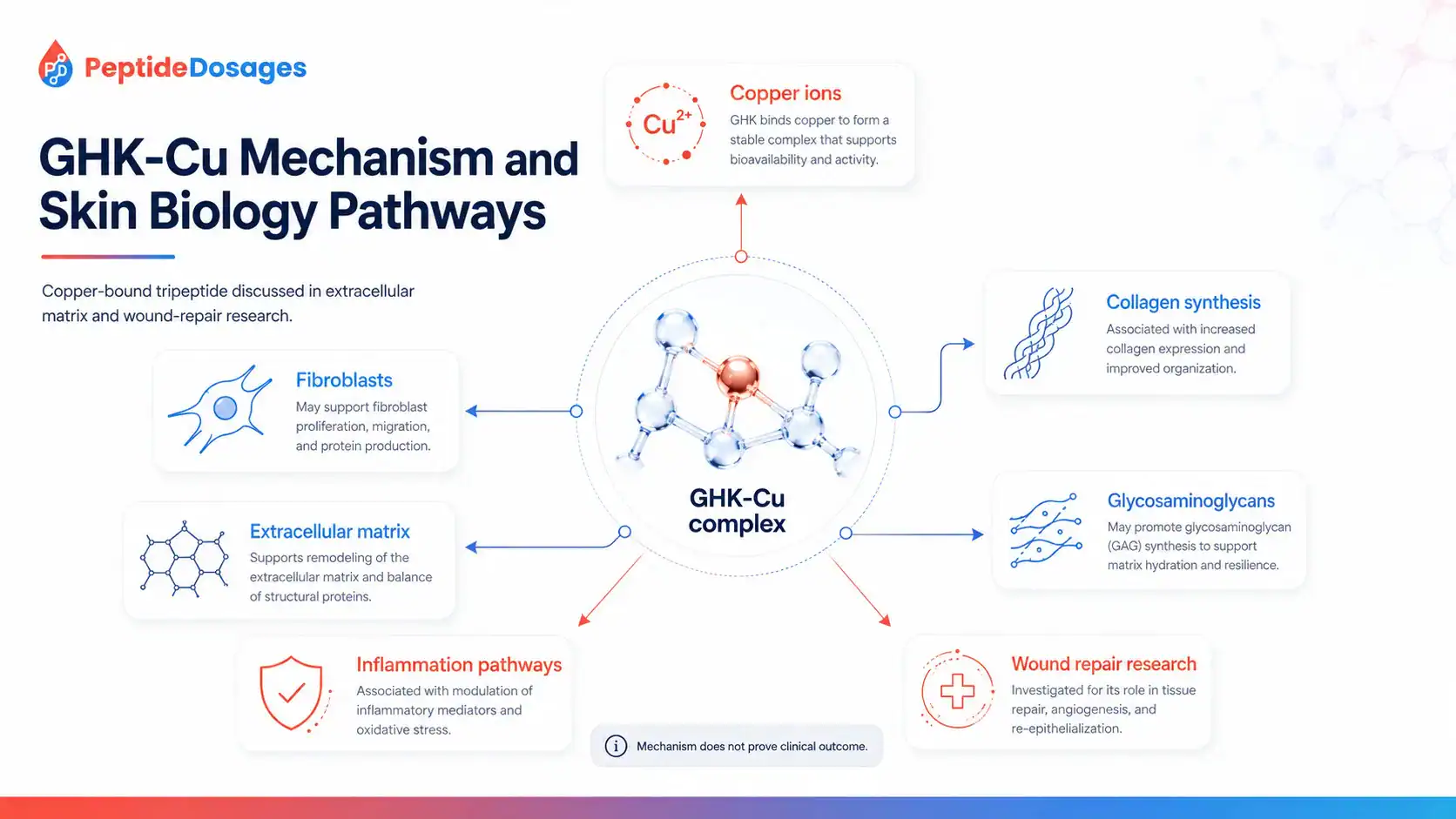
Animal work adds another piece: a rat wound-chamber experiment found increased collagen and other connective-tissue components after local GHK-Cu exposure. It was not a trial of cosmetic injections or whole-body rejuvenation in people. The species, injury model and delivery method are essential context. [2]
What do human GHK-Cu studies show?
The results are mixed, and the studies ask different questions. Wound closure, appearance after laser treatment and facial wrinkles should not be treated as one interchangeable outcome.
| Research setting | What was reported |
|---|---|
| Diabetic neuropathic foot ulcers, 1994 | A copper-peptide gel improved closure of plantar ulcers compared with vehicle in a randomized study. Everyone also received structured wound care, including debridement and pressure-relieving footwear. [3] |
| Venous stasis ulcers, 1992 | Among 86 evaluable participants, a tripeptide-copper cream did not reduce ulcer size more than placebo. Different wound types and formulations can produce different findings. [4] |
| After CO2 laser resurfacing, 2006 | Thirteen participants completed a randomized comparison. Objective assessments did not show an advantage for redness, wrinkles or overall skin quality, although patient satisfaction favored the GHK-Cu regimen. [5] |
| Facial wrinkle formulation, 2016 | An eight-week study in 40 women reported favorable wrinkle measurements with a nano-carrier GHK-Cu serum. The finding concerns that formulation, not every copper-peptide product. [6] |
Does GHK-Cu improve skin or reduce wrinkles?
Small topical studies provide reasons for further investigation, not a universal promise. The 2016 report combined laboratory work with a randomized, double-blind cosmetic study and reported improvement in selected wrinkle measurements. Its size, duration and formulation limit how confidently the result can be generalized. [6]
The laser study is a useful counterweight. Both groups improved after their procedure, but blinded reviewers did not find an additional objective improvement from the GHK-Cu regimen. Higher satisfaction is interesting, yet it is not the same result as a measured reduction in wrinkles. [5]
Does it heal wounds?
The diabetic-ulcer study reported a median plantar-ulcer area closure of 98.5% with the copper-peptide gel versus 60.8% with vehicle. These are area-closure measurements, not percentages of all patients completely healed. The treatment accompanied substantial standard care, and several authors were affiliated with the developer. [3]
The venous-ulcer trial did not find the same advantage for its copper complex. Together, these studies argue for specificity: which wound, which formulation and which comparison? They do not justify treating an infected wound or diabetic foot ulcer with a cosmetic serum. Such wounds need medical assessment. [4]
What about GHK-Cu for hair growth?
A frequently cited 2016 trial enrolled 45 men with pattern hair loss, but it tested a complex of 5-aminolevulinic acid and GHK, not GHK-Cu alone. One concentration showed a favorable hair-count comparison with placebo after six months. Hair length and thickness did not differ significantly between groups. [8]
That is an important ingredient distinction. The result cannot establish what an injectable GHK-Cu product does for hair loss, nor isolate GHK’s contribution to the combination. Claims about regrowth should identify the actual study treatment, not simply repeat “a copper peptide trial.”
Quick check: are GHK, GHK-Cu and every “copper peptide” the same?
No. GHK is the peptide, GHK-Cu is its copper complex, and product names may refer to different ingredients or mixtures. Read the ingredient identity and formulation in the study before applying its findings to a product.
Topical GHK-Cu versus injections
The route changes the question. A serum must deliver its ingredients through or onto skin in a particular formulation. An injection exposes tissue differently and introduces separate quality and safety requirements. More direct delivery is not evidence of a better outcome.
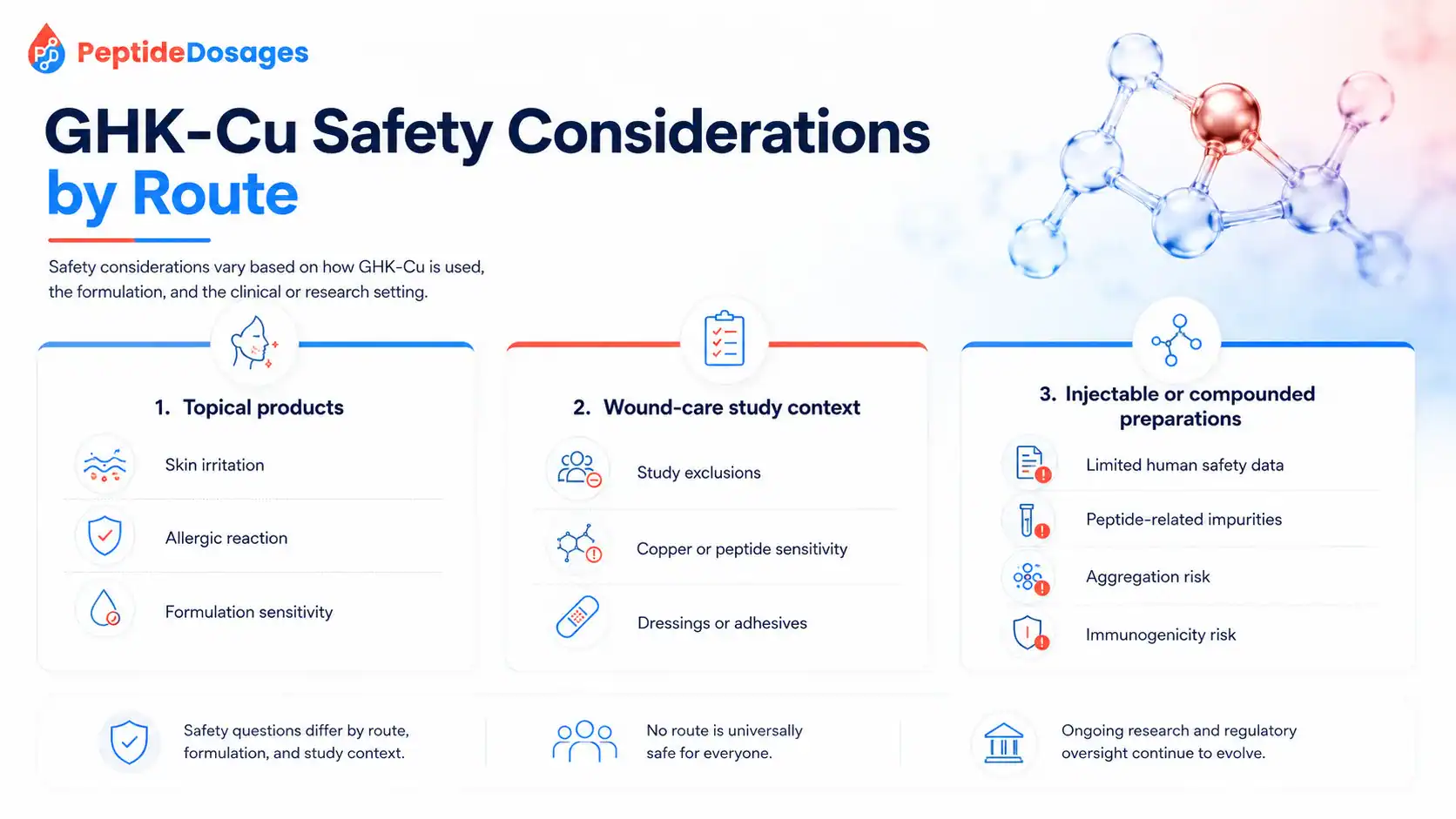
FDA specifically flags limited human safety information for injectable GHK-Cu and potential immune-reaction risks associated with aggregation and peptide-related impurities. A natural origin does not remove those concerns. Nor do short topical studies establish how often adverse effects occur during repeated injections. [7]
Is there an established GHK-Cu dosage?
There is no universal dose that can be derived from this evidence. A concentration in a skin cream, an amount applied to an ulcer and an injectable vial strength describe different exposures. Converting one into another is not a validated treatment method.
For a skin-care question, the practical starting point is the exact finished product and the concern being treated. For persistent hair loss, impaired healing or a skin disease, a dermatologist can help distinguish a cosmetic goal from a condition requiring diagnosis. Avoid substituting a research product for prescribed care.
Is GHK-Cu worth the hype?
GHK-Cu has research on copper binding, cells and topical products in people. That’s worth examining, but it isn’t proof of whole-body anti-aging benefits. Read positive and negative findings together, and check the formulation: a topical finding doesn’t establish an injection benefit.
Related GHK-Cu dosage protocols
Continue with the vial-strength-specific research protocol that matches the material being evaluated. Each page keeps its own concentration, reconstitution, and syringe-unit calculations.
Practical measurement and handling guides
References
- Maquart FX, et al. Stimulation of collagen synthesis in fibroblast cultures by the tripeptide-copper complex. FEBS Letters. 1988.
- Maquart FX, et al. In vivo stimulation of connective tissue accumulation by GHK-Cu in rat experimental wounds. Journal of Clinical Investigation. 1993.
- Mulder GD, et al. Enhanced healing of ulcers in patients with diabetes by topical treatment with glycyl-L-histidyl-L-lysine copper. Wound Repair and Regeneration. 1994.
- Bishop JB, et al. A prospective randomized evaluator-blinded trial of two potential wound healing agents for venous stasis ulcers. Journal of Vascular Surgery. 1992.
- Miller TR, et al. Effects of topical copper tripeptide complex on CO2 laser-resurfaced skin. Archives of Facial Plastic Surgery. 2006.
- Badenhorst T, et al. Effects of GHK-Cu on MMP and TIMP Expression, Collagen and Elastin Production, and Facial Wrinkle Parameters. Journal of Aging Science. 2016.
- FDA. Compounding safety-risk information: GHK-Cu for injectable routes.
- Lee WJ, et al. Efficacy of a Complex of 5-Aminolevulinic Acid and Glycyl-Histidyl-Lysine Peptide on Hair Growth. Annals of Dermatology. 2016.