
On this page
- Quick reference
- Dosage chart and four steps
- Supplies needed
- Peptide Reconstitution Simulator
- Vial and research context
- KLOW 80 mg Blend Overview
- KLOW Peptide Dosage Calculator
- What the 80 mg KLOW Blend Represents
- KLOW Peptide Blend Evidence: Four Components, No Validated Combination Trial
- TB-500 and BPC-157 Research Context
- KPV and GHK-Cu Research Context
- Why Component Research Does Not Validate the KLOW Injection Schedule
- KLOW Peptide Safety and Research Limitations
- KLOW Reconstitution and Storage Notes
- Reading U-100 Syringe Units and Injection-Site Guidance
- Frequently Asked Questions About the 80 mg Blend
- Research Reference Only
- References
- Related research, protocols, and guides
KLOW Quick Reference (80 mg Blend)
- Vial contents
- 80 mg total blend 50 mg GHK-Cu + 10 mg BPC-157 + 10 mg TB-500 + 10 mg KPV
- Final volume
- 3 mL
- Total blend concentration
- 26.67 mg/mL
- One U-100 unit
- 266.67 mcg total in 0.01 mL
Research context: For evidence on mechanisms, human and preclinical research, limitations, and safety, read KLOW Peptide: Benefits, Uses, Side Effects, Dosage, and Research.
KLOW Dosage and Reconstitution Chart (80 mg Blend)
Educational guide for reconstitution and daily dosing
Standard / Gradual Approach (3 mL = ~26.7 mg/mL Total)
This multi-peptide blend provides synergistic regenerative, anti-inflammatory, and tissue-repair support. The following titration schedule allows gradual introduction of each component.
| Week | Daily Dose (per component) | Units (per injection) (mL) |
|---|---|---|
| Weeks 1–2 | TB-500: 250 mcg | BPC-157: 250 mcg | KPV: 250 mcg | GHK-Cu: 1.25 mg | 7.5 units (0.075 mL) |
| Weeks 3–4 | TB-500: 500 mcg | BPC-157: 500 mcg | KPV: 500 mcg | GHK-Cu: 2.5 mg | 15 units (0.15 mL) |
| Weeks 5–8 | TB-500: 750 mcg | BPC-157: 750 mcg | KPV: 750 mcg | GHK-Cu: 3.75 mg | 22.5 units (0.225 mL) |
| Weeks 9–12 (Maintenance) | TB-500: 500 mcg | BPC-157: 500 mcg | KPV: 500 mcg | GHK-Cu: 2.5 mg | 15 units (0.15 mL) |
Frequency: Inject once daily subcutaneously. This schedule uses a 3.0 mL dilution to maintain measurable volumes. For ≤10-unit (≤0.10 mL) administrations during initial weeks, consider 30- or 50-unit insulin syringes for improved readability.
Reconstitution Steps
- Draw 3.0 mL bacteriostatic water with a sterile syringe.
- Inject slowly down the vial wall; avoid foaming.
- Gently swirl/roll until dissolved (do not shake).
- Label and refrigerate at 2–8 °C (35.6–46.4 °F), protected from light.
Syringe Math Reference
With 3.0 mL reconstitution volume and 80 mg total peptide:
- Total concentration: 26.67 mg/mL (26,667 mcg/mL)
- TB-500: 3.33 mg/mL → 33.3 mcg per unit
- BPC-157: 3.33 mg/mL → 33.3 mcg per unit
- KPV: 3.33 mg/mL → 33.3 mcg per unit
- GHK-Cu: 16.67 mg/mL → 166.7 mcg per unit
- 1 unit (0.01 mL) = 33.3 mcg each of TB-500, BPC-157, KPV + 166.7 mcg GHK-Cu
Supplies Needed
Plan based on an 8–16 week daily protocol with gradual titration.
- Peptide Vials (KLOW, 80 mg each):
- 8 weeks ≈ 3 vials
- 12 weeks ≈ 4 vials
- 16 weeks ≈ 5 vials
- Insulin Syringes (U-100):
- Per week: 7 syringes (1/day)
- 8 weeks: 56 syringes
- 12 weeks: 84 syringes
- 16 weeks: 112 syringes
- Bacteriostatic Water (10 mL bottles): Use ~3.0 mL per vial for reconstitution.
- 8 weeks (3 vials): 9 mL → 1 × 10 mL bottle
- 12 weeks (4 vials): 12 mL → 2 × 10 mL bottles
- 16 weeks (5 vials): 15 mL → 2 × 10 mL bottles
- Alcohol Swabs: One for the vial stopper + one for the injection site each day.
- Per week: 14 swabs (2/day)
- 8 weeks: 112 swabs → recommend 2 × 100-count boxes
- 12 weeks: 168 swabs → recommend 2 × 100-count boxes
- 16 weeks: 224 swabs → recommend 3 × 100-count boxes


Peptide Reconstitution Simulator
Practice preparing this vial with the verified strength and final volume from this protocol.
KLOW Vial and Research Context
- Reconstitute: Add 3.0 mL bacteriostatic water → ~26.7 mg/mL total concentration.
- Component concentrations: TB-500, BPC-157, KPV each at ~3.33 mg/mL; GHK-Cu at ~16.7 mg/mL.
- Easy measuring: At 26.7 mg/mL total, 1 unit = 0.01 mL ≈ 267 mcg total peptide on a U-100 insulin syringe.
- Storage: Lyophilized: freeze at −20 °C (−4 °F); after reconstitution, refrigerate at 2–8 °C (35.6–46.4 °F); avoid freeze–thaw cycles.
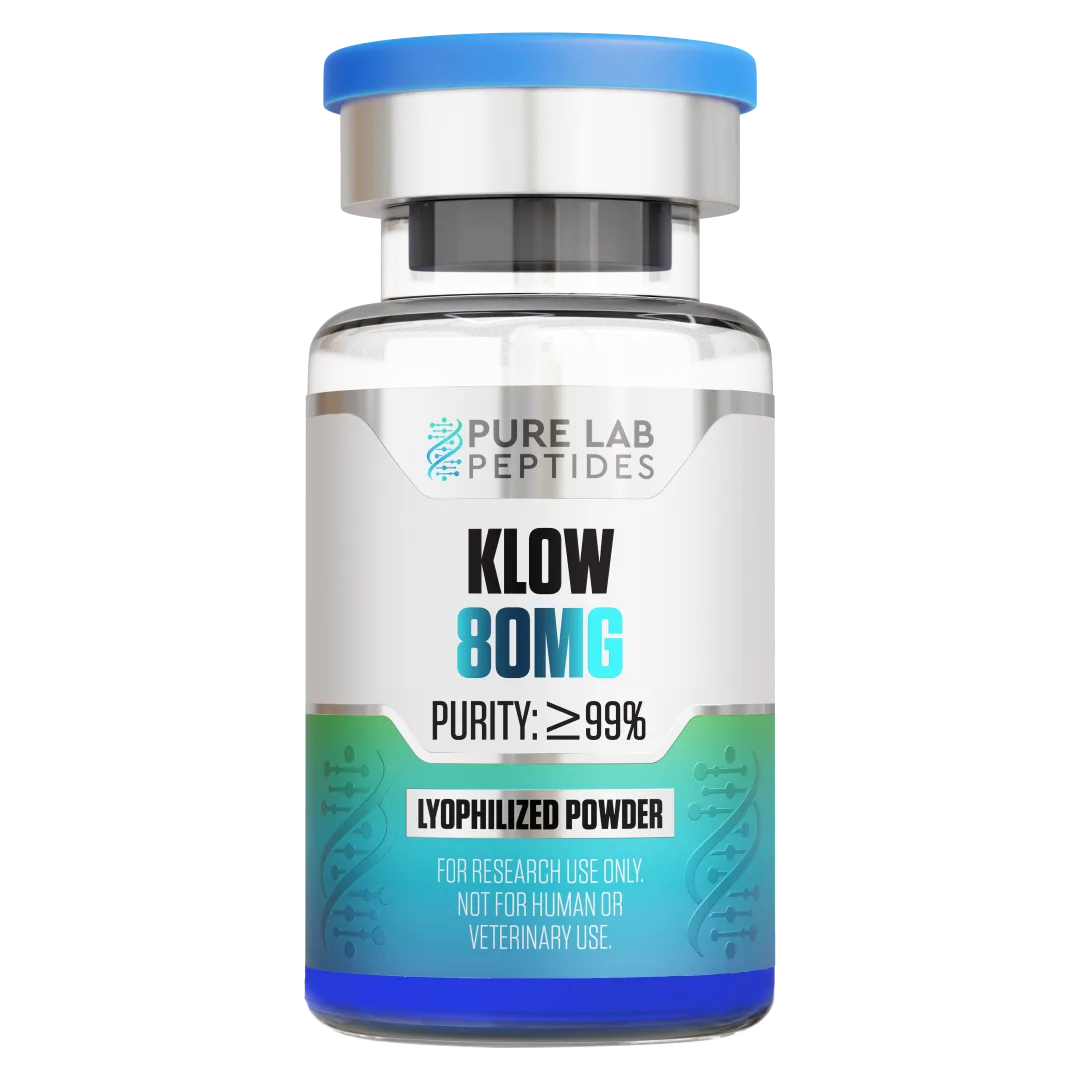
KLOW is a multi-peptide blend combining TB-500 (10 mg), BPC-157 (10 mg), KPV (10 mg), and GHK-Cu (50 mg) for a total of 80 mg per vial. TB-500 (synthetic thymosin beta-4) promotes wound healing, angiogenesis, and tissue repair[1][2]. BPC-157 exhibits regenerative properties with preclinical evidence supporting tendon, ligament, and muscle healing[3][4]. KPV is an anti-inflammatory tripeptide that modulates NF-κB signaling[5][6]. GHK-Cu supports collagen synthesis, wound healing, and tissue regeneration[7][8]. This educational protocol presents a once-daily subcutaneous approach using a practical dilution for clear insulin-syringe measurements.
KLOW 80 mg Blend Overview
The 80 mg blend combines 50 mg GHK-Cu, 10 mg BPC-157, 10 mg TB-500, and 10 mg KPV in one vial. The dosage chart presents a community-reported calculation schedule. The sections below explain the blend, evidence, and measurement logic without changing that schedule.
- Vial contents: 80 mg total peptide blend.
- Reconstitution: 3.0 mL of bacteriostatic water produces a total concentration of approximately 26.67 mg/mL.
- Frequency shown in the chart: Once daily across four phases, with component amounts listed for each phase.
- Evidence boundary: The individual components have separate preclinical or limited clinical research, but the four-component KLOW blend has not been validated in a controlled human trial.
KLOW Peptide Dosage Calculator
The dose-conversion math begins with 80 mg divided by 3.0 mL, or 26.67 mg/mL total. A U-100 insulin syringe unit equals 0.01 mL, so 1 unit contains approximately 266.7 mcg of the complete blend.
- GHK-Cu: 16.67 mg/mL, or about 166.7 mcg per U-100 unit.
- BPC-157: 3.33 mg/mL, or about 33.3 mcg per unit.
- TB-500: 3.33 mg/mL, or about 33.3 mcg per unit.
- KPV: 3.33 mg/mL, or about 33.3 mcg per unit.
- Combined total: About 266.7 mcg in each 0.01 mL unit.
These are concentration and volume conversions, not a dose recommendation. U-100 units describe liquid volume; they are not peptide international units.
What the 80 mg KLOW Blend Represents
KLOW is a fixed-ratio peptide blend rather than a single compound. Every syringe marking therefore changes all four component amounts at the same time. The supplier record documents the marketed vial identity and component amounts[12]; it is product provenance, not scientific proof of the schedule.
Compared with three-component products, KLOW adds KPV as a fourth peptide alongside GHK-Cu, BPC-157 and TB-500. That product-description distinction does not establish an additive biological effect.
- 62.5% GHK-Cu: 50 mg of the 80 mg total.
- 12.5% each: BPC-157, TB-500, and KPV each contribute 10 mg.
- Fixed ratio: Increasing volume increases every component in the same 5:1:1:1 mass ratio.
- Interpretation: Component research cannot establish that the combined blend has the same pharmacology, safety, or outcomes.
KLOW Peptide Blend Evidence: Four Components, No Validated Combination Trial
The KLOW blend is discussed online as a combined recovery and inflammation research protocol, but the available literature evaluates its ingredients separately. No controlled human trial in the retained reference set tests an 80 mg vial containing GHK-Cu, BPC-157, TB-500, and KPV in the 5:1:1:1 ratio used here. There is also no controlled study that validates the community-reported dose and frequency shown in the primary chart.
That distinction matters because a mixture is not automatically supported by evidence for its individual parts. The components differ in molecular size, proposed mechanisms, studied routes, formulations, and evidence maturity. Combining them can change exposure and tolerability in ways that cannot be predicted from a single-component experiment. The dosage chart should therefore be read as a transparent calculation record for the existing community-reported protocol, not as a clinically proven dosing standard.
Search phrases such as injury recovery, tissue repair, inflammation control, and anti-inflammatory effects describe areas of interest around the individual components. They should not be read as demonstrated clinical outcomes for the complete blend.
TB-500 and BPC-157 Research Context
TB-500 is commonly discussed in relation to thymosin beta-4 research. Laboratory and clinical-context literature has examined thymosin beta-4 in cell migration, angiogenesis, corneal or dermal repair, and wound-healing models[1][2]. A broader review describes thymosin beta-4 as a multifunctional peptide with regenerative research applications while also emphasizing that effects depend on the model, tissue, route, and formulation[13].
BPC-157 has a substantially more preclinical evidence base. A systematic review of orthopaedic and sports-medicine research identified mostly animal and laboratory studies and very limited human evidence[3]. Pharmacokinetic research in rats and dogs describes distribution and metabolism in those species, not an established human dose for the blend[4]. These sources support careful discussion of component research, but they do not validate the subcutaneous blend schedule or prove that BPC-157 and TB-500 are synergistic when mixed in one vial.
KPV and GHK-Cu Research Context
KPV is the Lys-Pro-Val tripeptide associated with the C-terminal region of alpha-melanocyte-stimulating hormone. Published work has investigated KPV uptake through the PepT1 transporter and inflammatory signaling in intestinal cell and animal models[5]. A separate nanoparticle-delivery study examined orally targeted KPV in experimental colitis models[6]. Those route- and formulation-specific experiments cannot be used to validate a daily subcutaneous KLOW protocol.
GHK-Cu is a naturally occurring copper peptide studied in skin, extracellular-matrix, gene-expression, and wound-repair research. Reviews describe proposed effects involving collagen, elastin, antioxidant pathways, tissue remodeling, and angiogenesis (new blood vessel formation)[7][8]. Another review discusses GHK as a potential anti-aging research peptide while noting the need for stronger clinical validation[14]. The KLOW blend contains more GHK-Cu by mass than any other component, but that ratio does not establish a validated clinical outcome.
Why Component Research Does Not Validate the KLOW Injection Schedule
A peptide protocol can only be compared with research when the compound, formulation, route, amount, frequency, duration, and population are sufficiently similar. The cited KPV studies include intestinal and orally targeted models, the BPC-157 evidence is predominantly preclinical, and the GHK-Cu and thymosin beta-4 literature spans multiple formulations and tissues. None reproduces the four-component vial or the exact blend dose per day displayed above.
The chart is useful for one narrow purpose: it keeps the community-reported schedule and its syringe math auditable. At 3.0 mL final volume, 7.5 units equals 0.075 mL, 15 units equals 0.15 mL, and 22.5 units equals 0.225 mL. Because the blend ratio is fixed, each of those volumes delivers all four components together. That arithmetic does not establish safety, effectiveness, or an optimal cycle length.
Readers comparing the dosing protocol should verify the vial composition, final volume, total concentration, amount of each component, U-100 units, mL, frequency, and phase duration in the same row. Omitting any one of those details makes a blend calculation difficult to interpret and increases the risk of confusing total blend mass with the mass of an individual peptide.
KLOW Peptide Safety and Research Limitations
The KLOW blend does not have a controlled human safety study in the cited literature. Safety cannot be inferred by adding together favorable findings from separate component experiments. A fixed blend also makes it impossible to adjust one component independently or identify which ingredient caused a reaction.
- Human evidence gap: BPC-157 and KPV research is largely preclinical, while GHK-Cu and thymosin beta-4 sources include varied routes and formulations.
- Combination gap: No retained source evaluates the complete four-peptide blend at the ratio, concentration, or schedule shown here.
- Quality variables: Identity, purity, sterility, handling, and batch consistency can materially affect research interpretation.
- Route variables: Evidence from topical, oral, cell, or animal studies should not be presented as proof of a subcutaneous injection protocol.
- Monitoring: Unexpected local or systemic reactions are safety signals, not evidence that a protocol is working.
This material is for educational and research review. It is not medical advice and does not recommend administering the blend to a person.
KLOW Reconstitution and Storage Notes
The four reconstitution checks in the primary dosage chart remain the page’s preparation standard: draw 3.0 mL of bacteriostatic water, add it slowly down the vial wall, gently swirl or roll without shaking, then label and refrigerate the reconstituted vial at 2–8 °C (35.6–46.4 °F) protected from light. The approved storage wording and product-specific instructions take precedence over generalized peptide handling advice.
For peptide reconstitution, clean the rubber stopper of the KLOW vial and the diluent stopper with separate alcohol swabs. Keep the vial upright and direct the bacteriostatic (“bac”) water slowly down the inside wall of the KLOW vial so the peptide solution is not agitated.
Final concentration depends on the final liquid volume. If liquid is lost, the stopper leaks, the solution becomes cloudy, particles appear, or the vial’s identity or storage history is uncertain, the calculator values should not be treated as reliable. Avoid repeated freeze-thaw cycles and follow the verified product-specific discard information for the exact batch.
Reading U-100 Syringe Units and Injection-Site Guidance
On a U-100 insulin syringe, 100 units equals 1 mL and one unit equals 0.01 mL. For this 26.67 mg/mL blend, that one-unit volume contains about 266.7 mcg total peptide. The printed syringe scale should be checked before interpreting the frequency chart, particularly when the row uses fractional volumes.
General subcutaneous peptide administration resources describe clean preparation, a new sterile syringe, appropriate site selection, and site rotation[9][10][11]. These sources explain injection technique only. They do not validate KLOW, any component dose, or the dosing protocol preserved on this page.
Frequently Asked Questions About the 80 mg Blend
What is in an 80 mg KLOW vial?
The vial contains 50 mg GHK-Cu, 10 mg BPC-157, 10 mg TB-500, and 10 mg KPV, for 80 mg total. The approved Pure Lab Peptides product record is used for vial identity and provenance[12].
Is an 80mg vial a peptide stack?
It contains four peptides in one fixed-ratio vial, so it is commonly grouped with peptide stack and blend searches. Unlike separately prepared components, however, every dose from the premixed vial changes all four peptide amounts together.
What is the role of KPV in KLOW?
KPV is the fourth peptide in the premixed 5:1:1:1 mass ratio. Its cited research concerns transporter and inflammatory-signaling models, not a validated human dose for the complete KLOW protocol.
How is the KLOW blend concentration calculated?
Reconstituting 80 mg to a final volume of 3.0 mL produces approximately 26.67 mg/mL total. One U-100 unit is 0.01 mL, so one unit contains about 266.7 mcg total: approximately 166.7 mcg GHK-Cu plus 33.3 mcg each of BPC-157, TB-500, and KPV.
How much bacteriostatic water is used per vial?
The page’s reconstitution guide uses 3.0 mL of bacteriostatic water per vial. That final volume is the basis for every mL, insulin-syringe unit, and mcg-per-dose calculation shown on the page.
What does “per injection” mean in this protocol guide?
Each primary chart row reports the amount of all four components per injection together with U-100 units and mL. Because the preserved frequency is once daily, the listed amount per dose is also the displayed daily dose for that phase; it is not a validated clinical recommendation.
Does the dosage chart represent a clinical trial schedule?
No. It preserves a community-reported calculation schedule. The cited studies examine individual components in different models, routes, and formulations; none validates the four-component KLOW injection schedule.
Can one component be changed without changing the others?
No. KLOW is a fixed-ratio blend. Drawing more or less liquid changes all four component amounts together. Independent adjustment would require separately prepared components rather than the premixed vial.
Are U-100 syringe units the same as peptide international units?
No. U-100 units are volume markings: one unit equals 0.01 mL. The peptide mass in that volume depends on the vial contents and final reconstitution volume.
What is the evidence quality for proposed KLOW benefits?
The evidence is component-level and uneven. Thymosin beta-4 and GHK-Cu have broader research literatures, while BPC-157 and KPV evidence is predominantly preclinical. There is no controlled human trial of the complete blend in the retained references[3][6][13][14].
Research Reference Only
This page explains concentration, component ratios, volume, and syringe-unit arithmetic for a research blend. It does not establish a standard of care, prove safety or efficacy, or recommend human use.
References
- 1PubMed — Thymosin beta 4 accelerates wound healing (Philp et al., 1999)
- 2PubMed — Thymosin β4 promotes dermal healing in preclinical models and clinical trials
- 3PMC — Emerging use of BPC-157 in orthopaedic sports medicine: systematic review
- 4PMC — Pharmacokinetics, distribution, metabolism, and excretion of BPC-157 in rats and dogs
- 5PMC — PepT1-mediated tripeptide KPV uptake reduces intestinal inflammation
- 6PMC — Orally targeted delivery of tripeptide KPV via HA-functionalized nanoparticles alleviates ulcerative colitis
- 7PMC — Regenerative and protective actions of the GHK-Cu peptide in light of new gene data
- 8PMC — GHK peptide as a natural modulator of multiple cellular pathways in skin regeneration
- 9CDC — Vaccine administration: subcutaneous injection technique guidelines
- 10CDC — Vaccine administration best practices
- 11NCBI Bookshelf — Chapter 18: Administration of parenteral medications
- 12Pure Lab Peptides — KLOW (80 mg) product page (vial identity and product provenance)
- 13PubMed — Thymosin β4: a multifunctional regenerative peptide
- 14PMC — The potential of GHK as an anti-aging peptide
Related research, protocols, and guides
Explore the available research context, protocol variants or comparisons, and practical guides. When vial-size variants exist, they remain separate because vial strength, concentration, and syringe-unit calculations can differ. Related compounds and blends are comparisons only, not interchangeable.
Research overview
- KLOW Peptide: Benefits, Uses, Side Effects, Dosage, and Research
- BPC-157 Peptide: Benefits, Uses, Side Effects, Dosage, and Research
- TB-500 Peptide: Benefits, Uses, Side Effects, Dosage, and Research
- KPV Peptide: Benefits, Uses, Side Effects, Dosage, and Research
- GHK-Cu Peptide: Benefits, Uses, Side Effects, Dosage, and Research
Related protocols and comparisons