
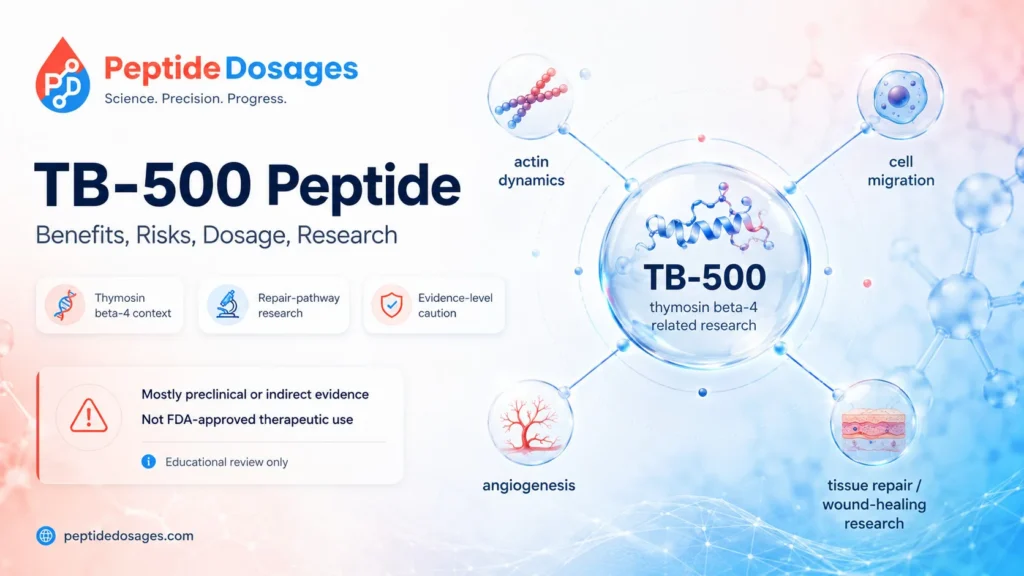
TB-500 peptide is commonly discussed online as a synthetic peptide related to thymosin beta-4, a naturally occurring protein involved in actin regulation, cell movement, and tissue-repair biology 1. This educational article explains what is known, what is uncertain, and why TB-500 therapy claims should be separated from approved medical use, clinical evidence, preclinical findings, and unsupported marketing claims. It does not provide personalized medical advice, a dosing protocol, injection instructions, or purchasing guidance.
- TB-500 is usually described as a synthetic peptide related to thymosin beta-4, but TB-500 products and terminology are not standardized like approved medicines 1, 2.
- Most therapeutic claims involve tissue repair, inflammation, wound healing, tendon or ligament recovery, and regenerative medicine, but much of the evidence comes from thymosin beta-4 biology, animal studies, cell models, or indirect human research 3, 4.
- Proposed mechanisms include actin binding, cell migration, angiogenesis, and inflammatory signaling, but a plausible mechanism does not prove clinical benefit in patients 3, 5.
- There is no FDA-approved TB-500 peptide product or approved-label dosage for TB-500, based on the absence of an approved TB-500 drug listing in FDA drug databases 6.
- Human trials have evaluated thymosin beta-4-related investigational products in some settings, but those studies should not be treated as proof that TB-500 products used outside regulated trials are safe or effective 7.
- Safety is uncertain for unapproved or compounded peptide use, especially because product quality, sterility, dose accuracy, and long-term risks may differ from regulated clinical-trial materials 8, 9.
- Athletes should be aware that the World Anti-Doping Agency prohibits thymosin beta-4 and its derivatives, including TB-500, under growth factor-related rules 10.
Related dosage pages: For vial-specific concentration, reconstitution, and measurement examples, see TB-500 (5 mg Vial) Dosage Protocol and TB-500 (10 mg Vial) Dosage Protocol. Each linked protocol remains a separate reference because vial strength changes concentration and syringe-unit calculations.
Fast Answer: What Readers Should Know First
TB-500 peptide is an unapproved synthetic peptide commonly described as related to thymosin beta-4, a protein involved in actin dynamics, cell migration, and tissue-repair pathways 1, 3. People search for it because of claims about inflammation, wound healing, injury recovery, and regenerative peptide therapy. The evidence is mainly preclinical or indirect, with limited human data for thymosin beta-4-related products, no approved TB-500 dosage, and important safety, quality, and regulatory concerns 6, 7, 9.
Most TB-500 Evidence Is Preclinical or Indirect
The strongest mechanistic evidence comes from thymosin beta-4 research, not from large, well-controlled human trials of TB-500 itself 3, 7. Preclinical studies can explain why researchers are interested in tissue healing, angiogenesis, and inflammation pathways, but they cannot establish that a therapy improves patient outcomes.
TB-500 Is Not Approved for Routine Therapeutic Use
TB-500 is not listed as an FDA-approved drug with labeled indications, prescribing information, or approved dosage instructions in Drugs@FDA 6. Regulatory status matters because unapproved products are not evaluated in the same way as approved medicines for manufacturing quality, safety, efficacy, labeling, and dose consistency 9.
What Is the TB-500 Peptide?
TB-500 is commonly marketed or discussed as a synthetic peptide related to thymosin beta-4, a small, naturally occurring actin-binding protein encoded by the TMSB4X gene 1, 2. Thymosin beta-4 is found in many tissues and has been studied for roles in cell movement, wound repair, inflammation, angiogenesis, and tissue remodeling 3, 4.
A key distinction is that thymosin beta-4 biology is not the same thing as proven TB-500 therapy. Published research often evaluates thymosin beta-4 or specific investigational formulations, while commercial or online “TB-500” products may vary in identity, quality, and regulatory status.
TB-500, Thymosin Beta-4, and Synthetic Peptide Identity
Thymosin beta-4 is a 43-amino-acid protein with actin-binding activity 1. TB-500 is usually described as a synthetic version or fragment-like analog associated with thymosin beta-4 research, but “TB-500” is not an FDA-approved nonproprietary drug name with a standardized approved label 6.
This matters for interpretation. If a study examines thymosin beta-4, a topical ophthalmic investigational product, or a synthetic peptide containing an actin-binding domain, the results should not automatically be applied to every product labeled TB-500.
How TB 500 Peptide Terminology Differs Online
Online sources often use “TB 500 peptide,” “TB-500,” and “thymosin beta-4” as if they are interchangeable. In scientific and medical writing, those terms should be handled carefully because the molecule, formulation, dose, route of administration, and regulatory status may differ.
For readers, the safest approach is to ask: Was the study about TB-500 specifically, thymosin beta-4, a fragment, a topical investigational drug, an injectable study product, an animal model, or an in vitro experiment?
Why TB-500 Is Discussed as a Regenerative Peptide
TB-500 is discussed as a regenerative peptide because thymosin beta-4 has been linked to cell migration, angiogenesis, inflammatory signaling, and wound repair in experimental systems 3, 4. These mechanisms are relevant to regenerative medicine, tissue engineering, sports medicine, tendon and ligament research, and post-injury repair models.
However, “regenerative” is an evidence-sensitive term. It describes research interest and proposed biology, not a guarantee of tissue regeneration or faster recovery from injuries in humans.
How Does TB-500 Peptide Work?
TB-500 is thought to work through pathways associated with thymosin beta-4, especially actin regulation and cell migration 1, 3. Actin is a major structural protein that helps cells move, change shape, divide, and respond to injury 5.
The proposed mechanism is biologically plausible, but clinical relevance remains uncertain. A mechanism can explain why researchers study a peptide without proving that it produces therapeutic benefits in patients.
Actin, Cell Migration, and Cellular Repair Pathways
Thymosin beta-4 is best known for binding actin and helping regulate the pool of actin monomers used in cytoskeletal remodeling 1, 3. Because cell migration is part of wound healing and tissue repair, this mechanism has drawn interest in damaged tissue models.
In plain language, cell migration is the process by which cells move into an injured area. That movement is important in wound healing, but improving a cellular process in a model does not necessarily mean a peptide therapy will accelerate healing in a patient.
Angiogenesis and New Blood Vessel Formation
Angiogenesis means the formation of new blood vessels. Thymosin beta-4 has been studied in relation to angiogenesis and tissue repair pathways, including cardiovascular and wound-repair models 3, 11.
Angiogenesis can be beneficial in some repair contexts, but it is also a reason for caution. A pathway that promotes blood vessel formation may have different implications depending on a person’s medical history, including cancer history, inflammatory disease, or abnormal tissue growth concerns.
Anti-Inflammatory Effects and Claims to Reduce Inflammation
Some thymosin beta-4 studies have explored anti-inflammatory effects in experimental injury and wound models 3, 4. These findings help explain why TB-500 is discussed for inflammation and chronic inflammation online.
The claim that TB-500 can reduce inflammation in humans is not established by high-quality TB-500-specific clinical trials. It should be presented as a research hypothesis or preclinical signal unless supported by a specific human study.
What Is TB-500 Peptide Used For or Studied For?
TB-500 is commonly discussed for tendon injury, ligament strain, muscle recovery, wound healing, tissue repair, and general regenerative therapy. In evidence-based terms, these are mostly studied uses, proposed uses, or anecdotal online claims—not approved indications.
No FDA-approved TB-500 product has labeled uses for injury recovery, orthopedic surgery, post-surgical recovery, tendon and ligament healing, or inflammatory conditions 6.
Tendon and Ligament Injury Recovery Claims
Tendon and ligament claims are common in sports medicine and performance-focused online discussions. The biological rationale usually points to cell migration, connective tissue repair, angiogenesis, and inflammation pathways described in thymosin beta-4 research 3.
That rationale is not the same as proof. For tendon and ligament injuries, established care may involve diagnosis, imaging when appropriate, rehabilitation, physical therapy, load management, pain control, or orthopedic evaluation, depending on injury severity.
Wound Healing, Tissue Repair, and Damaged Tissue Models
Wound healing is one of the more relevant research areas for thymosin beta-4 biology. A peer-reviewed study reported that thymosin beta-4 accelerated wound healing in experimental models, but that type of evidence does not automatically establish routine clinical effectiveness for TB-500 products in humans 4.
The evidence is best interpreted as preclinical support for further study. It is not a basis for self-directed peptide use after surgery, trauma, or chronic wounds.
Potential Benefits of TB-500 Peptide
Potential benefits of TB-500 peptide are often described as faster healing, reduced inflammation, improved injury recovery, tissue healing, and muscle recovery. These claims require evidence grading because they range from biologically plausible to mostly unsupported in human use.
A useful rule is simple: approved-label benefits are strongest, well-designed human trials are next, early human evidence is weaker, animal and cell data are hypothesis-generating, and anecdotal reports are lowest-quality evidence.
| Evidence Area | What Has Been Studied | Evidence Level | What It Can and Cannot Show |
|---|---|---|---|
| Actin and cellular movement | Thymosin beta-4 binding and cytoskeletal biology 1, 3 | Mechanistic / preclinical | Supports plausibility, not clinical effectiveness |
| Wound healing | Experimental wound models involving thymosin beta-4 4 | Preclinical | Suggests repair pathways, but may not translate to patients |
| Cardiac and vascular repair | Thymosin beta-4-related cell migration, survival, and angiogenesis research 11 | Preclinical / translational | Explains research interest, not routine therapy |
| Human investigational products | Registered clinical studies involving thymosin beta-4-related products 7 | Early human / clinical registry context | Shows clinical investigation exists, not approved TB-500 use |
| Online injury recovery claims | Anecdotal reports about faster recovery and peptide combination use | Unsupported / anecdotal | Cannot establish safety, dose, or efficacy |
Benefits of TB-500 Described in Research Contexts
The benefits of TB-500 most often discussed in research contexts are connected to thymosin beta-4 pathways: cell migration, tissue repair, wound healing, angiogenesis, and anti-inflammatory properties 3, 4. These areas are scientifically relevant, but they remain different from approved therapeutic benefits.
For a therapeutic peptide, “potential benefits” should mean possible effects under study. It should not mean guaranteed outcomes or a recommended treatment.
Reported Benefits Versus Published Clinical Evidence
Reported benefits include faster recovery, less pain, reduced inflammation, improved tissue healing, and better post-surgical recovery. Many of these reports are anecdotal and are not supported by large TB-500-specific randomized human trials.
Published clinical evidence is more limited and often relates to thymosin beta-4 investigational products rather than TB-500 products used outside trials 7. That gap is central to responsible interpretation.
Faster Healing, Faster Recovery, and Recovery Time Claims
Claims that TB-500 can accelerate healing or accelerate recovery are common, but they should be treated cautiously. Experimental wound models are not the same as a proven recovery-time benefit in humans 4.
For injury recovery, recovery time depends on diagnosis, tissue type, injury severity, rehabilitation, age, nutrition, medications, comorbidities, and activity demands. No peptide claim should replace medical assessment or physical therapy guidance.
What Does Human Research Say About TB-500?
Human research on TB-500 itself is limited. Clinical trial registries show studies involving thymosin beta-4-related investigational products, but registry entries vary by indication, formulation, dose, route, completion status, and whether results are publicly available 7.
Because of this, human evidence should be described as limited or indirect unless a specific peer-reviewed trial directly evaluates the same peptide, formulation, route, and clinical outcome.
Human Trials Involving Thymosin Beta-4 or Related Fragments
Human trials have explored thymosin beta-4-related investigational products in selected clinical areas, including ocular surface conditions and other investigational settings listed in ClinicalTrials.gov 7. These trials are important because they show that the biology has entered human research.
They do not establish that TB-500 products marketed outside regulated trials are equivalent to the studied product. Formulation, purity, sterility, route, dose, and regulatory oversight all matter.
What Is Known About Human Use and Safety Signals
Human safety knowledge is incomplete for TB-500 because there is no approved label that summarizes adverse reactions, contraindications, drug interactions, and post-marketing surveillance for a regulated TB-500 product 6. For investigational thymosin beta-4 products, safety interpretation depends on the exact trial protocol, population, dose, duration, and monitoring 7.
In unapproved peptide use, additional safety concerns include contamination, inaccurate dosing, impurities, sterility failures, and inconsistent manufacturing controls 8, 9.
Why TB-500-Specific Human Evidence Remains Limited
TB-500-specific human evidence remains limited because many claims rely on thymosin beta-4 biology, animal studies, or online experience reports rather than large, controlled clinical trials. ClinicalTrials.gov is useful for identifying registered studies, but a registry entry is not the same as peer-reviewed proof of safety and efficacy 12.
The key limitation is translation. A peptide may influence cellular pathways in a lab model and still fail to show meaningful, safe, reproducible benefit in patients.
What Preclinical Evidence Suggests About Inflammation and Healing
Preclinical evidence is the main reason TB-500 has attracted interest in regenerative medicine discussions. Thymosin beta-4 has been studied in animal and cell models involving wound repair, inflammation, angiogenesis, cardiac repair, and tissue remodeling 3, 4, 11.
Preclinical research is valuable, but it is not the same as clinical evidence. It helps researchers decide what to study next.
Animal Studies of Inflammation, Wounds, and Tissue Regeneration
Animal studies have examined thymosin beta-4 in wound healing and tissue-repair models 4. Other translational research has explored thymosin beta-4-related pathways in cardiac repair, cell survival, and neovascularization 11.
These findings support biological plausibility. They do not prove that TB-500 therapy improves wound healing, tendon recovery, ligament repair, or post-surgical recovery in humans.
Cell Migration Findings in Connective Tissue Research
Cell migration is central to healing because cells must move into injured tissue to rebuild matrix, support inflammation resolution, and restore structure. Thymosin beta-4’s relationship to actin biology gives researchers a plausible mechanism for studying migration in repair models 1, 3.
Connective tissue outcomes are more complex than cell movement alone. Tendon, ligament, joint, and muscle recovery involve mechanics, collagen organization, blood supply, inflammation, loading, and rehabilitation.
Translational Limits From Animal Testing to Patient Care
Animal testing can identify signals, dose ranges, toxicity concerns, and mechanisms. It cannot fully predict human outcomes because species differences, injury models, immune responses, metabolism, and study endpoints may differ.
For TB-500, translational limits are especially important because many online claims present preclinical findings as if they were established patient benefits. That is not a medically responsible interpretation.
BPC-157 and TB-500: How Peptides Work Together in Claims
BPC-157 and TB-500 are often discussed together in peptide therapies, especially for injury recovery and tissue healing. The phrase “peptides work together” is common online, but combination claims are largely unsupported by strong human evidence.
BPC-157 is a synthetic peptide sequence derived from a gastric protein fragment studied in experimental gastrointestinal, tendon, and wound models, but it is also not an FDA-approved drug with labeled therapeutic uses 6, 13.
Mechanistic Differences Between BPC-157 and TB-500
TB-500 claims usually point to thymosin beta-4-related pathways such as actin regulation, cell migration, angiogenesis, and anti-inflammatory effects 3. BPC-157 claims more often cite experimental gastrointestinal, vascular, tendon, and wound-healing models 13.
These mechanisms may overlap in broad repair biology, but overlap does not prove additive or synergistic benefit. A combination of BPC-157 and TB-500 should not be assumed safer or more effective than a single peptide.
Peptide Combination Claims and Evidence Gaps
Peptide combination claims often describe faster recovery from injuries, reduced pain, or broader therapeutic benefits. Those claims are not established unless tested in controlled human studies using defined products, defined dosing, safety monitoring, and clinically meaningful endpoints.
Combination use may also increase uncertainty. If a side effect occurs, it may be difficult to know which product, impurity, dose, route, or interaction contributed.
Side Effects and Safety Profile of TB-500
The safety profile of TB-500 is not well defined because there is no approved TB-500 label with standardized adverse-event data 6. Safety information must therefore be pieced together from thymosin beta-4 investigational research, general peptide administration risks, and regulatory warnings about unapproved or compounded products 7, 8.
Possible concerns include injection site reactions, allergic reactions, unknown long-term effects, product contamination, and theoretical risks related to angiogenesis or immune signaling.
Injection Site Reactions and Short-Term Adverse Effects
Any injected product can cause local reactions such as pain, redness, swelling, irritation, bruising, or infection at the injection site. For unapproved peptide products, sterility and quality concerns may increase risk compared with regulated products manufactured under approved standards 8.
This article does not provide injection instructions. Administration decisions should be handled in a licensed medical context when a legitimate medical product and indication exist.
Theoretical Risks Involving Angiogenesis and Chronic Inflammation
Because thymosin beta-4 research involves angiogenesis, cell migration, and inflammatory pathways, theoretical risks deserve caution 3, 11. A pathway that may support repair in one context may be undesirable in another context.
People with cancer history, abnormal growths, immune disorders, chronic inflammatory disease, or complex medical conditions should not assume this peptide is low risk. Evidence gaps are part of the safety issue.
Product Quality Risks With Compounded or Unapproved Peptides
Unapproved or compounded peptide products may differ in identity, potency, purity, sterility, and labeling. FDA explains that compounded drugs are not FDA-approved and are not reviewed for safety, effectiveness, or manufacturing quality before marketing in the same way approved drugs are 8.
FDA also warns that unapproved drugs may carry risks because they have not gone through the agency’s approval process for a given use 9. This is highly relevant for TB-500 peptide therapy claims.
Contraindications, Drug Interactions, and Higher-Risk Patients
There are no FDA-approved TB-500 prescribing instructions that define formal contraindications, drug interactions, pregnancy warnings, breastfeeding guidance, renal or hepatic dosing, or black box warnings 6. The absence of label warnings should not be interpreted as evidence of safety.
For unapproved peptides, unknowns are part of the risk assessment.
Pregnancy, Breastfeeding, Cancer History, and Immune Conditions
Pregnancy and breastfeeding require special caution because fetal, neonatal, and lactation safety data are not established for TB-500. Cancer history and immune conditions also deserve caution because thymosin beta-4-related biology involves cell migration, angiogenesis, and inflammatory signaling 3.
A clinician may also consider wound status, infection risk, autoimmune disease, surgery plans, medication use, and the availability of approved alternatives.
Medications and Conditions That Require Clinician Review
Potential drug interactions are not well characterized for TB-500. That uncertainty is clinically meaningful for patients using anticoagulants, immunosuppressants, anti-inflammatory drugs, chemotherapy, biologics, diabetes medications, or drugs that affect wound healing.
Readers considering peptide-related medical decisions should discuss current medications, diagnoses, allergies, pregnancy status, sports eligibility, and regulatory concerns with a qualified healthcare professional.
What Dosage Has Been Used in Published Studies?
There is no FDA-approved TB-500 dosage because TB-500 is not an approved drug with labeled indications or prescribing information 6. Some clinical research registries include thymosin beta-4-related investigational products, but study dose details are product-specific and should not be converted into a personal TB-500 protocol 7.
Study doses should not be interpreted as personal dosing advice.
Approved-Label Dosage Information: What Exists and What Does Not
For approved medicines, dosage information appears in regulator-reviewed labeling. For TB-500, there is no approved-label dosage, labeled route, approved indication, contraindication section, or standardized adverse-reaction table in FDA drug labeling databases 6.
That means online dosage charts should be treated with caution. They are not a substitute for approved prescribing information or clinician-guided care.
Study Dose Context Versus a Personal TB-500 Protocol
A TB-500 protocol found online is not the same as a published clinical-trial protocol or approved prescribing label. Even when a study lists a dose, that dose is tied to a specific formulation, population, monitoring plan, endpoint, and ethics-approved protocol 12.
A study dose is research context. It is not a recommendation for personal use, self-treatment, cycling, stacking, or post-injury recovery.
Why Dose, Route, and Formulation Affect Interpretation
Dose, route, and formulation can change absorption, distribution, local tissue exposure, adverse-event risk, and interpretation of results. A topical ophthalmic investigational product, an injectable research product, and an unverified online peptide are not interchangeable.
For peptide therapeutics, manufacturing quality and formulation can strongly influence safety and reliability. FDA’s compounding guidance highlights that compounded products are not evaluated like approved drugs before marketing 8.
Administration Routes Discussed in the Literature
Administration routes discussed in thymosin beta-4-related literature and registries include product-specific investigational routes, such as topical ocular formulations and injection-based research settings 7. These routes are part of study design, not instructions for self-administration.
Route matters because it affects exposure, safety monitoring, and whether findings apply to a particular clinical question.
Injection in Research Settings Without Self-Administration Instructions
Injection is a route used in some research and medical contexts, but this article does not explain how to inject, mix, reconstitute, or self-administer TB-500. Injection-related decisions require appropriate product identity, sterility, medical indication, training, monitoring, and legal prescribing context.
For unapproved products, injection can add risk because contamination, incorrect concentration, and sterile technique failures can lead to harm 8.
How Route of Administration May Affect Bioavailability and Safety
Bioavailability describes how much of a substance reaches systemic circulation or the target tissue. Peptide bioavailability can differ by route because peptides may be degraded, cleared, or distributed differently depending on formulation and administration method.
Without TB-500-specific pharmacokinetic studies for a defined regulated product, claims about optimal route, half-life, or tissue targeting should be considered uncertain.
Is TB-500 Peptide FDA-Approved or Legal?
TB-500 peptide is not FDA-approved for therapeutic use, and it does not have FDA-approved prescribing information 6. FDA approval status is indication- and product-specific, so claims about therapeutic use should be judged by whether a regulated product has been approved for that exact use.
Legal status can differ by jurisdiction, product category, and context. Readers should not assume that availability online means a peptide is approved, legal for human use, or medically appropriate.
Regulatory Status, Human Use, and Approval Gaps
An approved drug is reviewed for quality, safety, efficacy, labeling, manufacturing, and risk information for specific indications. Unapproved drugs have not completed that process for the marketed use 9.
For TB-500, the approval gap is central: there is no approved label to define therapeutic benefits, dosage, administration, contraindications, drug interactions, or adverse reactions 6.
World Anti-Doping Agency Status and Sports Medicine Concerns
The World Anti-Doping Agency lists thymosin beta-4 and its derivatives, including TB-500, as prohibited substances in sport 10. This matters for athletes, coaches, sports medicine clinicians, and anyone subject to anti-doping rules.
A substance can be prohibited in sport even when clinical evidence is limited. Anti-doping status is not proof of therapeutic benefit.
Evidence Limitations and Source Quality Filters
The evidence limitations for TB-500 are substantial. The biggest issues are limited TB-500-specific human trials, reliance on thymosin beta-4 extrapolation, variable product identity, lack of approved labeling, unclear long-term safety, and heavy online marketing.
A practical source-quality filter can help:
- Highest confidence: FDA or other regulator labels, peer-reviewed randomized trials, systematic reviews.
- Moderate confidence: registered clinical trials with clear methods and published results.
- Lower confidence: animal studies, in vitro mechanisms, small uncontrolled studies.
- Lowest confidence: anecdotal reports, clinic marketing pages, vendor claims, influencer testimonials, and forum posts.
How to Separate Published Data From Peptide Therapy Marketing
Published data should identify the molecule, formulation, dose, route, study population, comparator, endpoints, adverse-event monitoring, and limitations. Peptide therapy marketing often skips those details or treats animal studies as if they prove human results.
For TB-500, be especially cautious when a source claims guaranteed faster healing, “Wolverine-like” recovery, broad anti-inflammatory benefits, or a universal dose. Those claims are not supported by approved labeling or strong TB-500-specific clinical evidence.
Key Takeaways for Discussing TB-500 Therapy With a Clinician
TB-500 is best understood as an evidence-limited, unapproved peptide discussed because of thymosin beta-4-related biology. The mechanism is interesting, especially for actin, cell migration, angiogenesis, inflammation, and tissue repair, but clinical conclusions remain limited.
Before making peptide-related medical decisions, a clinician discussion could include:
- Whether the concern is an injury, wound, tendon problem, ligament issue, inflammatory condition, or post-surgical recovery question.
- Whether approved therapies, physical therapy, imaging, orthopedic evaluation, wound care, or other standard treatments are more appropriate.
- Whether the evidence being considered is approved-label, clinical, early human, preclinical, or anecdotal.
- Whether pregnancy, breastfeeding, cancer history, immune disease, infection risk, surgery plans, or medication use changes risk.
- Whether anti-doping rules apply.
- Whether product quality, sterility, identity, dose accuracy, and legal status can be verified.
- Whether the proposed benefit is realistic, measurable, and supported by human evidence.
The safest way to interpret TB-500 peptide is through evidence quality, regulatory status, safety data, and clinician-guided decision-making—not through online protocols, vendor claims, or unsupported promises.
Related dosage protocols and research
Use the available links to move between research context, dosage pages or comparisons, and supporting guides. When vial-size variants exist, they remain separate because concentration and syringe-unit calculations change with vial strength. Comparisons do not imply that different compounds are interchangeable.
Matching dosage protocols
Related protocols and comparisons
Further research context
REFERENCES
- UniProt Consortium. Thymosin beta-4 protein entry: TMSB4X / P62328. UniProtKB. Accessed 2026.
- National Center for Biotechnology Information. TMSB4X thymosin beta 4 X-linked gene. NCBI Gene. Accessed 2026.
- Hannappel E. β-Thymosins. Annals of the New York Academy of Sciences. 2007. DOI: 10.1196/annals.1408.013.
- Malinda KM, Sidhu GS, Mani H, et al. Thymosin beta 4 accelerates wound healing. Journal of Investigative Dermatology. 1999. PMID: 10495390.
- Pollard TD, Cooper JA. Actin, a central player in cell shape and movement. Science. 2009. DOI: 10.1126/science.1175862.
- U.S. Food and Drug Administration. Drugs@FDA: FDA-approved drug products database. FDA. Accessed 2026.
- National Library of Medicine. ClinicalTrials.gov search: thymosin beta 4. ClinicalTrials.gov. Accessed 2026.
- U.S. Food and Drug Administration. Compounding and the FDA: Questions and answers. FDA. Accessed 2026.
- U.S. Food and Drug Administration. Unapproved drugs. FDA. Accessed 2026.
- World Anti-Doping Agency. The Prohibited List. WADA. Accessed 2026.
- Bock-Marquette I, Saxena A, White MD, Dimaio JM, Srivastava D. Thymosin beta4 activates integrin-linked kinase and promotes cardiac cell migration, survival and cardiac repair. Nature. 2004. DOI: 10.1038/nature03000.
- National Library of Medicine. Learn About Clinical Studies. ClinicalTrials.gov. Accessed 2026.
- National Library of Medicine. PubMed search: BPC-157 tendon wound healing. PubMed. Accessed 2026.
Researchers Cited in This Article
The researchers below authored or co-authored publications cited in this article. Listing them here identifies sources; it does not mean they wrote, independently reviewed, sponsored, or endorsed this PeptideDosages.com article. The site author is identified in the article byline.
Hynda K. Kleinman
Researcher profile: PubMed Author Profile
Hynda K. Kleinman’s published work is relevant to the preclinical research context surrounding thymosin beta-4, wound-model literature, and synthetic peptide fragments connected to actin-binding biology. Her publications help frame why TB-500 peptide is often discussed in relation to tissue-repair models while also reinforcing the need to distinguish preclinical findings from established human clinical evidence. This research lane is especially relevant for interpreting claims about wound healing, cell migration, and peptide pharmacology without overstating therapeutic certainty.
Selected publications:
- Thymosin beta 4 accelerates wound healing — Journal of Investigative Dermatology, 1999. PMID: 10495390
- Thymosin beta 4 and a synthetic peptide containing its actin-binding domain promote dermal wound repair in db/db diabetic mice and in aged mice — Wound Repair and Regeneration, 2003. PMID: 12581421
Thomas D. Pollard
Researcher profile: Yale School of Medicine Profile
Thomas D. Pollard’s work provides important published literature for understanding actin biology, cytoskeletal remodeling, and cell movement—mechanisms that are central to how thymosin beta-4-related peptides are discussed in scientific contexts. His publications are not TB-500 clinical studies, but they help support the broader mechanism of action discussion by explaining how actin and actin-binding proteins influence cellular structure and migration. This background is useful for interpreting mechanistic hypotheses separately from clinical efficacy or safety conclusions.
Selected publications:
- Actin, a central player in cell shape and movement — Science, 2009. DOI: 10.1126/science.1175862
- Actin and actin-binding proteins: A critical evaluation of mechanisms and functions — Annual Review of Biochemistry, 1986. DOI: 10.1146/annurev.bi.55.070186.005011