
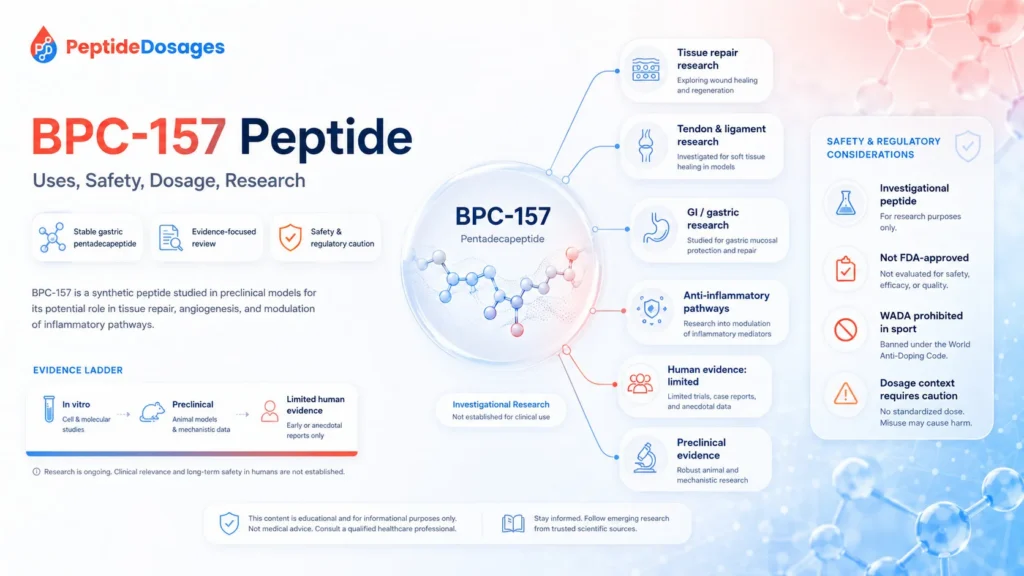
BPC-157 peptide is a synthetic 15-amino acid compound often described as body protection compound 157, bepecin, or PL 14736, and scientific databases classify it as investigational rather than an approved drug 1 2. This educational guide reviews what is known and not known about BPC-157, including proposed mechanisms, human evidence, animal studies, safety concerns, dosage information from studies, and regulatory status. It does not provide personal medical advice, dosing instructions, injection instructions, or purchasing guidance.
- BPC-157 is a synthetic pentadecapeptide, meaning a peptide made of 15 amino acids, with naming variants that include BPC 157, bepecin, and PL 14736 [1].
- It is discussed in gastric, wound-healing, tendon, ligament, and soft tissue research, but much of the evidence remains preclinical rather than based on large human trials 3 4.
- Proposed mechanisms include nitric oxide signaling, vascular responses, angiogenesis, fibroblast activity, and growth-factor-related pathways, but mechanism data do not prove clinical efficacy [4].
- Human evidence is limited to small or early studies, including a registered Phase 1 safety and pharmacokinetic trial, a small retrospective knee pain report, and a small pilot interstitial cystitis report 12 13 14.
- There is no FDA-approved BPC-157 dosage framework, so study doses should not be interpreted as personal dosing advice 15 16.
- Safety concerns include limited human safety data, unknown long-term effects, immunogenicity concerns, peptide-related impurities, and quality risks with compounded or unapproved products [16].
- Athletes should treat anti-doping status as high risk because BPC-157 is listed under WADA’s S0 unapproved substances category 19 20.
Related dosage pages: For vial-specific concentration, reconstitution, and measurement examples, see BPC-157 (5 mg Vial) Dosage Protocol and BPC-157 (10 mg Vial) Dosage Protocol. Each linked protocol remains a separate reference because vial strength changes concentration and syringe-unit calculations.
Fast Answer
BPC-157 peptide is an investigational synthetic gastric pentadecapeptide studied mostly in animal and cell models for tissue repair, gastrointestinal injury, inflammation, tendon healing, and wound healing [1] [3] [4]. People search for it because online claims often frame it as regenerative, but human evidence remains limited and does not establish broad safety or effectiveness [12] [13] [14]. BPC-157 is not an FDA-approved medication, and regulatory and anti-doping concerns are central to any evidence-based discussion [16] [19].
What Is the BPC-157 Peptide?
BPC-157 is a synthetic peptide modeled on a sequence associated with human gastric juice research, not an approved therapeutic peptide drug [1] [3]. The term “BPC” is commonly expanded as “body protection compound,” while “157” refers to the specific peptide sequence described in the literature [1] [4].
Stable Gastric Pentadecapeptide BPC 157 and Basic Structure
“Stable gastric pentadecapeptide BPC 157” refers to a 15 amino acid peptide sequence that has been studied for stability in gastric conditions and for biological effects in experimental models [3] [4]. PubChem lists BPC-157 as compound CID 9941957, and NCATS Inxight Drugs lists it as an investigational substance rather than a U.S.-approved drug [1] [2].
BPC 157, Body Protection Compound 157, and Naming Variants
The same compound may appear in literature and databases as BPC-157, BPC 157, body protection compound 157, body protective compound 157, bepecin, PL-10, PLD-116, or PL 14736 [1] [4]. These naming variants matter because clinical-trial records, compounding discussions, and older gastrointestinal studies may not use the same label [1] [12].
Why This Experimental Peptide Is Discussed in Regeneration Research
BPC-157 is discussed in regeneration research because animal and in vitro studies have examined wound healing, tendon and ligament repair, gastric lesions, vascular responses, and inflammatory injury models [3] [4] 9. The key caution is that regenerative findings in rats, tendon fibroblasts, or other models cannot be treated as established human benefit 21 22.
Chemical Identity and Therapeutic Research Classification
BPC-157 is best understood as an investigational synthetic peptide, not as a supplement, approved drug, or standard medical therapy [1] [16]. Its therapeutic discussion belongs in an evidence-graded research context because human evidence, dosing standards, contraindications, and long-term safety remain incomplete [12] [16].
What Does Peptide Derived From Human Gastric Juice Mean?
In BPC-157 literature, “peptide derived from human gastric juice” refers to the research origin of the sequence, not to a naturally standardized medicine extracted for routine human use [3] [4]. Products used in research are generally synthetic peptide preparations, and synthetic identity does not by itself establish safety, purity, or clinical efficacy [1] [16].
Synthetic Peptide Synthesis, Amino Acid Sequence, and Stability
NCATS lists the BPC-157 sequence as Gly-Glu-Pro-Pro-Pro-Gly-Lys-Pro-Ala-Asp-Asp-Ala-Gly-Leu-Val, and reviews describe it as a pentadecapeptide with unusual stability in water and gastric juice [1] [4]. This stability is one reason oral and gastric research models exist, but stability alone does not establish oral bioavailability, clinical efficacy, or safe human use [3] 10.
How Does BPC-157 Peptide Work?
BPC-157 does not have a single clearly established receptor-driven mechanism like many approved peptide drugs [4]. Published literature instead describes several proposed pathways, including nitric oxide modulation, vascular recruitment, angiogenesis, cytoprotection, fibroblast behavior, and growth-factor-related signaling [4] 8.
How Is Tissue Repair Proposed to Occur?
Preclinical studies suggest BPC-157 may affect tissue repair through cell migration, fibroblast survival, collagen organization, and vascular responses at injury sites 5 7 [9]. In a tendon fibroblast study, BPC 157 promoted ex vivo tendon outgrowth, cell survival under stress, and in vitro cell migration, likely through FAK-paxillin pathway activity [5].
Angiogenesis, Nitric Oxide, and Vascular Signaling
Several BPC-157 studies focus on angiogenesis, nitric oxide, endothelial function, and vascular endothelial growth factor signaling [4] [8]. These pathways are biologically relevant to healing, but they are also broad systems involved in many normal and disease processes, which is why mechanistic enthusiasm must be balanced with safety uncertainty [4].
Why Mechanism Does Not Automatically Predict Clinical Outcomes
A plausible mechanism can help explain why a compound is studied, but it does not prove that the compound improves patient outcomes [21] [22]. For BPC-157, the evidence gap is especially important because preclinical models are far more extensive than controlled human clinical trials [21] 23.
What Is BPC-157 Peptide Used For in Research?
BPC-157 has been studied in gastrointestinal injury, soft tissue healing, tendon and ligament models, wound healing, and musculoskeletal injury contexts [3] [9] [21]. These are studied uses, not FDA-approved labeled indications [16].
Tendon, Ligament, and Soft Tissue Healing Models
A rat Achilles tendon study reported improved healing of transected rat Achilles tendon after BPC-157 exposure, while cell work found effects on tendon fibroblasts, cell migration, and survival [5] [7]. A 2019 review summarized BPC-157 as promising in musculoskeletal soft tissue models but emphasized that the strongest data were still preclinical [23].
Gastric Ulcer and Gastrointestinal Tract Research
The gastrointestinal literature includes BPC-157 work in ulcer, colitis, fistula, NSAID-related injury, and gastric-protection models [3]. Sikiric, Seiwerth, Rucman, and collaborators are prominent in this research lane, but many of these reports are animal or mechanistic studies rather than large modern human trials [3] [9].
Knee Pain, Injury Recovery, and Musculoskeletal Claims
A small retrospective report described intra-articular BPC-157 use in patients with multiple types of knee pain, but it lacked the controls, blinding, imaging consistency, and sample size needed for firm conclusions [13]. A 2025 systematic review in orthopaedic sports medicine characterized the available musculoskeletal evidence as mostly low-level, with limited human data and important safety questions [21].
Potential Benefits of BPC-157 Peptide
Potential benefits should be separated by evidence level. BPC-157 may look promising in animal and cell studies, but human benefit has not been established to the same standard as approved medications [16] [21].
| Evidence Area | What Has Been Studied | Evidence Level | What It Can and Cannot Show |
|---|---|---|---|
| Chemical identity | Investigational BPC-157, bepecin, PL 14736, sequence and identifiers [1] [2] | Database / investigational | Supports identity, not therapeutic efficacy |
| Gastrointestinal injury | Gastric lesions, colitis, fistula, NSAID-related injury models [3] | Mostly preclinical, older clinical-development context | Suggests research rationale; does not establish approved use |
| Tendon and ligament repair | Rat Achilles tendon and tendon fibroblast studies [5] [7] | Preclinical / in vitro | Supports mechanistic hypotheses; cannot prove human injury recovery |
| Knee pain | Small retrospective intra-articular report [13] | Early human / low-level | Generates hypotheses; cannot define standard treatment or dosage |
| Interstitial cystitis | Small pilot report in 12 women [14] | Early human / low-level | Suggests possible signal; needs controlled trials |
| Safety | FDA safety-risk concerns, preclinical toxicology, limited human safety data 11 [16] | Mixed / incomplete | Does not establish long-term safety in broad human use |
What Preclinical Evidence Suggests About Wound Healing
A 2021 wound healing review described BPC 157 across bleeding, thrombosis, vascular obstruction, and tissue-injury models, but those models should be interpreted as preclinical evidence [9]. Animal studies can show biological activity under controlled conditions, but they do not define real-world benefit, adverse-event rates, or patient selection in humans [21] [22].
Why Anti-Inflammatory and Regenerative Claims Need Caution
Anti-inflammatory effects and regenerative mechanisms are evidence-sensitive claims because they sound clinically meaningful but may come mainly from animal models, cell models, or uncontrolled human reports [4] [21]. For readers, the safest framing is that BPC-157 has been studied for antiinflammatory and regenerative pathways, not that it is proven to regenerate injured tissue in people [16] [22].
What Human Clinical Evidence Exists for BPC-157?
Human evidence is limited. The published human material includes small reports and clinical-development records, while high-quality randomized, controlled human trials remain sparse or unavailable for common online claims [12] [13] [14].
What Early Human Use Data Are Available?
ClinicalTrials.gov lists a Phase 1 PCO-02 safety and pharmacokinetics trial in healthy volunteers, and NCATS classifies BPC-157 as investigational with that trial as a source [1] [12]. ClinicalTrials.gov also lists a 2026 acute hamstring muscle strain repair study record, which may help future evidence review but does not by itself prove safety or efficacy 24.
Interstitial Cystitis, PL 14736, and Reported Outcomes
A 2024 pilot study reported 12 women with interstitial cystitis who received a total of 10 mg intravesical BPC-157 during a single procedure, with 10 of 12 reporting complete symptom resolution and two reporting 80% improvement; no adverse events were reported in that small study [14]. This is early human evidence, not a basis for generalizing to all patients with interstitial cystitis or for creating self-use protocols [14] [16].
How Human Evidence Differs From Approved Therapeutic Use
Approved therapeutic use requires regulatory review of a defined product, indication, manufacturing controls, labeling, dosage, contraindications, and safety data [15]. BPC-157 does not have that approved-drug framework, and FDA has specifically identified safety and quality concerns for compounded drugs containing BPC-157 [16].
What Do Animal Studies and Cell Models Show?
Animal and cell studies are the largest part of the BPC-157 evidence base. They are useful for understanding mechanisms and hypotheses, but they sit below well-designed human trials in an evidence hierarchy [21] [22].
Rat Achilles Tendon, Muscle, and Ligament Healing Findings
The healing of transected rat Achilles tendon has been a recurring part of the BPC-157 research story, including findings on tendon structure and biomechanical recovery [7]. Additional musculoskeletal reviews discuss tendon, ligament, muscle, and bone models, while emphasizing that clinical translation is not settled [21] [23].
Tendon Fibroblasts, Cell Migration, and Cell Survival
In vitro work on tendon fibroblasts found BPC 157 effects on cell migration, spreading, survival under oxidative stress, and FAK-paxillin signaling [5]. Another cell study reported increased growth hormone receptor expression in tendon fibroblasts, but that should not be interpreted as evidence that BPC-157 functions like growth hormone therapy in humans 6.
Why Animal Models and In Vitro Data Have Translational Limits
Animal studies can control injury type, timing, route, dose, and tissue sampling in ways that are not identical to human medical care [21]. In vitro findings can reveal cell signaling, but isolated cells do not capture immune status, comorbidities, medication interactions, product quality, or long-term adverse events in patients [4] [16].
How Should Evidence Limitations Be Interpreted?
Evidence limitations are central to BPC-157. A cautious interpretation separates biological plausibility, preclinical activity, early human reports, and regulatory approval status [16] [21] [22].
How the Effect of BPC 157 Is Studied Across Models
The effect of BPC 157 has been studied across gastric injury models, tendon fibroblasts, rat tendon injury, vascular signaling, and early human reports [3] [5] [7] [13]. Because these models differ, a positive effect in one model does not automatically establish a treatment effect in another condition or route of administration [21].
How Online Claims Differ From Published Evidence
Online claims often present BPC-157 as a recovery, anti-aging, muscle, joint, or regenerative medicine solution, but published evidence does not support broad guaranteed outcomes [19] [21]. USADA specifically warns that BPC-157 is marketed in wellness and anti-aging settings despite lack of approval for human clinical use and limited published human clinical data [19].
Side Effects and Safety Concerns With BPC-157
BPC-157 safety is difficult to summarize because there is no FDA-approved label, no established post-marketing surveillance system for an approved product, and limited controlled human data [15] [16]. Preclinical toxicology may be reassuring in some respects, but it does not replace human safety data [11] [16].
What Adverse Effects Have Been Reported or Remain Unknown?
A preclinical safety evaluation reported that BPC157 was tolerated in animal toxicology models, but those data do not establish long-term human safety [11]. Small human reports have described no adverse events in narrow study contexts, yet sample sizes were too small to detect uncommon or delayed adverse events [13] [14].
What Product Quality Risks Apply to Compounded Peptides?
FDA states that compounded drugs are not FDA-approved and that FDA does not verify their safety, effectiveness, or quality before marketing [15]. For BPC-157 specifically, FDA has cited possible immunogenicity, peptide-related impurities, active pharmaceutical ingredient characterization issues, and limited safety information for proposed routes of administration [16].
Why Long-Term Safety and Pharmacokinetics Remain Unclear
A 2022 rat and dog pharmacokinetic study reported a prototype BPC157 half-life under 30 minutes after IV or IM administration, linear pharmacokinetics in those species, and metabolism into peptide fragments and amino acids [10]. These animal ADME findings help drug-development research, but they do not define long-term human safety, immune response, drug interactions, or optimal dosing [10] [16].
Contraindications, Drug Interactions, and Higher-Risk Groups
No FDA-approved BPC-157 label exists to define formal contraindications, warnings, drug interactions, pregnancy guidance, or breastfeeding guidance [15] [16]. That absence of labeling is itself a safety limitation.
What Should Pregnant or Breastfeeding Patients Discuss?
The 2024 interstitial cystitis pilot study excluded pregnant women and individuals 18 years old or younger, and the 2021 knee pain study also excluded pregnant women and certain higher-risk patients [13] [14]. Because pregnancy, breastfeeding, cancer history, immune conditions, and pediatric use are not adequately studied, these situations require clinician review rather than assumptions from animal data [16].
What Medication Interactions Need Clinical Review?
Drug interactions for BPC-157 are not well characterized in authoritative human labeling because no approved label exists [15] [16]. Medication review is especially important for people using anticoagulants, immunomodulators, cancer therapies, diabetes medications, NSAIDs, or other compounds that could interact with wound healing, bleeding, inflammation, or immune responses [4] [9] [16].
What Dosage Information Exists From Labels or Published Studies?
There is no approved U.S. prescribing label for BPC-157 and no standard approved dosage framework [15] [16]. Any dose mentioned below is study context only and should not be interpreted as personal dosing advice.
Why There Is No Standard Approved Dosage Framework
Approved dosage comes from regulator-reviewed product labeling, but BPC-157 is not an FDA-approved drug with labeled indications, dosing, contraindications, or administration instructions [15] [16]. FDA’s compounding safety-risk discussion also underscores that limited safety-related information exists for proposed BPC-157 routes of administration [16].
Published Study Dosage Versus Personal Medical Advice
The ClinicalTrials.gov-linked PCO-02 Phase 1 record described oral tablets containing 1 mg of bepecin, with single-dose and repeated-dose study phases in healthy volunteers [1] [12]. The knee pain retrospective report used 4 mg intra-articular BPC157 in the BPC-only group, while the interstitial cystitis pilot used a total of 10 mg intravesical BPC-157 in a single procedure [13] [14].
How Route, Formulation, and Pharmacokinetics Affect Interpretation
Dose interpretation depends on route, formulation, study population, endpoints, and pharmacokinetics [10] [12]. An oral tablet in a Phase 1 study, an intra-articular knee injection in a retrospective report, and an intravesical bladder procedure in a pilot study are not interchangeable dosing contexts [12] [13] [14].
Administration Routes Discussed in Medical Literature
Administration routes discussed in the literature include oral study tablets, intravesical administration, intra-articular injection in a clinical report, and IV or IM administration in animal pharmacokinetic studies [10] [12] [13] [14]. This article does not provide procedural instructions.
Oral, Intravesical, Local, and Injection-Based Research Contexts
The registered Phase 1 PCO-02 study used an oral tablet context, the interstitial cystitis pilot used intravesical administration during cystoscopy, and the knee pain report used an intra-articular route [12] [13] [14]. The rat and dog pharmacokinetic study involved IV and IM administration, which should be interpreted as preclinical ADME research rather than human self-administration guidance [10].
Why Administration Details Should Not Become Self-Use Instructions
Routes of administration in studies are selected under protocol conditions, with defined materials, eligibility criteria, monitoring, and endpoints [12] [13] [14]. Converting those details into self-use instructions would ignore product-quality risks, sterile-compounding risks, medical screening, and the absence of approved labeling [15] [16] 17.
Is BPC-157 Peptide FDA-Approved or Legal?
BPC-157 is not an FDA-approved drug for any indication, and FDA has raised specific concerns related to compounded BPC-157 [15] [16]. Legal and regulatory status can differ by country, setting, route, and product category, so readers should rely on current regulator and clinician guidance.
Food and Drug Administration Status and Compounding Questions
FDA has stated that compounded drugs are not FDA-approved and that poor compounding practices can create serious quality problems, including contamination or incorrect active-ingredient amounts [15]. FDA’s BPC-157 compounding safety-risk language cites immunogenicity concerns, peptide-related impurities, API characterization complexity, and insufficient safety information for proposed routes of administration [16].
FDA has also scheduled BPC-157-related bulk drug substances for Pharmacy Compounding Advisory Committee discussion in relation to possible 503A Bulks List consideration, with ulcerative colitis listed as the evaluated use 18. That kind of advisory review is not the same thing as FDA drug approval [15] [18].
How Does Anti-Doping Status Affect Athletes?
USADA states that BPC-157 is prohibited under the World Anti-Doping Agency Prohibited List in the S0 Unapproved Substances category [19]. The 2026 WADA Prohibited List includes BPC-157 under non-approved substances, so athletes should treat BPC-157 as an anti-doping risk even if it is marketed as a wellness or recovery product [20].
How BPC-157 Compares With Related Peptides and Therapies
BPC-157 is often discussed alongside TB-500 or thymosin beta-4 fragments in sports-medicine and online recovery contexts, but that comparison should focus on evidence level, mechanism, regulatory status, and safety uncertainty rather than “best peptide” claims [13] [16] [21]. FDA’s safety-risk page lists both BPC-157 and TB-500-related substances among peptide-related compounding concerns [16].
How Does BPC-157 Compare With TB-500 and Approved Therapies?
BPC-157 and TB-500 are both discussed in tissue-repair settings, but neither should be framed as equivalent to an approved medication with regulator-reviewed labeling [15] [16]. Approved therapies have defined indications, manufacturing standards, warnings, and dosage instructions; investigational or compounded peptides may lack that evidence and oversight [15] [16].
What Should Readers Take Away and Discuss With a Clinician?
The safest way to interpret BPC-157 is through evidence quality, regulatory status, safety data, and clinician-guided decision-making. Useful clinician-discussion points include:
- Whether the medical concern has an established diagnosis and approved treatment options.
- Whether BPC-157 claims are supported by human evidence or mainly by animal studies.
- Whether pregnancy, breastfeeding, cancer history, immune conditions, or pediatric use create additional risk.
- Whether current medications could affect bleeding, inflammation, wound healing, immune response, or pain perception.
- Whether a product is approved, compounded, investigational, or unregulated.
- Whether anti-doping rules apply to the reader’s sport, organization, or profession.
- Whether claimed benefits justify uncertainty about long-term safety, quality, and legal status.
The strongest conclusions come from approved labeling and well-designed human studies; weaker claims should be treated cautiously. Readers considering peptide-related medical decisions should discuss evidence, risks, alternatives, and regulatory status with a qualified healthcare professional.
Related dosage protocols and research
Use the available links to move between research context, dosage pages or comparisons, and supporting guides. When vial-size variants exist, they remain separate because concentration and syringe-unit calculations change with vial strength. Comparisons do not imply that different compounds are interchangeable.
Matching dosage protocols
Related protocols and comparisons
Further research context
REFERENCES
- NCATS Inxight Drugs. BPC-157. National Center for Advancing Translational Sciences / NIH. 2025.
- PubChem. BPC-157, CID 9941957. National Library of Medicine. Accessed 2026.
- Sikiric P, et al. Stable gastric pentadecapeptide BPC 157: novel therapy in gastrointestinal tract. Current Pharmaceutical Design. 2011. PMID: 21548867.
- Józwiak M, Bauer M, Kamysz W, Kleczkowska P. Multifunctionality and Possible Medical Application of the BPC 157 Peptide—Literature and Patent Review. Pharmaceuticals. 2025. DOI: 10.3390/ph18020185.
- Chang C-H, Tsai W-C, Lin M-S, Hsu Y-H, Pang J-HS. The promoting effect of pentadecapeptide BPC 157 on tendon healing involves tendon outgrowth, cell survival, and cell migration. Journal of Applied Physiology. 2011. PMID: 21030672.
- Chang C-H, et al. Pentadecapeptide BPC 157 Enhances the Growth Hormone Receptor Expression in Tendon Fibroblasts. Molecules. 2014.
- Staresinic M, et al. Gastric pentadecapeptide BPC 157 accelerates healing of transected rat Achilles tendon. Journal of Orthopaedic Research. 2003. PMID: 14554208.
- Brcic L, et al. Modulatory effect of gastric pentadecapeptide BPC 157 on angiogenesis in muscle and tendon healing. Journal of Physiology and Pharmacology. 2009. PMID: 20388964.
- Seiwerth S, et al. Stable Gastric Pentadecapeptide BPC 157 and Wound Healing. Frontiers in Pharmacology. 2021. DOI: 10.3389/fphar.2021.627533.
- He L, Feng D, Guo H, et al. Pharmacokinetics, distribution, metabolism, and excretion of body-protective compound 157 in rats and dogs. Frontiers in Pharmacology. 2022. PMID: 36588717.
- Xu C, Sun L, Ren F, et al. Preclinical safety evaluation of body protective compound-157. Regulatory Toxicology and Pharmacology. 2020. PMID: 32334036.
- ClinicalTrials.gov. NCT02637284: PCO-02 – Safety and Pharmacokinetics Trial. National Library of Medicine. 2015. NCT02637284.
- Lee E, Padgett B. Intra-Articular Injection of BPC 157 for Multiple Types of Knee Pain. Alternative Therapies in Health and Medicine. 2021. PMID: 34324435. PDF data reviewed from journal copy.
- Lee E, Walker C, Ayadi B. Effect of BPC-157 on Symptoms in Patients with Interstitial Cystitis: A Pilot Study. Alternative Therapies in Health and Medicine. 2024. PMID: 39325560. PDF data reviewed from journal copy.
- U.S. Food and Drug Administration. Compounding and the FDA: Questions and Answers. FDA. Updated 2025.
- U.S. Food and Drug Administration. Certain Bulk Drug Substances for Use in Compounding that May Present Significant Safety Risks. FDA. Updated 2026.
- U.S. Food and Drug Administration. Tailor Made Compounding LLC Warning Letter. FDA. 2020.
- U.S. Food and Drug Administration. July 23–24, 2026 Meeting of the Pharmacy Compounding Advisory Committee. FDA. 2026.
- U.S. Anti-Doping Agency. BPC-157: Experimental Peptide Prohibited. USADA. Updated resource page.
- World Anti-Doping Agency. The 2026 Prohibited List. WADA. 2026.
- Vasireddi N, et al. Emerging Use of BPC-157 in Orthopaedic Sports Medicine: A Systematic Review. HSS Journal. 2025. PMID: 40756949.
- McGuire FP, et al. Regeneration or Risk? A Narrative Review of BPC-157 for Musculoskeletal Healing. Current Reviews in Musculoskeletal Medicine. 2025. PMID: 40789979.
- Gwyer D, Wragg NM, Wilson SL. Gastric pentadecapeptide body protection compound BPC 157 and its role in accelerating musculoskeletal soft tissue healing. Cell and Tissue Research. 2019. PMID: 30915550.
- ClinicalTrials.gov. NCT07437547: BPC 157 for Acute Hamstring Muscle Strain Repair. National Library of Medicine. 2026. NCT07437547.
Researchers Cited in This Article
The researchers below authored or co-authored publications cited in this article. Listing them here identifies sources; it does not mean they wrote, independently reviewed, sponsored, or endorsed this PeptideDosages.com article. The site author is identified in the article byline.
Predrag Sikiric
Researcher profile: ORCID
Predrag Sikiric is a recurring author in the scientific literature on BPC-157, especially in work discussing the peptide’s gastric research origins, cytoprotection concepts, nitric oxide system context, and preclinical wound-model findings. His publications are relevant for understanding why BPC-157 peptide is often discussed in gastrointestinal, vascular, and tissue-model research, while also showing why evidence interpretation must distinguish model-specific findings from established human clinical use. The selected publications below provide background for the article’s discussion of mechanism of action, preclinical evidence, and evidence limitations.
Selected publications:
- A review of stable gastric pentadecapeptide BPC 157 in gastrointestinal-tract research — Current Pharmaceutical Design, 2011. PMID: 21548867.
- Stable Gastric Pentadecapeptide BPC 157 and Wound Healing — Frontiers in Pharmacology, 2021. DOI: 10.3389/fphar.2021.627533.
Jong-Hwei Su Pang
Researcher profile: Chang Gung University Academic Capacity Ensemble
Jong-Hwei Su Pang’s publications are relevant to the cellular and tendon-fibroblast research discussed in this article. This work helps frame BPC-157 as a peptide studied in in vitro and preclinical models involving tendon outgrowth, cell migration, cell survival, and growth-hormone-receptor-related signaling. These studies are useful for understanding mechanistic hypotheses, but they should not be read as proof of broad clinical effectiveness in humans. The selected publications are most relevant to the article’s coverage of tendon-cell models, mechanism interpretation, and the limits of translating laboratory findings into therapeutic conclusions.
Selected publications:
- The promoting effect of pentadecapeptide BPC 157 on tendon healing involves tendon outgrowth, cell survival, and cell migration — Journal of Applied Physiology, 2011. DOI: 10.1152/japplphysiol.00945.2010. PMID: 21030672.
- Pentadecapeptide BPC 157 Enhances the Growth Hormone Receptor Expression in Tendon Fibroblasts — Molecules, 2014. DOI: 10.3390/molecules191119066. PMID: 25415472.