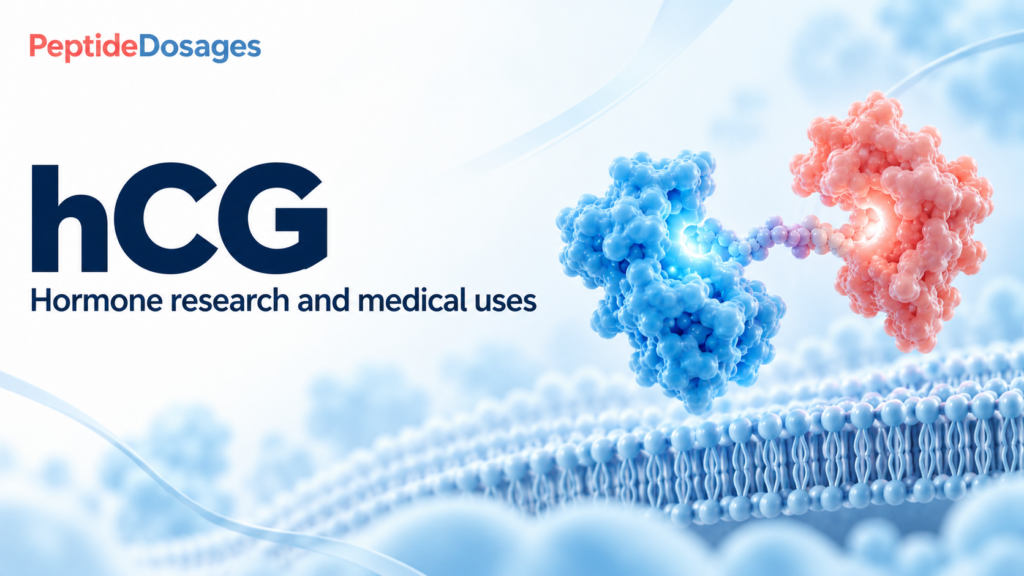
hCG stands for human chorionic gonadotropin, a hormone best known for its role in pregnancy. It is also used in prescription fertility care and selected hormonal conditions. If you found it under the name “hCG peptide,” you are still reading about this hormone, not a separate, improved version of it. [1][2]
hCG appears in pregnancy tests, prescription injections, research vials and weight-loss advertising. The shared name doesn’t give those uses the same evidence.
Is hCG a peptide?
hCG is a glycoprotein hormone, a protein with attached carbohydrate groups. Its two linked parts are the alpha and beta subunits. That protein structure explains its inclusion among peptide hormones, but “hCG peptide therapy” isn’t a separate medical indication. [2]
In pregnancy, hCG is produced by placental tissue. Pregnancy tests detect it in urine or blood. A blood test may report whether hCG is present or measure its concentration. [3]
How hCG works in the body
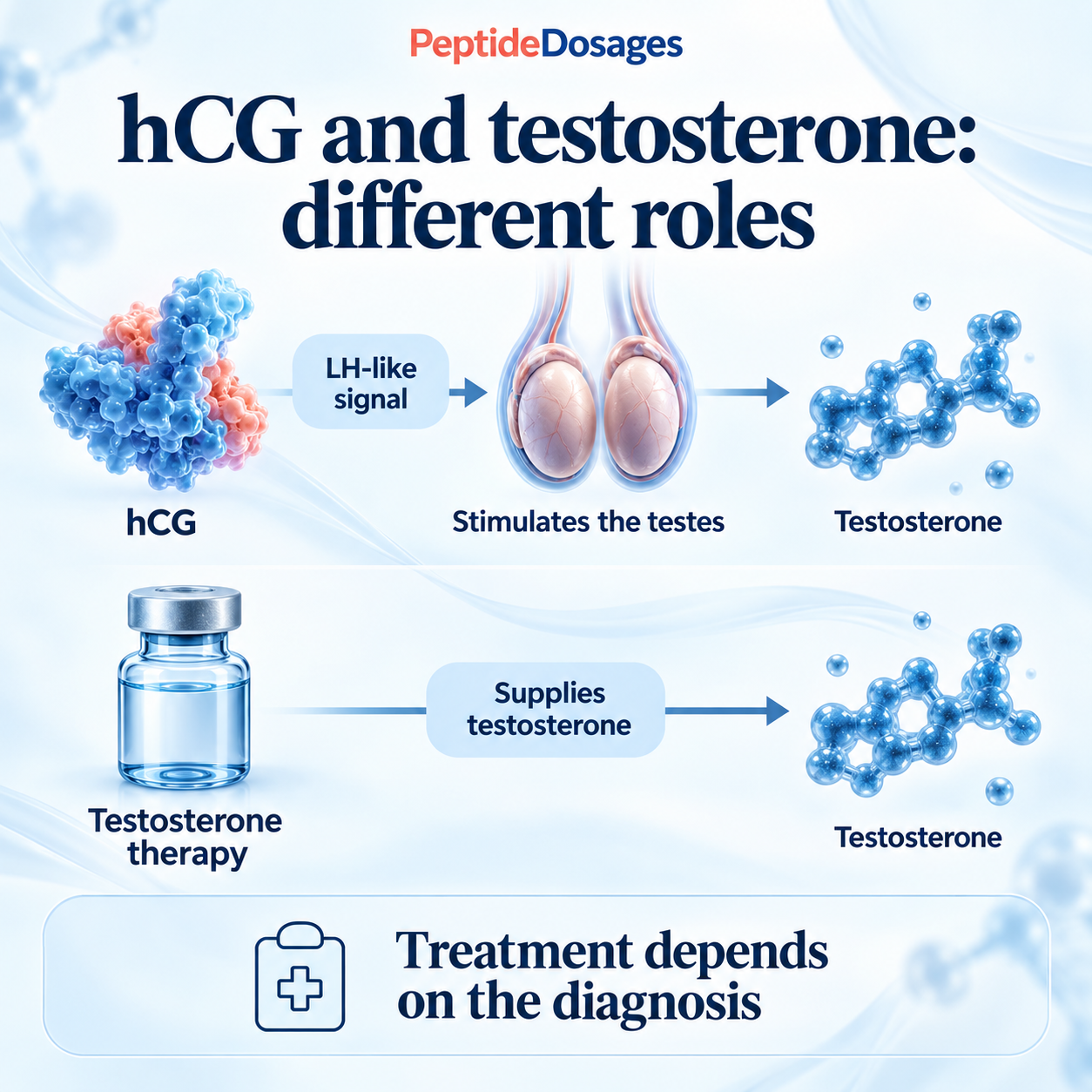
hCG mimics some of the actions of luteinizing hormone, or LH. In the testes, it stimulates Leydig cells to produce testosterone. In the ovaries, its LH-like activity is involved in ovulation and support of the corpus luteum, which produces progesterone. These effects explain its medical uses, but do not make it a general-purpose “hormone balance” treatment. [1]
The practical question is not simply whether hCG can change a hormone level. It is whether the underlying diagnosis makes that change useful, and whether an appropriate clinical outcome follows.
Medical uses of hCG: where the evidence applies
| Context | Supported role and limits |
|---|---|
| Fertility treatment involving ovulation | Prescription hCG is used at specific stages of supervised fertility treatment. [1][2] Keep in mind: It is not appropriate for every cause of infertility and cannot guarantee pregnancy. |
| Selected male hormonal conditions | PREGNYL labeling includes certain cases of hypogonadotropic hypogonadism, where hormone stimulation is deficient. [1] Keep in mind: Low testosterone alone does not identify the cause or establish the right treatment. |
| Infertile men with low testosterone | AUA/ASRM guidance includes hCG among possible therapies. The recommendation is conditional, with Grade C evidence. [4] Keep in mind: A possible option is not a promise of restored sperm production or a live birth. |
| Weight loss | A meta-analysis found no convincing benefit for weight loss, hunger or fat distribution. [5] Keep in mind: Weight loss during a restrictive diet does not prove hCG caused it. |
What can hCG do for men, and how is it different from TRT?
Testosterone replacement therapy supplies testosterone. hCG instead provides an LH-like signal that can stimulate the testes. That difference matters when fertility is a goal: external testosterone can suppress the hormonal signals involved in sperm production. AUA/ASRM guidance advises against testosterone monotherapy for men interested in current or future fertility. [4]
That does not mean hCG is automatically “better than TRT,” or that adding it guarantees fertility. Evaluation may involve hormone testing, semen analysis and the cause of the problem. A reproductive specialist can explain which outcome is being monitored and whether additional treatment is needed. Do not change an existing hormone prescription on the basis of a comparison chart.
Why the hCG diet claim does not hold up
In a six-week randomized trial involving 40 women, hCG did not outperform placebo for the weight-loss measures studied when both groups followed the same diet. [6] A broader meta-analysis reached a similar conclusion: the evidence did not support hCG as an effective weight-loss aid. [5]
The FDA says hCG is not approved for weight loss and warns against hCG diet products. Extremely restrictive diets promoted with these products can themselves cause harm, including gallstones and electrolyte problems. [7]
Quick check: if weight drops during an hCG diet, has hCG been shown to work?
Not necessarily. To separate a drug effect from a diet effect, researchers compare groups under similar conditions. The placebo-controlled study above did that and found no additional benefit from hCG. [6]
Potential side effects and important risks
Reported effects include injection-site discomfort, headache, fluid retention and breast enlargement in males. The risk profile depends on the person, product and treatment setting. A clinician also needs to check contraindications and other hormonal conditions before prescribing. [1]
In ovarian stimulation, a major concern is ovarian hyperstimulation syndrome (OHSS). Severe pelvic or abdominal pain, rapid weight gain, persistent vomiting, reduced urination or difficulty breathing during fertility treatment warrant urgent contact with the treating team. Severe OHSS can be dangerous. Multiple pregnancy and blood-clot risks also require counseling. [2]
Monitoring is part of treatment, not an optional extra. Depending on the situation, the care team may use ultrasound and laboratory results to decide whether and when to proceed. This is why a generic online cycle cannot substitute for a prescribed plan.
Research vials, prescription products and test results
| What you are looking at | What it tells you and limits |
|---|---|
| A medicine’s product name | The exact formulation matters. PREGNYL is supplied as a powder; OVIDREL is a recombinant hCG solution in a prefilled syringe. [1][2] Keep in mind: Preparation and route instructions cannot be transferred between products. |
| IU on a vial or mL of solution | Activity and liquid volume are different quantities. Keep in mind: A syringe marking alone does not establish the hormone amount or an appropriate dose. |
| hCG on a blood-test report | A measured concentration interpreted in clinical context. [3] Keep in mind: It is not an instruction for how much medicine to inject. |
Adding the word “peptide” or “research” to a vial does not demonstrate equivalence to an approved medicine. For prescribed treatment, follow the dispensing instructions for that exact product, including its storage and disposal requirements. Related calculation resources do not validate an unverified vial.
Common questions
Can an hCG injection affect a pregnancy test?
Yes. Fertility medicines containing hCG can cause a positive result that does not establish pregnancy. Follow the clinic’s testing schedule rather than interpreting an early home test by itself. Testing too early can also produce a false negative in someone who is pregnant. [3]
How quickly does hCG work?
There is no single timeline covering ovulation, testosterone levels, sperm production and pregnancy. These are different outcomes. Ask the treating clinician which result they expect to assess, when they will reassess it and what would change the plan.
Is hCG allowed in competitive sport?
The 2026 WADA Prohibited List includes chorionic gonadotropin as prohibited at all times in male athletes. Athletes should check their organization’s rules and any required therapeutic-use exemption before treatment. [8]
Bottom line: hCG has legitimate medical roles, but they are specific. A fertility medicine, a pregnancy-test marker and a weight-loss claim should not be blended into one list of benefits. Discuss treatment questions with a qualified healthcare professional.
Related dosage protocols and research
Explore related research, dosage references and guides below. Vial strengths have separate references because concentration and syringe-unit calculations differ. A comparison does not mean the compounds are interchangeable.
Matching dosage protocols
Further research context
References
- PREGNYL (chorionic gonadotropin): prescribing information. DailyMed.
- OVIDREL (choriogonadotropin alfa): prescribing information. DailyMed.
- MedlinePlus: Pregnancy Test. National Library of Medicine.
- AUA/ASRM: Diagnosis and Treatment of Infertility in Men, Part II. 2021 guideline summary.
- Lijesen et al. The effect of human chorionic gonadotropin in the treatment of obesity by means of the Simeons therapy: a criteria-based meta-analysis. British Journal of Clinical Pharmacology, 1995.
- Bosch et al. Human chorionic gonadotrophin and weight loss: a double-blind, placebo-controlled trial. South African Medical Journal, 1990.
- FDA: Avoid Dangerous HCG Diet Products.
- World Anti-Doping Agency: 2026 Prohibited List, S2.