
DSIP means delta sleep-inducing peptide, but its name is more confident than the clinical evidence. Small human studies have reported changes in sleep, while other controlled trials found little meaningful benefit. It is an experimental sleep-research compound, not an established solution for insomnia. [1][2]
Related dosage pages: The DSIP 5 mg and 10 mg vial references explain concentration calculations. They do not establish an effective bedtime dose.
What is DSIP peptide?
DSIP is described as a nine-amino-acid peptide investigated in sleep and related biological research. FDA discusses DSIP under the name emideltide, while noting inconsistencies in the identity of substances sold or described using these names. That makes precise product identity important, not just the acronym on a label. [5]
Did participants sleep better in a controlled study, and did they feel or function better afterward? A laboratory change in sleep architecture isn’t necessarily a noticeable improvement in daily life.
Does DSIP help with sleep?
The human findings are inconsistent. Much of the evidence comes from short experiments in the 1980s and early 1990s. Their age alone does not invalidate them, but their small size and brief follow-up limit the conclusions.
| Study | Finding |
|---|---|
| Six healthy volunteers, 1981 | A double-blind crossover experiment reported more sleep after morning intravenous DSIP and some changes in subsequent night sleep. Six volunteers cannot establish a dependable insomnia treatment. [3] |
| 14 people with chronic insomnia, 1987 | A seven-night study reported improved night sleep and daytime performance. The short observation period leaves long-term benefit unresolved. [1] |
| 16 people with chronic insomnia, 1992 | Some objective measures favored DSIP, but the effects were weak and subjective sleep quality did not improve. The authors doubted that the treatment offered a substantial short-term clinical benefit. [2] |
A separate 1987 double-blind crossover study adds an important negative finding. Some sleep-duration measurements differed from placebo, but those differences were already present at baseline. Slow-wave sleep and REM sleep did not change. The researchers judged the improvement to have little clinical significance. [4]
That is why a simple “DSIP improves deep sleep” statement goes too far. The studies do not show one consistent effect across sleep onset, deep sleep, perceived restfulness and daytime functioning.
What are sleep latency and sleep efficiency?
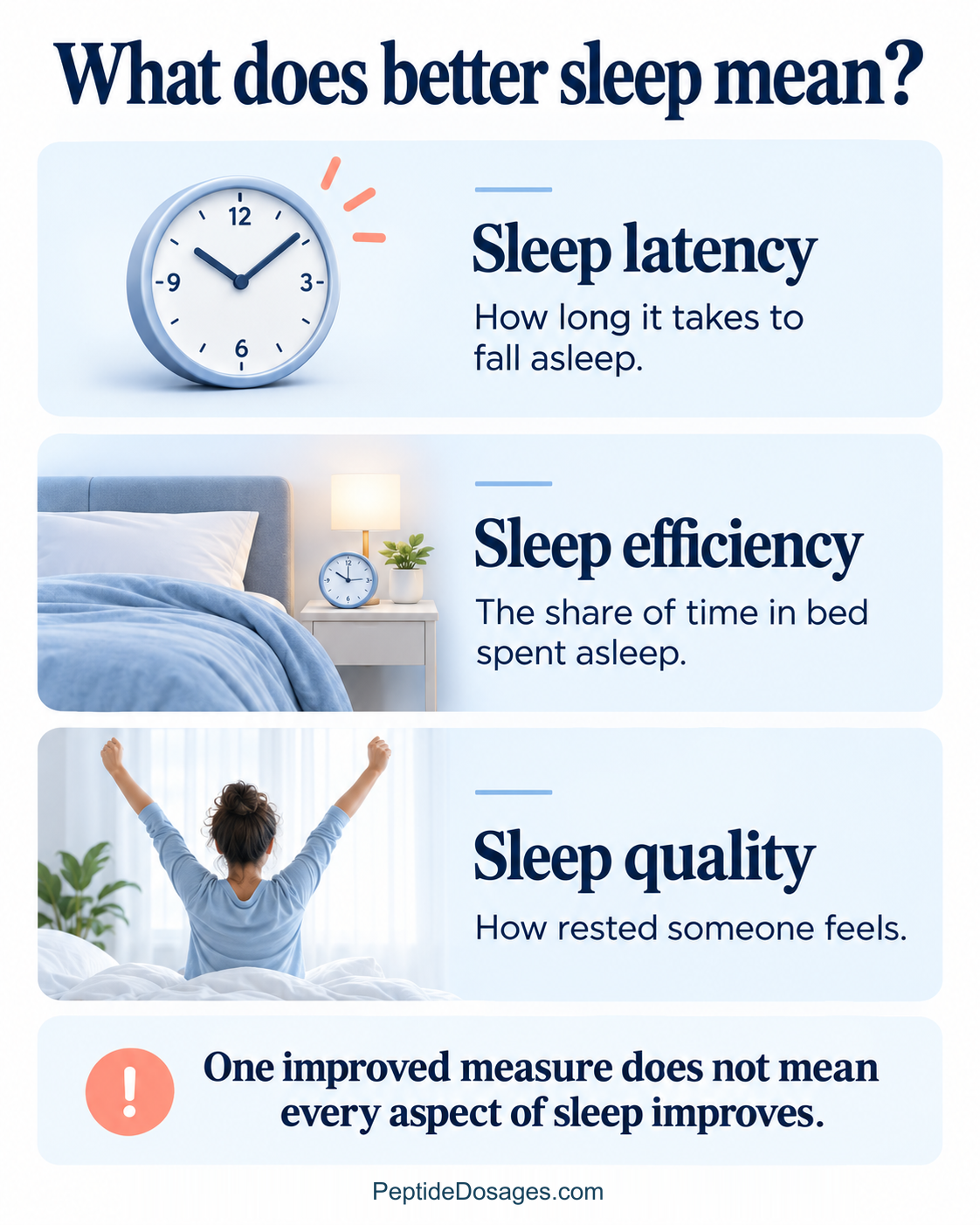
Sleep latency is the time it takes to fall asleep. Sleep efficiency is the proportion of time in bed spent asleep. Subjective sleep quality is how someone judges their sleep. These measurements can move in different directions, as the 1992 trial illustrates. [2]
How does DSIP make you feel, and how quickly?
The six-person 1981 experiment recorded a feeling of increased sleep pressure after an infusion, along with changes in sleep measurements. That is a report from a tightly controlled experiment, not a reliable prediction for a different person, product or route. [3]
These studies don’t establish that DSIP works within a set number of minutes or nights. Vivid dreams or a better sleep-tracker reading also can’t prove it caused a lasting benefit. Consistent improvement and daytime function matter more than one memorable night.
Side effects and safety: what remains uncertain?
FDA’s 2026 review describes headache, nausea, vertigo and cases of low blood pressure in older intravenous withdrawal studies; withdrawal itself complicates interpretation. It found no clinical safety data for the proposed subcutaneous preparations and highlighted potential aggregation, impurity and immune-reaction concerns. [5]
The six healthy volunteers in the early sleep experiment tolerated the exposure without observed adverse effects. That is reassuring only within the limits of that small study. It cannot exclude uncommon reactions or problems with repeated use. [3]
There is also no sound basis for describing DSIP as non-addictive or universally safe to combine with sleep medicines. Absence of adequate interaction or long-term evidence is not proof that those risks are absent.
Is DSIP approved, and is there a standard dosage?
The emideltide substances evaluated in FDA’s 2026 briefing were not components of an FDA-approved drug. A compounding evaluation is not a medicine approval. The briefing also raised substance-identity and formulation concerns. [5]
Historical intravenous sleep studies do not establish a standard subcutaneous, nasal or oral regimen. Changing the route changes exposure, and a vial’s milligram content does not tell you what amount is safe or effective. Copying an experimental amount into a nightly schedule skips those unanswered questions.
What about DSIP for opioid withdrawal?
An open clinical trial on opioid detoxification was published in 1998. An open study can generate a hypothesis, but it does not provide the protection against expectation and other biases that a well-controlled trial can offer. It should not be treated as proof that DSIP replaces established care. [6]
For opioid use disorder, evidence-based medication options include buprenorphine, methadone and naltrexone, chosen with a qualified treatment team. Do not stop prescribed treatment to substitute a research peptide. [7]
A more useful next step for persistent insomnia
If poor sleep is affecting daily life, start with an assessment of the sleep problem rather than a peptide choice. Keep a short sleep diary and discuss sleep timing, medicines and symptoms with a clinician. Sleep apnea and circadian rhythm disorders can require different approaches. [8]
NHLBI describes cognitive behavioral therapy for insomnia, or CBT-I, as the usual first treatment for long-term insomnia. It addresses the thoughts and habits that maintain sleep difficulties and is more structured than simply being told to practice better sleep hygiene. [9]
Does “sleep-inducing” mean DSIP is a proven sleeping medicine?
No. A compound’s name describes its research history, not the strength of its treatment evidence. For DSIP, small and conflicting trials leave both reliable benefits and a well-characterized safety profile unresolved.
Related DSIP dosage protocols
Continue with the vial-strength-specific research protocol that matches the material being evaluated. Each page keeps its own concentration, reconstitution, and syringe-unit calculations.
Practical measurement and handling guides
References
- Schneider-Helmert D. Effects of delta-sleep-inducing peptide on 24-hour sleep-wake behaviour in severe chronic insomnia. European Neurology. 1987.
- Bes F, et al. Effects of delta sleep-inducing peptide on sleep of chronic insomniac patients: a double-blind study. Neuropsychobiology. 1992.
- Schneider-Helmert D, et al. Acute and delayed effects of DSIP on human sleep behavior. 1981.
- Monti JM, et al. Study of delta sleep-inducing peptide efficacy in improving sleep on short-term administration to chronic insomniacs. 1987.
- FDA. Evaluation of emideltide-related bulk drug substances. Briefing document for the July 2026 Pharmacy Compounding Advisory Committee meeting.
- Backmund M, et al. Opioid detoxification with delta sleep-inducing peptide: results of an open clinical trial. Journal of Clinical Psychopharmacology. 1998.
- SAMHSA. Treatment options for substance use disorder.
- NHLBI. Insomnia: diagnosis.
- NHLBI. Insomnia: treatment.