

Cagrilintide is an investigational amylin analog being studied for weight management. It is not a GLP-1 drug, and it is not the same thing as CagriSema. CagriSema combines cagrilintide with semaglutide. Keeping those names separate is essential when reading weight-loss results. [1][3]
There is meaningful human trial evidence here, not just animal research. But trial results do not make an online research vial an approved medicine. As of this October 2026 update, FDA identifies cagrilintide as unapproved and says it cannot be used in compounding under federal law. [5]
Related dosage pages: The cagrilintide 5 mg and 10 mg vial references cover concentration calculations. A vial strength is not an approved dose or a substitute for the clinical-trial preparation.
What is cagrilintide, and how does it work?
Amylin is a pancreatic hormone involved in feeling full after eating. Cagrilintide was designed as a longer-acting analog to study sustained appetite and body-weight effects. Its development also addressed native amylin’s stability problems. [1]
Laboratory receptor studies describe cagrilintide, also called AM833, as an agonist at amylin and calcitonin receptors. That differs from semaglutide’s GLP-1 receptor activity. Combining the two is intended to engage complementary pathways, rather than simply doubling the same ingredient. [2][3]
Cagrilintide vs CagriSema
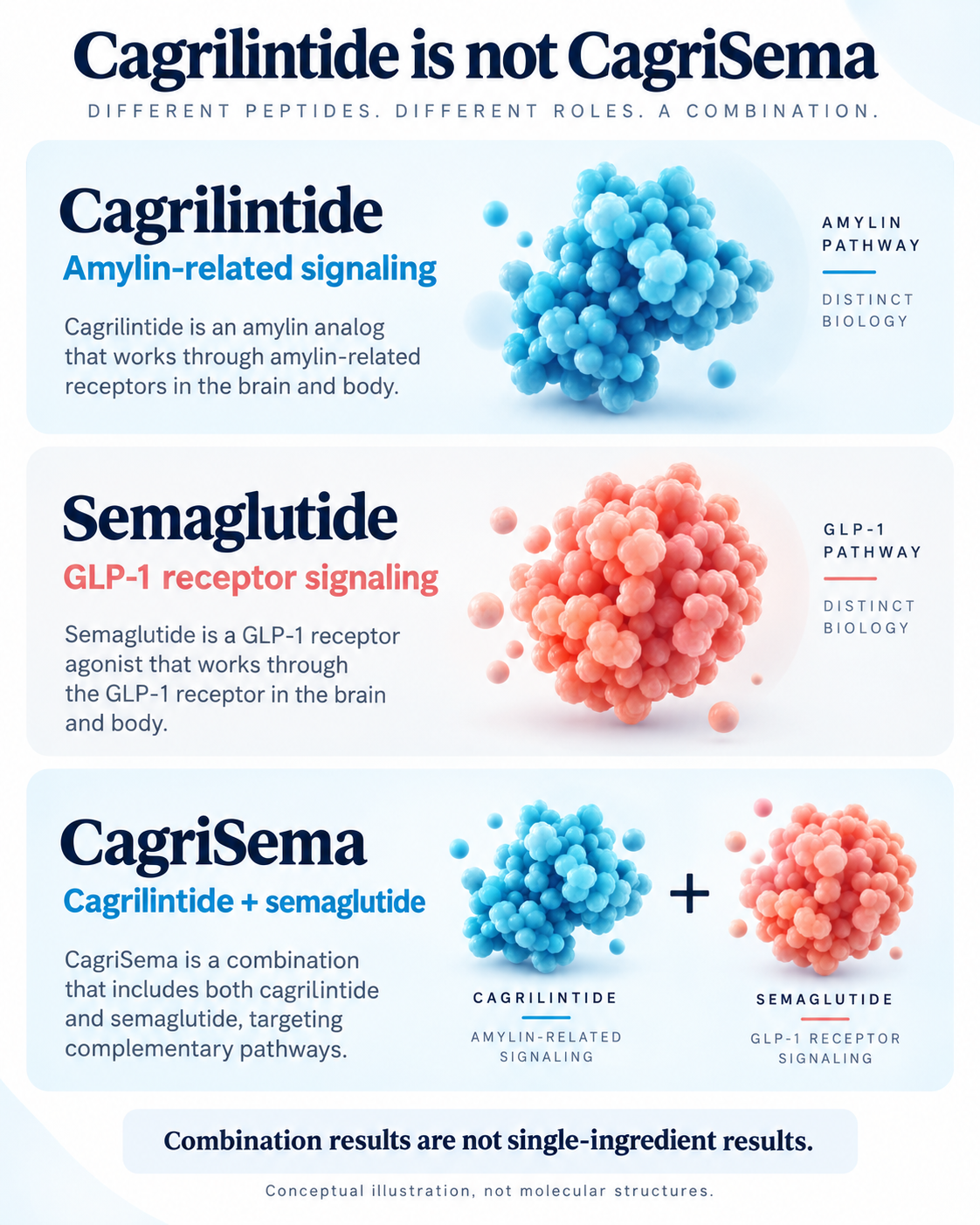
Cagrilintide is one ingredient. CagriSema is a two-ingredient investigational treatment. If a headline reports a result with CagriSema, it cannot be attributed to cagrilintide alone. A self-mixed combination is also not automatically equivalent to the formulation, monitoring and participant selection used in a trial.
How much weight loss did trials show?
A 26-week phase 2 trial randomized 706 adults without diabetes. Across the cagrilintide groups, estimated average weight loss ranged from 6.0% to 10.8%, versus 3.0% with placebo, in an analysis assuming treatment adherence. The highest studied group reached 10.8%, compared with 9.0% for liraglutide. Those are group averages, not a prediction for an individual. [4]
The later REDEFINE 1 trial provides a useful same-study comparison. It enrolled 3,417 adults with obesity, or overweight with a related complication, without diabetes. All groups received lifestyle intervention. The table uses the treatment-policy analysis, which accounts for participants regardless of treatment adherence. [3]
| Study group | Weight reduction |
|---|---|
| Cagrilintide alone | 11.5% |
| Semaglutide alone | 14.9% |
| CagriSema combination | 20.4% |
| Placebo | 3.0% |
Study target: 2.4 mg of each active ingredient, where applicable. These are trial results, not prescribing instructions. Source: Garvey et al., 2025. [3]
Why do other headlines say 22.7%?
REDEFINE 1 also estimated the effect if participants remained on treatment without additional weight-loss interventions. That analysis produced a 22.7% figure for CagriSema. It answers a different question from the 20.4% treatment-policy result. Neither number is a cagrilintide-only result. [3]
Is cagrilintide better than semaglutide or tirzepatide?
First identify whether the comparison concerns cagrilintide alone or CagriSema. Then check dose, population, duration and analysis. Calling one peptide “the best” without those details is misleading.
For example, Novo Nordisk’s February 2026 announcement for the open-label REDEFINE 4 trial reported that CagriSema did not meet its primary non-inferiority endpoint against tirzepatide. At 84 weeks, the treatment-adherence estimate was 23.0% weight loss with CagriSema versus 25.5% with tirzepatide 15 mg. That was a comparison of the combination, not cagrilintide alone. [6]
In September 2026, the company announced a different finding in REIMAGINE 5: lower-dose CagriSema produced greater weight loss than tirzepatide 5 mg in adults with type 2 diabetes. The doses, population and trial were different. Both announcements can be true without establishing a universal winner. These are sponsor-reported topline findings, which should be distinguished from a complete peer-reviewed report. [7]
Side effects and tolerability
Digestive symptoms are a central trade-off. In the phase 2 cagrilintide trial, gastrointestinal events affected 41% to 63% of participants across cagrilintide groups, versus 32% with placebo. Nausea was the most common, and constipation, diarrhea and injection-site reactions also occurred. [4]
In REDEFINE 1, gastrointestinal events were reported in 79.6% of the CagriSema group and 39.9% of the placebo group, mainly transient and mild to moderate. These combination figures should not be presented as cagrilintide-only rates. [3]
“Usually mild” does not mean every person tolerates treatment well. Trial teams can adjust treatment and evaluate symptoms; a product purchased outside that setting does not come with the same safeguards. Persistent vomiting or inability to keep fluids down needs medical assessment, not an automatic increase or a second appetite-suppressing compound.
Is cagrilintide FDA approved or available by prescription?
Not as an FDA-approved cagrilintide medicine at this update. FDA specifically states that cagrilintide is not a component of an approved drug and cannot be used in compounding under federal law. A research label or an online seller’s availability claim does not change that status. [5]
Novo Nordisk’s September 2026 update says the CagriSema application was submitted in December 2025, with a decision expected in the fourth quarter of 2026. An application and an expected decision are not an approval. That timeline concerns CagriSema, not interchangeable approval for all cagrilintide products. [7]
Is there a standard cagrilintide dosage?
Clinical studies have used different investigational amounts and escalation plans. These were study protocols with eligibility checks and monitoring, not a general dosing label. There is no approved cagrilintide prescription label to translate into a universal starting dose or cycle.
Can cagrilintide be combined with tirzepatide?
The CagriSema evidence does not answer that question: it concerns semaglutide, not tirzepatide. Nor does a head-to-head comparison test taking both products together. Do not treat separate results as proof that an unstudied combination is safe or more effective.
Does cagrilintide specifically remove belly fat?
The weight-loss results above do not establish selective removal of abdominal fat. A change in total body weight is not the same endpoint as a change in a particular fat compartment. Look for a directly measured outcome rather than a targeted-fat-loss claim.
The practical takeaway: cagrilintide is a promising research direction with human weight-loss data. Read results by exact treatment and trial, and discuss established weight-management options with a qualified clinician rather than substituting an unapproved research product.
Related Cagrilintide dosage protocols
Continue with the vial-strength-specific research protocol that matches the material being evaluated. Each page keeps its own concentration, reconstitution, and syringe-unit calculations.
Practical measurement and handling guides
References
- Kruse T, et al. Development of cagrilintide, a long-acting amylin analogue. Journal of Medicinal Chemistry. 2021.
- AM833 is a novel agonist of calcitonin family G protein-coupled receptors. Journal of Pharmacology and Experimental Therapeutics. 2021.
- Garvey WT, et al. Coadministered cagrilintide and semaglutide in adults with overweight or obesity. New England Journal of Medicine. 2025. Full trial report.
- Lau DCW, et al. Once-weekly cagrilintide for weight management: a dose-finding phase 2 trial. Lancet. 2021.
- FDA. Concerns with unapproved drugs used for weight loss. Cagrilintide approval and compounding statement.
- Novo Nordisk. REDEFINE 4 topline results. February 23, 2026. Sponsor announcement.
- Novo Nordisk. REIMAGINE 5 and REDEFINE 9 topline results and development update. September 21, 2026. Sponsor announcement.