
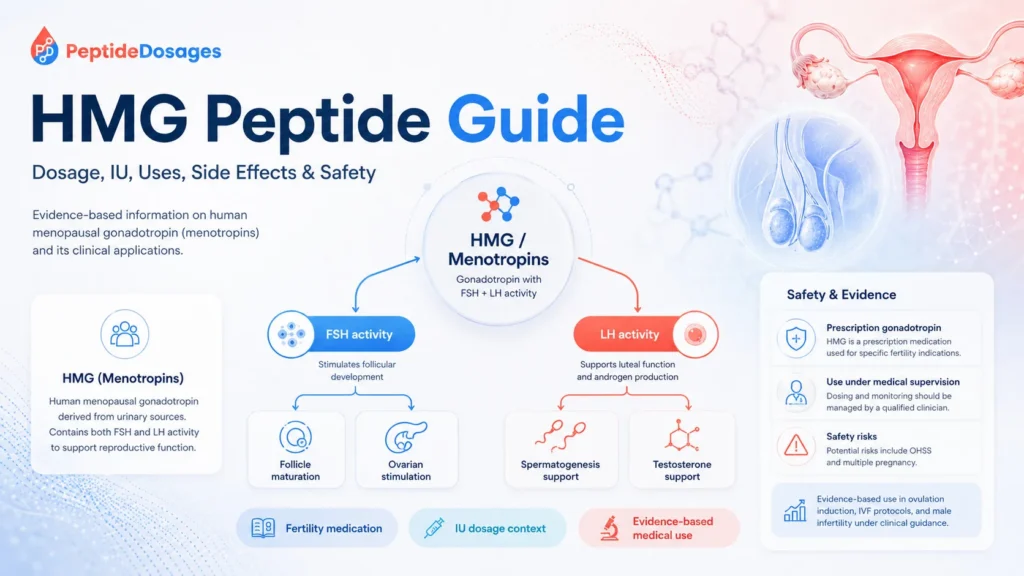
Searches for HMG peptide usually refer to HMG, or human menopausal gonadotropin, a prescription gonadotropin medication also called menotropins rather than a typical short peptide 1 2. This educational guide explains how HMG is used in reproductive medicine, how FSH and LH activity are interpreted, and where evidence is strongest or limited [1] [2]. It is not personal medical advice and does not provide self-dosing, injection, or purchasing instructions.
- HMG is better described as menotropins, a gonadotropin medication containing follicle-stimulating hormone activity and luteinizing hormone activity, often derived from the urine of postmenopausal women [1] [2].
- The strongest evidence is in fertility medicine, especially ovarian stimulation in assisted reproductive technology settings and selected ovulation-induction contexts managed by specialists [1] 3 4.
- HMG works through gonadotropin pathways, including FSH receptor and luteinizing hormone / choriogonadotropin receptor signaling in reproductive tissues 9 10.
- Potential benefits depend on diagnosis and monitoring, such as follicle maturation in women or sperm production support in men with hypogonadotropic hypogonadism, but these are not guaranteed fertility outcomes [1] 13.
- Potential side effects include local injection site reactions and hormone-related symptoms, while serious risks include ovarian hyperstimulation syndrome, multiple pregnancy, thromboembolic events, and ovarian torsion in susceptible contexts [1] 8.
- Dosage is expressed in IU, not as a simple milligram amount, and label or study doses should not be interpreted as personal dosing advice [1].
- Regulatory status matters because FDA-approved menotropins, country-specific products, compounded preparations, imported products, and unsupported online “peptide” claims are not evaluated in the same way [1] 16.
Related dosage pages: For vial-specific concentration, reconstitution, and measurement examples, see HMG (0.15 mg / 75 IU Vial) Dosage Protocol. Each linked protocol remains a separate reference because vial strength changes concentration and syringe-unit calculations.
Fast Answer
HMG peptide is a search term for human menopausal gonadotropin, or menotropins, a prescription gonadotropin hormone medication with FSH and LH activity used in specialist fertility care [1] [2]. It is discussed for infertility, ovulation, IVF stimulation, and some male infertility contexts, but evidence strength depends on the indication [1] [3] [4]. Key caveats include IU-based dosage, injection-route differences, ovarian hyperstimulation risk, contraindications, and regulatory quality concerns [1] [8] [16].
What Is the HMG Peptide?
HMG stands for human menopausal gonadotropin, also spelled human menopausal gonadotrophin in some regions, and the drug class is usually referred to as menotropins [1] [2]. In a fertility context, HMG is not a single small peptide sequence like many research peptides; it is a biologic gonadotropin medication containing hormone activity relevant to ovarian and testicular function [1] [2].
The phrase “HMG peptide” can be confusing because HMG also means “high-mobility group” in genetics and chromatin biology, but this article focuses only on the reproductive medicine meaning: human menopausal gonadotropin / menotropins [2].
How Are Human Menopausal Gonadotropin, Menotropins, and HMG Related?
Human menopausal gonadotropin, HMG, and menotropins are closely related names for preparations containing gonadotropin activity used in fertility treatment [1] [2]. FDA-approved menotropins labeling describes MENOPUR as a gonadotropin preparation with follicle-stimulating hormone and luteinizing hormone activity [1].
“Menotropins” is the generic drug term commonly used in prescribing information, while HMG is the older and widely recognized abbreviation in reproductive endocrinology literature [1] [2]. When readers search for HMG peptide, they are usually looking for information about this fertility medication rather than an online wellness peptide product.
Why Is HMG More Accurately a Gonadotropin Hormone Medication?
HMG is more accurately described as a gonadotropin hormone medication because its clinically relevant activity comes from FSH and LH bioactivity [1] [2]. FSH and LH are glycoprotein hormones that act through specific receptors in reproductive tissues, not small peptide fragments with a single short amino acid sequence [9] [10] 11 12.
This distinction matters for safety. A regulated gonadotropin drug used in fertility care has label-based warnings, contraindications, monitoring expectations, and potency units, while many online “peptide” claims do not have the same evidentiary or regulatory foundation [1] [16].
How Are HMG Preparations Derived From the Urine of Postmenopausal Women?
Traditional HMG preparations are extracted from the urine of postmenopausal women, then purified to concentrate gonadotropin activity [1] [2]. The term “human menopausal” reflects that postmenopausal urine contains elevated gonadotropins because ovarian estrogen feedback is reduced after menopause, although product manufacturing and purification are controlled pharmaceutical processes [1] [2].
Modern HMG preparations may be described as highly purified HMG or menotropins depending on the product and jurisdiction [1]. Product-specific labels are important because potency, excipients, route, indication, and safety instructions can differ between approved medicines [1] [3].
How Does HMG Peptide Work?
HMG works by supplying exogenous gonadotropin activity, mainly FSH activity and LH activity, to stimulate reproductive tissues under medical supervision [1] [2]. In women, this can support ovarian follicle development during fertility treatment; in men with certain hormone deficiencies, gonadotropin therapy can support testosterone production and spermatogenesis [1] [13] 14.
Mechanism is not the same as a guaranteed outcome. Follicle development, ovulation, semen parameters, fertilisation, and pregnancy depend on diagnosis, age, ovarian reserve, sperm quality, embryo factors, uterine factors, protocol choice, and monitoring [4] 5 18.
FSH and LH Receptor Activity in Hormonal Stimulation
FSH acts through the FSH receptor, a G protein-coupled receptor encoded by the FSHR gene, and this pathway is central to follicular growth in women and Sertoli-cell function in men [9] [11]. LH acts through the luteinizing hormone / choriogonadotropin receptor, encoded by LHCGR, which is also activated by human chorionic gonadotropin because LH and hCG share receptor signaling biology [10] [12].
In ovarian stimulation, FSH activity supports recruitment and growth of follicles, while LH activity contributes to steroidogenesis and later follicular maturation depending on the physiologic and protocol context [4] [11] [12]. Clinicians monitor response because too little stimulation may be ineffective and too much may increase ovarian hyperstimulation risk [1] [4] [8].
How Do Luteinizing Hormone Signaling, hCG, and Ovulation Timing Connect?
Luteinizing hormone signaling is closely connected to ovulation physiology, and hCG is often used in fertility protocols because it activates the same LH / choriogonadotropin receptor pathway [10] [12]. FDA labeling for menotropins describes using hCG after sufficient follicular development to trigger final oocyte maturation, while also warning that hCG may be withheld if ovarian hyperstimulation risk is excessive [1].
This is a timing-sensitive medical decision, not a general “stack.” The use of HMG and hCG in fertility care depends on ultrasound findings, laboratory markers, follicular response, and the treating clinician’s protocol [1] [4] [8].
Leydig Cells, Testosterone Production, and Spermatogenesis in Men
In men, LH-like activity supports Leydig cells in the testes, which are involved in testosterone production [12] [13]. FSH activity supports Sertoli-cell function and spermatogenesis in men, which is why hCG plus FSH-containing therapy such as HMG may be considered in selected men with hypogonadotropic hypogonadism [13] [14].
This does not mean HMG is a general testosterone booster or performance product. In male infertility care, gonadotropin treatment is tied to a specific endocrine diagnosis, semen analysis, testicular volume, baseline hormone testing, and specialist monitoring [13] [14] [18].
What Is HMG Used For in Fertility Treatment?
HMG is used in fertility-related medical settings because gonadotropins can stimulate the ovaries or support sperm production when the underlying diagnosis fits that mechanism [1] [3] [13]. The word “infertility” itself has formal medical definitions, including failure to establish a clinical pregnancy after a defined period of regular unprotected intercourse, but the cause of infertility varies widely between individuals and couples [5] [18].
Approved, studied, and off-label uses should not be blended together. FDA-approved Menopur labeling is specific to development of multiple follicles and pregnancy in ovulatory women as part of an assisted reproductive technology cycle, while other uses may depend on product, jurisdiction, diagnosis, and clinician judgment [1] [3].
Ovulation Induction for Selected Causes of Infertility
Gonadotropins have been studied for ovulation induction in selected anovulatory infertility contexts, including women with polycystic ovary syndrome who do not respond to first-line approaches, but treatment requires careful monitoring because multifollicular development can increase safety risks 7 [18]. MedlinePlus also describes menotropins as being used to cause ovulation in women whose ovaries can produce follicles but who need medical stimulation [3].
This does not mean HMG is appropriate for every cause of infertility. Tubal disease, uterine factors, diminished ovarian reserve, severe male-factor infertility, endocrine disorders, and unexplained infertility require different evaluations and treatment pathways [5] [18].
Ovarian Stimulation for IVF and Assisted Reproductive Technologies
In IVF and other assisted reproductive technologies, gonadotropin stimulation is used to promote development of multiple follicles so that eggs in women can be retrieved for fertilisation procedures [1] [4]. ESHRE guidance discusses ovarian stimulation for IVF / ICSI as a protocol-driven process involving medication selection, dose adjustment, monitoring, and risk reduction [4].
HMG preparations are one category among several gonadotropin options used in assisted reproduction [4] 6. Evidence comparisons often evaluate outcomes such as oocyte yield, pregnancy rate, live birth, cancellation rates, and safety, but no comparison should be interpreted as choosing the “best” medication for every patient [4] [6].
Male Infertility and Hypogonadotropic Hypogonadism Contexts
In men with hypogonadotropic hypogonadism, the pituitary signal to the testes is deficient, and gonadotropin therapy may be used to stimulate testosterone production and spermatogenesis in men seeking fertility [13] [14]. MedlinePlus notes that menotropins may be used with hCG to increase sperm production in men whose infertility is caused by low levels of certain hormones [3].
The evidence is more diagnosis-specific than the phrase “male infertility” suggests. Gonadotropins are biologically plausible and clinically used for gonadotropin-deficient men, but evidence for idiopathic male-factor subfertility is more limited and has been evaluated separately in systematic reviews [13] 15.
HMG Preparations, IU Strengths, and Product Types
HMG products vary by brand, country, purification method, potency, and labeled route of administration [1] [3]. In the United States, the FDA-approved menotropins product MENOPUR is a prescription drug with product-specific labeling for indication, dosage, administration route, contraindications, and adverse reactions [1].
Some regions and sources may use terms such as urinary HMG, highly purified HMG, menotrophin, human menopausal gonadotrophin, or generic HMG. These names should always be checked against an official label or medicine database because fertility medications are not interchangeable based only on informal names [1] [3].
What Does 75 IU Mean in HMG Products?
IU means international units, a potency-based expression rather than a direct mass measurement. FDA labeling for Menopur describes each vial as containing 75 IU of FSH activity and 75 IU of LH activity, which reflects standardized biological activity rather than a simple milligram dose [1].
This is one reason HMG dosage information can be misread online. A number such as 75 IU describes potency in a labeled medication context; it is not a personal recommendation, and it cannot be safely converted into a self-directed protocol [1].
Potential Benefits of HMG Treatment
The potential benefits of HMG treatment are best understood by indication. In fertility care, benefits are usually measured through endpoints such as follicle development, oocyte yield, ovulation in women, semen parameters, pregnancy rate, or live birth, not through general wellness claims [1] [4] [5].
Even when a benefit is biologically plausible, it may not translate into pregnancy or live birth for an individual patient. Age, diagnosis, embryo quality, sperm factors, uterine health, and treatment protocol can all affect fertility outcomes [4] [5] [18].
Potential Benefits for Follicle Maturation and Eggs in Women
In women undergoing ART, the clinically intended effect of menotropins is development of multiple follicles as part of a reproductive treatment cycle [1]. Ovarian stimulation guidelines discuss medication selection and monitoring because follicle maturation must be balanced against risks such as excessive ovarian response and ovarian hyperstimulation syndrome [4] [8].
Potential benefits therefore include follicular growth and retrieval of eggs in women within a supervised IVF or assisted reproductive technology cycle [1] [4]. These are treatment-process endpoints, not a promise of fertilisation, implantation, pregnancy, or live birth [4] [5].
Potential Benefits for Sperm Count and Fertility in Men
For men with hypogonadotropic hypogonadism, HMG or FSH-containing therapy used in combination with hCG may help induce spermatogenesis when the testes can respond to gonadotropin stimulation [13] [14]. In that context, improved sperm count or sperm production is tied to replacing deficient hormonal signals rather than “boosting” normal physiology [13] [14].
For broader male infertility without clear gonadotropin deficiency, evidence is less certain. A Cochrane review of gonadotrophins for idiopathic male-factor subfertility evaluated possible effects, but this evidence should not be generalized to all men with fertility concerns [15].
What Does Human Research Show About HMG?
Human evidence for HMG is strongest when the product, population, and outcome match approved-label or fertility-guideline contexts [1] [4]. Evidence becomes weaker when claims move into different diagnoses, different endpoints, or unsupported wellness uses.
| Evidence Area | What Has Been Studied | Evidence Level | What It Can and Cannot Show |
|---|---|---|---|
| ART ovarian stimulation | Menotropins and other gonadotropins have been used to stimulate multiple follicle development in IVF / ICSI cycles [1] [4]. | Approved / Clinical | Supports use in supervised ART settings, but does not guarantee fertilisation, pregnancy, or live birth. |
| Urinary gonadotropins vs recombinant FSH | Cochrane reviews have compared urinary gonadotrophins, including HMG-type products, with recombinant FSH in assisted reproduction [6]. | Clinical | Helps compare treatment categories, but product choice still depends on patient factors and protocol. |
| Ovulation induction | Gonadotropins have been studied for ovulation induction in women with PCOS and other anovulatory contexts [7] [18]. | Clinical | Shows a studied fertility-treatment role, but requires monitoring to reduce multifollicular and OHSS risks. |
| Male hypogonadotropic hypogonadism | hCG with FSH-containing therapy such as HMG has been used to induce spermatogenesis in men with gonadotropin deficiency [13] [14]. | Clinical / Early human by subgroup | Supports specialist-managed use in a defined endocrine condition, not general male enhancement. |
| Idiopathic male-factor subfertility | Systematic review evidence has evaluated gonadotrophins for idiopathic male subfertility [15]. | Early human / Mixed clinical | May suggest possible benefit in selected settings, but evidence is not strong enough for broad claims. |
| Weight loss or general wellness | FDA-approved menotropins labeling does not list weight loss, anti-aging, or performance enhancement as indications [1]. | Unsupported | Online claims should not be treated as evidence-based therapeutic uses. |
Clinical Evidence in Ovulation Induction and Assisted Reproduction
Clinical literature supports gonadotropins as part of carefully monitored ovulation induction and ART protocols, but the evidence is protocol-specific [4] [6] [7]. In assisted reproduction, HMG preparations are compared with other stimulation options such as recombinant FSH, and outcomes can vary by study design, ovarian response, and patient population [4] [6].
The most medically responsible interpretation is that HMG has an established role in reproductive endocrinology, not that it is universally superior to other fertility hormones. Treatment selection is individualized by licensed clinicians using diagnosis, ovarian reserve, prior response, safety risk, and patient goals [4] [18].
Studies of HMG Therapy in Men With Hypogonadotropic Hypogonadism
Human evidence in men is most coherent in hypogonadotropic hypogonadism, where the missing signal from the hypothalamic-pituitary-gonadal axis can be replaced with hCG and FSH-containing therapy [13] [14]. Reviews describe gonadotropin therapy as a fertility-inducing approach for men with this endocrine condition, often requiring months of treatment and monitoring of semen parameters and testosterone [13] [14].
This evidence should not be stretched to men with normal gonadotropin signaling or nonspecific wellness goals. Exogenous testosterone can suppress spermatogenesis, so men concerned about fertility need clinician-guided endocrine evaluation rather than self-directed hormone use 19.
How Should Pregnancy Rate and Fertility Outcomes Be Interpreted?
Pregnancy rate is a useful research endpoint, but it is not the same as live birth, and neither endpoint predicts an individual outcome with certainty [4] [5]. Fertility outcomes are influenced by female age, ovarian reserve, sperm quality, embryo aneuploidy, uterine factors, treatment protocol, and the underlying cause of infertility [4] [5] [18].
This is why evidence tables and labels should be read as population-level information. They help clinicians and patients discuss options, but they do not replace personalized diagnosis, monitoring, or informed consent [4] [18].
Preclinical Evidence and Mechanistic Research
Preclinical evidence is useful for understanding receptor biology, but HMG’s clinical use is not based only on animal or in vitro data. The core pharmacology is tied to FSH and LH receptor pathways, which have been described in molecular and endocrine literature [9] [10] [11] [12].
Mechanistic research can explain why gonadotropins may stimulate follicles or support spermatogenesis. It cannot, by itself, prove pregnancy outcomes, long-term safety, or the best treatment protocol in humans [4] [5].
Animal and Laboratory Models of Gonadotropin Signaling
Laboratory studies and receptor biology reviews describe how FSHR and LHCGR signaling influence reproductive tissues [9] [10] [11] [12]. These pathways are relevant because HMG preparations provide FSH and LH activity rather than acting through unrelated peptide pathways [1] [2].
Animal and cell models help clarify biology, dose-response concepts, and receptor signaling. However, ovarian response, ovulation, fertilisation, and pregnancy outcomes must be evaluated in human clinical contexts because reproductive medicine outcomes are multifactorial [4] [5].
What Can Preclinical Evidence Predict About HMG?
Preclinical evidence can support biological plausibility. For HMG, it helps explain why FSH activity can affect follicle growth and Sertoli-cell function, and why LH-like activity can affect steroidogenesis and Leydig-cell signaling [9] [10] [11] [12].
What it cannot do is prove that an online HMG peptide product will improve fertility, weight loss, testosterone, or general health. Product quality, regulatory approval, diagnosis, dosing, route, monitoring, and patient selection all determine clinical relevance [1] [4] [16].
Evidence Limitations and Unsupported Online Claims
HMG has real medical uses, but that does not validate every online claim attached to the phrase “HMG peptide.” Evidence is strongest for approved menotropins labeling and reproductive medicine studies; it is weaker or absent for claims about general wellness, weight loss, anti-aging, bodybuilding, or unsupervised hormonal optimization [1] [4] [16].
A useful rule is to ask whether the claim is supported by an approved label, a clinical trial, a systematic review, a guideline, early human evidence, preclinical research, or only anecdotal reports. Claims at the bottom of that evidence ladder should be treated cautiously [4] [6] [7].
Why Isn’t HMG a General Wellness or Weight Loss Peptide?
HMG is not approved as a weight loss drug, anti-aging product, or general wellness peptide [1]. Its evidence-based role is tied to reproductive endocrinology and selected infertility contexts, not dieting, metabolism enhancement, or body-composition claims [1] [4] [18].
This matters because gonadotropin therapy can affect estrogen, testosterone, ovarian response, and pregnancy-related risks [1] [8] [13]. Those effects require medical assessment, not casual wellness use.
Separating Mechanistic Plausibility From Clinical Benefit
A mechanism can be real without proving a clinical benefit. For example, HMG stimulates gonadotropin pathways, but that does not mean it will improve fertility outcomes unless the diagnosis, treatment context, and monitoring are appropriate [1] [4] [13].
This distinction is especially important for online peptide content. Mechanistic plausibility is a starting point for research, while approved uses and clinical evidence are stronger standards for medical decision-making [4] [16].
Side Effects and Potential Adverse Effects
Side effects from HMG products can range from mild local reactions to serious reproductive medicine complications [1] [3] [8]. The FDA label and patient drug information sources discuss adverse reactions such as headache, abdominal symptoms, nausea, injection site discomfort, and ovarian hyperstimulation syndrome [1] [3].
The risk profile depends on patient factors and treatment context. For example, ovarian hyperstimulation risk is relevant to ovarian stimulation, while semen-parameter monitoring is more relevant in male infertility contexts [1] [8] [13].
What Potential Side Effects Are Reported With HMG Injection?
Reported potential side effects include headache, abdominal pain or fullness, nausea, and injection site reactions [1] [3]. Because HMG affects reproductive hormones, some people also report symptoms during fertility treatment that overlap with hormonal shifts and the stress of treatment, including mood-related symptoms [3].
Any severe abdominal pain, rapid weight gain, shortness of breath, decreased urination, swelling, or other concerning symptoms during ovarian stimulation requires urgent medical evaluation because these may be warning signs of ovarian hyperstimulation syndrome or related complications [1] [8].
Injection Site Reactions, Abdominal Symptoms, and Mood Swings
Injection site reactions may include pain, redness, bruising, or irritation, depending on the product and route used [1] [3]. Abdominal bloating or discomfort can occur during ovarian stimulation because ovaries may enlarge as follicles develop [1] [8].
Mood swings should be interpreted carefully. They can occur in the broader setting of fertility treatment and hormone changes, but they do not prove a predictable medication effect in every person [3] [18].
Serious Safety Risks and Contraindications
Serious risks described in menotropins labeling include ovarian hyperstimulation syndrome, pulmonary and vascular complications, ovarian torsion, multifetal gestation, congenital anomalies, ectopic pregnancy, spontaneous abortion, and possible concerns about ovarian neoplasms after repeated stimulation, although causality can be difficult to establish [1] [8]. These are reasons fertility treatment is medically monitored rather than self-directed [1] [4] [8].
Contraindications in FDA labeling include hypersensitivity to menotropins, high FSH levels indicating primary ovarian failure, uncontrolled non-gonadal endocrinopathies, sex hormone-dependent tumors, pituitary or hypothalamic tumors, abnormal uterine bleeding of undetermined origin, ovarian cyst or enlargement not due to polycystic ovary syndrome, and pregnancy [1].
Ovarian Hyperstimulation Syndrome and Ovarian Enlargement
Ovarian hyperstimulation syndrome is a potentially serious complication of ovarian stimulation marked by enlarged ovaries, fluid shifts, abdominal symptoms, and in severe cases thromboembolic or respiratory complications [1] [8]. ASRM guidance addresses prevention and treatment of moderate and severe OHSS because risk reduction is a major part of fertility treatment safety [8].
HMG labeling instructs clinicians to monitor ovarian response and consider withholding hCG when ovarian response suggests increased OHSS risk [1]. This is one reason hCG timing cannot be turned into a simple self-use protocol [1] [8].
Multiple Pregnancy, Ectopic Pregnancy, and Miscarriage Risks
Gonadotropin stimulation can increase the chance of multifollicular development, which can raise the risk of multiple pregnancy in some treatment contexts [1] [4]. Menotropins labeling also discusses ectopic pregnancy and spontaneous abortion as risks observed in fertility treatment populations [1].
These risks do not mean HMG causes every adverse pregnancy outcome. They mean patients need counseling about baseline infertility risks, treatment-related risks, embryo factors, and monitoring plans [1] [4] [18].
Which Hormone-Sensitive Tumors or Endocrine Imbalances Matter?
FDA labeling lists sex hormone-dependent tumors, pituitary or hypothalamic tumors, and uncontrolled non-gonadal endocrinopathies among contraindication-related concerns [1]. Thyroid, adrenal, prolactin, ovarian, uterine, testicular, and pituitary-hypothalamic evaluation may be relevant depending on the patient’s symptoms and reproductive history [1] [18].
A hormonal imbalance should not be self-diagnosed from symptoms alone. Infertility evaluation usually relies on history, examination, semen analysis when relevant, imaging, and laboratory testing [18].
Drug Interactions and Combination Therapy Considerations
For HMG, “drug interactions” are often protocol-based rather than classic liver-enzyme interactions. Key medical decisions involve how HMG is used with hCG, GnRH agonists or antagonists, clomiphene, letrozole, progesterone support, or other fertility medications [1] [4] [7] [18].
The safety issue is not only which drugs are combined, but when and why they are combined. Small timing or dose changes can affect follicular response, ovulation timing, OHSS risk, cycle cancellation, and pregnancy-related outcomes [1] [4] [8].
hCG, GnRH Analogues, Clomiphene, Letrozole, and Timing Sensitivity
FDA labeling describes using hCG after adequate follicular development to induce final oocyte maturation in ART cycles, while ESHRE guidance discusses broader stimulation protocols that may include GnRH analogues or other medication strategies [1] [4]. Ovulation-induction literature also includes medications such as clomiphene and letrozole before or alongside gonadotropin-based escalation in selected patients [7] [18].
These combinations should be interpreted as clinician-managed fertility treatment strategies. They are not “stacks,” and they should not be copied from online protocols [1] [4] [18].
Why Does HMG and hCG Combination Therapy Require Monitoring?
HMG and hCG are used in combination because HMG can support follicle development or FSH/LH activity, while hCG can activate LH receptor signaling for final oocyte maturation or Leydig-cell stimulation in male hypogonadotropic hypogonadism contexts [1] [10] [12] [13]. The same combination can also contribute to excessive ovarian response if used inappropriately [1] [8].
Monitoring may include ultrasound, estradiol testing, semen parameters, testosterone levels, or other clinical markers depending on the indication [1] [4] [13]. The exact monitoring plan is a medical decision based on the treatment goal and patient risk profile [4] [18].
What Dosage Information Appears in Approved Labels and Studies?
Dosage information for HMG should be read only as label, guideline, or published-study context. Study doses should not be interpreted as personal dosing advice, because HMG dosing depends on diagnosis, product, age, ovarian reserve, semen parameters, baseline hormones, risk of ovarian hyperstimulation, and clinician monitoring [1] [4] [13].
| Context | Source Type | Dosage Information Discussed | How to Interpret It |
|---|---|---|---|
| FDA-approved ART use for MENOPUR | FDA labeling | The label describes an initial 225 IU subcutaneous daily dose for at least the first 5 days, later individualized adjustments, a maximum daily dose of 450 IU, and a maximum treatment duration of 20 days in the ART context [1]. | This is approved-label information for a specific product and indication, not a self-treatment instruction. |
| 75 IU vial strength | FDA labeling | The label describes each vial as containing 75 IU FSH activity and 75 IU LH activity [1]. | IU reflects biological potency; it is not interchangeable with milligrams or informal online dosing. |
| IVF / ICSI stimulation studies | Guideline and systematic-review context | Studies and guidelines compare different gonadotropin types, starting doses, and adjustment strategies in ART cycles [4] [6]. | Study protocols help interpret evidence but do not define one universal dose. |
| Male hypogonadotropic hypogonadism | Endocrine literature | hCG is often used first or with FSH-containing therapy such as HMG to induce spermatogenesis in selected men [13] [14]. | Specialist evaluation is needed; male fertility treatment is not the same as testosterone enhancement. |
Why Is HMG Dosage Expressed in IU Rather Than Milligrams?
HMG dosage is expressed in IU because products are standardized by biological activity of gonadotropins rather than by a simple mass of powder [1] [2]. A 75 IU HMG vial is labeled by FSH and LH activity, which is more clinically meaningful for a biologic hormone preparation than milligram weight alone [1].
This is why comparing products by “mg” or by informal peptide-vial descriptions can be misleading. Official labels and medical literature should be used to understand potency and dosing context [1] [16].
Label Examples Using Starting Units and Individualized Titration
The FDA label for MENOPUR gives an ART-cycle example using 225 IU subcutaneously daily at the start, followed by individualized dose adjustments based on ovarian response, with specified maximum daily dose and treatment duration limits [1]. The label also describes hCG administration after sufficient follicular development and advises withholding hCG when ovarian response suggests increased OHSS risk [1].
This information belongs in a supervised prescribing context. It should not be converted into a personal protocol, beginner dose, cycle, or reconstitution guide [1] [8].
How Do Study Doses Differ From Personal Medical Advice?
Study doses are chosen for a defined population, inclusion criteria, endpoints, and monitoring schedule. Personal medical decisions require diagnosis, contraindication review, medication reconciliation, baseline labs, ultrasound findings, and clinician oversight [4] [18].
This distinction is especially important for fertility treatment. A dose that is appropriate in one ART cycle could be unsafe or ineffective in another patient with a different ovarian reserve, endocrine history, or OHSS risk profile [1] [4] [8].
Administration Routes Discussed in Medical Literature
Administration routes for menotropins depend on the specific product and label. FDA labeling for MENOPUR describes subcutaneous administration, while patient information sources note that menotropins products may be administered subcutaneously or intramuscularly depending on the medication and instructions from a healthcare professional [1] [3].
Route matters because labels, study protocols, absorption assumptions, and tolerability findings are product-specific. A published route of administration is not a procedural guide [1] [3].
Subcutaneous Injection and Intramuscular Injection in Prescribing Information
Subcutaneous injection means medication is administered into tissue under the skin, while intramuscular injection means administration into muscle; which route applies depends on the labeled product and clinician instruction [1] [3]. FDA-approved MENOPUR labeling is specific to subcutaneous administration in its approved ART context [1].
This article discusses routes only as literature and labeling context. It does not teach injection technique, mixing, reconstitution, needle selection, or self-administration steps.
Why This Article Does Not Provide Step-by-Step Injection Instructions
HMG is a prescription fertility medication with risks that depend on response monitoring, timing, contraindications, and combination therapy [1] [4] [8]. Step-by-step injection instructions could encourage unsafe self-treatment or use of unverified products, especially when online “HMG peptide” content blurs regulated medicines with unapproved products [16] 17.
Readers who are prescribed menotropins should follow the instructions provided by their licensed clinician and the official product labeling. Readers who are not under medical care should not infer that published dosage or route information is personal permission to use HMG [1] [16].
Regulatory Status, Approved Uses, and Quality Concerns
In the United States, MENOPUR is an FDA-approved menotropins product, and its approval, indications, labeling, and safety information are available through Drugs@FDA [1]. Its labeled indication is development of multiple follicles and pregnancy in ovulatory women as part of an assisted reproductive technology cycle [1].
Regulatory status can differ by country and product. A medication name, vial strength, or “HMG” label should be verified through the relevant national regulator, official drug label, or licensed pharmacy system rather than through vendor marketing [1] [16] [17].
Is HMG FDA-Approved as Menotropins?
Yes, an HMG-type menotropins product is FDA-approved as MENOPUR for a specific ART indication [1]. This does not mean every product marketed online as HMG, human menopausal gonadotropin, or HMG peptide is FDA-approved, equivalent, or appropriate for human use [1] [16].
Approved status is product-specific and indication-specific. Claims outside the approved label should be interpreted as off-label, investigational, or unsupported depending on the evidence and regulatory context [1] [16].
Approved Menotropins Versus Unapproved, Compounded, or Imported HMG Products
FDA-approved medications are evaluated for specific indications, manufacturing quality, labeling, and safety information, while compounded drugs are not FDA-approved before marketing [16]. FDA consumer safety resources also warn that medicines obtained through unsafe online sources may be counterfeit, contaminated, expired, mislabeled, or otherwise risky [17].
This article does not provide buying guidance. The key educational point is that a regulated prescription menotropins product and an unapproved or imported “HMG peptide” product should not be treated as interchangeable [1] [16] [17].
How Does HMG Compare With hCG, Recombinant FSH, and Other Fertility Hormones?
HMG contains FSH activity and LH activity, while hCG primarily mimics LH-like activity through the LH / choriogonadotropin receptor [1] [10] [12]. Recombinant FSH products provide FSH activity without the same urinary-derived mixture, and systematic reviews have compared urinary gonadotropins with recombinant gonadotropins in ART settings [6].
These comparisons are not rankings. In fertility care, medication selection depends on diagnosis, ovarian response, prior treatment history, safety risk, product availability, cost considerations, and clinician experience [4] [6] [18].
Questions About Infertility Causes, Monitoring, Risks, and Alternatives
A clinician-facing discussion about HMG may include the following topics:
- What is the diagnosed cause of infertility, and has evaluation followed evidence-based fertility-assessment steps? [5] [18]
- Is the proposed HMG treatment within approved labeling, guideline-supported practice, off-label use, early evidence, or unsupported online claims? [1] [4] [16]
- What baseline tests are needed, such as ovarian reserve markers, ultrasound, semen analysis, thyroid or prolactin testing, or gonadotropin levels? [13] [18]
- What monitoring will be used to reduce risks such as ovarian hyperstimulation, multifollicular response, or inappropriate hCG timing? [1] [4] [8]
- In men, is hypogonadotropic hypogonadism present, and are exogenous testosterone or anabolic-androgenic agents affecting spermatogenesis? [13] [19]
- What alternatives are reasonable, such as letrozole, clomiphene, recombinant FSH, hCG-only approaches, IVF protocol changes, or non-medication fertility care depending on diagnosis? [4] [7] [18]
- What adverse effects should prompt urgent contact with a healthcare professional? [1] [3] [8]
The safest way to interpret HMG peptide information is through evidence quality, official labeling, product regulation, safety data, and clinician-guided decision-making. The strongest conclusions come from approved labeling and well-designed human studies, while claims about wellness, weight loss, performance, or unsupervised hormone use should be treated as unsupported unless high-quality clinical evidence says otherwise.
Related dosage protocols and research
Use the available links to move between research context, dosage pages or comparisons, and supporting guides. When vial-size variants exist, they remain separate because concentration and syringe-unit calculations change with vial strength. Comparisons do not imply that different compounds are interchangeable.
Matching dosage protocols
Further research context
REFERENCES
- U.S. Food and Drug Administration. Drugs@FDA: MENOPUR, menotropins for injection, application 021058. FDA Drugs@FDA database. Current database entry.
- National Cancer Institute. Menotropins. NCI Drug Dictionary. Current database entry.
- MedlinePlus. Menotropin Injection. U.S. National Library of Medicine. Current drug information page.
- ESHRE Reproductive Endocrinology Guideline Group. ESHRE guideline: ovarian stimulation for IVF/ICSI. Human Reproduction Open. 2020. DOI: 10.1093/hropen/hoaa009.
- Zegers-Hochschild F, Adamson GD, Dyer S, et al. The International Glossary on Infertility and Fertility Care, 2017. Fertility and Sterility. 2017. DOI: 10.1016/j.fertnstert.2017.06.005. PMID: 28760517.
- van Wely M, Kwan I, Burt AL, et al. Recombinant versus urinary gonadotrophin for ovarian stimulation in assisted reproductive technology cycles. Cochrane Database of Systematic Reviews. 2011. DOI: 10.1002/14651858.CD005354.pub2.
- Weiss NS, Kostova E, Nahuis M, et al. Gonadotrophins for ovulation induction in women with polycystic ovary syndrome. Cochrane Database of Systematic Reviews. 2019. DOI: 10.1002/14651858.CD010290.pub3.
- Practice Committee of the American Society for Reproductive Medicine. Prevention and treatment of moderate and severe ovarian hyperstimulation syndrome: a guideline. Fertility and Sterility. 2016. PMID: 27678017.
- National Center for Biotechnology Information. FSHR follicle stimulating hormone receptor. NCBI Gene database. Current database entry.
- National Center for Biotechnology Information. LHCGR luteinizing hormone/choriogonadotropin receptor. NCBI Gene database. Current database entry.
- Simoni M, Gromoll J, Nieschlag E. The follicle-stimulating hormone receptor: biochemistry, molecular biology, physiology, and pathophysiology. Endocrine Reviews. 1997. PMID: 9408742.
- Ascoli M, Fanelli F, Segaloff DL. The lutropin/choriogonadotropin receptor, a 2002 perspective. Endocrine Reviews. 2002. PMID: 11943741.
- Endotext, NCBI Bookshelf. Male Hypogonadism. National Center for Biotechnology Information. Updated medical reference chapter.
- Fraietta R, Zylberstejn DS, Esteves SC. Hypogonadotropic hypogonadism revisited. Clinics. 2013. DOI: 10.6061/clinics/2013(Sup01)09.
- Attia AM, Abou-Setta AM, Al-Inany HG. Gonadotrophins for idiopathic male factor subfertility. Cochrane Database of Systematic Reviews. 2013. DOI: 10.1002/14651858.CD005071.pub4.
- U.S. Food and Drug Administration. Compounding and the FDA: Questions and Answers. FDA Human Drug Compounding. Current FDA guidance page.
- U.S. Food and Drug Administration. BeSafeRx: Know Your Online Pharmacy. FDA consumer drug safety resource. Current FDA resource page.
- National Institute for Health and Care Excellence. Fertility problems: assessment and treatment. NICE Clinical Guideline CG156. 2013, updated.
- Bhasin S, Brito JP, Cunningham GR, et al. Testosterone Therapy in Men With Hypogonadism: An Endocrine Society Clinical Practice Guideline. Journal of Clinical Endocrinology & Metabolism. 2018. DOI: 10.1210/jc.2018-00229. PMID: 29562364.
Researchers Cited in This Article
The researchers below authored or co-authored publications cited in this article. Listing them here identifies sources; it does not mean they wrote, independently reviewed, sponsored, or endorsed this PeptideDosages.com article. The site author is identified in the article byline.
Marian van Wely
Researcher profile: PubMed Author Search
Marian van Wely is a research author whose systematic-review work is relevant to the clinical evidence base for gonadotropins in fertility medicine. Her publications help frame how urinary gonadotropins, recombinant FSH, and ovulation-induction approaches are compared in assisted reproductive technology and polycystic ovary syndrome research. This is directly useful for interpreting HMG / menotropins as one part of a broader fertility-treatment category, where outcomes depend on study design, patient population, protocol, and endpoint rather than a single universal effect.
Selected publications:
- Recombinant versus urinary gonadotrophin for ovarian stimulation in assisted reproductive technology cycles — Cochrane Database of Systematic Reviews, 2011. DOI: 10.1002/14651858.CD005354.pub2.
- Gonadotrophins for ovulation induction in women with polycystic ovary syndrome — Cochrane Database of Systematic Reviews, 2019. DOI: 10.1002/14651858.CD010290.pub3.
Manuela Simoni
Researcher profile: PubMed Author Search
Manuela Simoni is a scientific author whose work is relevant to the mechanism of action and male-fertility context discussed in this article. Her publications on the follicle-stimulating hormone receptor and FSH-related male infertility research help explain why HMG’s FSH activity is interpreted differently in ovarian stimulation, testicular physiology, and selected infertility settings. Her work is especially useful for separating receptor biology and mechanistic plausibility from clinical outcomes that require diagnosis-specific evidence and clinician-guided interpretation.
Selected publications:
- The follicle-stimulating hormone receptor: biochemistry, molecular biology, physiology, and pathophysiology — Endocrine Reviews, 1997. PMID: 9408742.
- FSH treatment of male idiopathic infertility improves pregnancy rate: a meta-analysis — Endocrine Connections, 2015. DOI: 10.1530/EC-15-0050.