Prostamax is a synthetic four-amino-acid peptide studied in prostate tissue and cellular-aging experiments. Its sequence is Lys-Glu-Asp-Pro, shortened to KEDP. That makes it a tetrapeptide, not an established answer to urinary symptoms. The useful question is not simply whether it has biological activity, but whether the research shows a benefit that matters to people. [1]
The sources discussed here include cells, animals and human examples in a patent. They don’t establish a reliable treatment effect, a safe personal dose or a predictable time to improvement.
Related dosage pages: For vial-specific concentration, reconstitution, and measurement examples, see Prostamax (20 mg Vial) Dosage Protocol. Each linked protocol remains a separate reference because vial strength changes concentration and syringe-unit calculations.
What is Prostamax being studied for?
“Peptide bioregulator” describes research into short peptides that may influence cell activity. It doesn’t mean a product has been shown to restore normal organ function.
Two research threads are easy to confuse. One concerns inflammation and changes in prostate tissue. The other examines chromatin, the way DNA is packaged inside cells. A finding in one thread does not automatically prove the claims made in the other.
Prostamax research at a glance
Here is what the main sources actually examined. The final column is just as important as the reported finding.
| Research setting | Reported observation | Important limit |
|---|---|---|
| Human cells, 2012 [1] | Changes in chromatin markers in cells from older donors. | People were not treated to test urinary symptoms or aging outcomes. |
| Human lymphocytes, 2004 [2] | Heat-denaturation measurements suggested changes in DNA packaging. | A biophysical measurement is not a health outcome. |
| Rat tissue cultures, 2006 [3] | Tissue-specific growth effects were reported for several peptides. | Isolated tissue cannot establish effectiveness in a person. |
| Rat prostatitis model, 2013 [4] | Less inflammation and tissue damage on microscopic examination. | Prostate weight and volume changes were not statistically significant. |
| Human examples in a patent [5] | Symptom and urinary-function improvements were described. | These are patent reports, not independently confirmed, randomized clinical evidence. |
The prostate-inflammation study
A 2013 experiment involved 60 male rats with surgically induced, nonbacterial prostate inflammation. Researchers reported improvements in tissue appearance after Prostamax treatment, including less swelling and inflammatory-cell infiltration. [4]
That result is worth investigating, but the model does not reproduce every cause of pelvic pain or an enlarged prostate in humans. It also does not support the simple claim that Prostamax shrinks the prostate: the measured weight and volume differences were not statistically significant.
What the human-cell studies mean
The phrase human study needs care here. In the 2012 paper, the material came from donors aged 75 to 86. Researchers studied cellular markers after peptide exposure, not whether those donors felt better or developed fewer diseases. [1]
An earlier experiment used differential scanning calorimetry, which measures how a sample responds to heating. The authors interpreted the lymphocyte results as partial relaxation of chromatin structure. This is not evidence that Prostamax lowers body temperature, repairs damaged DNA or reverses aging. [2]
Related work by Khavinson and colleagues tested several short peptides in leukocytes from older people. It helps explain the interest in gene expression, but results for Vilon or Epithalon should not be reassigned to Prostamax. [6]
What about the patent’s patient reports?
It would be inaccurate to say that no human examples exist. Patent RU2177802C1 describes groups of 35 patients with chronic prostatitis and 19 with prostate adenoma, with comparison groups receiving conventional treatment. It reports improvements. [5]
However, the examples do not describe randomized assignment or blinding. The treatment exposure also varies substantially. A patent’s description of an invention is not a substitute for a well-reported clinical trial that other investigators can scrutinize and reproduce.
Does Prostamax have proven benefits for BPH or prostatitis?
The reviewed evidence is not strong enough to call it an established treatment for either condition. Prostatitis means inflammation of the prostate and can have different causes. Benign prostatic hyperplasia, or BPH, is noncancerous enlargement. They are not interchangeable diagnoses. [7] [8]
A laboratory signal can justify more research without settling whether a treatment relieves pain, improves urine flow or prevents complications. The missing step is convincing clinical evidence in a clearly defined patient population, with an appropriate comparison and meaningful safety follow-up.
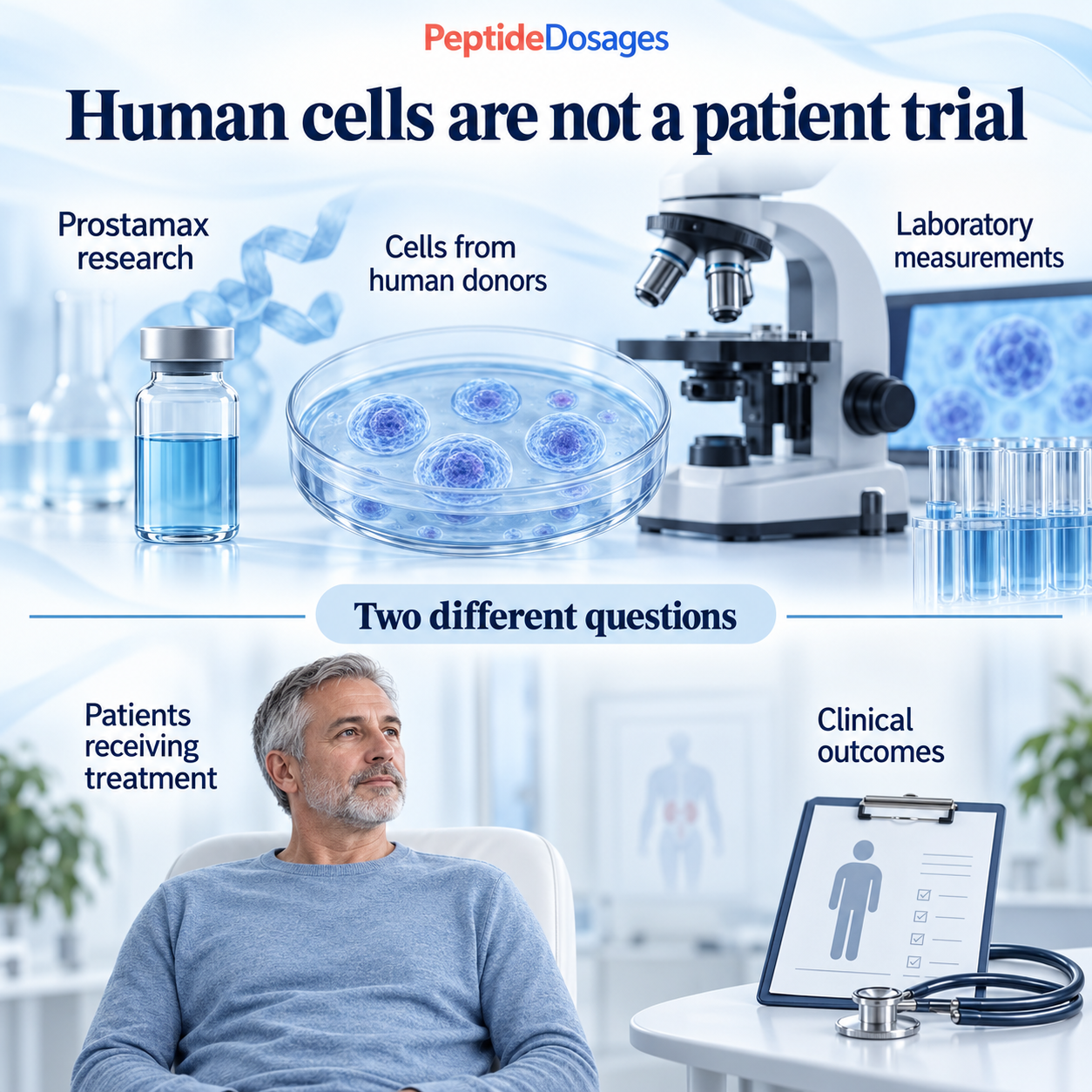
Quick reader check: does “tested in human cells” mean “works in people”?
No. Human cells in a laboratory can reveal biological activity, but they do not show how a whole person absorbs a substance, tolerates it or benefits from it. Look for the study population and the outcome measured before accepting a treatment claim.
Prostamax side effects and safety questions
These studies do not provide a dependable estimate of how often side effects occur in people, which medicines interact with Prostamax, or what repeated exposure does over months or years. A short report without a detailed adverse-event analysis cannot answer those questions.
That means claims such as “no side effects” or “safe to combine with prostate medication” go beyond the evidence reviewed here. Do not stop prescribed treatment or use an online peptide claim as a substitute for evaluation of urinary symptoms.
Get medical help promptly for an inability to urinate, blood in the urine, severe lower-abdominal pain, or painful urgent urination with fever and chills. These symptoms need assessment, not a trial of a research product. [7]
What can a Prostamax dosage chart tell you?
A concentration chart can explain how mass and liquid volume relate. It cannot establish that a chosen amount is effective or safe. The separate Prostamax 20 mg reference page should not be read as clinical validation of a regimen.
For someone reading a paper or discussing a claim with a clinician, three questions are more useful than copying a cycle:
- Was the experiment in isolated cells, animals or people with my diagnosis?
- Did it measure symptoms and daily functioning, or only a laboratory marker?
- Were adverse events, comparison groups and follow-up reported clearly?
Bottom line: Prostamax is an interesting research compound with a much narrower evidence base than many prostate-health claims suggest. Discuss persistent symptoms and treatment choices with a qualified healthcare professional.
References
- Dzhokhadze et al. (2012). KEDP and chromatin changes in older-donor cells. Georgian Medical News. Human-cell experiment.
- Meskhi et al. (2004). Prostamax and heterochromatin in human lymphocytes. Biofizika. Biophysical experiment.
- Zakutskii et al. (2006). Tissue-specific effects of synthetic peptides in rat organ cultures. Advances in Gerontology.
- Borovskaya et al. (2013). Prostamax in an experimental chronic aseptic prostatitis model. Modern Research in Inflammation. doi:10.4236/mri.2013.23007.
- Patent RU2177802C1. Tetrapeptide and prostate-function claims, particularly examples 6 and 7. Patent evidence, not independent clinical confirmation.
- Khavinson et al. (2004). Short peptides and lymphocyte chromatin in older subjects. Bulletin of Experimental Biology and Medicine. doi:10.1023/B:BEBM.0000024393.40560.05.
- National Institute of Diabetes and Digestive and Kidney Diseases. Prostatitis: inflammation of the prostate.
- National Institute of Diabetes and Digestive and Kidney Diseases. Enlarged prostate: benign prostatic hyperplasia.
Related dosage protocols and research
Explore related research, dosage references and guides below. Vial strengths have separate references because concentration and syringe-unit calculations differ. A comparison does not mean the compounds are interchangeable.
Matching dosage protocols
Further research context