
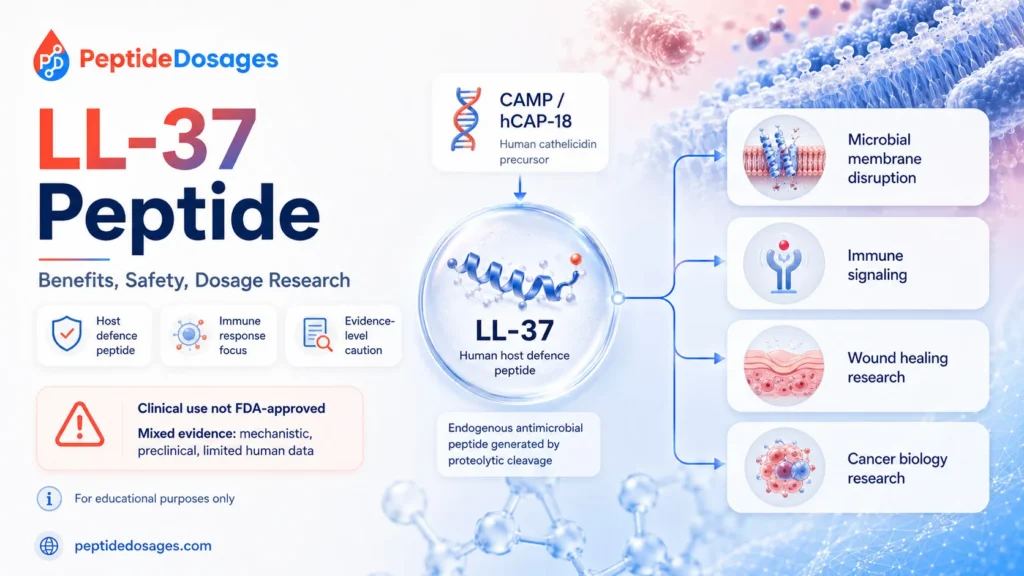
LL-37 peptide is the active antimicrobial peptide generated from the human cathelicidin antimicrobial peptide precursor encoded by the CAMP gene 1, 2. This educational guide reviews LL-37 as a host defence peptide in antimicrobial activity, immune response, wound healing, cancer biology, safety, dosage research, and regulatory status. It does not provide personalized medical advice, dosing instructions, or purchasing guidance.
- LL-37 is a human cathelicidin-derived peptide involved in innate immune defense, barrier protection, and immune signaling [1], 3.
- It is often described as an antimicrobial peptide because in vitro studies show activity against some bacteria, fungi, and viruses, although laboratory activity does not automatically prove clinical effectiveness 4.
- LL-37 also modulates inflammation, chemotaxis, Toll-like receptor signaling, cytokine responses, and epithelial repair pathways 5, 6.
- Human evidence includes biomarker studies and limited clinical research, including a topical wound-healing trial in venous leg ulcers; evidence is not equivalent to broad approval for treatment use 7.
- Cancer-related LL-37 research is complex: studies report context-dependent effects on cancer cell behavior, tumor microenvironments, and inflammation, but this does not establish LL-37 as a cancer therapy 8.
- Side effects and safety remain incompletely characterized for therapeutic LL-37 use, especially with unapproved, compounded, or research-only products.
- There is no approved FDA label dosage for LL-37 peptide; any dosage information should be interpreted only as published-study context, not personal dosing advice 9, 10.
Related dosage pages: For vial-specific concentration, reconstitution, and measurement examples, see LL-37 (5 mg Vial) Dosage Protocol. Each linked protocol remains a separate reference because vial strength changes concentration and syringe-unit calculations.
Fast Answer
LL-37 peptide is a human cathelicidin antimicrobial peptide studied for host defence, antimicrobial effects, immune response modulation, wound healing, and cancer biology [1], [2], [5]. Evidence is strongest for its biological role in innate immunity and weaker for therapeutic use, where human research is limited and much of the literature is preclinical. LL-37 is not an FDA-approved standalone drug with labeled dosing, so safety, regulatory status, and study context matter before interpreting online claims [9], [10].
What Is the LL-37 Peptide?
LL-37 is the best-known active peptide fragment derived from the human cathelicidin antimicrobial peptide precursor, often called hCAP-18 or CAMP [1], [2]. It is part of the innate immune system and is produced by cells such as neutrophils, epithelial cells, keratinocytes, and other immune-related tissues [2], [3].
Unlike approved peptide drugs with labeled indications, LL-37 is mainly discussed in scientific research as a naturally occurring host defence peptide. Its therapeutic potential is still being evaluated, and the evidence depends heavily on whether the question involves normal biology, human biomarker data, early clinical testing, animal models, or in vitro experiments [5].
Human Cathelicidin LL-37 and the CAMP Gene
The CAMP gene encodes the cathelicidin antimicrobial peptide precursor, which is processed into active LL-37 after proteolytic cleavage [1], 11. This processing matters because LL-37 activity depends not only on gene expression but also on peptide release, tissue environment, proteases, salt concentration, pH, and local inflammation [5], [11].
Human cathelicidin LL-37 is considered part of the first-line defense at epithelial surfaces, including skin, airways, and the gastrointestinal and genitourinary tracts [3], [5]. Vitamin D signaling has also been shown to regulate CAMP expression, linking micronutrient status, barrier immunity, and antimicrobial peptide expression in mechanistic research 12.
What Is the Sequence of LL-37 and Its Alpha-Helix Structure?
The sequence of LL-37 is LLGDFFRKSKEKIGKEFKRIVQRIKDFLRNLVPRTES, according to the UniProt entry for human CAMP [2]. The name “LL-37” reflects that the peptide begins with two leucines and contains 37 amino acids [2], [4].
LL-37 can adopt an amphipathic alpha-helix structure, meaning one side tends to interact with lipids while the other interacts with water or charged molecules [4]. This structure helps explain why a cationic antimicrobial peptide can interact with negatively charged microbial cell membranes, although membrane disruption is only one part of LL-37 biology [4], [5].
How Does LL-37 Differ From Approved Peptide Drugs?
Approved peptide drugs are evaluated for specific indications, manufacturing quality, dosage, labeling, contraindications, and adverse-event information by regulators such as the FDA or EMA 9, 13. LL-37, by contrast, is not listed as an FDA-approved drug product with approved prescribing information in Drugs@FDA or DailyMed as of this writing [9], [10].
That difference matters. A naturally occurring human peptide can have important biological functions without being an approved, safe, or effective treatment when supplied as an external product.
Why Is LL-37 Called an Antimicrobial Peptide?
LL-37 is called an antimicrobial peptide because laboratory studies show that it can inhibit or kill certain microorganisms under defined experimental conditions [4], [5]. Antimicrobial peptides are typically short, often cationic molecules that help protect host surfaces from pathogens while also shaping immune signaling [3], 14.
The term “peptide antibiotic” is sometimes used in research discussions, but it should not be confused with an approved antibiotic drug. Conventional antibiotics have defined clinical indications, dosing, resistance data, adverse-effect profiles, and regulatory labeling; LL-37 does not have that status as a standalone therapeutic product [9], [10], [14].
What Antimicrobial Activities Are Studied Against Bacteria, Fungi, and Viruses?
In vitro research has examined LL-37 against bacteria, fungi, and some viruses, often by testing how different concentrations of LL-37 affect microbial growth, membrane integrity, or host-cell infection models [4], [5]. These antimicrobial activities are biologically important, but lab conditions may not match the salt concentration, protein binding, tissue distribution, degradation, or immune complexity of human disease [5], [14].
The activity of LL-37 can vary by organism, local environment, peptide concentration, and formulation [4], [5]. For example, findings against a microorganism in vitro should not be interpreted as proof that LL-37 treats infections in people.
How Does the Cationic Peptide Interact With Cell Membranes?
LL-37 is positively charged, while many microbial membranes contain negatively charged phospholipids and other anionic molecules [4]. This charge relationship helps LL-37 bind to the lipid bilayer, insert into membranes, and sometimes disrupt membrane integrity [4].
Human cell membranes differ from bacterial membranes in lipid composition and cholesterol content, which may partly influence selectivity [4]. Still, selectivity is not absolute, and concentrations of the peptide can influence whether effects are antimicrobial, immunomodulatory, irritating, or cytotoxic in models [5].
How Does LL-37 Peptide Work in the Immune System?
LL-37 peptide works as more than a direct antimicrobial molecule. It can influence immune cell recruitment, cytokine signaling, epithelial repair, macrophage responses, dendritic cell activation, neutrophil biology, and interactions between microbial products and pattern-recognition receptors [5], [6], 15.
This is why LL-37 is often described as a host defence peptide rather than only an antibiotic-like molecule. Host defence includes antimicrobial effects, barrier maintenance, immune cell communication, and inflammatory regulation [3], [5].
How Does LL-37 Influence Innate Immune System Signaling and Chemotaxis?
A key mechanism is chemotaxis, the movement of immune cells toward chemical signals. Human peptide LL-37 has been reported to act as a chemoattractant through formyl peptide receptor-like pathways, now commonly discussed in relation to formyl peptide receptor 2, depending on terminology and study context [6].
LL-37 also interacts with monocytes, neutrophils, macrophages, epithelial cells, and other immune cell types in ways that may change cytokine release or cellular activation [5], [15]. These effects can be protective in some settings and potentially inflammatory in others.
How Are Toll-Like Receptors, Cytokines, and Inflammatory Balance Involved?
LL-37 can bind microbial and host molecules, including lipopolysaccharide, DNA, and RNA, which can change how Toll-like receptors detect those molecules [5], [15]. This is central to the dual nature of LL-37: it can dampen some inflammatory signals while amplifying others depending on the tissue, ligand, receptor, and disease setting [5], [15].
In psoriasis research, LL-37 complexes with self-DNA and self-RNA have been shown to activate immune pathways involving Toll-like receptor 9 and Toll-like receptor 7/8, contributing to inflammatory signaling models 16, 17. This illustrates why claims that LL-37 is simply “anti-inflammatory” are too broad.
Mechanism of Action: How Does LL-37 Act in Host Defence?
LL-37 acts through multiple proposed mechanisms: membrane interaction, immune-cell chemotaxis, modulation of cytokines, binding to pathogen-associated molecular patterns, epithelial repair signaling, angiogenesis-related pathways, and effects on cell survival or apoptosis in some models [4], [5], [6], 18.
This broad mechanism profile makes LL-37 scientifically interesting, but it also complicates therapeutic interpretation. A peptide that influences many immune and cell-signaling pathways may have different effects in infection, wounds, autoimmune inflammation, cancer biology, and healthy tissue.
How Can Membrane Disruption Affect Pathogen Selectivity?
Membrane disruption is one reason LL-37 has antimicrobial effects in vitro [4]. The peptide can associate with microbial membranes and, under certain conditions, contribute to pore formation, membrane destabilization, or microbial death [4].
However, antimicrobial peptide behavior depends on concentration, ionic strength, serum proteins, microbial strain, and local tissue factors [4], [5]. That is why the effect of LL-37 in a laboratory assay cannot be translated directly into a human infection treatment claim.
Why Do LL-37 Fragments and Proteolysis Matter?
LL-37 and its fragments may differ in structure, charge, receptor interaction, and antimicrobial or immunomodulatory activity [5], [11]. Proteolysis can activate the precursor peptide, degrade LL-37, or generate fragments with altered activity [11].
This matters for drug-development questions. A synthetic LL-37 formulation, a naturally produced peptide at an inflamed tissue site, and a degraded peptide fragment in serum may not behave the same way.
What Is LL-37 Peptide Used For or Studied For?
LL-37 is studied in several overlapping areas: innate immunity, antimicrobial defense, skin barrier biology, wound healing, respiratory and urinary tract defense, inflammatory diseases, and cancer biology [5], [8], [14]. These are research contexts, not broad approved medical uses.
The safest interpretation is evidence-graded. Normal biological function and mechanistic evidence are not the same as clinical proof that treatment with LL-37 improves patient outcomes.
What Infection-Related Research Contexts Involve LL-37?
Infection-related research has examined LL-37 expression in epithelial tissues, neutrophils, and mucosal defenses, as well as its activity against bacteria and other pathogens in vitro [3], [4], [5]. Studies have also explored the role of antimicrobial peptide expression in urinary tract defense and other barrier sites 19.
LL-37 may contribute to host defense in the body, but externally administered LL-37 has not become an approved anti-infective treatment. Infection treatment decisions require clinically validated therapies, pathogen identification when appropriate, and medical supervision.
How Is Wound Healing Studied in Epithelial Barrier Models?
Wound healing research has examined LL-37 in keratinocyte migration, epithelial repair, angiogenesis-related signaling, and local immune responses [18], 20. These mechanisms make LL-37 relevant to skin and wound models.
A limited human trial also evaluated topical LL-37 in hard-to-heal venous leg ulcers, reporting wound-related outcomes and tolerability in a controlled study setting [7]. That trial is important, but it does not create an approved label, general dosing recommendation, or proof for all wound types.
What Potential Benefits of LL-37 Peptide Are Supported by Evidence?
Potential benefits of LL-37 should be separated by evidence level. The strongest support is for LL-37 as a biologically important host defense peptide; therapeutic benefit from externally administered LL-37 remains much less established [3], [5], [7].
| Evidence Area | What Has Been Studied | Evidence Level | What It Can and Cannot Show |
|---|---|---|---|
| Innate host defence | CAMP expression, neutrophil storage, epithelial production, antimicrobial peptide biology [1], [2], [3] | Biological / mechanistic | Supports normal immune function, not a treatment claim |
| Antimicrobial effects | In vitro activity against selected microorganisms [4], [5] | Preclinical | Shows laboratory activity; cannot prove human infection efficacy |
| Wound healing | Keratinocyte and epithelial models; topical venous ulcer trial [7], [20] | Early human / preclinical | Suggests research potential; not approved dosing or broad wound therapy |
| Cancer biology | Cancer cell signaling, tumor microenvironment, context-dependent effects [8] | Mostly preclinical / mechanistic | Helps explain possible roles; does not establish cancer treatment |
| Inflammation | Toll-like receptor, cytokine, DNA/RNA complex, and psoriasis-related mechanisms [15], [16], [17] | Mechanistic / human disease biology | Shows immune relevance; effects may be pro- or anti-inflammatory |
What Is Known About Antimicrobial Effects and Biofilm Research?
LL-37 exhibits antimicrobial effects in laboratory models, and antimicrobial peptides more broadly are being studied as possible templates for future anti-infective therapies [4], [14]. Biofilm-related research is of interest because biofilms can reduce antibiotic susceptibility and complicate chronic infections, but LL-37 biofilm findings remain largely preclinical [14].
This is an important distinction. The ability of LL-37 to affect microbes in vitro does not mean it should be used instead of approved antibiotics or standard medical treatment.
When Might LL-37 Show Anti-Inflammatory Versus Pro-Inflammatory Effects?
LL-37 may reduce some inflammatory responses, such as certain lipopolysaccharide-driven pathways, while enhancing immune activation in other settings by forming complexes with host DNA or RNA [15], [16], [17]. This context-dependent activity is why the anti-inflammatory effect of LL-37 cannot be generalized across diseases.
For example, LL-37 can be involved in protective barrier defense while also contributing to inflammatory circuits in psoriasis models [16], [17]. The same host defence peptide can therefore appear beneficial or harmful depending on concentration, tissue, receptor context, and disease biology.
LL-37 in Cancer Research: What Is Known?
LL-37 in cancer is a complex research topic. Reviews describe both tumor-promoting and tumor-suppressive observations depending on cancer type, receptor pathways, inflammatory context, and experimental model [8].
This does not mean LL-37 is a cancer therapy. Cancer-related findings should be interpreted as cancer biology research unless supported by well-designed clinical trials showing patient benefit.
What Is the Effect of LL-37 on Cancer Cell Signaling?
The effect of LL-37 on cancer cell signaling has been studied in pathways related to proliferation, migration, invasion, apoptosis, immune-cell recruitment, and receptor transactivation [8], [18]. Some studies suggest LL-37 promotes growth or migration in certain cancer cell models, while other contexts suggest inhibitory or immune-modifying effects [8].
These mixed findings are not unusual for immune-active peptides. Cancer cell behavior in vitro does not always predict tumor behavior in humans, where stromal cells, immune cells, blood vessels, genetics, and therapy exposure all matter.
Cancer Cell Lines, Tumor Microenvironments, and Translational Limits
Cancer cell lines can help researchers test mechanisms, but they lack the full tumor microenvironment found in patients. LL-37 may interact with immune cells, cytokines, extracellular matrix, epithelial cells, and microbial or inflammatory signals, all of which can change outcomes [8].
For colon cancer cells, gastric cancer models, or other cancer cell lines, the key question is not whether a signal changes in a dish. The key question is whether a clinically meaningful outcome is shown in people, and that evidence is not established for LL-37 as a cancer treatment.
What Does Human Research Show About LL-37?
Human research on LL-37 includes expression studies, disease-association studies, tissue-level observations, and limited interventional research [5], [7], [16], [17]. This makes LL-37 relevant to human biology, but most evidence does not prove that giving LL-37 improves disease outcomes.
The venous leg ulcer trial is one of the more clinically relevant examples because it tested topical LL-37 in a controlled wound-healing setting [7]. Even so, a limited trial does not equal regulatory approval or broad therapeutic certainty.
Human Antimicrobial Peptide LL-37 Levels in Disease States
Human antimicrobial peptide LL-37 levels have been studied in inflammatory skin disease, infection-related contexts, and barrier tissues [5], [16], [17], [19]. The expression of LL-37 can rise or fall with inflammation, vitamin D signaling, infection, epithelial injury, and immune activation [5], [12].
Disease-associated LL-37 expression may be a marker, mediator, or both. Association studies can show correlation, but they cannot prove that changing LL-37 levels will improve health outcomes.
Why Association Studies Cannot Establish Treatment Effects
If LL-37 is elevated in a disease, that may mean it contributes to the disease, responds to the disease, or both. If LL-37 is reduced in another setting, that may reflect impaired barrier defense, local depletion, degradation, or other upstream biology [5].
This is why LL-37 findings need careful study design. Randomized controlled trials, validated endpoints, standardized formulations, and safety monitoring are needed before a biological association can become a treatment claim.
What Preclinical Research Suggests About LL-37
Preclinical research suggests that LL-37 can affect antimicrobial defense, immune signaling, epithelial repair, angiogenesis-related pathways, and cancer cell behavior [4], [5], [8], [18]. These findings are useful for hypothesis generation.
They also have limits. Cell models and animal models simplify human biology, and LL-37 activity may differ across species, tissues, formulations, and concentrations.
In Vitro Findings in Microorganisms and Cell Models
In vitro studies have explored LL-37 against microorganisms and in cell models involving keratinocytes, immune cells, epithelial cells, and cancer cell lines [4], [5], [8], [20]. These studies can identify mechanisms such as membrane interaction, chemotaxis, cytokine modulation, and receptor signaling [4], [6], [15].
The limitation is translation. A concentration of LL-37 that changes a cell-signaling pathway in vitro may not be achievable, stable, selective, or safe in human tissue.
Animal Models of Infection, Wound Healing, and Inflammation
Animal models can examine tissue-level effects that cell studies cannot, such as inflammation, wound closure, pathogen burden, or immune-cell recruitment [5], [14]. However, human LL-37 is a human peptide, and species differences in cathelicidins can affect interpretation [3], [5].
Preclinical success also does not guarantee clinical success. Many antimicrobial peptide candidates face challenges with stability, toxicity, delivery, manufacturing, and efficacy in human trials [14].
Where Is the Evidence for LL-37 Still Limited?
The evidence for LL-37 is strongest in basic biology and mechanistic immunology. It is more limited for therapeutic dosing, long-term safety, disease-specific efficacy, drug interactions, and real-world outcomes.
Claims about LL-37 should be ranked by evidence level: approved-label evidence, clinical trials, early human evidence, animal studies, in vitro studies, mechanistic hypotheses, and anecdotal reports. For LL-37, approved-label evidence as a standalone drug is absent, and clinical evidence remains limited [7], [9], [10].
How Should Approved Use Versus Investigational Research Be Separated?
Approved use means a regulator has reviewed a specific product for a specific indication and labeling. Investigational research means a compound is being studied and may not have established safety, efficacy, manufacturing standards, or dosing for general medical use [9], [13].
LL-37 should be treated as investigational in therapeutic contexts unless a reader is discussing a specific regulated product or clinical trial with a qualified clinician. Study findings should not be converted into self-treatment protocols.
Which Online Claims About LL-37 Remain Unsupported?
Unsupported online claims often describe LL-37 as a broad infection treatment, immune booster, anti-aging peptide, cancer therapy, or wound-healing solution. These claims exceed the available evidence when they are not tied to approved labeling or high-quality human trials.
A more accurate framing is that LL-37 plays a role in host defense and is being studied for therapeutic relevance. The ability of LL-37 in human biology does not prove that commercially supplied or compounded LL-37 products are safe or effective.
Side Effects and Safety Concerns With LL-37
Because LL-37 is not an FDA-approved standalone drug, there is no official prescribing label that summarizes adverse reactions, contraindications, dose adjustments, or postmarketing surveillance for general LL-37 use [9], [10]. Safety must therefore be interpreted from limited clinical studies, mechanistic biology, and preclinical research.
Potential concerns include local irritation, immune activation, inflammatory worsening in susceptible conditions, hypersensitivity, formulation-related reactions, and unknown long-term effects. These risks are especially important for unapproved or research-only peptides, where purity, sterility, dose accuracy, and manufacturing quality may vary.
What Local Irritation, Immune Activation, or Hypersensitivity Concerns Exist?
Topical LL-37 wound research provides some human safety context, but it does not define safety for all routes, doses, populations, or formulations [7]. Local reactions are plausible because LL-37 interacts with skin, epithelial cells, immune cells, and inflammatory pathways [5], [20].
Hypersensitivity and immune activation are theoretical concerns for any immunologically active peptide. Without approved labeling, the frequency and severity of adverse events cannot be characterized as they would be for an approved medication.
Why Inflammation, Psoriasis, and Autoimmune Disease Require Caution
LL-37 has been implicated in psoriasis-related immune activation through complexes with self-DNA and self-RNA that stimulate Toll-like receptor pathways [16], [17]. This does not mean LL-37 causes psoriasis in every context, but it does show that LL-37 can participate in inflammatory disease mechanisms.
People with autoimmune or inflammatory disease require extra caution because immune modulation can have unpredictable effects. Any discussion of LL-37 in these settings should occur within clinician-guided care and evidence-based treatment planning.
Contraindications, Drug Interactions, and Medical Supervision
There are no FDA label-defined contraindications or drug-interaction sections for LL-37 as a standalone approved drug because no such approved label exists [9], [10]. That absence is not proof of safety; it means formal regulatory safety information is lacking.
Medical supervision matters because LL-37 intersects with immune response, inflammation, infection biology, skin disease, and potential cancer-related pathways. Those are not low-risk self-treatment areas.
Who Should Discuss LL-37 With a Clinician First?
Anyone with active infection, cancer, autoimmune disease, psoriasis, immune deficiency, pregnancy, breastfeeding, complex medication use, or a history of allergic reactions should discuss peptide-related questions with a licensed clinician. These groups are more likely to face higher uncertainty because LL-37 may influence inflammatory cytokines, immune-cell activity, and host-pathogen interactions [5], [16], [17].
A clinician can also help distinguish evidence-based treatment from investigational, unsupported, or unsafe claims. This is especially important when approved alternatives exist.
What Interaction Concerns Could Involve Immunotherapy or Anti-Inflammatory Drugs?
Direct drug-interaction studies for LL-37 are limited. However, because LL-37 modulates immune signaling, theoretical concerns may involve immunotherapy, immunosuppressants, anti-inflammatory drugs, antibiotics, or therapies used for inflammatory skin disease [5], [15], [16].
These concerns are not a substitute for documented interaction data. They are a reason to avoid self-directed use and to interpret LL-37 within a supervised medical context.
What Dosage Information Exists for LL-37?
No approved FDA label dosage exists for LL-37 peptide as a standalone drug product [9], [10]. Dosage information in the literature should therefore be limited to research context and should not be interpreted as personal dosing advice.
The most relevant human dosage context comes from published clinical research, including topical LL-37 in venous leg ulcer patients [7]. Preclinical studies may report concentrations of LL-37 in micromolar ranges or animal dosing methods, but those values are not personal-use instructions.
No Approved Label Dosage for LL-37 Peptide
Approved-label dosage is available only when a regulator has reviewed a product, indication, formulation, route, and dosing schedule. LL-37 does not have this type of FDA-approved prescribing information [9], [10].
This matters because dose is not just an amount. It depends on formulation, route, stability, tissue exposure, indication, patient factors, adverse-event monitoring, and manufacturing quality.
How Published Studies Report Concentrations of LL-37
Published studies often report concentrations of LL-37 differently depending on the model. In vitro studies may report micromolar concentrations, while topical clinical research has reported defined concentration arms in wound-care settings [4], [7].
For example, the venous leg ulcer study reported topical LL-37 concentrations in a controlled trial context, including 0.5 mg/mL and 1.6 mg/mL arms [7]. Study doses should not be interpreted as personal dosing advice, and they should not be converted into injection, topical-use, or self-treatment protocols.
Administration Routes Discussed in LL-37 Literature
Administration routes discussed in LL-37 literature include topical or local use in wound models, experimental local delivery, and in vitro exposure of cells or microorganisms [4], [7], [20]. Some research also explores antimicrobial peptide delivery challenges, including stability, degradation, and tissue targeting [14].
A route used in a study is not a recommendation for personal use. Route affects exposure, safety, degradation, immune effects, and the relevance of a study’s findings.
Topical, Local, Intranasal, and Experimental Delivery Contexts
Topical and local delivery are most relevant to wound and epithelial-barrier research because LL-37 is naturally active at barrier surfaces [5], [7], [20]. Intranasal or airway-related contexts appear in mechanistic and infectious-disease research, but they do not establish approved administration for LL-37 [5], [14].
Experimental delivery methods should remain research context. This article does not provide injection, mixing, reconstitution, or self-administration instructions.
How Route of Administration Affects Evidence Interpretation
Route of administration changes pharmacokinetics, local concentration, immune exposure, and safety monitoring. LL-37 applied to a wound surface in a trial cannot be assumed to behave like LL-37 delivered systemically or by another route [7], [14].
This is one reason dosage comparisons across studies are difficult. A concentration in a cell culture plate, a topical wound formulation, and an animal model are not interchangeable.
Is LL-37 Peptide FDA-Approved or Legally Available?
LL-37 peptide is not an FDA-approved standalone drug with approved labeling in Drugs@FDA or DailyMed as of this writing [9], [10]. It also should not be assumed to have EMA-approved medicinal-product status unless a specific authorized product can be identified in official medicine databases [13].
Regulatory status matters because approved products are evaluated for defined uses, quality standards, safety information, labeling, and manufacturing controls. Unapproved, compounded, or research-only peptides do not carry the same regulatory assurance.
Regulatory Status by Country and Source Type
Regulatory status can differ by country, formulation, product name, and intended use. A compound studied in research may still be unapproved for clinical use, and a product sold online may not be a regulated medication.
ClinicalTrials.gov can help identify whether LL-37-related studies are registered, but trial registration is not the same as approval 21. Readers should rely on official regulator databases rather than marketing claims when checking legal or medical status.
Risks of Compounded, Unapproved, or Research-Only Peptides
Compounded or research-only peptides may raise concerns about identity, sterility, purity, potency, contaminants, storage, labeling, and inappropriate human use. These concerns are especially important for immune-active peptides with incomplete clinical safety data.
A product labeled for research use should not be treated as equivalent to an approved medicine. The safest interpretation of LL-37 is through evidence quality, regulatory status, and clinician-guided decision-making.
How LL-37 Compares With Related Antimicrobial Peptides and Therapies
LL-37 belongs to the broader antimicrobial peptide field, which includes cathelicidins, defensins, and engineered peptide candidates [3], [14]. These molecules may share antimicrobial or immunomodulatory themes, but they differ in structure, tissue expression, mechanism, evidence level, and regulatory status.
Conventional antibiotics are different again. They are approved for defined infections, pathogens, routes, dosing, safety information, and resistance considerations, while LL-37 remains investigational as a therapeutic product [9], [10], [14].
Cathelicidin Peptide LL-37 Versus Defensins
Cathelicidin peptide LL-37 and defensins are both host defence peptides involved in innate immune protection [3], [5]. LL-37 is the major human cathelicidin-derived peptide, while defensins are a separate family with different structures, expression patterns, and antimicrobial properties [3].
The comparison is useful for biology, not for choosing a peptide. Neither family should be reduced to a simple “stronger” or “better” ranking without indication-specific, formulation-specific, and human outcome data.
Peptide Antibiotic Concepts Versus Conventional Antibiotics
Peptide antibiotic concepts aim to use antimicrobial peptides or peptide-derived molecules as anti-infective tools, but development has been challenging because peptides can be unstable, costly to manufacture, degraded by proteases, or difficult to deliver safely [14]. LL-37 illustrates both the promise and difficulty of this field.
For readers evaluating LL-37 claims, a practical clinician-discussion checklist may include:
- What condition is being discussed, and are approved treatments available?
- Is the claim supported by an approved label, human study, preclinical study, or anecdote?
- What route and formulation were used in the cited research?
- Are there immune, inflammatory, cancer-related, pregnancy, breastfeeding, or medication-related concerns?
- Is the product regulated, prescribed, compounded, or labeled for research only?
- What adverse effects and monitoring would be relevant?
- What evidence gaps remain?
The safest way to interpret LL-37 peptide is through evidence quality, regulatory status, safety data, and clinician-guided decision-making.
Related dosage protocols and research
Use the available links to move between research context, dosage pages or comparisons, and supporting guides. When vial-size variants exist, they remain separate because concentration and syringe-unit calculations change with vial strength. Comparisons do not imply that different compounds are interchangeable.
Matching dosage protocols
Further research context
REFERENCES
- NCBI Gene. CAMP cathelicidin antimicrobial peptide, Homo sapiens. National Center for Biotechnology Information. Accessed 2026.
- UniProt. CAMP_HUMAN Cathelicidin antimicrobial peptide. UniProt Knowledgebase. Accessed 2026.
- Zanetti M. Cathelicidins, multifunctional peptides of the innate immunity. Journal of Leukocyte Biology. 2004. PMID: 15075355.
- Dürr UHN, Sudheendra US, Ramamoorthy A. LL-37, the only human member of the cathelicidin family of antimicrobial peptides. Biochimica et Biophysica Acta. 2006. PMID: 17052617.
- Vandamme D, Landuyt B, Luyten W, Schoofs L. A comprehensive summary of LL-37, the factotum human cathelicidin peptide. Cellular Immunology. 2012. PMID: 22561736.
- Yang D, Chen Q, Schmidt AP, et al. LL-37, the neutrophil granule- and epithelial cell-derived cathelicidin, utilizes formyl peptide receptor-like 1 as a receptor to chemoattract human peripheral blood neutrophils, monocytes, and T cells. Journal of Experimental Medicine. 2000. PMID: 11015447.
- Grönberg A, Mahlapuu M, Ståhle M, Whately-Smith C, Rollman O. Treatment with LL-37 is safe and effective in enhancing healing of hard-to-heal venous leg ulcers: a randomized, placebo-controlled clinical trial. Wound Repair and Regeneration. 2014. PMID: 25156994.
- Piktel E, Niemirowicz K, Wnorowska U, et al. The Role of Cathelicidin LL-37 in Cancer Development. Archivum Immunologiae et Therapiae Experimentalis. 2016.
- U.S. Food and Drug Administration. Drugs@FDA: FDA-Approved Drugs. Official FDA drug database. Accessed 2026.
- National Library of Medicine. DailyMed. Official source of FDA label information. Accessed 2026.
- Sørensen OE, Follin P, Johnsen AH, et al. Human cathelicidin, hCAP-18, is processed to the antimicrobial peptide LL-37 by extracellular cleavage with proteinase 3. Blood. 2001. PMID: 11238167.
- Gombart AF, Borregaard N, Koeffler HP. Human cathelicidin antimicrobial peptide gene is a direct target of the vitamin D receptor and is strongly up-regulated in myeloid cells by 1,25-dihydroxyvitamin D3. FASEB Journal. 2005. PMID: 15966744.
- European Medicines Agency. Medicines search. EMA official medicine database. Accessed 2026.
- Mahlapuu M, Håkansson J, Ringstad L, Björn C. Antimicrobial Peptides: An Emerging Category of Therapeutic Agents. Frontiers in Cellular and Infection Microbiology. 2016. PMID: 27242925.
- Mookherjee N, Brown KL, Bowdish DME, et al. Modulation of the TLR-mediated inflammatory response by the endogenous human host defense peptide LL-37. Journal of Immunology. 2006. PMID: 16982813.
- Lande R, Gregorio J, Facchinetti V, et al. Plasmacytoid dendritic cells sense self-DNA coupled with antimicrobial peptide. Nature. 2007. PMID: 17873860.
- Ganguly D, Chamilos G, Lande R, et al. Self-RNA-antimicrobial peptide complexes activate human dendritic cells through TLR7 and TLR8. Journal of Experimental Medicine. 2009. PMID: 19726873.
- Koczulla R, von Degenfeld G, Kupatt C, et al. An angiogenic role for the human peptide antibiotic LL-37/hCAP-18. Journal of Clinical Investigation. 2003.
- Chromek M, Slamová Z, Bergman P, et al. The antimicrobial peptide cathelicidin protects the urinary tract against invasive bacterial infection. Nature Medicine. 2006. PMID: 16369542.
- Heilborn JD, Nilsson MF, Kratz G, et al. The cathelicidin anti-microbial peptide LL-37 is involved in re-epithelialization of human skin wounds and is lacking in chronic ulcer epithelium. Journal of Investigative Dermatology. 2003. PMID: 12648225.
- ClinicalTrials.gov. LL-37 clinical trial search. U.S. National Library of Medicine. Accessed 2026.
Researchers Cited in This Article
The researchers below authored or co-authored publications cited in this article. Listing them here identifies sources; it does not mean they wrote, independently reviewed, sponsored, or endorsed this PeptideDosages.com article. The site author is identified in the article byline.
Mikael Mahlapuu
Researcher profile: PubMed Author Search
Mikael Mahlapuu is a published researcher whose work is relevant to the clinical and translational literature surrounding LL-37 and antimicrobial peptide development. His publications provide useful context for interpreting LL-37 peptide research across early human evidence, topical wound-healing studies, and broader peptide research challenges. The work highlighted below is especially relevant to this article’s discussion of evidence quality, therapeutic research limits, formulation context, and the difficulty of translating antimicrobial peptide activity into regulated clinical applications.
Selected publications:
- Treatment with LL-37 is safe and effective in enhancing healing of hard-to-heal venous leg ulcers: a randomized, placebo-controlled clinical trial — Wound Repair and Regeneration, 2014. PMID: 25156994.
- Antimicrobial Peptides: An Emerging Category of Therapeutic Agents — Frontiers in Cellular and Infection Microbiology, 2016. PMID: 27242925.
Niels Borregaard
Researcher profile: PubMed Author Search
Niels Borregaard is a published author in the LL-37 and cathelicidin literature, with work relevant to peptide processing, innate immunity, and gene-regulation mechanisms. His publications help frame how hCAP-18 is processed into LL-37 and how vitamin D signaling can influence cathelicidin antimicrobial peptide expression. These topics are directly relevant to the article’s discussion of LL-37 identity, mechanism of action, host-defence biology, and the distinction between normal biological function and therapeutic use.
Selected publications:
- Human cathelicidin, hCAP-18, is processed to the antimicrobial peptide LL-37 by extracellular cleavage with proteinase 3 — Blood, 2001. PMID: 11238167.
- Human cathelicidin antimicrobial peptide gene is a direct target of the vitamin D receptor and is strongly up-regulated in myeloid cells by 1,25-dihydroxyvitamin D3 — FASEB Journal, 2005. PMID: 15966744.