Ipamorelin can stimulate growth hormone release. That is the clearest finding from its early human research. It does not follow that ipamorelin has been shown to build muscle, improve sleep, reduce body fat or slow aging in otherwise healthy people. Those are different questions requiring different trials. [1][2]
A hormone response isn’t necessarily a health benefit. Also keep ipamorelin alone separate from CJC-1295 blends and other combinations: evidence for one doesn’t automatically apply to another.
What is ipamorelin, and how does it work?
Ipamorelin is a synthetic five-amino-acid peptide. As a growth hormone secretagogue, it prompts growth hormone release rather than supplying the hormone itself. It acts through the ghrelin-receptor pathway, not the pathway used by growth hormone-releasing hormone analogs. [1] [4]
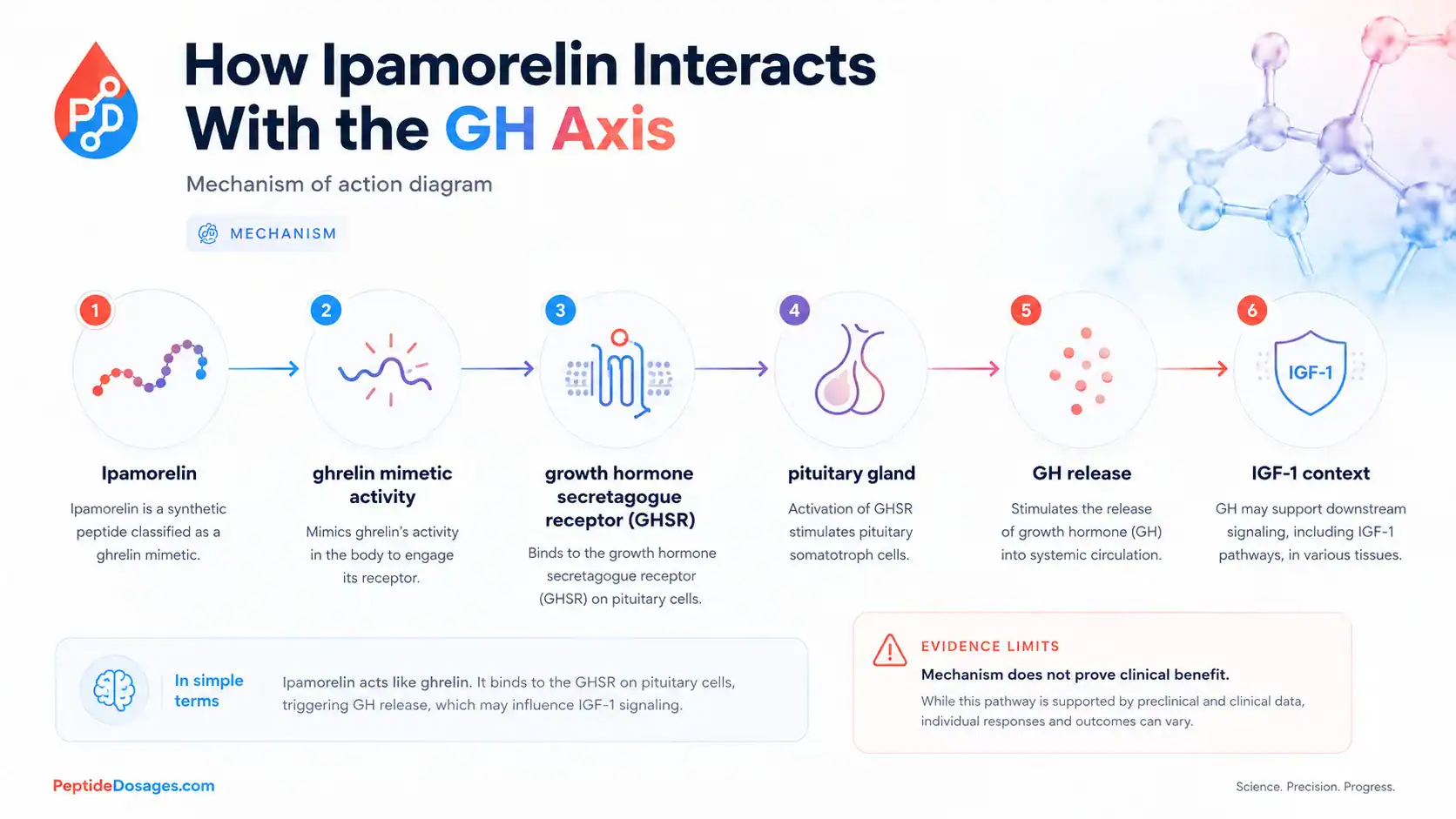
The original 1998 characterization used rat and swine experiments. It found growth hormone release with comparatively little ACTH or cortisol stimulation in the tested animal conditions. This is the source of many “selective” claims. It is not a guarantee that ipamorelin never affects cortisol, prolactin or other hormones in people. [1]
Ipamorelin benefits: what the studies support
| Claim or question | Relevant evidence | Reasonable conclusion |
|---|---|---|
| Raises growth hormone | A controlled infusion study measured an acute GH response in healthy men. [2] | Supported in that experimental setting; not a demonstration of long-term benefit. |
| Speeds bowel recovery after surgery | A randomized phase 2 trial did not show statistically significant improvement in its primary or secondary efficacy outcomes. [3] | Clinical benefit was not established. |
| Builds muscle or burns belly fat | The hormone-response study did not test these outcomes. [2] | A rise in GH cannot substitute for a body-composition trial. |
| Improves sleep, recovery or longevity | These benefits were not established by the human studies reviewed here. | Do not treat popular claims as measured results. |
| Works better with CJC-1295 | The often-cited CJC-1295 trial studied long-acting CJC-1295, not an ipamorelin blend. [6] | Combination effectiveness and safety need their own evidence. |
The human growth hormone study
A 1999 study tested several intravenous dose levels, with eight healthy men studied at each level. Researchers followed drug concentrations and growth hormone after a 15-minute infusion. GH rose briefly and then declined. The estimated terminal half-life of ipamorelin was approximately two hours. [2]
This tells us about short-term pharmacology. It does not tell us how much muscle someone would gain, how much weight they would lose or whether they would sleep better. It also does not validate a repeated subcutaneous schedule.
The postoperative ileus trial
Postoperative ileus is delayed bowel recovery after surgery. In a randomized study, 117 patients were enrolled and 114 were included in the safety and main analysis populations. Participants received intravenous ipamorelin or placebo after bowel resection. The median time to tolerate a solid meal was 25.3 hours versus 32.6 hours, but the difference was not statistically significant. The trial did not demonstrate significant improvement in its primary or secondary efficacy outcomes. [3]
A numerically shorter recovery time is not the same as a confirmed treatment effect. Describing this trial as proof that ipamorelin improves gut function would overstate the result.
Ipamorelin side effects and safety gaps
There is no dependable long-term side-effect profile for the wellness schedules commonly discussed online. Hospital trial results and early volunteer studies do not establish safety for chronic use in a different population.
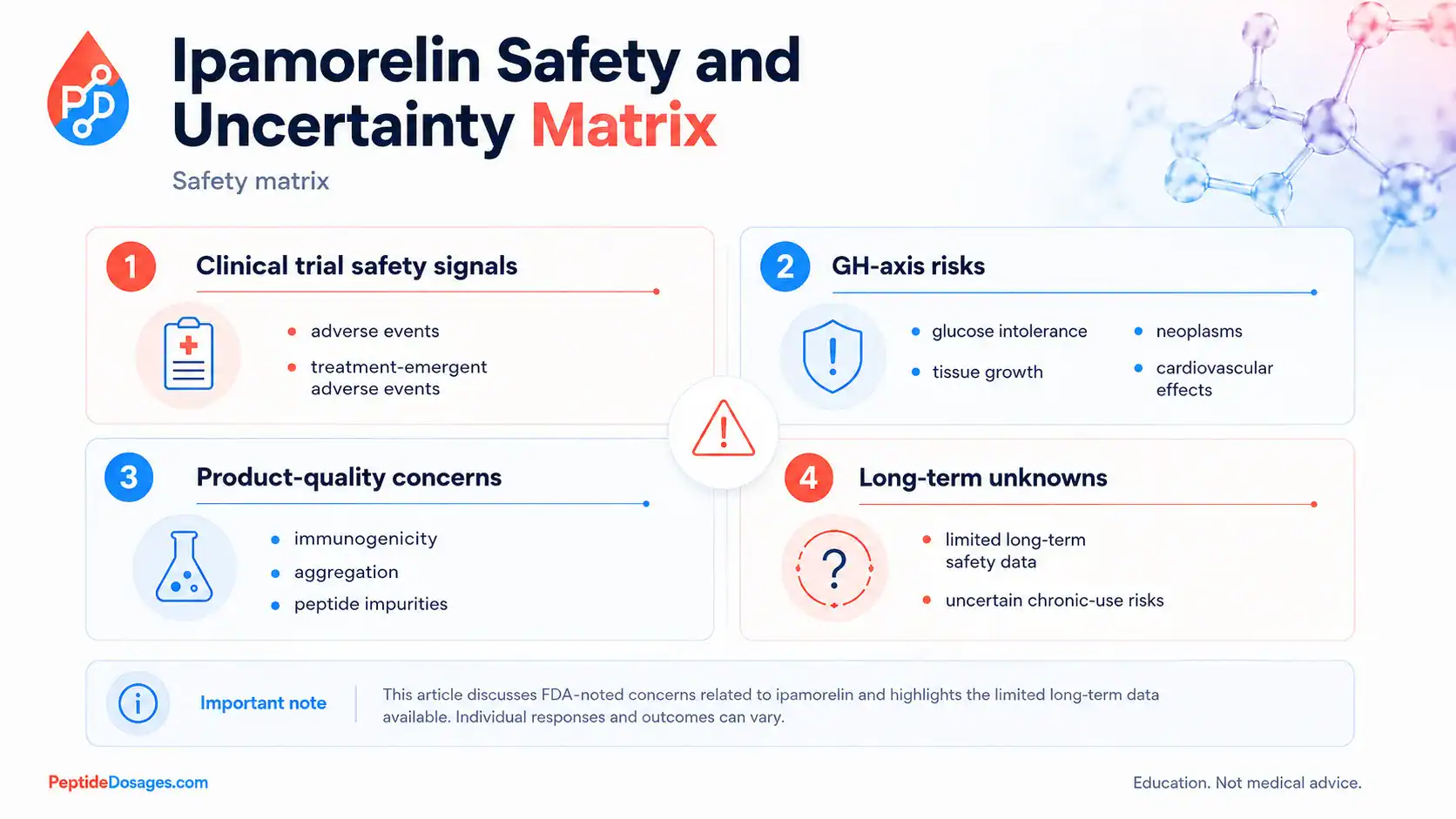
The FDA’s 2024 review discussed serious events in the postoperative study, including two deaths in the ipamorelin group following complications after cancer-related bowel surgery. The causal relationship to ipamorelin was unclear. Neither “ipamorelin caused the deaths” nor “there were no serious safety concerns” accurately describes that evidence. [4]
The agency’s current compounding safety page also identifies potential immune-reaction risks related to aggregation and peptide impurities, plus difficulty characterizing products containing non-natural amino acids. It notes inadequate information to determine safety for certain other routes. A vial’s stated purity does not, by itself, answer all of those questions. [5]
If you are considering a peptide because of fatigue, body-composition changes or poor recovery, a clinician can evaluate possible causes rather than assuming a growth hormone problem. Existing hormone disorders, diabetes, cancer history and concurrent medicines are reasons for an individualized medical assessment, not reasons to choose a dose from an online chart.
Ipamorelin dosage: study context is not a personal protocol
The published human experiments discussed above used intravenous administration under study supervision. Translating those exposures into a home injection schedule requires assumptions that the studies did not test. Timing claims such as “always before bed” or “always on an empty stomach” are not established by those experiments.
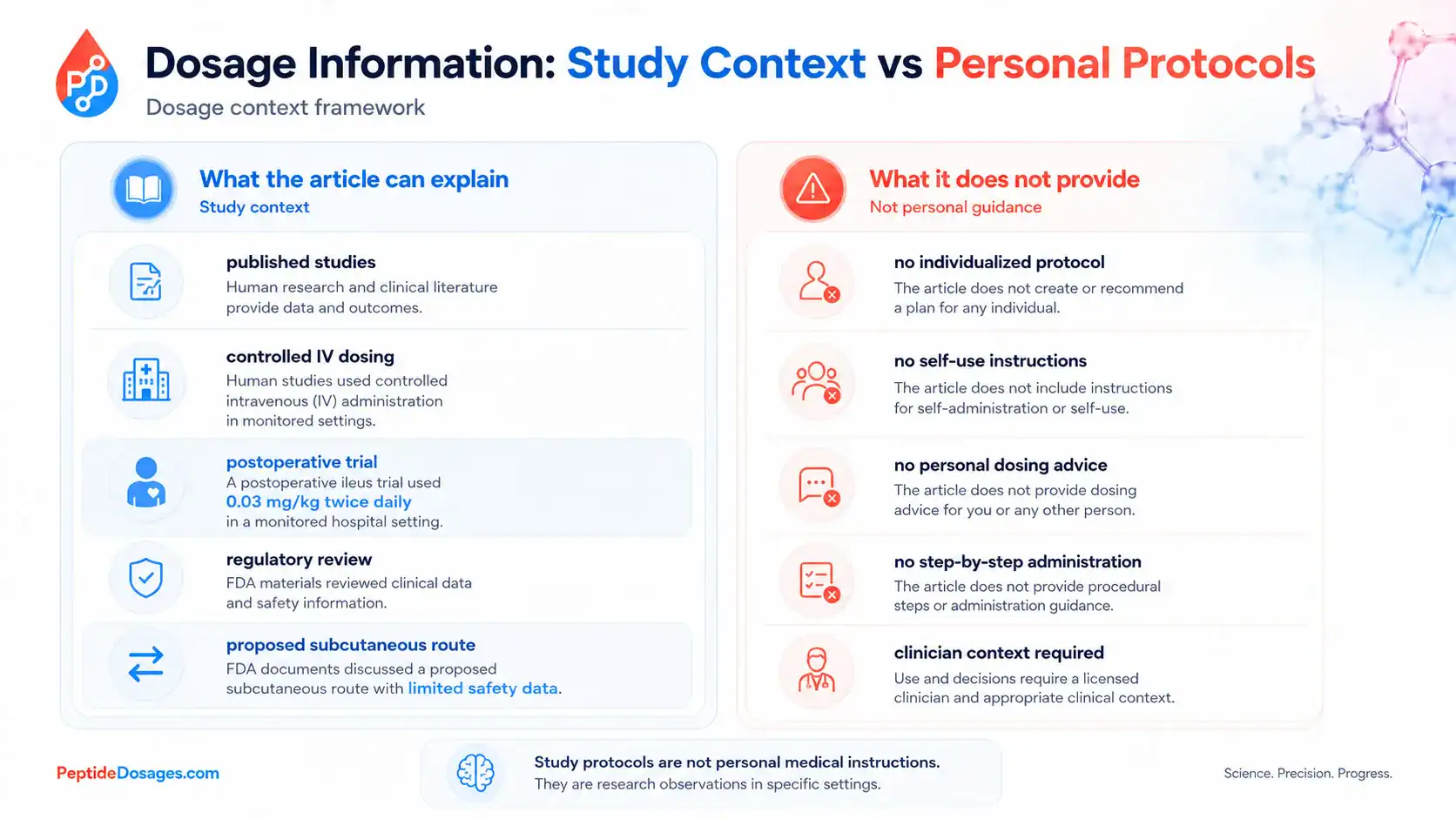
Reconstitution arithmetic answers how much substance is present in a volume. It cannot determine whether the substance is appropriate, whether a regimen works or whether a product is sterile.
Related dosage pages: For vial-specific concentration, reconstitution, and measurement examples, see Ipamorelin (5 mg Vial) Dosage Protocol and Ipamorelin (10 mg Vial) Dosage Protocol. Each linked protocol remains a separate reference because vial strength changes concentration and syringe-unit calculations.
Ipamorelin versus CJC-1295 and tesamorelin
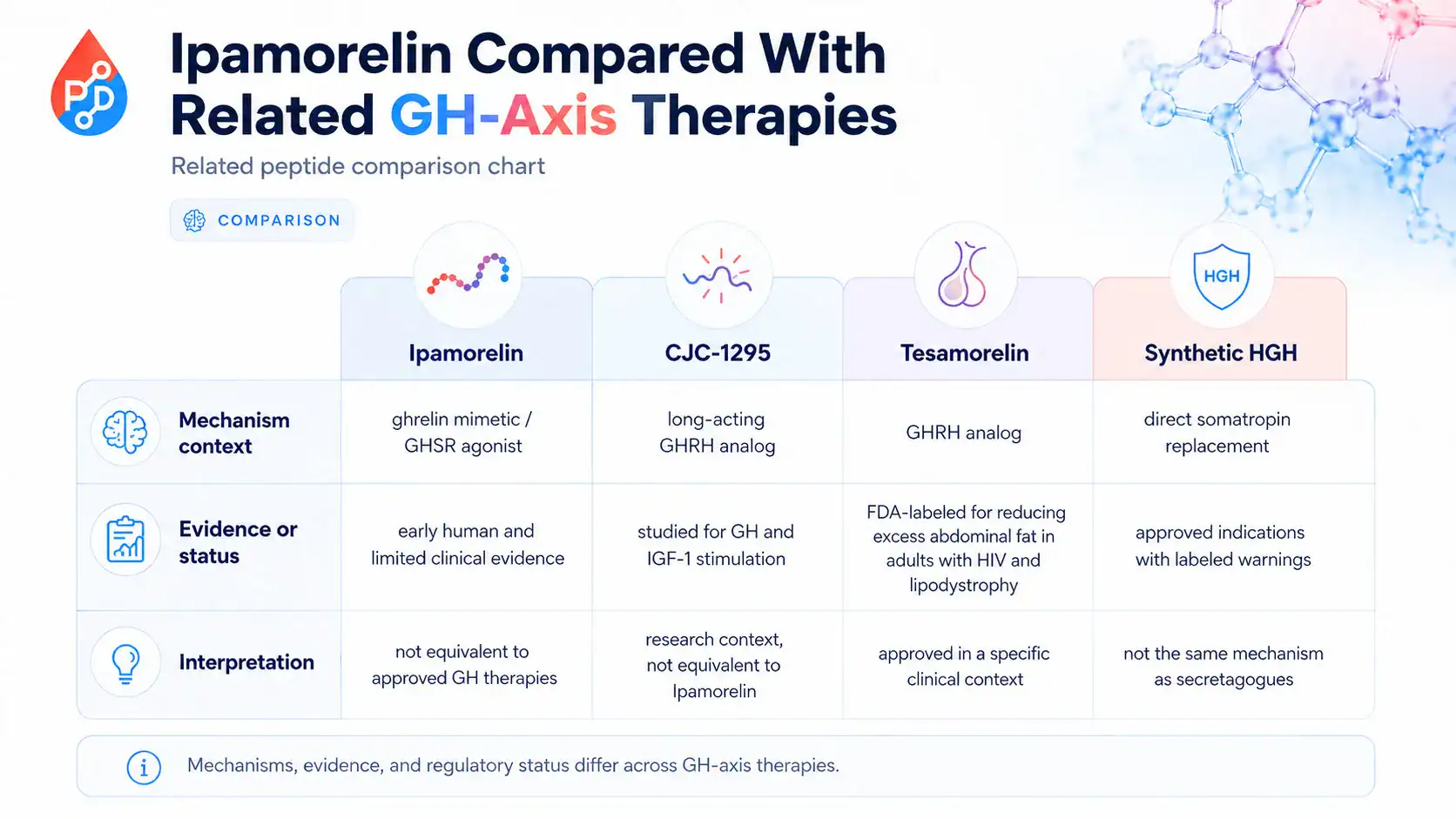
These names often appear together, but their research should be kept separate. A human trial of long-acting CJC-1295 found sustained changes in GH and IGF-1. It did not test an ipamorelin combination, and it should not be presented as evidence for a short-acting “no DAC” blend. [6]
Tesamorelin has a specific labeled use: reducing excess abdominal fat in adults with HIV-associated lipodystrophy. The EGRIFTA WR label explicitly states that it is not indicated for weight-loss management. That indication cannot be transferred to ipamorelin just because both influence the GH axis. [7]
Quick claim check: “It raises GH, so it must build muscle.”
The missing step is a trial measuring meaningful changes in muscle or function. A laboratory hormone response is an intermediate finding. It cannot tell you whether a person will feel better, gain strength or experience a favorable balance of benefits and harms.
Common questions
Is ipamorelin FDA approved or banned?
These are different questions. FDA’s 2024 evaluation described ipamorelin-related substances as not components of an FDA-approved drug and assessed whether they should qualify for a particular compounding list. That historical evaluation is not a blanket statement about every present-day legal situation. The current FDA safety page is a better starting point than a seller’s claim that availability means approval. [4][5]
How long before results appear?
A hormone response can occur during a research session. A timeline for better sleep, fat loss or muscle gain is a different claim and is not established by the studies described here.
Is ipamorelin the same as HGH?
No. Ipamorelin stimulates release of the body’s own growth hormone; growth hormone replacement supplies the hormone itself. Similar vocabulary does not make them equivalent therapies. [1]
The bottom line
Ipamorelin has human evidence for an acute GH response, but its popular wellness claims outrun the available clinical findings. The most useful question is not whether it changes a hormone. It is whether a well-designed trial shows a meaningful benefit for the problem you actually want to address.
Related dosage protocols and research
Explore related research, dosage references and guides below. Vial strengths have separate references because concentration and syringe-unit calculations differ. A comparison does not mean the compounds are interchangeable.
Matching dosage protocols
Related protocols and comparisons
- CJC-1295 NO DAC + Ipamorelin (10 mg Blend) Dosage Protocol
- Tesamorelin 5mg + Ipamorelin 5mg (10mg Blend) Dosage Protocol
- CJC-1295 DAC (5 mg) + Ipamorelin (5 mg) Stack Dosage Protocol
- CJC-1295 DAC (2 mg) + Ipamorelin (5 mg) Stack Dosage Protocol
- AOD-9604 + CJC-1295 + Ipamorelin (12 mg Blend) Dosage Protocol
Further research context
References
- Raun et al. Ipamorelin, the first selective growth hormone secretagogue. Animal and laboratory study, 1998.
- Gobburu et al. Pharmacokinetic and pharmacodynamic modeling of ipamorelin in human volunteers, 1999.
- Beck et al. Randomized placebo-controlled study of ipamorelin in postoperative ileus, 2014.
- FDA. Evaluation of ipamorelin-related substances for the Pharmacy Compounding Advisory Committee, 2024.
- FDA. Bulk substances used in compounding that may present significant safety risks.
- Teichman et al. Long-acting CJC-1295 and GH/IGF-1 secretion in healthy adults, 2006.
- FDA. EGRIFTA WR prescribing information, revised March 2025.