Thymogen is a short peptide made from glutamic acid and tryptophan, commonly written Glu-Trp. It has been investigated for effects on immune signaling. It is not the same molecule as thymosin alpha-1, and the word “immune” does not make their evidence interchangeable.1,2
Thymogen research spans cells, animals and clinical studies in specific populations. It also includes a negative cancer trial. That result belongs in the discussion alongside the proposed benefits.
What is Thymogen?
Thymogen contains two amino-acid residues, making it a dipeptide. Chemical references also call it oglufanide. The National Cancer Institute lists Thymogen and IM862 as names associated with oglufanide disodium, the particular salt form studied clinically. 1 2
That naming connection helps locate relevant literature. It does not establish that every capsule, nasal preparation or injectable product sold under a similar name has equivalent exposure or quality.
How does it affect immune signaling?
A 2023 in-vitro study examined alpha-glutamyl-tryptophan in endothelial cells and blood immune cells from healthy donors. It found changes in inflammatory cytokine production and in ICAM-1, a molecule involved in cell interactions.3
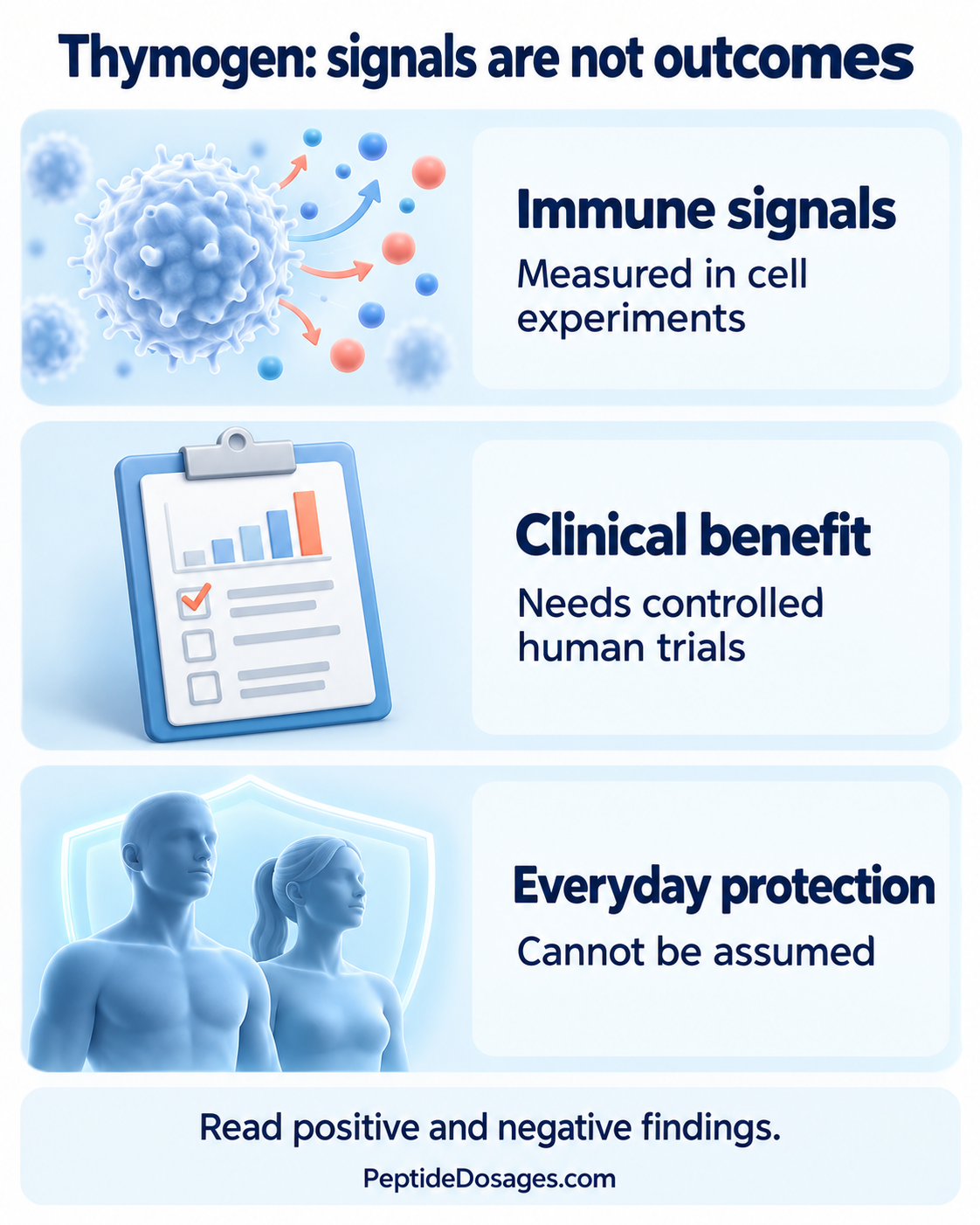
The effects were not a simple “everything goes up” response. Some stimulated cytokine signals decreased while certain cell-surface signals increased. This is why immunomodulation, meaning a change in immune activity, is more accurate than an unqualified claim that a peptide “boosts immunity.”
The cells were studied outside the body. The experiment did not show that taking Thymogen prevents infections or improves a healthy person’s resistance to illness.
What clinical evidence exists?
Small studies in specific settings
A 2011 Russian-language report described a randomized, blinded, placebo-controlled study of a Thymogen preparation in older patients before abdominal or retroperitoneal tumor surgery. The abstract reported improvements in cellular immune measures and postoperative outcomes.4
This narrow surgical setting is very different from everyday wellness use. The accessible abstract does not provide enough detail for a reliable estimate of benefit or a general-purpose regimen.
A negative phase 3 cancer trial
IM862 was tested in a randomized trial involving 202 people with HIV-associated Kaposi sarcoma. The response rate was 23% with IM862 and 21% with placebo. The trial did not show superiority to placebo and found a shorter median time to progression in the IM862 group.5
Participants’ antiretroviral therapy complicated interpretation of earlier promising response estimates. This trial is a useful reminder that an encouraging mechanism or an early uncontrolled result may not translate into clinical benefit.
| Evidence | Finding | Limit |
|---|---|---|
| Cell-based immune research | Changes in selected cytokines and ICAM-1 | Not a demonstration of infection prevention |
| Preoperative study | Favorable outcomes reported in a specific surgical setting | Not a general wellness trial |
| IM862 phase 3 cancer trial | No advantage over placebo; concerning progression result | Does not support cancer-treatment claims |
The studies used different populations and preparations; their results should not be pooled as if they tested one general benefit.3,4,5
Thymogen versus thymosin alpha-1
They are different peptides, not two spellings of the same compound. Do not transfer a thymosin alpha-1 study, schedule or safety claim to Thymogen. The separate thymosin alpha-1 guide reviews that evidence on its own terms.
Thymus-related names can also refer to multi-peptide extracts. Always check the actual ingredients and formulation rather than relying on the first few letters of a product name.
Side effects and safety considerations
The absence of dramatic short-term side effects in a particular study would not establish long-term safety across other populations or routes. The negative cancer trial is especially important: a product can appear tolerable yet fail to help, and clinical outcomes can still be unfavorable.5
People receiving cancer treatment, immune-suppressing therapy or care for a serious infection should discuss any proposed immune-active product with their treating team. It should not replace prescribed treatment or be assumed compatible with it.
What about dosage and cycles?
The evidence reviewed here does not establish a universal Thymogen routine for “immune support.” Different study preparations and routes answer different questions. A published experimental amount is not automatically a suitable dose for another product or condition.
Research-vial instructions and concentration calculations cannot resolve those clinical uncertainties. They also do not turn an investigational product into a licensed prescription medicine.
Frequently asked questions
Does Thymogen prevent colds?
The cell experiment and surgical study described above do not establish routine cold prevention. Changes in laboratory immune markers are not the same outcome as fewer infections in a well-designed trial.
Is Thymogen a cancer treatment?
The cited phase 3 IM862 trial did not support efficacy for AIDS-related Kaposi sarcoma.5 It should not be promoted as an established cancer therapy.
What is the main takeaway?
Thymogen has a genuine but uneven research record. Read the exact formulation, population and outcome, and include negative findings. Broad “immune booster” language hides more than it explains.
References
- PubChem. Thymogen / Glu-Trp: compound identity.
- National Cancer Institute. Oglufanide disodium: drug dictionary entry and synonyms.
- Effects of alpha-glutamyl-tryptophan preparations on cytokine secretion and ICAM-1 in vitro. Cell and Tissue Biology. 2023.
- Smirnov VS, et al. Thymogen for preoperative preparation of older patients with abdominal tumors. Advances in Gerontology. 2011. Russian-language report.
- Noy A, et al. IM862 in AIDS-related Kaposi sarcoma: randomized phase 3 trial. Journal of Clinical Oncology. 2005.