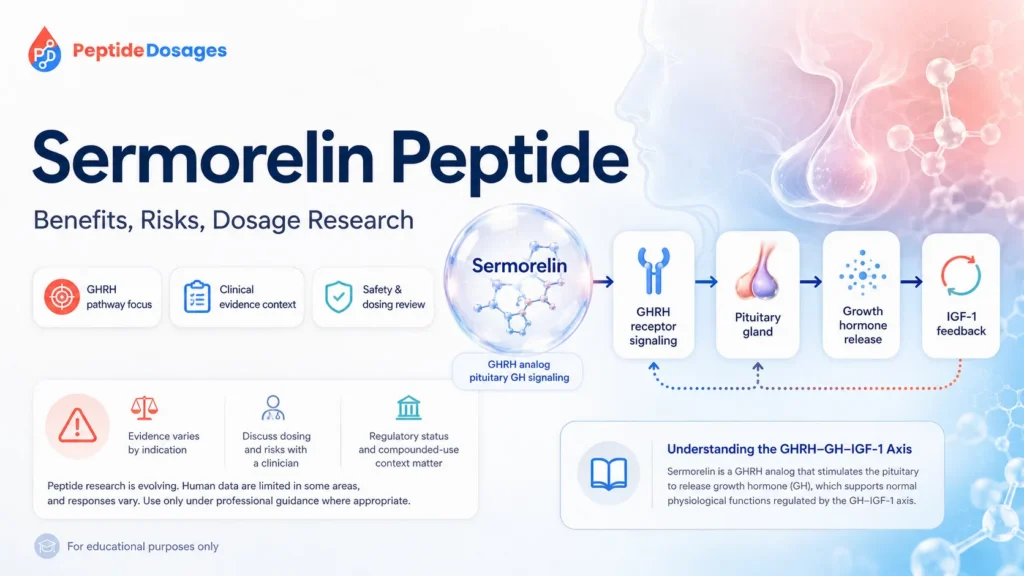
Sermorelin peptide is a synthetic analog of growth hormone–releasing hormone, the hypothalamic signal that helps the pituitary gland release growth hormone 1 2. This educational guide reviews how sermorelin works, what it has been studied or historically used for, and why claims about anti-aging, body composition, and sleep should be interpreted through evidence quality rather than marketing language. It does not provide personalized medical advice, dosing instructions, injection training, or product-sourcing guidance.
- Sermorelin is a synthetic peptide related to endogenous growth hormone-releasing hormone, also called GHRH [1] [2].
- Sermorelin stimulates the pituitary gland to release growth hormone through the GHRH receptor pathway, rather than supplying recombinant human growth hormone directly [2] 3.
- Historical medical use centered on evaluating or treating growth hormone deficiency in children, but current availability and regulatory status should be verified through official sources 4 5.
- The benefits of sermorelin are best discussed by evidence level: pediatric endocrine contexts have more medical relevance than broad online claims about anti-aging, muscle growth, or “optimization” 6 7.
- Side effects of sermorelin reported in labeling and clinical context include injection site reactions, flushing, headache, nausea, dizziness, and potential concerns related to growth hormone pathways [4].
- Published or labeled dosage information should be read only as historical or study context, not as personal dosing advice [4].
- Compounded sermorelin and unapproved peptide products raise quality, labeling, and regulatory concerns that differ from approved prescription drugs 8.
Related dosage pages: For vial-specific concentration, reconstitution, and measurement examples, see Sermorelin (5 mg Vial) Dosage Protocol and Sermorelin (10 mg Vial) Dosage Protocol. Each linked protocol remains a separate reference because vial strength changes concentration and syringe-unit calculations.
Fast Answer
Sermorelin peptide is a synthetic GHRH analog that signals the pituitary gland to release growth hormone, making it different from direct HGH replacement [1] [2]. It has been discussed in pediatric growth hormone deficiency, endocrine testing, and off-label hormone therapy settings, but evidence for anti-aging, body composition, and sleep claims is much weaker [4] [6] [7]. Safety, dosage, and regulatory status depend on product status, medical context, and clinician supervision.
What Is the Sermorelin Peptide?
Sermorelin is a synthetic peptide analog of growth hormone–releasing hormone, often described as GRF 1-29 or modified GRF (1-29), because it represents the biologically active N-terminal fragment of native GHRH [1] [2]. In medical terms, it belongs to the group of growth hormone secretagogues, meaning compounds that stimulate endogenous growth hormone release rather than replacing the hormone directly [2] [3].
The distinction matters. Direct human growth hormone, often called HGH or somatropin, is an exogenous replacement therapy, while sermorelin works upstream by stimulating pituitary signaling if the pituitary gland can respond [2] 9.
Is Sermorelin a Synthetic Peptide Related to GHRH?
Yes. Sermorelin is a synthetic peptide related to growth hormone-releasing hormone, a hypothalamic hormone that normally helps regulate pulsatile growth hormone secretion [1] [3]. DrugBank describes sermorelin as a GHRH analog that binds the GHRH receptor and stimulates growth hormone secretion from somatotroph cells in the anterior pituitary [2].
In plain language, sermorelin mimics a natural signaling molecule. It does not become growth hormone itself; it asks the body’s endocrine system to release growth hormone through an existing receptor pathway [2] [3].
What Are Sermorelin Acetate and Modified GRF (1-29)?
Sermorelin acetate is the acetate salt form used in drug products and research descriptions [1] [2]. The term modified GRF (1-29) reflects that sermorelin is based on the first 29 amino acids of the larger GHRH molecule, which retain growth hormone-releasing activity [2].
Different names can appear in medical literature, product labeling, and databases. Readers may see sermorelin, sermorelin acetate, GRF 1-29, or growth hormone-releasing factor 1-29 used in related contexts [1] [2] [4].
Why Did Growth Hormone Deficiency Shape Early Medical Use?
Growth hormone deficiency occurs when growth hormone secretion is inadequate for age and clinical context, and pediatric diagnosis requires careful auxologic, biochemical, and endocrine evaluation [6] 10. Sermorelin’s early medical relevance came from its ability to test or stimulate the growth hormone axis in children with suspected or established growth hormone deficiency [4] [6].
This is different from broad wellness claims. Pediatric growth hormone deficiency is a medical diagnosis; anti-aging or hormone optimization claims are usually off-label and require much more cautious evidence grading [6] [7].
How Does Sermorelin Peptide Work?
Sermorelin works by activating the GHRH receptor on pituitary somatotroph cells, which can trigger growth hormone release through intracellular signaling pathways [2] [3]. Growth hormone is then released into circulation and can influence downstream mediators such as insulin-like growth factor 1, or IGF-1, especially through hepatic and peripheral tissue responses [3] 11.
This mechanism is biologically plausible, but mechanism is not the same as proven clinical benefit for every claimed use. A peptide can affect a hormone pathway without producing predictable or safe outcomes in all patients.
How Sermorelin Stimulates Natural Growth Hormone Release
Sermorelin stimulates natural growth hormone release by mimicking GHRH signaling at the pituitary gland [2] [3]. The body’s growth hormone system is normally pulsatile, meaning secretion rises and falls in bursts that are shaped by sleep, age, nutrition, sex steroids, somatostatin, and feedback from IGF-1 [3] [11].
Because sermorelin depends on pituitary responsiveness, it may not work the same way in people with severe pituitary damage or absent somatotroph reserve. This is one reason endocrine evaluation matters before interpreting sermorelin therapy claims.
What Roles Do the Pituitary Gland and Hypothalamus Play?
The hypothalamus releases stimulatory and inhibitory hormones that regulate pituitary function, including GHRH and somatostatin [3]. GHRH promotes growth hormone release, while somatostatin inhibits it, creating a feedback-controlled system rather than a simple on-off switch [3] [11].
The pituitary gland acts as the immediate source of circulating growth hormone. Sermorelin targets that regulatory layer, so its effect depends on endocrine physiology, not only on the administered compound [2] [3].
Why Does Sermorelin Work Differently Than Direct HGH?
Direct HGH therapy supplies recombinant human growth hormone from outside the body, while sermorelin encourages the pituitary gland to release endogenous growth hormone [2] [9]. That difference affects monitoring, expected response, and clinical decision-making.
For diagnosed adult or pediatric growth hormone deficiency, medical guidelines focus on formal diagnosis, recombinant GH treatment when indicated, individualized dose titration, and monitoring for adverse effects [6] [9]. Sermorelin should not be assumed to be interchangeable with approved somatropin products.
Mechanism of Action: Growth Hormone, IGF-1, and Feedback
The sermorelin mechanism sits within the growth hormone–IGF-1 axis. Growth hormone release can raise IGF-1, and IGF-1 is commonly used as a marker of growth hormone activity, though it is not a perfect stand-alone measure of secretion or clinical response [3] [9] [11].
Feedback matters because higher growth hormone or IGF-1 signaling can suppress upstream signals. The endocrine system is designed to maintain balance, so more stimulation does not always mean better outcomes.
What Happens at the GHRH Receptor?
At the cellular level, GHRH receptor activation on pituitary somatotrophs is linked to cyclic AMP signaling and growth hormone secretion [2] [3]. Sermorelin uses this receptor pathway to stimulate growth hormone release.
This receptor-based explanation helps separate sermorelin from unrelated peptides. It is not primarily a tissue-repair peptide, mitochondrial peptide, or melanocortin agonist; its main pharmacologic lane is the growth hormone axis [2].
How Is Insulin-Like Growth Factor 1 Used as a Marker?
IGF-1 reflects integrated growth hormone activity and is often used in diagnosis and monitoring of growth hormone disorders, although interpretation depends on age, sex, nutrition, liver function, and assay context [9] [11]. Clinicians may use IGF-1 alongside symptoms, growth patterns, stimulation tests, and safety monitoring.
A normal or abnormal IGF-1 result does not automatically answer whether a person should use sermorelin. It is one clinical data point within a broader endocrine assessment [9] [11].
Why Mechanism Does Not Guarantee Clinical Benefits
A plausible mechanism can support research, but it does not prove benefit for body composition, sleep quality, muscle growth, or anti-aging claims. For example, growth hormone activity changes with age, and giving growth hormone to healthy older adults has shown limited benefit with increased adverse events in systematic review evidence [7].
This is a key evidence distinction: sermorelin may stimulate growth hormone release, but the clinical value of that stimulation depends on diagnosis, baseline hormone function, age, safety profile, and outcome studied.
What Is Sermorelin Peptide Therapy Used For?
Sermorelin therapy has been discussed in three main contexts: historical labeled medical use, endocrine evaluation or research, and off-label hormone therapy or hormone optimization settings [4] [5] 13. These categories should not be treated as equivalent.
Approved or historically labeled uses are supported by regulatory review for a specific product and indication. Off-label use may occur in medicine, but it requires careful clinician judgment and should not be confused with general wellness marketing.
What Approved or Historical Medical Contexts Matter?
Historical labeling for sermorelin products described use in children with growth failure associated with growth hormone deficiency and included weight-based subcutaneous administration in that medical context [4]. Official FDA drug databases and labeling sources are the appropriate places to verify whether a product is currently approved, discontinued, or otherwise listed [4] [5].
Pediatric endocrine guidelines emphasize that growth hormone deficiency in children requires specialist evaluation and that treatment decisions should be based on diagnosis, growth pattern, benefits, risks, and family-centered decision-making [6]. Sermorelin use should be interpreted within that medical framework, not as a general wellness intervention.
Off-Label Hormone Optimization Claims Requiring Caution
Off-label claims often frame sermorelin peptide therapy as a way to improve energy, sleep, body composition, recovery, or men’s health. These claims may be biologically connected to growth hormone physiology, but high-quality evidence for broad use in otherwise healthy adults is limited.
Claims about anti-aging benefits need special caution. A systematic review of growth hormone use in healthy older adults found small changes in body composition but more adverse events, and it did not establish anti-aging benefit [7].
Potential Benefits of Sermorelin Peptide
The potential benefits of sermorelin should be separated by evidence category. The most medically relevant discussion involves growth hormone deficiency and the growth hormone axis; weaker claims include anti-aging, body composition enhancement, sleep quality, and general vitality.
An evidence landscape helps keep these claims in context.
| Evidence Area | What Has Been Studied | Evidence Level | What It Can and Cannot Show |
|---|---|---|---|
| Pediatric growth hormone deficiency | Historical labeling and pediatric endocrine literature discuss growth hormone axis evaluation and treatment contexts [4] [6]. | Approved or historical medical context / clinical | Relevant to diagnosed pediatric endocrine disorders, not general wellness use. |
| Adult growth hormone deficiency | Guidelines focus mainly on diagnosis and recombinant GH replacement when indicated [9] [11]. | Clinical guideline evidence | Supports endocrine evaluation, not broad sermorelin use for healthy adults. |
| Anti-aging claims | Growth hormone interventions in healthy older adults have not shown established anti-aging benefit and have raised safety concerns [7]. | Clinical evidence for GH; indirect for sermorelin | Does not prove sermorelin reverses aging. |
| Body composition | GH-related interventions may affect lean mass and fat mass in some settings, but clinical meaning and safety vary [7] [9]. | Mixed / context-dependent | Does not establish a general body composition therapy. |
| Sleep quality | Growth hormone secretion is linked to sleep physiology, but sleep improvement claims for sermorelin are not well established [3]. | Mechanistic / limited | Biological plausibility is not proof of clinical sleep benefit. |
| Compounded sermorelin | Compounded products are not reviewed like FDA-approved drugs for safety, effectiveness, or manufacturing quality [8]. | Regulatory safety context | Raises quality concerns; does not establish efficacy. |
Exploring the Benefits Without Overstating Evidence
Exploring the benefits of sermorelin requires asking: benefit for whom, measured how, compared with what, and under what medical supervision? A child with diagnosed growth hormone deficiency is not the same evidence context as a healthy adult seeking hormone optimization [6] [9].
The strongest conclusions come from labeled indications, guidelines, and well-designed human studies. Weaker claims should be described as preliminary, indirect, or unsupported.
Body Composition, Lean Muscle, and Muscle Mass Claims
Body composition claims often focus on lean muscle, muscle mass, fat mass, or muscle growth. Growth hormone biology can influence body composition, but evidence from healthy older adults using GH shows limited clinical benefit and increased adverse effects, so related claims should be cautious [7].
Sermorelin may raise growth hormone levels in responsive individuals, but that does not prove meaningful or safe body composition changes for general users. Claims about “numerous benefits” or “full benefits” are marketing-style language unless supported by clinical outcomes.
What Is Known About Sleep Quality and Improve Sleep Claims?
Growth hormone secretion is linked to sleep, especially slow-wave sleep, and GH pulses often occur during early nighttime sleep [3]. That connection helps explain why sleep quality appears in online discussions of sermorelin.
However, “linked to sleep physiology” is not the same as “proven to improve sleep.” Published evidence does not establish sermorelin as a general sleep treatment, and sleep problems can have many causes that require clinical evaluation.
What Does Human Research Say About Sermorelin?
Human evidence for sermorelin is strongest in endocrine contexts, especially pediatric growth hormone deficiency or testing of the growth hormone axis [4] [6] [13]. For broad adult wellness use, the evidence is much less certain.
ClinicalTrials.gov lists research records involving sermorelin, but the existence of trial records does not mean that a use is approved, effective, or appropriate for all patients [13]. Study design, sample size, endpoints, duration, and publication status all matter.
Pediatric Growth Hormone Deficiency and Idiopathic Cases
Pediatric growth hormone deficiency and idiopathic short stature are specialized endocrine topics. Guidelines from the Pediatric Endocrine Society recommend careful diagnosis and shared decision-making when growth hormone or IGF-1 treatment is considered in children and adolescents [6].
Sermorelin’s historical role is connected to this pediatric growth hormone deficiency landscape, but current practice often centers on approved recombinant GH products when therapy is indicated [6]. Growth hormone deficiency in children should not be self-diagnosed or treated outside specialist care.
What Adult Studies Suggest About Ageing Claims
Ageing is associated with changes in growth hormone secretion, body composition, and IGF-1 patterns, which has led to interest in GH-axis interventions [7] [11]. But evidence in healthy older adults does not support growth hormone as an anti-aging therapy and shows increased adverse events such as edema, joint symptoms, and glucose-related concerns [7].
Because sermorelin acts through the GH axis, anti-aging claims about sermorelin should be held to a high standard. Indirect physiology and anecdotal reports do not establish that sermorelin can combat the effects of aging.
What Preclinical and Mechanistic Evidence Adds
Preclinical and mechanistic evidence helps explain how a compound might work, but it cannot prove clinical benefit in humans. For sermorelin, the most relevant preclinical foundation is the biology of GHRH, pituitary receptor signaling, growth hormone release, and feedback regulation [2] [3].
Mechanistic evidence is useful for hypothesis generation. It is weaker than controlled human outcomes for deciding whether a therapy improves health, function, or disease-related endpoints.
Animal and Cell Signaling Findings Relevant to GH Release
Cell signaling studies and endocrine physiology research support the concept that GHRH receptor activation can stimulate growth hormone secretion [2] [3]. Animal and laboratory models can also help clarify receptor pathways, somatostatin balance, and endocrine feedback.
These findings are not the same as clinical proof for wellness outcomes. Translation from receptor signaling to patient benefit requires human studies with appropriate endpoints.
What Preclinical Research Can and Cannot Show
Preclinical research can show biological plausibility, receptor activity, and hormone signaling patterns. It cannot show whether compounded sermorelin improves overall health, safely changes body composition, or improves sleep quality in a general adult population.
This distinction is especially important for peptide content online. Many claims begin with a real mechanism but stretch beyond what human data can support.
Where the Evidence for Sermorelin Is Limited
The main evidence limitation is that sermorelin’s best-supported context is narrow compared with the broad claims often made online. Pediatric endocrine use, diagnostic testing, adult hormone optimization, athletic performance, anti-aging, and sleep claims are different evidence categories.
A second limitation is product status. Evidence from a labeled drug product cannot automatically be applied to an unapproved or compounded peptide product with different manufacturing, purity, stability, or oversight [8].
Online Anti-Aging Benefits Versus Published Outcomes
Online claims may state that sermorelin offers anti-aging benefits, improves sleep, increases lean muscle, or supports overall health. Those claims should be treated as anecdotal or unsupported unless tied to high-quality human studies.
The best available caution comes from GH-axis research more broadly. In healthy older adults, growth hormone interventions did not establish anti-aging benefit and increased adverse events [7].
Claim Strength Matrix for Potential Benefits
A practical claim-strength matrix can help readers interpret sermorelin use claims:
- Stronger: Historical labeled or specialist endocrine contexts, such as pediatric growth hormone deficiency evaluation or treatment settings [4] [6].
- Moderate but indirect: Mechanistic GH-axis effects, such as pituitary stimulation and IGF-1 monitoring [2] [3] [9].
- Limited: Adult hormone optimization claims without strong controlled outcomes.
- Weak or unsupported: Promises to reverse aging, guarantee muscle growth, or improve sleep in all users.
Side Effects of Sermorelin and Common Reactions
The side effects of sermorelin reported in labeling include injection site reactions and systemic symptoms such as flushing, headache, nausea, dizziness, somnolence, and possible hypersensitivity reactions [4]. Not every person experiences these effects, and the risk of side effects depends on product, dose, patient factors, and medical context.
Safety data from a historical label should not be generalized to every compounded or unapproved product. Compounded drugs may have different quality and testing standards than FDA-approved products [8].
Injection Site Reactions and Short-Term Symptoms
Common side effects may include injection site pain, redness, swelling, or itching, along with headache, flushing, dizziness, or nausea [4]. These effects are generally described as short-term in labeling, but any concerning reaction requires clinician assessment.
This article does not provide injection instructions. Administration details belong in clinician-supervised care, and injection-related complications can include local irritation, infection risk, or allergic reactions.
Possible Side Effects Linked to Growth Hormone Pathways
Because sermorelin stimulates growth hormone release, clinicians may consider GH-axis risks such as fluid retention, joint symptoms, glucose changes, or excessive IGF-1 response, especially in patients with relevant medical histories [7] [9]. These concerns are better established for growth hormone therapy than for broad sermorelin use, but the pathway overlap is clinically relevant.
People with diabetes, cancer history, edema, sleep apnea, intracranial lesions, or active endocrine disorders need individualized medical review. Guidelines for growth hormone therapy emphasize monitoring and risk assessment [9] [11].
When Do Side Effects of Sermorelin Need Urgent Evaluation?
Potentially urgent symptoms include signs of allergic reaction, severe swelling, breathing difficulty, fainting, chest symptoms, severe headache, or neurologic changes. Labeling for medications commonly treats hypersensitivity as a serious concern, and sermorelin labeling includes hypersensitivity-type reactions among reported adverse events [4].
Any severe or rapidly worsening reaction should be handled through appropriate medical care. Online advice is not a substitute for emergency evaluation.
Safety Risks, Contraindications, and Medical Supervision
Medical supervision matters because sermorelin affects an endocrine pathway. Growth hormone and IGF-1 signaling can interact with glucose metabolism, fluid balance, tissue growth, and underlying disease states [7] [9] [11].
Sermorelin therapy offers a biologically targeted mechanism, but that does not remove the need for screening, monitoring, and appropriate diagnosis. “Natural growth hormone production” language can be misleading if it implies that endocrine stimulation is risk-free.
Cancer, Diabetes, Edema, and Other Risk Contexts
Growth hormone therapy guidelines advise caution and monitoring in patients with conditions such as diabetes, malignancy history, intracranial tumors, edema, and other endocrine disorders [9] [11]. These concerns are not identical for every sermorelin scenario, but they are relevant because sermorelin acts through the GH axis.
Patients with active cancer or unexplained abnormal growth-related symptoms should not interpret sermorelin content as reassurance. A clinician needs to evaluate risks, alternatives, and whether GH-axis stimulation is appropriate.
Pregnancy, Breastfeeding, Children, and Specialist Oversight
Pregnancy and breastfeeding require special caution because evidence is limited, and endocrine therapies can have maternal and fetal implications. Drug labeling and clinical guidelines generally treat pregnancy, lactation, and pediatric endocrine treatment as specialist-supervised contexts [4] [6].
Children with possible growth hormone deficiency need pediatric endocrinology evaluation. Growth patterns, bone age, lab testing, genetics, nutrition, and chronic disease assessment may all matter [6] [10].
Drug Interactions and Conditions Requiring Caution
Sermorelin interaction data are not as extensive as many widely used prescription drugs. Still, any compound that changes growth hormone levels can affect clinical interpretation of endocrine tests and may interact with conditions or medications related to glucose, thyroid, adrenal, sex hormones, or fluid balance [9] [11].
Medication reviews are especially important if a patient uses glucocorticoids, diabetes medications, thyroid replacement, sex steroids, or other hormone therapies. These systems can influence growth hormone and IGF-1 interpretation [9] [11].
Hormones, Glucose-Lowering Drugs, and Steroid Considerations
Glucocorticoids can affect growth and growth hormone physiology, and diabetes medications may need careful review if GH-axis therapy changes glucose metabolism [6] [9]. Thyroid and adrenal status can also affect how endocrine symptoms and lab results are interpreted [11].
These are clinician-level decisions. A published dosage or study design should never be converted into a personal plan without medical evaluation.
Why Medication Reviews Matter Before Sermorelin Use
Medication reviews help identify risks, overlapping hormone therapy, abnormal labs, contraindications, and safer approved alternatives. They also help prevent misattribution, where symptoms such as fatigue, poor sleep, weight change, or low energy are incorrectly assumed to reflect low growth hormone.
A practical clinician discussion checklist includes:
- Current prescription and nonprescription medications.
- History of cancer, diabetes, edema, sleep apnea, or pituitary disease.
- Pregnancy, breastfeeding, or fertility-related plans.
- Baseline IGF-1 and other endocrine testing.
- Whether an approved alternative is more appropriate.
- Regulatory status and product-quality concerns.
- Monitoring plan for adverse events.
Sermorelin Dosage Information From Labels and Studies
Dosage information for sermorelin should be interpreted only from approved labeling, historical labeling, or published study context. Historical labeling has described weight-based subcutaneous dosing in pediatric growth hormone deficiency contexts, including administration at bedtime, but this should not be treated as a personal dosing recommendation [4].
Study doses should not be interpreted as personal dosing advice. Dose decisions depend on diagnosis, age, growth pattern, lab results, comorbidities, adverse effects, formulation, and clinician oversight [6] [9].
What Dosage Appeared in Approved Labeling or Trials?
Historical labeling for sermorelin acetate described a pediatric medical context and weight-based dosing rather than a universal adult wellness dose [4]. Published trial or labeling doses are designed for specific populations and endpoints.
This distinction matters because off-label adult “sermorelin dosage” discussions online often remove the medical context. A dose studied in one setting does not establish safety or efficacy in another.
Why Sermorelin Dosage Is Not Personal Dosing Advice
Personal dosing advice requires a licensed clinician with access to a patient’s diagnosis, medications, lab values, medical history, and treatment goals. Article-level dosage summaries cannot account for pituitary reserve, IGF-1 response, contraindications, product quality, or adverse effects.
For that reason, this guide discusses dosage of sermorelin only as historical label or literature context. It does not tell readers how much to take sermorelin, when to take it, or how to administer it.
Sermorelin Injections and Administration Routes in Literature
Sermorelin injections appear in labeling and clinical literature because subcutaneous administration has been used in medical contexts [4]. Subcutaneous administration means the medication is delivered under the skin, but this article does not provide technique, device, mixing, or reconstitution instructions.
Administration route affects pharmacokinetics, tolerability, and monitoring. It also affects how study findings should be interpreted [4] [9].
Subcutaneous Administration in Clinical Context
Historical sermorelin labeling described subcutaneous administration in pediatric treatment contexts [4]. Other endocrine testing contexts for GHRH-like agents may involve different routes, doses, and monitoring, depending on the test and product.
Readers should avoid translating route descriptions into self-use instructions. Administration decisions belong in a clinician-supervised setting.
How Route, Timing, and Monitoring Affect Study Interpretation
Route and timing can influence hormone peaks, tolerability, and interpretation of growth hormone or IGF-1 results [3] [4]. Growth hormone secretion is pulsatile, so single lab values may not capture the full pattern of secretion [3] [11].
Monitoring may include growth response in children, IGF-1, glucose-related markers, adverse effects, and other endocrine labs depending on context [6] [9]. The monitoring plan is part of the medical decision, not an optional add-on.
Regulatory Status: FDA Approval, Compounded Sermorelin, and Sport
Regulatory status matters because approved drugs are reviewed for specific indications, labeling, manufacturing quality, safety, and dosing instructions. FDA databases and DailyMed labeling should be used to verify whether a sermorelin product is currently approved, discontinued, or listed under a specific status [4] [5].
Compounded sermorelin is a separate issue. Compounded drugs can be appropriate in some medical situations, but they are not FDA-approved and are not evaluated by FDA for safety, effectiveness, or manufacturing quality in the same way as approved drugs [8].
Former Approved Products Versus Current Availability
Sermorelin has appeared in historical labeling and FDA-related drug databases, but product availability can change over time [4] [5]. A discontinued or historically approved product is not the same as an actively marketed FDA-approved product.
Readers should verify current status through official regulatory sources rather than clinic marketing pages or peptide vendor claims. Regulatory status can also vary by country.
Compounded Sermorelin, USADA Rules, and Quality Concerns
Compounded sermorelin raises quality and oversight questions because compounded medications are not FDA-approved products [8]. This does not mean every compounded medication is inappropriate, but it does mean safety, sterility, potency, labeling, and clinical justification require careful scrutiny.
Athletes also need anti-doping awareness. WADA prohibits growth hormone and growth hormone-releasing factors, and sport rules can apply even when a medication is prescribed 12. Athletes should consult qualified sports-medicine and anti-doping professionals before using any GH-axis therapy.
Sermorelin vs HGH and Related Growth Hormone Secretagogues
Sermorelin vs HGH comparisons often oversimplify the issue. Sermorelin is a GHRH analog that stimulates endogenous release, while HGH or somatropin is recombinant human growth hormone used as replacement therapy in approved medical contexts [2] [9].
Related growth hormone secretagogues may target different receptors. For example, some secretagogues act through ghrelin-related pathways rather than GHRH receptors, so they should not be assumed to share the same evidence, safety, or regulatory profile [2] [3].
A responsible comparison looks at mechanism, indication, evidence quality, regulatory status, monitoring needs, and risk. It does not ask which option is “best” for everyone.
Questions to Discuss Before Considering Sermorelin
Readers considering sermorelin-related medical decisions should discuss evidence, risks, alternatives, and regulatory status with a qualified healthcare professional. Useful questions include:
- Is there a diagnosed growth hormone deficiency or another endocrine disorder?
- What approved therapies or diagnostic tests are relevant?
- What evidence supports the intended use?
- What labs and clinical outcomes would be monitored?
- What side effects or contraindications are most relevant?
- Is the product FDA-approved, discontinued, compounded, or unapproved?
- Are there sport, employment, or legal restrictions?
- What would be the plan if adverse effects occur?
The safest way to interpret sermorelin is through evidence quality, regulatory status, safety data, and clinician-guided decision-making. The strongest conclusions come from approved labeling and well-designed human studies; weaker claims about anti-aging, sleep, and body composition should be treated cautiously.
Related dosage protocols and research
Use the available links to move between research context, dosage pages or comparisons, and supporting guides. When vial-size variants exist, they remain separate because concentration and syringe-unit calculations change with vial strength. Comparisons do not imply that different compounds are interchangeable.
Matching dosage protocols
Further research context
REFERENCES
- National Center for Biotechnology Information. PubChem Compound Summary: Sermorelin. PubChem. Accessed 2026.
- DrugBank Online. Sermorelin. DrugBank. Accessed 2026.
- StatPearls / NCBI Bookshelf. Physiology, Growth Hormone. National Library of Medicine. Updated periodically.
- DailyMed. DailyMed search results and labeling records for sermorelin. National Library of Medicine. Accessed 2026.
- U.S. Food and Drug Administration. Orange Book: Approved Drug Products with Therapeutic Equivalence Evaluations. FDA. Accessed 2026.
- Grimberg A, DiVall SA, Polychronakos C, et al. Guidelines for Growth Hormone and Insulin-Like Growth Factor-I Treatment in Children and Adolescents. Hormone Research in Paediatrics. 2016. DOI: 10.1159/000452150.
- Liu H, Bravata DM, Olkin I, et al. Systematic review: the safety and efficacy of growth hormone in the healthy elderly. Annals of Internal Medicine. 2007. PMID: 17227934. DOI: 10.7326/0003-4819-146-2-200701160-00005.
- U.S. Food and Drug Administration. Compounding and the FDA: Questions and Answers. FDA. Accessed 2026.
- Molitch ME, Clemmons DR, Malozowski S, Merriam GR, Vance ML. Evaluation and Treatment of Adult Growth Hormone Deficiency: An Endocrine Society Clinical Practice Guideline. Journal of Clinical Endocrinology & Metabolism. 2011. DOI: 10.1210/jc.2011-0179.
- NCBI Bookshelf / Endotext. Disorders of Growth Hormone in Childhood. Endotext. Updated periodically.
- NCBI Bookshelf / Endotext. Adult Growth Hormone Deficiency — Clinical Management. Endotext. Updated periodically.
- World Anti-Doping Agency. 2025 Prohibited List. WADA. 2025.
- ClinicalTrials.gov. ClinicalTrials.gov search results for sermorelin. U.S. National Library of Medicine. Accessed 2026.
Researchers Cited in This Article
The researchers below authored or co-authored publications cited in this article. Listing them here identifies sources; it does not mean they wrote, independently reviewed, sponsored, or endorsed this PeptideDosages.com article. The site author is identified in the article byline.
Adda Grimberg
Researcher profile: Children’s Hospital of Philadelphia Profile
Adda Grimberg’s published work is relevant to the pediatric endocrine context discussed in this Sermorelin peptide article, especially the evaluation and treatment framework for children with growth hormone deficiency. Her guideline work helps place growth hormone–axis interventions within a structured clinical setting that considers diagnosis, growth patterns, safety, and evidence quality. Her broader research on referral patterns and growth evaluation also provides useful background for interpreting why pediatric endocrine indications should not be generalized to adult wellness or hormone optimization claims.
Selected publications:
- Guidelines for Growth Hormone and Insulin-Like Growth Factor-I Treatment in Children and Adolescents — Hormone Research in Paediatrics, 2016. DOI: 10.1159/000452150.
- Sex differences in patients referred for evaluation of poor growth — The Journal of Pediatrics, 2005. PMID: 15973321.
Hau Liu
Researcher profile: Stanford Profiles
Hau Liu’s systematic review work is relevant to the article’s cautious discussion of growth hormone, aging-related claims, body composition, safety, and evidence limitations. His publications help frame why biologic plausibility in the growth hormone axis should not be treated as proof of broad clinical benefit. This is especially important when interpreting claims about Sermorelin, because Sermorelin acts through growth hormone release but does not automatically establish efficacy for anti-aging, fat loss, recovery, or performance-related uses.
Selected publications:
- Systematic review: the safety and efficacy of growth hormone in the healthy elderly — Annals of Internal Medicine, 2007. PMID: 17227934.
- The effects of growth hormone on athletic performance: a systematic review — Annals of Internal Medicine, 2008. PMID: 18347346.