
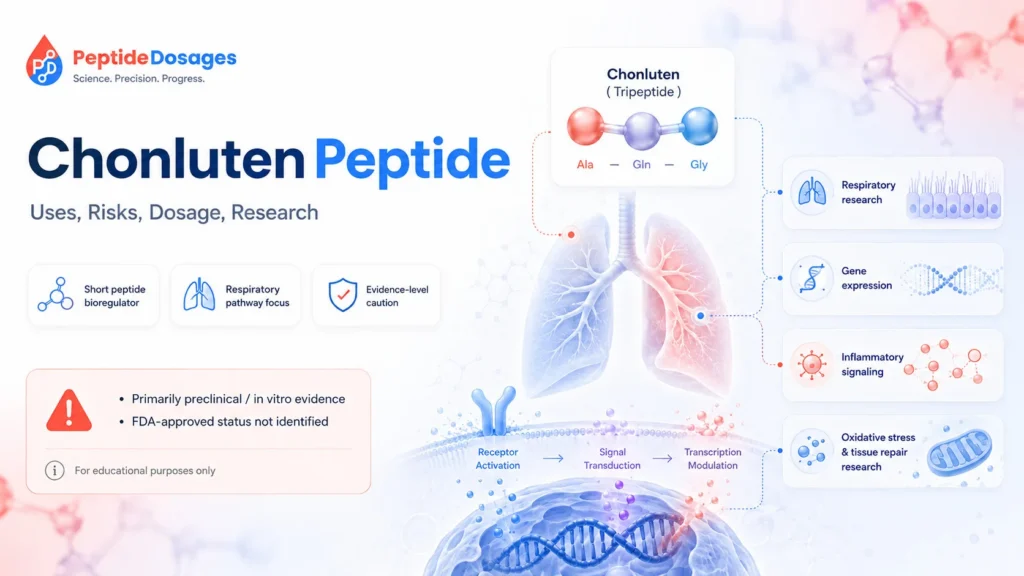
Chonluten peptide is a short peptide bioregulator discussed in relation to lung, bronchial, and inflammatory research, not as an FDA-approved respiratory medicine. This educational article reviews compound identity, proposed mechanisms, potential respiratory benefits, side effects, dosage evidence, administration routes discussed in literature, regulatory status, and evidence limits using scientific and official regulatory sources 1 2 9. It is informational only and does not provide personal medical advice, self-use instructions, or a treatment protocol.
- Chonluten is commonly associated with glutamyl-aspartyl-glycine, also written as Glu-Asp-Gly or EDG; PubChem lists glutamyl-aspartyl-glycine as CID 194641 with molecular formula C11H17N3O8 and molecular weight 319.27 g/mol [1].
- The most directly relevant peer-reviewed Chonluten study identified here is an in vitro THP-1 monocyte/macrophage study that evaluated inflammatory and proliferative pathways [2].
- Chonluten is discussed as a respiratory bioregulator because the tripeptide has been described as derived from bronchial epithelial cells, but this does not establish human respiratory benefit [2].
- Claims about lung function, respiratory health, anti-inflammatory effects, antioxidant activity, regeneration, or tissue repair need evidence grading because in vitro findings do not prove clinical outcomes [2] 5.
- No FDA-approved Chonluten product, labeled indication, approved dosage, or FDA label was identified in the official FDA resources reviewed for this article [9] 10 11.
- Dosage information for Chonluten is limited to research context, such as cell-culture exposure concentrations, and should not be interpreted as personal dosing advice [2].
- Safety remains uncertain because robust human adverse-event data are not available in the reviewed sources, and unapproved or compounded peptides may carry quality, contamination, dosing, and immunogenicity risks 12 14.
Related dosage pages: For vial-specific concentration, reconstitution, and measurement examples, see Chonluten (20 mg Vial) Dosage Protocol. Each linked protocol remains a separate reference because vial strength changes concentration and syringe-unit calculations.
Fast Answer
Chonluten peptide is a short Glu-Asp-Gly tripeptide discussed as a respiratory peptide bioregulator, mainly in lung, bronchial, gene regulation, and inflammatory research contexts [1] [2]. The strongest direct evidence located for Chonluten is preclinical, including in vitro THP-1 immune-cell findings, not large human clinical trials [2]. It is not identified here as an FDA-approved drug, so benefit, side-effect, dosage, administration, and safety claims should be interpreted cautiously [9] [10] [11].
What Is the Chonluten Peptide?
Chonluten is usually described as a short peptide connected to respiratory-system research. In evidence-based terms, it is best treated as a research-focused peptide unless a specific approved product, indication, label, and jurisdiction can be verified through official regulatory sources [9] [10] [11].
Peptide Classification, Sequence, and T-34 Naming
Chonluten is commonly associated with the tripeptide glutamyl-aspartyl-glycine, written as Glu-Asp-Gly or EDG. A tripeptide contains three amino acid residues, and PubChem lists glutamyl-aspartyl-glycine as CID 194641 with molecular formula C11H17N3O8 and molecular weight 319.27 g/mol [1].
Some sources also use the shorthand T-34. Because peptide names, complexes, and commercial labels can vary, the exact compound identity should be verified before interpreting any research, safety, or dosage claim [1] [2].
Chonluten as a Short Peptide Bioregulator
The phrase “peptide bioregulator” is used in short-peptide literature for molecules studied for possible effects on gene expression, protein synthesis, cell signaling, and tissue-specific regulation. A systematic review by Khavinson and colleagues describes short peptides as molecules that may interact with nucleosomes, histones, DNA, and transcription-related processes, but evidence strength varies by peptide and model 3.
For Chonluten, the most directly relevant peer-reviewed evidence located here is an in vitro study in THP-1 monocyte/macrophage models. That study evaluated Chonluten alongside other short peptides for effects on inflammatory and proliferative pathways [2].
Why Respiratory Bioregulator Claims Need Evidence Grading
Respiratory bioregulator claims can overreach when they move from cell signaling to human treatment claims. A peptide may affect cytokines, phosphorylation, or cell adhesion in a cell line without improving asthma, COPD, bronchitis, pulmonary fibrosis, respiratory function, oxygenation, or lung function in people [2] 6.
The safest evidence framework separates approved medical use, clinical evidence, early human evidence, preclinical findings, and unsupported online claims. For Chonluten, the direct evidence is mainly preclinical, so patient-facing claims should be conservative [2] [6] [9].
How Does Chonluten Work?
Chonluten is proposed to work through cellular signaling and gene-regulatory pathways. Its full mechanism of action has not been established in human respiratory disease, so “how it works” should be read as a research hypothesis rather than a proven clinical mechanism [2] [3].
How Chonluten Works in Proposed Lung Models
In the key in vitro study, researchers evaluated Chonluten in THP-1 monocyte/macrophage models exposed to lipopolysaccharide, a bacterial inflammatory stimulus. The study reported effects related to tumor necrosis factor, interleukin-6, STAT signaling, ERK1/2 phosphorylation, and endothelial adhesion assays [2].
The same paper describes Chonluten as a tripeptide derived from bronchial epithelial cells. That helps explain why the peptide is discussed in respiratory and bronchial research, but it does not show that it improves human lung function [2].
Mechanism Versus Meaningful Clinical Outcomes
A mechanism can be biologically plausible and still fail to produce a meaningful clinical result. In respiratory medicine, meaningful outcomes may include spirometry measures such as FEV1, exacerbation frequency, symptom control, oxygenation, hospitalization risk, quality of life, or reduced need for established therapies, depending on the disease and study design [6] 16 17.
For Chonluten, the current direct evidence does not bridge that gap. Cell-model findings can support mechanistic research, but they cannot establish clinical efficacy, optimal dosage, long-term safety, or treatment value in respiratory disease [2] [6].
How Might Chonluten Affect Gene Regulation and Cell Signaling?
Chonluten is usually discussed within the broader short-peptide bioregulator concept. That concept includes peptide regulation of gene expression, cellular signaling, and possible modulation of inflammatory or stress-response pathways [2] [3].
Peptide Regulation of Gene Expression in Theory
The Khavinson systematic review describes short peptides as possible regulators of gene expression and protein synthesis through interactions involving DNA, histones, chromatin, nucleosomes, and epigenetic mechanisms such as DNA methylation [3]. This provides a theoretical framework for peptide bioregulation, not proof that each short peptide has clinically useful effects.
For Chonluten specifically, gene regulation remains a proposed mechanism. The exact expression of genes affected in human lung tissue, the durability of those effects, and the clinical relevance to respiratory function remain unclear [2] [3].
Molecular Pathways Involving Inflammatory and Antioxidant Signals
The Chonluten in vitro study reported activity involving inflammatory pathways, including TNF, IL-6, ERK1/2, STAT1, STAT3, and endothelial adhesion-related assays [2]. These findings suggest that Chonluten may modulate immune-cell signaling in experimental conditions.
Antioxidant and regeneration claims require more caution. Broader peptide literature discusses antioxidant, immunomodulatory, and anti-inflammatory peptide activity, but direct evidence that Chonluten improves oxidative stress, lung tissue repair, or regeneration in humans has not been established [3] 7 [14].
How Is Chonluten Discussed in Respiratory Research?
Chonluten is discussed as a respiratory peptide because of its bronchial association and its role in inflammatory cell models. This makes it relevant to lung research conversations, but it does not make it an approved respiratory therapy [2] [5].
What Lung Tissue and Bronchial Structures Are Discussed?
The Chonluten study links the peptide to bronchial epithelial cell origin, then studies it in THP-1 immune-cell models rather than in whole lung tissue, respiratory epithelium, airway organoids, or patients with respiratory disease [2]. Related work on Bronchogen/AEDL has examined gene expression and protein synthesis in bronchial epithelium, but that is a different peptide and should not be treated as direct Chonluten evidence 4.
Respiratory peptide research more broadly includes lung delivery, airway inflammation, fibrosis models, infection-related inflammation, immune regulation, and peptide-based drug development [5] 8. Chonluten occupies a narrow and preliminary part of that broader field.
Respiratory Function Claims Versus Measurable Endpoints
Claims about “respiratory benefits” or “lung function” need measurable endpoints. Human respiratory studies may use spirometry, exacerbation counts, exercise tolerance, imaging, oxygen needs, symptom scores, or validated quality-of-life tools [6] [16] [17].
No high-quality human trial evidence was identified here showing that Chonluten improves those endpoints. Respiratory benefit claims should therefore be described as unproven unless tied to specific human studies with clear respiratory endpoints [2] [6].
What Is Chonluten Used For or Studied For?
Chonluten is best described as studied for possible effects on inflammatory and cellular signaling pathways. Its respiratory relevance is proposed from bronchial association and immune-cell findings, not from approved therapeutic use [2].
Research Models for Lung and Bronchial Conditions
The most relevant Chonluten research model used THP-1 monocytes and macrophage-like cells exposed to inflammatory conditions. Researchers measured cytokine release, phosphorylation, proliferative activity, apoptosis or necrosis-related markers, and endothelial adhesion [2].
Related bronchial peptide research may involve bronchial epithelial cells, protein synthesis, gene expression, or epithelial differentiation, but those findings should be attributed to the specific peptide studied [3] [4]. Chonluten should not be credited with results from unrelated or only loosely related peptides.
Peptide Use Boundaries: Research Context Versus Treatment Claims
The phrase “peptide use” can mean laboratory exposure, clinical-trial intervention, approved prescription use, compounded medication, supplement-like marketing, or unapproved research-peptide use. These categories differ in evidence quality, manufacturing oversight, labeling, and legal status [9] [10] [12].
For Chonluten, the responsible framing is research context. Published cell-study conditions should not be converted into a personal treatment plan, dosage protocol, injection plan, or self-experimentation guide [2] [12].
What Are the Potential Benefits of Chonluten Peptide?
Potential benefits of Chonluten peptide are mainly hypotheses based on preclinical and mechanistic evidence. The strongest direct claims should be limited to what the in vitro study examined: inflammatory signaling, cytokine responses, proliferative markers, STAT activity, and cell adhesion models [2].
What Does Research Suggest About Respiratory Benefits?
The respiratory rationale comes from Chonluten’s bronchial association and from broader interest in peptide-based approaches to lung disease [2] [5]. However, no direct human respiratory benefit has been established from the sources reviewed.
A careful interpretation is that Chonluten may be relevant to respiratory research, but relevance is not the same as clinical efficacy. A molecule can be biologically interesting without being ready for patient use [2] [6].
Anti-Inflammatory, Antioxidant, and Regeneration Hypotheses
The anti-inflammatory hypothesis is the most directly supported Chonluten claim, but only at the preclinical level. In the THP-1 study, Chonluten and other peptides influenced TNF and IL-6 responses under lipopolysaccharide-stimulated conditions, suggesting cytokine modulation in vitro [2].
Antioxidant and regeneration hypotheses are less direct for Chonluten. They fit broader short-peptide and bioactive-peptide theories, but direct evidence that Chonluten produces antioxidant benefit, lung tissue regeneration, or tissue repair in humans has not been established [3] [5] [7].
What Does Human Research Show About Chonluten?
Human evidence for Chonluten appears very limited in the reliable public sources reviewed for this article. No FDA-approved label, FDA-recognized indication, or robust public clinical-trial evidence was identified in the official regulatory and clinical-trial resources reviewed here [9] [10] [11] 15.
Have Clinical Trials or Regional Studies Been Published?
ClinicalTrials.gov describes itself as an online database of clinical research studies and information about their results [15]. This review did not identify a robust Chonluten clinical-trial evidence base in the official and peer-reviewed sources used here [10] [11] [15].
Some peptide bioregulator literature originates from regional research traditions and does not always map neatly onto modern regulatory standards. For Chonluten, patient-facing content should avoid implying broad human benefit unless a specific trial, population, comparator, endpoint, dose, route, and safety dataset can be verified [2] [3] [6].
Why Early Human Evidence Requires Conservative Language
Early human evidence, when it exists for a peptide, may be small, regional, non-randomized, or focused on surrogate endpoints. Such studies can generate hypotheses, but they cannot establish general safety, approved dosage, disease treatment, or predictable patient outcomes [6].
For Chonluten, the practical conclusion is conservative: evidence is not strong enough to support personal use claims, disease-treatment claims, or claims that it improves lung function. Respiratory disease decisions should be guided by licensed clinicians and established standards of care [16] [17].
Preclinical Evidence: Cells, Animals, and Mechanistic Models
Preclinical evidence is the main evidence category for Chonluten. The direct evidence includes cell-culture findings, cytokine release, immune-cell signaling, phosphorylation pathways, and endothelial adhesion models [2].
In Vitro Findings in Bronchial Epithelial Cells and Immune Cells
The direct Chonluten study used THP-1 monocytes and macrophage-like cells, not patients or intact human lung tissue [2]. Researchers treated THP-1-derived macrophages with 100 ng/mL of each peptide, including Chonluten, alone or with 100 ng/mL lipopolysaccharide in a time-course experiment [2].
Related bronchial epithelial research exists for Bronchogen/AEDL, where investigators studied gene expression and protein synthesis in bronchial epithelium [4]. That evidence can help with comparison, but it should not be cited as direct proof of Chonluten’s effects.
What Translational Limits Affect Preclinical Lung Research?
Cell lines simplify biology. THP-1 cells can help study monocyte and macrophage signaling, but they do not reproduce the full respiratory system, airway mucus, lung tissue architecture, gas exchange, microbiome exposure, drug metabolism, or patient-level disease complexity [2] [6].
Respiratory peptide therapies also face delivery and formulation challenges. Reviews of inhaled protein and peptide therapies describe the potential value of lung delivery while also noting barriers such as formulation stability, delivery efficiency, immune response, and translation from models into clinical use [8].
Where Are the Evidence Limitations and Unsupported Claims?
The main limitation is that Chonluten’s direct evidence base is not broad enough to support strong therapeutic claims. The difference between “studied in inflammatory cell models” and “clinically useful for respiratory disease” should remain clear [2] [6].
Where Do Bioregulator Claims Exceed Published Evidence?
Bioregulator claims exceed the evidence when they imply that Chonluten treats asthma, COPD, bronchitis, pulmonary fibrosis, infection, neoplasm, allergy, or lung damage. None of those outcomes were established by the in vitro Chonluten study identified here [2].
Claims also exceed the evidence when they treat broad short-peptide theories as direct Chonluten clinical data. A systematic review can support the idea that some short peptides may influence gene expression, but each peptide still needs its own compound-specific human evidence [3].
Claim Strength Matrix for Benefits, Uses, and Safety
| Evidence Area | What Has Been Studied | Evidence Level | What It Can and Cannot Show |
|---|---|---|---|
| Compound identity | Glutamyl-aspartyl-glycine is listed in PubChem as CID 194641 with formula C11H17N3O8 and molecular weight 319.27 g/mol [1]. | Compound database | Supports identity, not safety or efficacy. |
| Inflammatory signaling | Chonluten was tested in THP-1 monocyte/macrophage models with inflammatory stimulation [2]. | Preclinical / in vitro | Can suggest mechanisms; cannot prove human respiratory benefit. |
| Gene regulation theory | Short peptides have been reviewed for possible effects on gene expression, histones, DNA, and protein synthesis [3]. | Mechanistic review | Provides a framework; does not prove Chonluten-specific outcomes. |
| Respiratory peptide field | Reviews describe peptide-based therapies being explored for lung diseases and respiratory delivery [5] [8]. | Review / field context | Supports research relevance; does not validate Chonluten as treatment. |
| Human clinical benefit | No FDA-approved Chonluten label or robust public clinical-trial evidence was identified in reviewed sources [9] [10] [11] [15]. | Not established | Cannot support approved-use, proven-benefit, or standard-dose claims. |
| Online respiratory claims | Claims about asthma, COPD, fibrosis, regeneration, and lung repair are common in peptide discussions. | Unsupported unless clinically cited | Should be treated as unproven without peer-reviewed human data. |
What Side Effects Are Reported or Theoretically Plausible?
There is no robust public human adverse-event profile for Chonluten in the sources reviewed. Side effects should therefore be framed as unknown or theoretically plausible rather than absent [2] [14].
Known Adverse Event Data Versus Unknown Human Risk
The in vitro Chonluten paper reported cell-model observations, including inflammatory signaling and cell-behavior findings, not clinical adverse events [2]. That distinction matters because cell activity cannot be used to claim safety in people.
More broadly, peptide therapeutics can raise immunogenicity concerns. FDA-affiliated authors have noted that product-related factors, including impurities, can affect immunogenicity risk, and that clinical immunogenicity is influenced by product, patient, and treatment-related factors [14].
Which Inflammatory, Immune, or Respiratory Signals Matter?
Chonluten research has involved cytokines and signaling pathways such as TNF, IL-6, ERK1/2, STAT1, STAT3, and cell adhesion models [2]. These signals matter because inflammation is part of respiratory defense, repair, infection response, allergy, autoimmunity, and chronic disease biology.
Modulating inflammatory or immune signals can be useful in some approved medical contexts, but it can also carry risk when done without diagnosis, monitoring, or a validated indication. The Chonluten evidence base is not sufficient to define those clinical tradeoffs [2] [14].
What Safety Considerations Matter for Chonluten?
The main safety considerations are evidence uncertainty, product identity, purity, contamination, dose variability, route uncertainty, immune effects, drug interactions, and the risk of delaying proven respiratory care. These concerns are especially relevant when a peptide is unapproved or compounded outside an FDA-approved product pathway [9] [12] 13.
Quality, Purity, Contamination, and Product-Identity Risks
FDA states that compounded drugs are not FDA-approved and that the agency does not verify their safety, effectiveness, or quality before marketing [12]. FDA also warns that poor compounding practices can lead to contamination or products that contain too much or too little active ingredient, which can cause serious harm [12] [13].
Product identifiers can also be misunderstood. FDA says inclusion in the National Drug Code Directory does not indicate FDA approval, and assignment of an NDC number does not denote FDA approval 18.
Why Unapproved Peptides Require Medical Caution
Approved medicines are reviewed for specific indications, labeling, manufacturing quality, and safety information. FDA’s Orange Book identifies drug products approved on the basis of safety and effectiveness, and Drugs@FDA provides information about most FDA-approved prescription, generic, and over-the-counter drug products [9] [10].
That regulatory distinction is central to Chonluten because no FDA-approved Chonluten label was identified in the reviewed FDA resources [9] [10] [11]. A product being sold, listed, or discussed online should not be interpreted as evidence that it is approved, safe, effective, or appropriate for personal use [12] [18].
What Contraindications and Higher-Risk Contexts Need Caution?
Because no approved Chonluten prescribing information was identified, there are no FDA-labeled contraindications, warnings, pregnancy data, lactation data, pediatric instructions, geriatric guidance, or drug-interaction tables for Chonluten [9] [10] [11]. Lack of label information is not reassurance; it means standard regulatory safety information is unavailable.
Who May Be at Higher Risk?
Higher-risk groups include pregnant or breastfeeding people, children, older adults with multiple conditions, people with active respiratory disease, people with immune disorders, people using immunosuppressive medicines, and people with a history of severe allergies or adverse reactions to peptide or biologic products. These cautions reflect the absence of Chonluten-specific clinical safety data and the broader reality that peptide therapeutics can involve immune and product-quality risks [12] [14].
People with serious symptoms such as shortness of breath, wheezing, chest pain, fever, low oxygen, coughing blood, or worsening respiratory disease should seek conventional medical evaluation. Established respiratory conditions require diagnosis and evidence-based management [16] [17].
Asthma, COPD, Fibrosis, Neoplasm, and Autoimmune Disease
Asthma, COPD, pulmonary fibrosis, neoplasm, and autoimmune disease are high-risk contexts because they involve complex airway, immune, inflammatory, and tissue-remodeling biology. Chonluten should not be presented as a treatment for these conditions without strong human evidence and regulatory approval [2] [9] [16] [17].
Approved and guideline-supported respiratory treatments have disease-specific evidence and safety frameworks. NHLBI asthma guidance discusses inhaled corticosteroids, long-acting muscarinic antagonists, trigger reduction, immunotherapy, fractional exhaled nitric oxide testing, and bronchial thermoplasty in specific contexts [16]. COPD management guidance discusses spirometry-based diagnosis, inhaled bronchodilators, inhaled corticosteroid combinations in selected patients, smoking cessation, pulmonary rehabilitation, oxygen therapy criteria, and other evidence-based approaches [17].
What Drug Interactions and Monitoring Questions Are Relevant?
No formal Chonluten drug-interaction studies or FDA-labeled interaction information were identified in the reviewed sources [9] [10] [11]. That means interaction risk is unknown, not absent.
What Is Known About Drug Interactions?
The direct Chonluten study involved inflammatory signaling and immune-cell behavior, which raises theoretical questions about interactions with medicines that affect immune or respiratory pathways [2]. Examples that require clinician review include corticosteroids, biologic asthma therapies, immunosuppressants, bronchodilators, anti-inflammatory drugs, anticoagulants, and medicines used for chronic lung disease [16] [17].
These are not proven Chonluten interactions. They are examples of why unapproved peptide exposure should be assessed in the context of the full medication list, diagnoses, allergies, lab results, and clinical goals.
Health Professional Review Before Peptide Exposure
A health professional can help separate evidence-based respiratory care from experimental or unsupported peptide claims. Useful questions include: what condition is being addressed, what approved therapies are available, what evidence supports the specific claim, what side effects are plausible, what product quality can be verified, and how adverse symptoms would be handled [6] [12] [16].
This review is especially important when peptide claims go beyond published evidence. For Chonluten, the gap between cell-culture findings and human respiratory outcomes is large enough that clinician-guided caution is warranted [2] [6].
What Dosage Information Comes From Approved Labels or Published Studies?
No FDA-approved Chonluten label or approved dosage was identified in the FDA resources reviewed [9] [10] [11]. Dosage information should therefore be limited to published research context, and study doses should not be interpreted as personal dosing advice.
What Dosage Information Appears in Labels or Studies?
The direct in vitro Chonluten study used 100 ng/mL peptide exposure in cell-culture experiments involving THP-1 cells and inflammatory stimulation [2]. That is a laboratory concentration, not a human dose, prescription dose, route of administration, or clinical protocol [2].
FDA labeling resources are intended to provide official product labeling where available, but no Chonluten label was identified in the reviewed FDA label and drug-approval resources [10] [11]. Without approved labeling or verified human trial protocols, there is no evidence-based public dose to present for patient use.
Why Study Doses Are Not Personal Dosing Protocols
A cell-culture concentration cannot be converted into a personal dose. Human dosing depends on route, formulation, molecular stability, absorption, distribution, metabolism, excretion, immune response, indication, comorbidities, and clinical monitoring [6] [8] [14].
This is why dosage sections for Chonluten must avoid “how much to take,” “beginner dose,” “cycle,” “stack,” or “protocol” language. The medically responsible statement is that no approved dosage was identified, and published research concentrations are not personal medical advice [2] [9] [11].
Which Administration Routes Are Discussed in Medical Literature?
For Chonluten specifically, the directly relevant published study used in vitro exposure in cell culture rather than a human administration route [2]. Claims about oral, nasal, injectable, inhaled, sublingual, or other Chonluten administration routes should not be treated as clinically established unless supported by a verified human study or approved label.
Route Types Discussed as Evidence Context
Respiratory peptide literature broadly discusses inhalation and other delivery routes for some protein and peptide-based therapies because direct lung delivery can target the respiratory tract [8]. However, reviews also describe challenges such as delivery efficiency, formulation stability, immune responses, and translation from models into clinical use [8].
Those general route discussions do not create a Chonluten administration recommendation. They only explain why route matters when interpreting peptide research [8] [14].
Route, Bioavailability, and Study-Design Interpretation
Route of administration can affect bioavailability, tissue exposure, immune recognition, dose-response, and safety. For peptides, the same molecule may behave differently depending on whether it is studied in cell culture, inhaled delivery systems, parenteral formulations, or other routes [8] [14].
Because no approved Chonluten route was identified, this article does not provide administration instructions. Any route-specific claim should be tied to a specific source, study design, formulation, and regulatory context [9] [11].
Regulatory Status, Legal Context, and Comparisons
Regulatory status matters because approved and unapproved products are not evaluated the same way. For Chonluten, the reviewed FDA sources did not identify an FDA-approved drug product, approved indication, or approved label [9] [10] [11].
Is Chonluten FDA-Approved or Investigational?
FDA’s Orange Book identifies drug products approved on the basis of safety and effectiveness, while Drugs@FDA provides information about most FDA-approved prescription, generic, and over-the-counter drug products [9] [10]. In the reviewed FDA resources, Chonluten was not identified as an FDA-approved drug with labeled respiratory indications [9] [10] [11].
If Chonluten appears in a commercial, compounded, supplement-like, or research-peptide context, that should not be interpreted as FDA approval. FDA explicitly states that compounded drugs are not FDA-approved, and that NDC listing does not indicate FDA approval [12] [18].
How Chonluten Compares With Bronchogen and Approved Respiratory Therapies
Chonluten and Bronchogen are both discussed in short-peptide or bronchial research contexts, but they should not be conflated. Chonluten has direct in vitro evidence in THP-1 immune-cell models, while Bronchogen/AEDL has separate bronchial epithelial gene-expression research; neither evidence type is the same as approved prescribing information for respiratory disease [2] [4] [9].
Approved respiratory therapies are evaluated in disease-specific clinical contexts. Asthma guidance discusses evidence-based inhaled corticosteroid and add-on approaches, while COPD guidance discusses spirometry-based diagnosis, bronchodilators, inhaled therapy combinations, pulmonary rehabilitation, and smoking cessation [16] [17].
Before making any peptide-related medical decision, readers can discuss these topics with a licensed clinician:
- Whether respiratory symptoms have been properly diagnosed.
- Whether approved respiratory therapies have been considered.
- Whether the specific Chonluten claim is supported by human evidence.
- Whether the product has an approved label, verified identity, and regulated quality.
- Whether pregnancy, breastfeeding, immune disease, cancer history, allergy history, or current medications increase risk.
- What adverse events would require urgent medical attention.
- Whether an unapproved peptide could delay proven treatment.
The safest way to interpret Chonluten peptide is through evidence quality, regulatory status, safety uncertainty, and clinician-guided decision-making. Strong conclusions require approved labeling or well-designed human studies; weaker claims should be treated cautiously.
Related dosage protocols and research
Use the available links to move between research context, dosage pages or comparisons, and supporting guides. When vial-size variants exist, they remain separate because concentration and syringe-unit calculations change with vial strength. Comparisons do not imply that different compounds are interchangeable.
Matching dosage protocols
Further research context
REFERENCES
- National Center for Biotechnology Information. PubChem Compound Summary: Glutamyl-aspartyl-glycine. PubChem. Accessed 2026. CID 194641.
- Avolio F, Martinotti S, Khavinson VK, et al. Peptides Regulating Proliferative Activity and Inflammatory Pathways in the Monocyte/Macrophage THP-1 Cell Line. International Journal of Molecular Sciences. 2022;23(7):3607. DOI: 10.3390/ijms23073607.
- Khavinson VK, Popovich IG, Linkova NS, Mironova ES, Ilina AR. Peptide Regulation of Gene Expression: A Systematic Review. Molecules. 2021;26(22):7053. DOI: 10.3390/molecules26227053. PMID: 34834147.
- Khavinson VK, Tendler SM, Vanyushin BF, et al. Peptide regulation of gene expression and protein synthesis in bronchial epithelium. Lung. 2014;192(5):781-791. PMID: 25015171. DOI: 10.1007/s00408-014-9620-7.
- Li S, Li Y, Liu Y, Wu Y, Wang Q, Jin L, Zhang D. Therapeutic Peptides for Treatment of Lung Diseases: Infection, Fibrosis, and Cancer. International Journal of Molecular Sciences. 2023;24(10):8642. DOI: 10.3390/ijms24108642. PMID: 37239989.
- National Institutes of Health. NIH Clinical Research Trials and You. NIH. Reviewed 2025.
- La Manna S, Di Natale C, Florio D, Marasco D. Peptides as Therapeutic Agents for Inflammatory-Related Diseases. International Journal of Molecular Sciences. 2018;19(9):2714. DOI: 10.3390/ijms19092714.
- Fellner RC, Terryah ST, Tarran R. Inhaled protein/peptide-based therapies for respiratory disease. Molecular and Cellular Pediatrics. 2016;3(1):16. PMID: 27098663. DOI: 10.1186/s40348-016-0044-8.
- U.S. Food and Drug Administration. Approved Drug Products with Therapeutic Equivalence Evaluations: Orange Book. FDA. Updated 2026.
- U.S. Food and Drug Administration. Drug Approvals and Databases. FDA. Updated 2025.
- U.S. Food and Drug Administration. FDA Label Search. FDA. Official drug labeling resource.
- U.S. Food and Drug Administration. Compounding and the FDA: Questions and Answers. FDA. Updated 2025.
- U.S. Food and Drug Administration. Understanding the Risks of Compounded Drugs. FDA. Updated 2026.
- Puig M, Shubow S. Immunogenicity of therapeutic peptide products: bridging the gaps regarding the role of product-related risk factors. Frontiers in Immunology. 2025;16. DOI: 10.3389/fimmu.2025.1608401.
- U.S. National Library of Medicine. ClinicalTrials.gov. NIH/NLM. Official clinical research study database.
- National Heart, Lung, and Blood Institute. 2020 Focused Updates to the Asthma Management Guidelines. NHLBI/NIH. 2021.
- Cagle SD Jr, Landrum LT, Kennedy AM. Chronic Obstructive Pulmonary Disease: Diagnosis and Management. American Family Physician. 2023.
- U.S. Food and Drug Administration. National Drug Code Directory. FDA. Updated 2026.
Researchers Cited in This Article
The researchers below authored or co-authored publications cited in this article. Listing them here identifies sources; it does not mean they wrote, independently reviewed, sponsored, or endorsed this PeptideDosages.com article. The site author is identified in the article byline.
Vladimir Khatskelevich Khavinson
Researcher profile: RUDN Journal Profile
Vladimir Khatskelevich Khavinson authored and co-authored published literature on short peptide bioregulators, including work relevant to gene expression, peptide research, and preclinical model interpretation. His publications are especially relevant to the Chonluten peptide topic because they help frame the broader scientific background around short peptides, bronchial-related peptide models, and mechanism-focused evidence. This context is useful for interpreting Chonluten cautiously, especially where the available evidence is strongest in laboratory or mechanistic settings rather than well-established human clinical use.
Selected publications:
- Peptides Regulating Proliferative Activity and Inflammatory Pathways in the Monocyte/Macrophage THP-1 Cell Line — International Journal of Molecular Sciences, 2022. DOI: 10.3390/ijms23073607. PMID: 35408963
- Peptide Regulation of Gene Expression: A Systematic Review — Molecules, 2021. DOI: 10.3390/molecules26227053. PMID: 34834147
Stefano Martinotti
Researcher profile: ResearchGate
Stefano Martinotti is a published scientific author whose work is relevant to the article’s discussion of peptide biology, inflammatory cell models, and evidence interpretation. His co-authored THP-1 study is directly relevant to Chonluten because it examined Chonluten alongside other short peptides in an in vitro monocyte/macrophage model. His broader peptide-related review work also provides useful context for evaluating published literature, study design, bioactivity claims, and the need to separate research findings from clinical conclusions.
Selected publications:
- Peptides Regulating Proliferative Activity and Inflammatory Pathways in the Monocyte/Macrophage THP-1 Cell Line — International Journal of Molecular Sciences, 2022. DOI: 10.3390/ijms23073607. PMID: 35408963
- The Role of Peptides in Nutrition: Insights into Metabolic, Musculoskeletal, and Behavioral Health: A Systematic Review — International Journal of Molecular Sciences, 2025. DOI: 10.3390/ijms26136043. PMID: 40649821