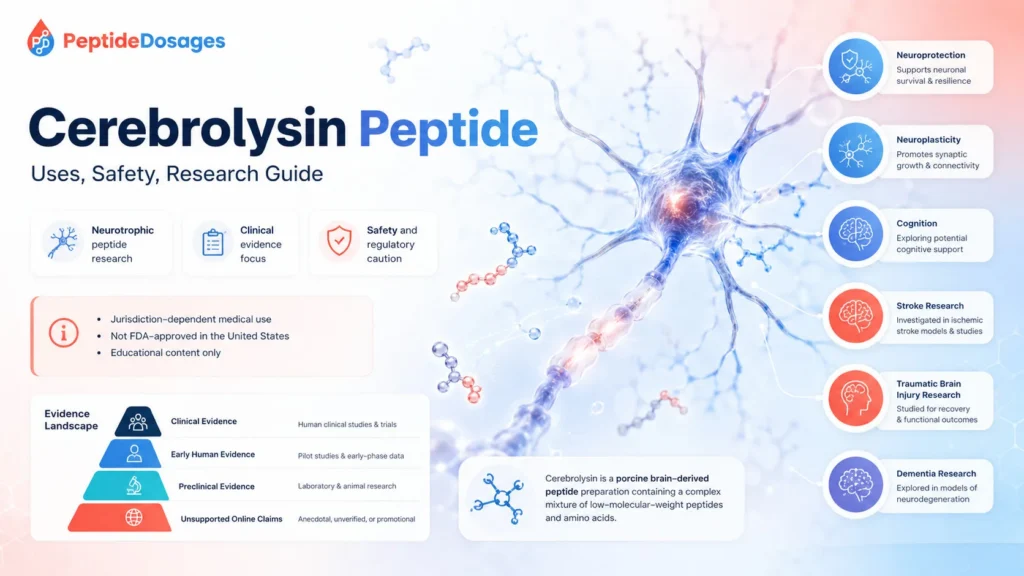
Cerebrolysin Peptide is best understood as a porcine brain-derived peptide preparation rather than a single synthetic peptide sequence; FDA’s UNII database lists Cerebrolysin as a named substance, while product labeling describes it as a solution for injection containing Cerebrolysin concentrate 1, 2. This educational article reviews how Cerebrolysin is described in research, what clinical studies have examined, and where safety, dosage, and regulatory questions remain. It does not provide personal medical advice, dosing instructions, injection instructions, or a recommendation to use cerebrolysin.
- Cerebrolysin is a mixture of low-molecular-weight peptides and amino acids derived from porcine brain, and it is discussed in neurological research for stroke, dementia, and brain injury contexts 3.
- Public labeling outside the United States lists cerebrovascular disorders, Alzheimer’s-type senile dementia, vascular dementia, stroke, and craniocerebral trauma as indications, but labeling differs by jurisdiction [2].
- In the United States, FDA records include an orphan designation entry for a “peptide fraction derived from porcine brain protein” that is not FDA-approved for that orphan indication 4.
- Human evidence is mixed: some trials and meta-analyses report neurological or functional signals, while Cochrane reviewers found no clear mortality benefit in acute ischemic stroke and raised concern about non-fatal serious adverse events [3].
- Dosage information in this article is limited to labeling or study contexts and should not be interpreted as personal dosing advice [2].
- Safety discussions should include adverse effects, hypersensitivity, epilepsy or seizure history, severe renal impairment, pregnancy or breastfeeding questions, and regulatory status [2].
Related dosage pages: For vial-specific concentration, reconstitution, and measurement examples, see Cerebrolysin (60 mg Vial) Dosage Protocol. Each linked protocol remains a separate reference because vial strength changes concentration and syringe-unit calculations.
Fast Answer
Cerebrolysin peptide is a porcine brain-derived mixture of peptide fragments and amino acids studied mainly in neurological conditions such as ischemic stroke, traumatic brain injury, vascular dementia, and Alzheimer’s disease [3]. It is not a simple single-sequence peptide, and evidence quality varies by condition. Some studies report potential neurorecovery or cognitive signals, but systematic reviews are mixed and regulatory status differs by country [2], [3]. Safety, dosage, and administration should be interpreted only through labeling, clinical trials, and clinician-guided care.
What Is the Cerebrolysin Peptide?
Cerebrolysin is often searched as a “peptide,” but the more accurate description is a porcine brain-derived peptide preparation. The FDA UNII record identifies Cerebrolysin as a named substance and lists synonyms, while Cochrane describes it as a mixture of low-molecular-weight peptides and amino acids derived from porcine brain [1], [3].
What Is in a Porcine Brain-Derived Peptide Preparation?
The product monograph describes Cerebrolysin as a solution for injection in which one milliliter contains 215.2 mg of Cerebrolysin concentrate in aqueous solution, with sodium hydroxide and water for injection listed as excipients [2]. Cochrane’s acute ischemic stroke review describes the preparation as low-molecular-weight peptides and amino acids from porcine brain [3].
How Does Cerebrolysin Differ From a Single Neuropeptide?
A single neuropeptide usually refers to one defined peptide molecule or sequence, while Cerebrolysin is a biological mixture. A dementia review describes Cerebrolysin as a parenterally administered, porcine brain-derived peptide preparation with pharmacodynamic properties similar to endogenous neurotrophic factors 7.
Why Is Cerebrolysin Discussed in Neurological Conditions?
Cerebrolysin is discussed because neurological conditions involve damaged neurons, disrupted networks, and impaired recovery pathways. NINDS describes neurons as the primary functional units of the nervous system, and research on Cerebrolysin focuses on whether neurotrophic-factor-like activity could influence recovery after injury or disease 16, [7].
What Should Readers Know First About Cerebrolysin?
The most important first point is that Cerebrolysin research should be separated by condition, evidence level, dosage context, and regulatory status. Evidence in acute ischemic stroke, vascular dementia, Alzheimer’s disease, and traumatic brain injury does not support one broad claim that applies to all patients [3], [7].
Which Benefits, Uses, Safety Issues, and Evidence Matter Most?
The strongest practical questions are whether a claim is supported by approved labeling in a specific country, by randomized trials, by systematic review evidence, or only by mechanism and online reports. Cochrane’s acute ischemic stroke review found seven studies with 1,773 participants and concluded that Cerebrolysin probably does not reduce all-cause death after acute ischemic stroke [3].
How Does Cerebrolysin Work?
Cerebrolysin is usually described as multimodal because research discusses neurotrophic-factor-like, neuroprotective, metabolic, and neuroplasticity-related effects. These proposed mechanisms are not the same as proof of clinical benefit.
What Is the Proposed Mechanism of Action in Neurons?
The proposed mechanism of action centers on neurotrophic-factor-like support for neurons and synaptic recovery. Reviews describe BDNF as important for neuronal survival, growth, and synaptic plasticity, which helps explain why researchers study neurotrophic pathways in brain injury and neurodegenerative contexts 17.
Which Neurotrophic Factors Are Relevant to BDNF, NGF, and GDNF?
BDNF, nerve growth factor, and glial cell line-derived neurotrophic factor are relevant because they are well-studied survival and plasticity signals in neuroscience. NGF was originally characterized for growth and survival effects in sensory and sympathetic neurons, while GDNF was first characterized as a survival-promoting factor for dopaminergic neurons 18, 19.
How Might Sonic Hedgehog, Neuroplasticity, and Neurogenesis Pathways Fit?
The Cerebrolysin product monograph describes modification of neurotrophic-factor and sonic hedgehog signaling pathways as part of its proposed pharmacology [2]. This is a mechanistic claim, not a guarantee that neuroplasticity or neurogenesis outcomes will occur in a person.
Why Mechanism Does Not Prove Clinical Benefit
Mechanistic plausibility can help explain why a compound is studied, but clinical benefit must be tested in humans. Cochrane’s stroke review illustrates this gap: despite proposed neuroprotective properties, pooled evidence did not show a reduction in death after acute ischemic stroke [3].
What Is Cerebrolysin Used For or Studied For?
Cerebrolysin has been studied in acute ischemic stroke, stroke rehabilitation, traumatic brain injury, Alzheimer’s disease, vascular dementia, and other neurological disorders. Product labeling in some jurisdictions lists cerebrovascular disorders, Alzheimer’s-type senile dementia, vascular dementia, stroke, and craniocerebral trauma, but that does not mean the same uses are approved everywhere [2].
Where Has Use of Cerebrolysin Been Studied in Stroke?
Stroke research includes large randomized controlled trials and meta-analyses. The CASTA trial tested Cerebrolysin in acute ischemic stroke in Asia, while a later meta-analysis pooled nine ischemic stroke trials to evaluate early global neurological improvement 9, 10.
What Have Studies Examined in Traumatic Brain Injury?
Traumatic brain injury studies have evaluated functional, neuropsychological, and recovery outcomes. A prospective meta-analysis of the CAPTAIN trial series reported a small-to-medium effect favoring Cerebrolysin at days 30 and 90 in moderate-to-severe traumatic brain injury, while also stating that guideline integration would require careful review 11.
How Is Cerebrolysin Studied in Vascular Dementia, Alzheimer’s Disease, and Cognitive Impairment?
Dementia research includes randomized trials and systematic reviews, but evidence quality varies. Cochrane’s vascular dementia review states that the supporting evidence base remains weak and that adequately powered, methodologically robust trials are needed 13.
Potential Benefits of Cerebrolysin Peptide
Potential benefits should be framed by evidence level. The phrase “effect of Cerebrolysin” should mean “reported effect in a defined study,” not a general promise.
What Outcomes Relate to Cognitive Function and Cognitive Decline?
In Alzheimer’s disease, one randomized, double-blind, placebo-controlled trial used 30 mL intravenously five days per week for four weeks and reported a significant CIBIC+ difference at week 12, but this does not establish Cerebrolysin as a standard Alzheimer’s treatment 14. NICE guidance instead discusses acetylcholinesterase inhibitors and memantine as recommended medication options in defined Alzheimer’s disease contexts 21.
How Might Neuroprotection, Brain Cells, and Functional Recovery Connect?
The neuroprotection hypothesis relates to reducing injury cascades and supporting brain cells after ischemia, trauma, or neurodegenerative stress. In a primary cortical neuron culture model, Cerebrolysin reduced glutamate-mediated neuronal damage markers, but cell-culture findings cannot prove human clinical benefit 20.
What Does Human Research Say About Cerebrolysin?
Human research is not uniform. Stroke, traumatic brain injury, Alzheimer’s disease, and vascular dementia studies differ in patient selection, endpoints, timing, dose, route, and background standard care [3], [11], [13].
How Do Randomized Controlled Trials and Placebo Comparisons Inform Evidence?
Randomized controlled trials help reduce bias by comparing Cerebrolysin against placebo or standard care, but trial design quality still matters. ClinicalTrials.gov lists NCT00868283 as an acute ischemic stroke study evaluating a 10-day course of daily 30 mL intravenous Cerebrolysin versus placebo 15.
What Do Systematic Review and Meta-Analysis Findings Show?
Systematic reviews do not all emphasize the same outcomes. The 2023 Cochrane stroke update found no reduction in all-cause death and reported that non-fatal serious adverse events were probably increased, while a 2021 safety meta-analysis of 12 randomized controlled trials found no statistically significant difference in overall adverse events or serious adverse events [3], 8.
Where Are Clinical Trial Results Stronger or Weaker?
Evidence is stronger when trials are randomized, blinded, adequately powered, and independently replicated. It is weaker when outcomes are exploratory, follow-up is short, sponsorship may influence reporting, or trials use different endpoints that are difficult to pool [3].
| Evidence Area | What Has Been Studied | Evidence Level | What It Can and Cannot Show |
|---|---|---|---|
| Acute ischemic stroke | Cerebrolysin added to standard therapy in RCTs and reviews [3], [9] | Clinical evidence, mixed | Can assess mortality, serious adverse events, and neurological scales; does not prove routine benefit for all stroke patients. |
| Stroke recovery | Early neurological improvement and motor recovery in meta-analyses [10] | Clinical evidence | Suggests possible recovery signals; endpoints and trial selection affect conclusions. |
| Traumatic brain injury | CAPTAIN trial series and systematic reviews [11], 12 | Early-to-clinical human evidence | May suggest functional recovery signals; guideline adoption remains uncertain. |
| Vascular dementia | Cochrane review of RCTs [13] | Clinical evidence with weak certainty | May suggest cognitive or global-function signals; evidence remains insufficient for routine conclusions. |
| Mechanism and excitotoxicity | Neuronal cell models and neurotrophic hypotheses [17], [20] | Preclinical | Can explain biological plausibility; cannot establish human outcomes. |
What Does Preclinical Evidence Suggest About Cerebrolysin?
Preclinical evidence helps explain why researchers study Cerebrolysin, but it is not enough to establish treatment effectiveness. Animal and cell models simplify disease biology and do not capture the full complexity of stroke, dementia, or traumatic brain injury in patients.
Animal Models of Ischemic Stroke and Brain Injury
Animal models have been used to explore recovery signals after ischemia or trauma, but translation from animal models to clinical outcomes is often uncertain. Human stroke reviews remain necessary because proposed neuroprotection has not consistently translated into mortality or disability benefits across trials [3].
Neuronal Cell Models and Endogenous Repair Signals
Cell models are useful for studying excitotoxicity, oxidative stress, and inflammatory signaling. The glutamate-exposure study in primary cortical neurons suggested reduced glutamate-related neuronal damage with Cerebrolysin treatment, but the authors’ cell-culture findings should be treated as mechanistic, not clinical [20].
Evidence Limitations and Unsupported Online Claims
Online peptide therapy claims often compress all evidence into broad promises about brain health, cognition, or recovery. A medically responsible review separates approved-label contexts, published clinical evidence, early human signals, preclinical hypotheses, and unsupported claims.
Why the Efficacy of Cerebrolysin Remains Condition-Specific
The efficacy of Cerebrolysin cannot be summarized as one universal conclusion because acute ischemic stroke, vascular dementia, Alzheimer’s disease, and traumatic brain injury have different biology and endpoints. Cochrane’s stroke and vascular dementia reviews reach cautious conclusions and call for better evidence rather than broad routine-use claims [3], [13].
How Online Peptide Therapy Claims Can Overreach
Claims that Cerebrolysin universally improves memory, reverses cognitive decline, or guarantees neuroprotection go beyond the evidence. Published reviews include both promising and negative or uncertain findings, so claims should be tied to study design and condition [3], [7].
What Remains Unknown About Long-Term Outcomes
Long-term safety, durability of response, and independent replication remain important gaps. The 2021 safety meta-analysis noted that more randomized trials with longer follow-up and mixed or repeated treatment cycles would help clarify the safety profile [8].
Side Effects and Adverse Effects Reported With Cerebrolysin
Side effects should be interpreted through trials, reviews, and labeling, not marketing claims. In dementia trials, Plosker reported that Cerebrolysin was generally well tolerated, with dizziness or vertigo the most frequently reported adverse event [7].
Common Adverse Events Described in Clinical Studies
In the Alzheimer’s disease trial by Panisset and colleagues, adverse events were recorded in 73% of placebo patients and 64% of Cerebrolysin patients, with common events including headache, dizziness, weight loss, and anxiety [14]. Cochrane’s vascular dementia review also reported non-serious adverse events such as headache, asthenia, dizziness, hypertension, and hypotension [13].
Hypersensitivity, Allergy, and Anaphylaxis Concerns
Labeling lists hypersensitivity to one of the product components as a contraindication [2]. A 2024 case report described a severe, well-documented anaphylactic reaction after intravenous Cerebrolysin administration, which supports treating allergy risk as clinically important even if such reports are rare 24.
Serious Adverse Events and Mortality Outcomes
Cochrane’s acute ischemic stroke review found no clear mortality reduction and reported that non-fatal serious adverse events were probably higher with Cerebrolysin plus standard therapy than with standard therapy alone or placebo [3]. A separate 2021 safety meta-analysis pooled 2,202 patients and found no statistically significant difference in overall serious adverse events, illustrating how review methods can affect interpretation [8].
Safety Profile, Contraindications, and Medical Cautions
Safety depends on the patient group, setting, product quality, route, comorbidities, and concurrent medications. The abbreviated product information lists hypersensitivity, epilepsy, and severe renal impairment as contraindications [2].
Severe Renal Impairment and Other Label-Based Cautions
Severe renal impairment is listed as a contraindication in the abbreviated prescribing information [2]. This is a high-risk medical issue because peptide and protein-derived preparations may be used in medically complex patients, and kidney disease can affect drug-safety decisions.
Pregnancy, Breastfeeding, Seizure, and Epilepsy Considerations
The abbreviated prescribing information lists epilepsy as a contraindication and points readers to local product information for fertility, pregnancy, and lactation details [2]. Pregnancy, breastfeeding, seizure history, and epilepsy should therefore be handled as clinician-review issues rather than self-treatment considerations.
Drug Interactions and Healthcare Professional Review
The public abbreviated product information states that more information on interactions with other medicinal products is available in the full summary of product characteristics [2]. Because accessible interaction data are limited, a healthcare professional should review current medications, neurological history, allergy history, and local labeling before any medical decision.
What Dosage Information Exists for Cerebrolysin?
Dosage information should be read as label or study context only. Study doses should not be interpreted as personal dosing advice.
Dosage Used in Approved Labels or Clinical Studies
The product monograph lists daily dosage ranges of 20–50 mL for stroke, 20–50 mL for traumatic brain injury, and 10–30 mL for Alzheimer’s disease or vascular dementia in its dosing table, with durations varying by condition [2]. NCT00868283 evaluated 30 mL daily by intravenous infusion for 10 consecutive days in acute ischemic stroke [15].
| Context | Dosage Information Reported | Interpretation |
|---|---|---|
| Stroke labeling context | 20–50 mL daily for 10–21 days [2] | Label context in jurisdictions where applicable; not personal advice. |
| TBI labeling context | 20–50 mL daily for 7–30 days [2] | Label context only; medical setting matters. |
| Alzheimer’s disease labeling context | 10–30 mL, five days weekly for four weeks, with repeated cycles described [2] | Should be interpreted through local prescribing information. |
| Acute ischemic stroke trial | 30 mL daily IV for 10 days in NCT00868283 [15] | Clinical-trial context, not a protocol for readers. |
How Study Doses Differ From Personal Medical Advice
A study dose is chosen for a research population under protocol-defined monitoring. It should not be converted into self-use instructions because patient selection, comorbidities, local approval status, route, sterility, and monitoring change the risk-benefit analysis [2], [15].
What Administration Routes Are Discussed in the Literature?
Administration routes are discussed here only to explain how studies and labeling should be interpreted. This article does not provide injection, mixing, reconstitution, or self-administration instructions.
Intravenous Therapy and Intramuscular Injection Context
The product monograph describes slow intravenous infusion for larger doses and also references intramuscular or direct intravenous injection limits in labeling context [2]. These are medical-administration details and should not be treated as procedural guidance.
Regulatory Status: Is Cerebrolysin FDA-Approved?
No FDA-approved Cerebrolysin product was identified in the official FDA materials reviewed for this article. FDA’s orphan database lists a “peptide fraction derived from porcine brain protein” for frontotemporal dementia as “Not FDA Approved for Orphan Indication,” and an FDA compounding warning letter stated that Cerebrolysin was not a component of an FDA-approved human drug and did not appear on the 503A bulks list [4], 6.
Use in the United States Versus Europe and Asia
Cochrane describes Cerebrolysin as widely used in Russia, Eastern Europe, China, and other Asian and post-Soviet countries for acute ischemic stroke [3]. In the United States, FDA explains that importing drugs that have not been approved for use and sale in the U.S. is illegal in most circumstances, and the agency cannot ensure the safety and effectiveness of medicines purchased from foreign sources 5.
Why Approval Status Affects Safety and Product Quality
Regulatory status matters because approved products are evaluated for specific indications, labeling, manufacturing quality, dosage, and safety information. FDA’s compounding warning letter specifically highlighted that certain compounded products using Cerebrolysin did not qualify for statutory compounding exemptions from FDA approval, adequate directions for use, and CGMP requirements [6].
How Cerebrolysin Compares With Related Neurorecovery Therapies
Cerebrolysin should be compared with established care based on evidence level, not as a “best peptide” claim. Stroke, dementia, and traumatic brain injury care already involve condition-specific medical systems, rehabilitation, and approved or guideline-supported therapies [21], 22, 23.
Cerebrolysin, Standard Rehabilitation, and Approved Neurological Treatments
For Alzheimer’s disease, NICE recommends donepezil, galantamine, and rivastigmine as options for mild-to-moderate Alzheimer’s disease and memantine for defined moderate or severe contexts [21]. For stroke recovery, AHA/ASA emphasizes early involvement of physical therapy, occupational therapy, speech-language pathology, and rehabilitation specialists based on patient needs [22]. For severe traumatic brain injury, Brain Trauma Foundation guidelines focus on evidence-based neurocritical care topics rather than peptide therapy [23].
What Should Readers Discuss With a Clinician?
Readers considering any peptide-related medical decision should discuss evidence quality, regulatory status, diagnosis, approved alternatives, safety, and monitoring with a licensed clinician. The safest interpretation of Cerebrolysin peptide is through condition-specific evidence, country-specific labeling, and medical supervision.
Questions About Diagnosis, Treatment Goals, Risk, and Evidence
A practical clinician discussion checklist may include:
- What condition is being discussed: acute ischemic stroke, traumatic brain injury, Alzheimer’s disease, vascular dementia, or another neurological disorder?
- Is Cerebrolysin approved or labeled for this use in the relevant country, and is there a local summary of product characteristics?
- What evidence level supports the proposed use: approved labeling, randomized trial, systematic review, preclinical research, or anecdotal claim?
- Are there contraindications such as hypersensitivity, epilepsy, or severe renal impairment [2]?
- Are pregnancy, breastfeeding, seizure history, allergy history, or current medications relevant [2], [24]?
- Are there approved treatments or rehabilitation options that should be prioritized or compared [21], [22], [23]?
- How would adverse events be monitored, documented, and managed in a medical setting?
The strongest conclusions come from approved labeling and well-designed human studies; weaker claims should be treated cautiously. Readers considering peptide-related medical decisions should discuss evidence, risks, alternatives, and regulatory status with a qualified healthcare professional.
Related dosage protocols and research
Use the available links to move between research context, dosage pages or comparisons, and supporting guides. When vial-size variants exist, they remain separate because concentration and syringe-unit calculations change with vial strength. Comparisons do not imply that different compounds are interchangeable.
Matching dosage protocols
Further research context
REFERENCES
- U.S. Food and Drug Administration. UNII Search Service: Cerebrolysin, 37KZM6S21G. FDA Global Substance Registration System. 2026.
- Austrian Federal Office for Safety in Health Care (BASG). Cerebrolysin: Austrian Summary of Product Characteristics (March 2021). Official Austrian product information. 2021.
- Cochrane. Cerebrolysin for acute ischaemic stroke. Cochrane evidence summary. 2023.
- U.S. Food and Drug Administration. Search Orphan Drug Designations and Approvals: peptide fraction derived from porcine brain protein. FDA Orphan Drug Designations and Approvals Database. 2016 entry.
- U.S. Food and Drug Administration. Personal Importation. FDA Import Basics. Updated 2025.
- U.S. Food and Drug Administration. Tailor Made Compounding LLC Warning Letter. FDA Warning Letter 594743. 2020.
- Plosker GL, Gauthier S. Cerebrolysin: a review of its use in dementia. Drugs & Aging. 2009. PMID: 19848437.
- Strilciuc S, Vécsei L, Boering D, et al. Safety of Cerebrolysin for Neurorecovery after Acute Ischemic Stroke: A Systematic Review and Meta-Analysis of Twelve Randomized-Controlled Trials. Pharmaceuticals. 2021. DOI: 10.3390/ph14121297.
- Heiss WD, Brainin M, Bornstein NM, Tuomilehto J, Hong Z; CASTA Investigators. Cerebrolysin in patients with acute ischemic stroke in Asia: results of a double-blind, placebo-controlled randomized trial. Stroke. 2012. DOI: 10.1161/STROKEAHA.111.628537.
- Bornstein NM, Guekht A, Vester J, et al. Safety and efficacy of Cerebrolysin in early post-stroke recovery: a meta-analysis of nine randomized clinical trials. Neurological Sciences. 2018. PMID: 29248999.
- Vester JC, Buzoianu AD, Florian SI, Hömberg V, Kim SH, et al. Cerebrolysin after moderate to severe traumatic brain injury: prospective meta-analysis of the CAPTAIN trial series. Neurological Sciences. 2021. PMID: 33620612.
- Jarosz K, et al. Cerebrolysin in Patients with TBI: Systematic Review and Meta-Analysis. Peer-reviewed systematic review in PMC. 2023.
- Cochrane. Cerebrolysin for vascular dementia. Cochrane evidence summary. 2019.
- Panisset M, Gauthier S, Moessler H, Windisch M. Cerebrolysin in Alzheimer’s disease: a randomized, double-blind, placebo-controlled trial with a neurotrophic agent. Journal of Neural Transmission. 2002. PMID: 12111446.
- ClinicalTrials.gov. The Safety and Efficacy of Cerebrolysin in Patients With Acute Ischemic Stroke. NCT00868283.
- National Institute of Neurological Disorders and Stroke. Brain Basics: Know Your Brain. NINDS. Updated 2025.
- Bathina S, Das UN. Brain-derived neurotrophic factor and its clinical implications. Archives of Medical Science. 2015.
- Aloe L, Rocco ML, Bianchi P, Manni L. Nerve Growth Factor: A Focus on Neuroscience and Therapy. Current Neuropharmacology. 2015.
- Cortés D, Carballo-Molina OA, Castellanos-Montiel MJ, Velasco I. The Non-Survival Effects of Glial Cell Line-Derived Neurotrophic Factor on Neural Cells. Frontiers in Molecular Neuroscience. 2017.
- Avci S, et al. Cerebrolysin Alleviating Effect on Glutamate-Mediated Neurotoxicity in Primary Cortex Neuron Culture. PubMed-indexed preclinical study. 2022. PMID: 36333611.
- National Institute for Health and Care Excellence. Donepezil, galantamine, rivastigmine and memantine for the treatment of Alzheimer’s disease. NICE Technology Appraisal TA217. Updated 2018.
- American Heart Association. Improving Access to Stroke Rehabilitation and Recovery: Top Things to Know. AHA/ASA policy statement summary. 2025.
- Brain Trauma Foundation. Guidelines for the Management of Severe TBI, 4th Edition. Brain Trauma Foundation Guidelines. 2016.
- Trimmel H, Tauber W, Zikeli M. Life-Threatening Anaphylaxis due to Cerebrolysin. Case Reports in Neurological Medicine. 2024. PMID: 39055722.
FAQs
What does Cerebrolysin contain?
Cerebrolysin contains a porcine brain-derived mixture rather than one single peptide sequence. Published descriptions and labeling describe peptides in Cerebrolysin along with amino acids, while Cochrane describes it as low-molecular-weight peptides and free amino acids from porcine brain [2], [3]. This is why Cerebrolysin peptide is often discussed differently from a defined synthetic neuropeptide or a peptide supplement.
What is Cerebrolysin peptide used for?
Cerebrolysin peptide has been studied or labeled in some jurisdictions for neurological and cerebrovascular disease contexts, including stroke, traumatic brain injury, Alzheimer’s disease, and vascular dementia [2], [3], [11], [13]. Clinical use depends on country-specific approval, local labeling, diagnosis, and clinician judgment. Evidence quality varies by condition, so studied uses should not be interpreted as a general recommendation for personal use.
What does research say about Cerebrolysin and motor function?
Research on Cerebrolysin and motor function is condition-specific and should be read as clinical evidence, not a guaranteed outcome. Stroke recovery meta-analyses have evaluated neurological or functional recovery signals, while traumatic brain injury studies have examined functional outcomes in moderate-to-severe injury contexts [10], [11]. These findings do not prove broad brain health benefits for all users or all neurological conditions.
What side effects or allergic reaction risks should readers know about?
Side effects and adverse reactions reported with Cerebrolysin include events such as dizziness, headache, asthenia, blood pressure changes, and anxiety in some clinical contexts [13], [14]. Labeling lists hypersensitivity as a contraindication, and a published case report described life-threatening anaphylaxis after intravenous Cerebrolysin [2], [24]. Any allergic reaction risk should be discussed with a qualified healthcare professional.
What dosage and route of administration information exists?
Dosage information for Cerebrolysin should come from product labeling or published studies, not self-use protocols. The product monograph lists condition-specific dosing ranges, while an acute ischemic stroke trial studied 30 mL daily by intravenous infusion for 10 days [2], [15]. Route of administration is a medical-context issue, and study dosing should not be interpreted as personal medical advice.
Is Cerebrolysin FDA-approved or legal in the United States?
Cerebrolysin is not identified in the reviewed FDA materials as an FDA-approved prescription drug for U.S. use. FDA records list a porcine brain protein-derived peptide fraction for an orphan indication as not FDA-approved, and FDA has raised concerns about compounded products using Cerebrolysin [4], [6]. Legal status and off-label use questions should be handled through regulatory sources and licensed medical guidance.
Researchers Cited in This Article
The researchers below authored or co-authored publications cited in this article. Listing them here identifies sources; it does not mean they wrote, independently reviewed, sponsored, or endorsed this PeptideDosages.com article. The site author is identified in the article byline.
Natan M. Bornstein
Researcher profile: ORCID
Natan M. Bornstein’s Cerebrolysin-related publications are relevant to the clinical evidence base discussed in this article, especially the stroke literature. His work appears in published analyses of randomized trials and observational clinical research involving Cerebrolysin in ischemic stroke and post-stroke recovery. These publications help frame how readers should interpret study design, effect measures, safety findings, and evidence limitations in Cerebrolysin peptide research. They are useful for understanding why clinical findings should be evaluated by endpoint, patient population, timing, comparator, and methodology rather than treated as broad claims about neurological benefit.
Selected publications:
- Safety and efficacy of Cerebrolysin in early post-stroke recovery: a meta-analysis of nine randomized clinical trials — Neurological Sciences, 2018. DOI: 10.1007/s10072-017-3214-0; PMID: 29248999.
- Cerebrolysin in patients with acute ischemic stroke in Asia: results of a double-blind, placebo-controlled randomized trial — Stroke, 2012. DOI: 10.1161/STROKEAHA.111.628537; PMID: 22282884.
Serge Gauthier
Researcher profile: McGill University Profile
Serge Gauthier’s published work is relevant to the dementia and cognitive-impairment context reviewed in this article. His Cerebrolysin publications help situate the compound within Alzheimer’s disease research, including randomized clinical trial evidence and later meta-analysis methods. This literature is useful for interpreting pharmacodynamic rationale, clinical endpoints, placebo comparison, and the limits of drawing treatment conclusions from condition-specific studies. His work also supports the article’s emphasis on separating study-context evidence from generalized claims about cognition, brain health, or therapeutic use.
Selected publications:
- Cerebrolysin in Mild-to-Moderate Alzheimer’s Disease: A Meta-Analysis of Randomized Controlled Clinical Trials — Dementia and Geriatric Cognitive Disorders, 2015. DOI: 10.1159/000377672; PMID: 25832905.
- Cerebrolysin in Alzheimer’s disease: a randomized, double-blind, placebo-controlled trial with a neurotrophic agent — Journal of Neural Transmission, 2002. DOI: 10.1007/s007020200092; PMID: 12111446.