

Livagen is a synthetic four-amino-acid peptide studied mainly in laboratory models of chromatin, protein synthesis and digestive-enzyme activity. It is often described as a liver peptide, but that label is not evidence that it treats fatty liver, hepatitis or age-related liver disease.
Some Livagen experiments used cells from older people outside the body. They didn’t give Livagen to older adults and demonstrate a health benefit. That distinction is easy to miss in online benefit lists.
Related reference: The Livagen 20 mg vial page provides separate measurement context. Concentration arithmetic does not establish an effective or safe human treatment.
What is Livagen peptide?
Published studies identify Livagen as Lys-Glu-Asp-Ala, abbreviated KEDA: lysine, glutamic acid, aspartic acid and alanine. It belongs to the short-peptide “bioregulator” research program associated with Vladimir Khavinson and collaborators. [1][2]
Its liver connection comes partly from how it was designed: investigators used information from liver polypeptide preparations to develop the synthetic sequence. The resulting defined peptide should not be treated as identical to a whole liver extract or another organ-associated peptide. [1]
What has actually been studied?
| Research area | What investigators observed | What it does not establish |
|---|---|---|
| Rat liver cells | Changes in protein-synthesis activity in cultured hepatocytes. [1] | Recovery from liver disease in patients. |
| Human lymphocytes in culture | Changes in chromatin organization and ribosomal-gene activity. [2][3] | Reversal of aging in a person. |
| Digestive-enzyme experiments | Age-dependent enzyme changes in rats and laboratory assays. [4] | A treatment for human gastrointestinal symptoms. |
| Patent example involving hepatitis | A small patient report within an invention document. [5] | Independent confirmation of clinical effectiveness. |
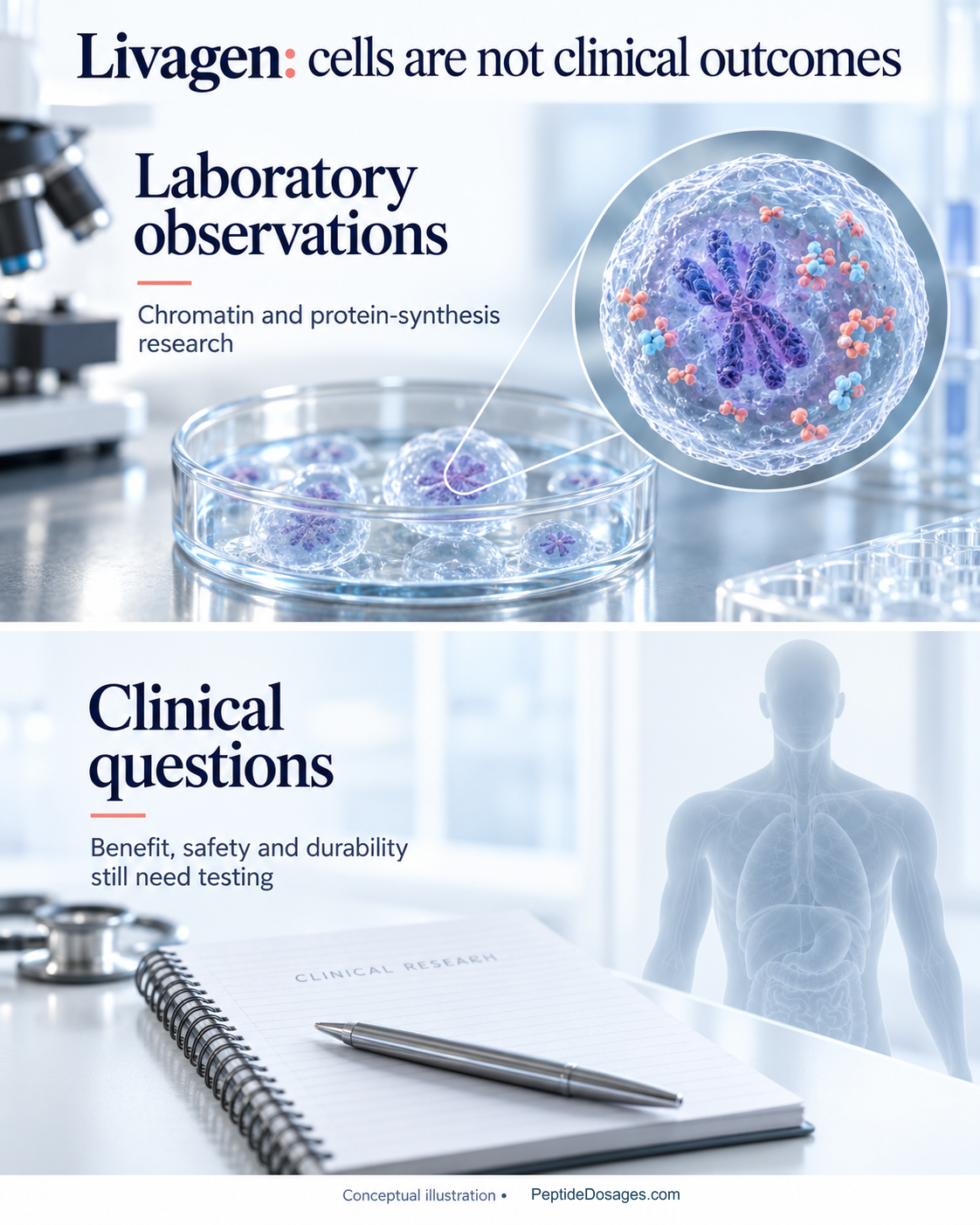
Chromatin and gene expression, in plain language
Chromatin is DNA packaged with proteins inside a cell. Packaging affects how accessible parts of the DNA are to the cell’s machinery. Researchers use “decondensation” to describe less tightly packed chromatin; the term does not mean that damaged genes have been repaired or that biological age has been reset.
A 2002 experiment exposed lymphocytes from older donors to Livagen and reported chromatin changes alongside activation of ribosomal genes. A 2023 paper examined Livagen and several other short peptides in cultured lymphocytes from people aged 75–88, again reporting selective changes in chromosome regions. [2][3]
These findings help frame questions about cellular regulation. They do not tell us whether a product reaches the same cells after oral or injected use, how long any effect lasts, or whether a person feels or functions better. Gene activity is an experimental endpoint, not a synonym for better health.
Does Livagen improve liver function?
The 2001 hepatocyte study used liver cells from rats of different ages. Livagen increased protein synthesis, with the largest effect reported in cells from older animals. This was a cell-culture experiment, not a human trial showing reduced liver scarring, fewer complications or improved survival. [1]
There is also an early Russian patent that describes 23 patients with chronic persistent hepatitis and a comparison group of 12 patients receiving conventional treatment. It reports changes in symptoms and laboratory markers. However, the example does not describe the randomization and blinding needed to interpret it as a robust controlled trial. A patent records an inventor’s claims; it is not regulatory approval or independent clinical validation. [5]
It would therefore be inaccurate to say that no human use has ever been described. It would be equally inaccurate to present Livagen as an established treatment for liver disease. The evidence reviewed here does not support that conclusion.
What about digestion and the gastrointestinal tract?
A 2005 study found that two weeks of oral Livagen changed digestive-enzyme activity differently in young and old rats: activity decreased in younger animals and increased in older animals. The paper also reported an enzyme-inhibition result in a laboratory assay. [4]
That age-dependent pattern is more informative than a blanket claim that Livagen “boosts digestion.” It also shows why a biochemical result should not be converted into a promise about bloating, nutrient absorption or gastrointestinal disease in people.
Side effects and safety uncertainties
The available studies do not provide a reliable human side-effect rate, a long-term safety profile or a well-characterized list of medication interactions. A lack of reported problems in a small experiment does not establish that a product is harmless.
The same gap applies to pregnancy, breastfeeding, children and people with serious liver or kidney disease. A short amino-acid sequence is not inherently safe simply because the body uses amino acids.
For someone with abnormal liver tests, trying an unproven product can also distract from identifying the cause. Liver disorders can involve viral infection, alcohol, metabolic conditions, medicines or other problems. Medical evaluation should come before choosing a purported liver-support peptide. [6]
Dosage, reconstitution and research-product claims
There is no clinically validated general Livagen regimen established by the studies discussed here. Laboratory concentrations, animal schedules and patent examples answer different questions and should not be translated into a personal dosing plan.
Reconstitution changes how much material is present per volume. It cannot resolve whether the material is appropriate for a person, whether the claimed identity is correct, or whether the proposed use has meaningful evidence.
If a page advertises a “standard cycle,” look for a study of the same compound, formulation, route and population. A schedule repeated across sellers is not independent confirmation.
Questions worth taking to a clinician
- What is causing the abnormal test or symptom?
- Do I need additional blood tests, imaging or assessment for liver scarring?
- Could medicines, supplements or alcohol be contributing?
- Which treatments have evidence for my actual diagnosis?
NIDDK explains that liver assessment combines medical history with appropriate testing. An elevated ALT or AST is a reason to investigate, not a diagnosis that identifies one universal treatment. [7]
Common questions
Is Livagen an anti-aging peptide?
It is studied in aging-related laboratory research. That description does not establish longer lifespan, restored youthful organ function or a clinical anti-aging benefit.
Is Livagen the same as Ovagen?
No. Similar liver-related marketing does not make different peptides interchangeable. Evidence must match the exact compound, not just the organ named in a description.
What is the best peptide for liver health?
There is no evidence-based universal ranking that makes Livagen the answer. The relevant question is which care is supported for a particular diagnosis and person.
Livagen has laboratory findings about cellular regulation. A change in a dish doesn’t yet establish a dependable treatment benefit in a person.
Related Livagen dosage protocols
Continue with the vial-strength-specific research protocol that matches the material being evaluated. Each page keeps its own concentration, reconstitution, and syringe-unit calculations.
Practical measurement and handling guides
References
- Brodskii VIa, et al. Rhythm of protein synthesis in cultures of hepatocytes from rats of different ages: effect of Livagen. Izvestiia Akademii Nauk, Seriia Biologicheskaia. 2001.
- Khavinson VKh, et al. Effects of Livagen peptide on chromatin activation in lymphocytes from old people. Bulletin of Experimental Biology and Medicine. 2002.
- Lezhava T, et al. Epigenetic modification under the influence of peptide bioregulators on the “old” chromatin. Georgian Medical News. 2023.
- Timofeeva NM, et al. Effect of Livagen on digestive enzymes in rats of different ages. Advances in Gerontology. 2005.
- Khavinson VKh. Tetrapeptide stimulating functional activity of hepatocytes. Russian patent RU2166957C1, Example 7. 2001. Patent evidence, not a peer-reviewed clinical trial.
- National Institute of Diabetes and Digestive and Kidney Diseases. Liver disease.
- National Institute of Diabetes and Digestive and Kidney Diseases. Diagnosis of NAFLD and NASH, also termed MASLD and MASH.