
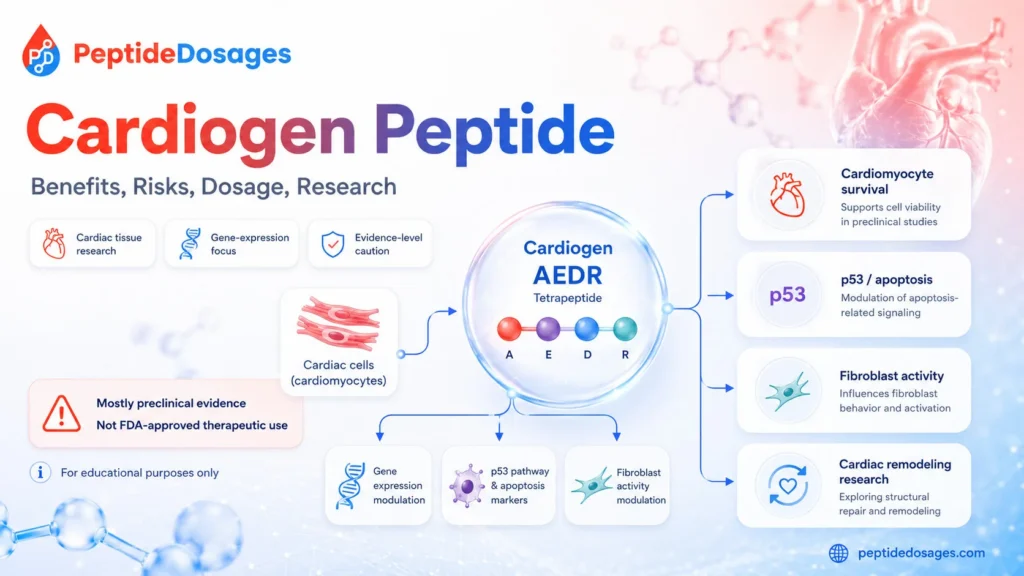
Cardiogen peptide is a synthetic short peptide, usually described in the literature as the tetrapeptide AEDR, that is discussed for cardiac and cardiovascular research rather than as an approved heart medication 1 2 15. This educational guide reviews what has been studied, how Cardiogen may work in cell and animal models, and why those findings should not be treated as proven human benefits [2] 3. It does not provide personalized medical advice, dosing instructions, injection guidance, or peptide purchasing information.
- Cardiogen is discussed as a short peptide bioregulator; peer-reviewed papers commonly identify the sequence as H-Ala-Glu-Asp-Arg-OH, or AEDR [2] 4.
- The main published Cardiogen peptide research involves preclinical myocardial tissue culture, fibroblast protein-expression models, and tumor-cell animal models rather than human cardiovascular outcomes [3] [4] 9.
- Potential benefits of Cardiogen peptide are evidence-sensitive; model findings about cardiomyocyte proliferation, apoptosis, and fibroblast activity do not prove improved heart function in people [3] [4].
- No FDA-approved Cardiogen peptide drug label or approved Cardiogen peptide dosage was identified in FDA drug approval sources during this review [15].
- Cardiogen peptide should not be confused with CardioGen-82, an FDA-approved rubidium Rb 82 generator used for PET myocardial perfusion imaging, which is a different radioactive diagnostic product 20.
- Safety, side effects, interactions, pregnancy considerations, and long-term risks for human Cardiogen peptide use remain poorly characterized; FDA peptide-drug guidance highlights the need to evaluate pharmacokinetics, drug interactions, QTc risk, and immunogenicity during peptide drug development 16.
Fast Answer
Cardiogen peptide is an evidence-limited synthetic tetrapeptide, commonly represented as AEDR, studied mainly in cardiac tissue, fibroblast, and tumor-cell research models [2] [3] [4]. People search for it because online sources connect it with cardiac tissue repair, cardiomyocyte survival, and cardiovascular health, but those claims rest mostly on preclinical data, not approved-label or robust human clinical evidence [3] [15]. No personal peptide use, dosing, or administration decision should be drawn from these studies; safety and regulatory status need clinician review [16] 17.
What Is the Cardiogen Peptide?
Cardiogen peptide is usually described in short-peptide literature as AEDR, a four-amino-acid peptide made from alanine, glutamic acid, aspartic acid, and arginine [2] [4]. The broader term “peptide” means a short chain of amino acids, but that definition alone does not establish a compound as a medicine, therapy, or approved treatment [1].
What Class of Peptide Is Cardiogen?
Cardiogen is discussed as a synthetic tetrapeptide and peptide bioregulator, a term used in a body of literature on short peptides that may influence gene expression or protein synthesis in experimental systems [2]. This category is different from approved peptide drugs, which require defined product quality, pharmacology, safety testing, clinical evidence, labeling, and regulatory review [16] [17].
What Is Its Amino Acid Sequence and Tetrapeptide Context?
The sequence most often linked to Cardiogen in peer-reviewed sources is H-Ala-Glu-Asp-Arg-OH, abbreviated AEDR [4]. “Tetrapeptide” simply means four amino acids; it does not imply therapeutic efficacy, predictable bioavailability, or an established receptor target [1] [16].
How Does Cardiogen Peptide Work?
The proposed mechanism of action for Cardiogen peptide is based on preclinical and mechanistic studies, not a validated human pharmacology model. The central hypothesis is that short peptides like AEDR may affect cellular function through gene expression, DNA- or chromatin-associated interactions, and protein-expression changes [2] 5 6.
What Is the Proposed Mechanism of Action in Cardiac Cells?
A rat organotypic myocardial tissue-culture study reported that Cardiogen exposure was associated with increased proliferation in tissues from young and old rats and reduced p53 protein expression by immunohistochemistry [3]. The authors interpreted the p53 finding as consistent with reduced apoptosis in myocardial tissue, but this was a tissue-culture result, not a clinical endpoint such as improved heart function, reduced myocardial infarction size, or lower mortality [3].
How Cardiogen Works in Cellular Gene Expression Models
Short-peptide literature proposes that some ultrashort peptides may interact with DNA, histones, or related nuclear processes that influence gene expression [2] [5] [6]. Separate work on peptide transport discusses POT and LAT carrier families as possible routes for some ultrashort peptide movement in tissues, but this should be read as a mechanistic hypothesis rather than confirmed human Cardiogen pharmacokinetics 7.
Why Mechanism Does Not Prove Clinical Benefit
A biologically plausible mechanism can help generate hypotheses, but it cannot replace human trials. For Cardiogen, the leap from p53 modulation, fibroblast protein changes, or tissue-culture proliferation to real-world cardiac outcomes remains unproven [3] [4] [16].
What Is Cardiogen Peptide Used For or Studied For?
Cardiogen peptide is studied mainly in preclinical contexts related to myocardial tissue culture, fibroblast protein expression, gene regulation, and tumor-cell models [3] [4] [9]. It should not be described as an approved therapy for cardiovascular disease, heart failure, cardiac remodeling, ischemia, or cancer based on the current evidence landscape 14 [15].
Cardiac Tissue Repair and Scar Formation Models
Interest in Cardiogen often centers on cardiac tissue repair and scar formation because heart injury can involve cardiomyocyte death, fibroblast activation, extracellular matrix deposition, and fibrosis 10. Cardiogen-related studies have examined cardiac tissue culture and fibroblast protein expression, but they have not shown that Cardiogen repairs scarred cardiac tissue in humans [3] [4].
Cardiovascular Health and Endothelial Research Context
The Cardiogen evidence base is much thinner than the evidence base for standard cardiovascular therapies. While short-peptide reviews discuss gene expression, cell stress, apoptosis, and related processes, those themes should not be converted into claims that Cardiogen improves cardiovascular health in people [2] [14].
Heart Failure, Ischemia, and Cardiac Remodeling Questions
Heart failure and ischemic heart disease are high-risk medical conditions that require evidence-based diagnosis and treatment. The 2022 AHA/ACC/HFSA heart failure guideline emphasizes guideline-directed medical therapy for heart failure, including established medication classes for reduced ejection fraction, while Cardiogen does not have comparable clinical evidence or approved labeling [14].
Potential Benefits of Cardiogen Peptide
The benefits of Cardiogen peptide are best framed as potential research signals, not established therapeutic outcomes. The most relevant findings involve cell proliferation, apoptosis markers, and protein-expression changes in preclinical models [3] [4].
Benefits of Cardiogen for Cardiomyocyte Survival: What Is Known?
The rat myocardial tissue-culture study is the main source behind claims that Cardiogen may reduce apoptosis in cardiac cells through lower p53 protein expression [3]. This is hypothesis-generating because p53 is involved in cell-cycle regulation and programmed cell death, but p53 biology in cardiovascular disease is complex and context-dependent 11 12 13.
Cardiogen Benefits for Fibroblast Activity and Tissue Repair
A cultured mouse embryonic fibroblast study reported that H-Ala-Glu-Asp-Arg-OH increased expression of cytoskeletal proteins such as actin, tubulin, and vimentin, along with nuclear matrix proteins lamin A and lamin C [4]. That finding may relate to cell structure, proliferation, and apoptosis hypotheses, but fibroblast-model data do not prove tissue repair in patients [4] [10].
Cardiovascular Benefits Claimed Online Versus Published Evidence
Online claims often describe Cardiogen as a heart health peptide, endothelial support compound, or cardiac remodeling tool. Published evidence supports a more cautious statement: Cardiogen has preclinical findings in myocardial tissue culture and cell models, while robust human cardiovascular outcome data have not been established [3] [4] [14].
What Does Human Research on Cardiogen Show?
Human evidence for Cardiogen as a therapeutic peptide appears very limited. One relevant paper used human prostate fibroblast aging cultures, but a cell culture derived from human tissue is not the same as a human clinical trial 8.
Are There Published Human Studies or Clinical Trials?
This review did not identify randomized human trials showing that Cardiogen peptide improves cardiac function, cardiovascular health, endothelial function, heart failure outcomes, or post-injury cardiac remodeling. The available peer-reviewed Cardiogen literature is concentrated in preclinical or cell-based work, so human efficacy, safety, dosing, and interactions remain uncertain [3] [4] [8] [9].
Preclinical Research Studies on Cardiogen
Preclinical research can identify mechanisms, signals, and research directions. It cannot establish that a peptide is safe or effective for general human use without well-designed clinical studies [16].
What Findings Come From Young and Old Rats?
In the organotypic myocardial tissue-culture study, researchers examined tissue from young and old rats and reported that tetrapeptide Cardiogen stimulated proliferation in both age groups [3]. Because the model was tissue culture, the result does not answer whether Cardiogen improves pumping function, exercise capacity, hospitalization risk, or survival in people [3] [14].
Cardiomyocyte, Fibroblast, and Cellular Proliferation Findings
The strongest preclinical signals involve myocardial tissue proliferation and fibroblast protein-expression changes [3] [4]. These findings fit the broader short-peptide research theme that some peptides may influence gene expression, cell differentiation, senescence, apoptosis, or cell stress, but the clinical meaning for Cardiogen remains unproven [2].
Tumor Cells and Context-Dependent Apoptosis Findings
A rat M-1 sarcoma study examined Cardiogen’s tumor-modifying effects in senescent rats and reported changes related to apoptosis in tumor cells [9]. This does not support using Cardiogen for cancer; tumor biology, p53 signaling, and apoptosis are highly context-dependent, and oncology-related findings require dedicated clinical testing before any therapeutic conclusion [9] [11].
Mechanism of Action: Cellular Pathways and Cardiac Remodeling
Cardiogen’s proposed mechanism of action should be separated from clinical claims. The available work points to gene expression, p53-associated apoptosis markers, and cytoskeletal or nuclear matrix protein expression, but not to a verified receptor-driven pathway or approved pharmacodynamic biomarker [2] [3] [4].
What Does Research Suggest About Apoptosis and p53 Protein Expression?
The myocardial tissue-culture paper reported lower p53 protein expression after Cardiogen action and interpreted that as possible inhibition of apoptosis in myocardial tissue [3]. However, p53 can promote or regulate cell death in cardiovascular models, and cardiomyocyte apoptosis can also occur through p53-independent pathways, so a simple “lower p53 equals better heart repair” claim would be medically unsafe [11] [12] [13].
How Could Cardiac Progenitor Cells and Cytoskeleton Proteins Fit?
Some cardiac-repair research focuses on cell survival, progenitor-cell activation, extracellular matrix remodeling, cytoskeletal proteins, and scar biology [10]. Cardiogen’s fibroblast findings involving actin, tubulin, vimentin, lamin A, and lamin C may be relevant to this research lane, but there is no proof that Cardiogen directs cardiac progenitor cells or regenerates heart muscle in humans [4] [10].
Evidence Quality and Claim Strength
A useful way to evaluate Cardiogen is to rank each claim by evidence level. The table below separates what has been studied from what it can and cannot show.
| Evidence Area | What Has Been Studied | Evidence Level | What It Can and Cannot Show |
|---|---|---|---|
| Compound identity | Cardiogen is discussed as AEDR, a tetrapeptide sequence also written H-Ala-Glu-Asp-Arg-OH [2] [4]. | Compound identity / preclinical | Identifies the research compound, but does not establish therapeutic use. |
| Cardiac tissue culture | Rat myocardial tissue cultures from young and old rats exposed to Cardiogen [3]. | Preclinical | Can suggest cellular effects; cannot prove improved human heart function. |
| Fibroblast protein expression | Mouse embryonic fibroblast expression of actin, tubulin, vimentin, lamin A, and lamin C [4]. | Preclinical | Can suggest cellular protein-expression effects; cannot prove tissue repair. |
| Gene-expression hypothesis | Short peptides studied for DNA, histone, and gene-expression interactions [2] [5] [6]. | Mechanistic / preclinical | Can support a mechanism hypothesis; cannot establish clinical efficacy. |
| Tumor-cell models | Rat M-1 sarcoma apoptosis-related findings [9]. | Preclinical oncology model | Cannot support cancer treatment claims. |
| Human cardiac outcomes | No robust human Cardiogen cardiac trials were identified in this review [3] [14] [15]. | Evidence gap | Human efficacy, safety, and dosing remain unknown. |
| Regulatory status | No FDA-approved Cardiogen peptide label was identified; CardioGen-82 is a different approved imaging product [15] [20]. | Regulatory context | Approval status must be verified by product, indication, and country. |
What Can Preclinical Evidence Show Versus Clinical Outcomes?
Preclinical evidence can show whether a compound changes a marker, cell behavior, protein expression, or tissue-culture response under controlled conditions. It cannot show whether a person will experience better cardiac function, fewer symptoms, lower heart failure hospitalization rates, or improved survival [14] [16].
Which Online Claims Need Stronger Evidence?
Claims about “cardiac repair,” “endothelial health,” “anti-aging,” “heart regeneration,” “cardiovascular benefits,” or “tumor effects” need stronger evidence before they can be used as therapeutic conclusions. For Cardiogen, those claims should be described as preclinical, mechanistic, or unsupported unless supported by human data [3] [4] [9].
What Remains Unknown About Cardiogen Peptide Research?
Major unknowns include human pharmacokinetics, bioavailability, metabolism, dose-response, route-dependent effects, adverse events, drug interactions, long-term safety, and patient outcomes. FDA peptide-drug guidance specifically highlights development questions such as hepatic impairment, drug-drug interactions, QTc risk, immunogenicity, pharmacokinetics, safety, and efficacy [16].
Side Effects and Safety Concerns
No reliable human side-effect profile for Cardiogen peptide was identified in this review. The absence of reported adverse events is not evidence of safety when human exposure, controlled trials, and product-quality data are limited [16] [17].
What Side Effects Have Been Reported or Remain Unknown?
Because Cardiogen does not appear to have approved labeling or robust human clinical trials, there is no approved adverse-reaction table, contraindication section, or postmarketing safety database specific to Cardiogen peptide [15] [16]. Unknowns include immune reactions, cardiovascular effects, allergic reactions, interactions with heart medications, effects in pregnancy or breastfeeding, and risks in people with cancer history or active neoplasm [16].
Immunogenicity, Peptide Impurities, and Product-Quality Risks
Synthetic peptides require careful control of manufacturing, characterization, specifications, stereoisomers, truncated sequences, insertion sequences, deletion sequences, impurities, sterility, and immunogenicity considerations [17]. FDA has also warned that some bulk drug substances used in compounding can raise significant safety risks, and its peptide-related safety discussions for other compounds highlight concerns such as immunogenicity, peptide-related impurities, limited safety data, and API characterization problems 18 19.
Contraindications, Drug Interactions, and Higher-Risk Groups
For an approved drug, contraindications and interactions are usually described in the label. For Cardiogen peptide, the key safety issue is that no approved human label or adequate clinical safety framework was identified [15] [16].
Which Groups Have Pregnancy, Breastfeeding, or Pediatric Safety Gaps?
Pregnancy, breastfeeding, pediatric use, older adults with complex disease, and people with serious cardiovascular conditions are higher-risk contexts because Cardiogen-specific human safety data are not established [16]. This uncertainty is different from CardioGen-82, whose FDA label includes specific-use sections because it is an approved diagnostic radiopharmaceutical, not Cardiogen AEDR peptide [20].
Cardiovascular Disease, Cancer History, and Complex Medical Conditions
People with heart failure, coronary artery disease, hypertension, arrhythmia, ischemic disease, cancer history, or complex medication regimens need evidence-based clinical care rather than extrapolation from peptide research models. Standard cardiovascular care is guided by clinical guidelines and approved therapies, while Cardiogen lacks comparable human outcome evidence [14] [15].
What Interactions Are Known, Theoretical, or Unstudied?
No well-characterized Cardiogen drug-interaction profile was identified. For peptide drug development generally, FDA guidance calls attention to drug-drug interactions, QTc prolongation risk, hepatic impairment, immunogenicity, pharmacokinetics, safety, and efficacy, which are exactly the types of data missing for Cardiogen as a therapeutic product [16].
Cardiogen Peptide Dosage Information From Research
Cardiogen peptide dosage should be discussed only as literature context. There is no FDA-approved Cardiogen peptide dose, and study concentrations are not personal dosing advice [3] [15].
What Dosage Has Been Used in Published Studies?
The rat myocardial tissue-culture study investigated synthetic tetrapeptide Cardiogen at an experimental concentration of 10^-12 M in organotypic myocardial tissue culture [3]. That is a lab concentration, not a human dose, prescription regimen, injection protocol, or route-of-administration recommendation [3] [16].
Why Study Doses and Approved-Label Gaps Are Not Personal Dosing Advice?
Published study concentrations are designed for specific models, endpoints, and laboratory conditions. Without approved labeling, human pharmacokinetic data, dose-ranging trials, safety monitoring, and defined product quality, Cardiogen peptide dosage cannot be converted into personal use guidance [15] [16] [17].
Administration Routes Discussed in Medical Literature
The Cardiogen literature reviewed here primarily discusses experimental exposure in tissue or cellular models, not an approved route for human therapeutic administration [3] [4]. Administration route matters because it can change absorption, distribution, metabolism, immune response, and safety monitoring needs [16].
How Does Route of Administration Affect Evidence Interpretation?
A cell-culture exposure does not answer the same question as oral, intranasal, intravenous, or subcutaneous administration in a person. FDA’s peptide-drug guidance treats route-dependent issues such as pharmacokinetics, safety, drug interactions, immunogenicity, and QTc considerations as part of development planning [16].
Why Do Administration Decisions Require Medical Context?
Administration decisions require product identity, formulation, route, sterility, dose, clinical indication, patient-specific risk, and regulatory status. This article does not provide step-by-step administration instructions because research models are not self-use protocols [16] [17].
Is Cardiogen Peptide FDA-Approved or Legally Available?
No FDA-approved Cardiogen peptide drug label or approved Cardiogen peptide therapeutic indication was identified in FDA drug approval sources during this review [15]. Regulatory status should always be checked by product, active ingredient, route, indication, and country.
Regulatory Status, Compounding, and Unapproved Peptide Use
FDA’s Orange Book identifies drug products approved on the basis of safety and effectiveness under the Federal Food, Drug, and Cosmetic Act, and it is a key U.S. source for approved drug status [15]. Compounded or unapproved peptides are not evaluated in the same way as approved products, and FDA’s compounding pages describe category-based reviews and safety risks for some bulk substances, including concerns about certain peptide-related impurities and immunogenicity [18] [19].
Why Approved Cardiac Drugs Differ From Research Peptides
Approved cardiac drugs have defined indications, quality standards, labeling, dosing, contraindications, adverse-reaction information, and clinical evidence reviewed by regulators. Cardiogen peptide research does not provide the same evidence framework, and the similarly named CardioGen-82 should not be mistaken for Cardiogen peptide because CardioGen-82 is a rubidium Rb 82 generator used to produce a radioactive diagnostic agent for PET myocardial perfusion imaging [20].
Cardiogen vs Related Cardiac and Tissue-Repair Peptides
Cardiogen vs related peptides should be compared by mechanism, evidence level, regulatory status, safety data, and studied endpoint, not by marketing claims. Related cardiac and tissue-repair peptides often have different sequences, targets, and research histories.
Cardiogen vs BPC-157, TB-500, and Cardiac-Targeting Peptides
Cardiogen is AEDR and is mainly supported by short-peptide, myocardial tissue-culture, fibroblast, and tumor-model papers [3] [4] [9]. TB-500 is commonly discussed in relation to thymosin beta-4 fragments; thymosin beta-4 has a separate cardiac-repair literature involving myocardial and vascular regeneration hypotheses, but that does not establish a direct clinical comparison with Cardiogen 21. BPC-157 is another tissue-repair peptide discussed online, but FDA has identified safety concerns for compounded BPC-157, including immunogenicity and peptide-related impurity concerns, which illustrates why unapproved peptide comparisons need regulatory caution [19].
Medical Decision-Making and Key Takeaways
The safest way to interpret Cardiogen peptide is through evidence quality, regulatory status, safety uncertainty, and clinician-guided decision-making. The strongest Cardiogen claims are preclinical; the weakest claims are broad online claims that imply human cardiac benefits without human outcome data [3] [4] [14].
What Should Readers Discuss With a Clinician?
Readers considering peptide-related medical decisions should discuss:
- The condition being evaluated and whether it has guideline-supported care [14].
- Current medications, including heart, blood pressure, anticoagulant, antiplatelet, diabetes, hormone, and oncology medicines [16].
- Pregnancy, breastfeeding, pediatric use, older age, kidney disease, liver disease, cancer history, and cardiovascular disease risk [16].
- Whether the compound has an approved indication, verified active ingredient, and regulated product quality [15] [17].
- Whether claims are supported by approved labeling, clinical trials, preclinical research, or anecdotal reports [2] [3] [16].
- What monitoring and alternatives are appropriate under licensed medical care [14] [16].
When Should Standard Cardiovascular Care Take Priority?
Standard cardiovascular care should take priority for symptoms such as chest pain, shortness of breath, fainting, new swelling, palpitations, signs of stroke, or suspected heart attack. Cardiogen peptide has not been shown to replace guideline-directed heart failure therapy, coronary artery disease care, emergency evaluation, cardiac rehabilitation, or clinician-directed risk management [14]. The strongest conclusions come from approved labeling and well-designed human studies; weaker Cardiogen claims should be treated cautiously until better clinical evidence exists.
Related dosage protocols and research
Use the available links to move between research context, dosage pages or comparisons, and supporting guides. When vial-size variants exist, they remain separate because concentration and syringe-unit calculations change with vial strength. Comparisons do not imply that different compounds are interchangeable.
Further research context
REFERENCES
- European Medicines Agency. Peptide. EMA Glossary. Current page accessed 2026.
- Khavinson VK, Popovich IG, Linkova NS, Mironova ES, Ilina AR. Peptide Regulation of Gene Expression: A Systematic Review. Molecules. 2021;26(22):7053. DOI: 10.3390/molecules26227053. PMID: 34834147.
- Chalisova NI, et al. The effect of the amino acids and cardiogen on the development of myocard tissue culture from young and old rats. Advances in Gerontology. 2009. PMID: 20210190.
- Khavinson VK, Tendler SM, Vanyushin BF, Kasyanenko NA, Kvetnoy IM, Linkova NS, et al. Tetrapeptide H-Ala-Glu-Asp-Arg-OH stimulates expression of cytoskeletal and nuclear matrix proteins. Bulletin of Experimental Biology and Medicine. 2012. DOI: 10.1007/s10517-012-1766-9. PMID: 22977870.
- Khavinson VK, et al. Site-specific binding of short peptides with DNA modulated eukaryotic endonuclease activity. Bulletin of Experimental Biology and Medicine. 2011. DOI: 10.1007/s10517-011-1261-8. PMID: 22442805.
- Fedoreyeva LI, et al. Interaction of short peptides with FITC-labeled wheat histones and their complexes with deoxyribooligonucleotides. Biochemistry (Moscow). 2013;78(2):166–175. DOI: 10.1134/S0006297913020053. PMID: 23581987.
- Khavinson V, Linkova N, Dyatlova A, Kuznik B, Umnov R. Transport of Biologically Active Ultrashort Peptides Using POT and LAT Carriers. International Journal of Molecular Sciences. 2022;23(14):7733. DOI: 10.3390/ijms23147733. PMID: 35887081.
- Kheifets OV, et al. Peptidergic regulation of the expression of signal factors of fibroblast differentiation in the human prostate gland in cell aging. Advances in Gerontology. 2010;23(1):68–70. PMID: 20586252.
- Levdik TI, Knyazkin IV. Tumor-modifying effect of cardiogen peptide on M-1 sarcoma in senescent rats. Bulletin of Experimental Biology and Medicine. 2009;148(3):433–436. DOI: 10.1007/s10517-010-0730-9. PMID: 20396706.
- Talman V, Ruskoaho H. Cardiac fibrosis in myocardial infarction—from repair and remodeling to regeneration. Cell and Tissue Research. 2016;365:563–581. DOI: 10.1007/s00441-016-2431-9.
- Men H, et al. The regulatory roles of p53 in cardiovascular health and disease. Peer-reviewed review. 2020.
- Long X, et al. p53 and the hypoxia-induced apoptosis of cultured neonatal rat cardiac myocytes. Journal of Clinical Investigation. 1997;99(11):2635–2643. DOI: 10.1172/JCI119452. PMID: 9169493.
- Webster KA, Discher DJ, Kaiser S, Hernandez O, Sato B, Bishopric NH. Hypoxia-activated apoptosis of cardiac myocytes requires reoxygenation or a pH shift and is independent of p53. Journal of Clinical Investigation. 1999;104(3):239–252. DOI: 10.1172/JCI5871. PMID: 10430605.
- Heidenreich PA, Bozkurt B, Aguilar D, et al. 2022 AHA/ACC/HFSA Guideline for the Management of Heart Failure. American Heart Association / American College of Cardiology / Heart Failure Society of America. 2022. DOI: 10.1161/CIR.0000000000001063.
- U.S. Food and Drug Administration. Approved Drug Products with Therapeutic Equivalence Evaluations, Orange Book. FDA drug approval database. Current page updated 2026.
- U.S. Food and Drug Administration. Clinical Pharmacology Considerations for Peptide Drug Products. FDA Draft Guidance. 2023.
- European Medicines Agency. Development and manufacture of synthetic peptides — Scientific guideline. EMA scientific guideline. 2025/2026.
- U.S. Food and Drug Administration. Bulk Drug Substances Used in Compounding Under Section 503A of the FD&C Act. FDA Human Drug Compounding. Current page updated 2026.
- U.S. Food and Drug Administration. Certain Bulk Drug Substances for Use in Compounding May Present Significant Safety Risks. FDA Human Drug Compounding. Current page updated 2026.
- U.S. Food and Drug Administration. CardioGen-82 Prescribing Information: rubidium Rb 82 generator. FDA label. Revised 2020.
- Shrivastava S, et al. Thymosin beta4 and cardiac repair. Annals of the New York Academy of Sciences. 2010;1194:87–96. DOI: 10.1111/j.1749-6632.2010.05468.x. PMID: 20536454.
Researchers Cited in This Article
The researchers below authored or co-authored publications cited in this article. Listing them here identifies sources; it does not mean they wrote, independently reviewed, sponsored, or endorsed this PeptideDosages.com article. The site author is identified in the article byline.
Vladimir Khatskelevich Khavinson
Researcher profile: RUDN Journal Profile
Vladimir Khatskelevich Khavinson’s publications are relevant to the short-peptide and peptide bioregulator literature used to frame Cardiogen peptide research. His work helps contextualize how short peptides have been studied in relation to gene expression, DNA–peptide interactions, protein synthesis, and model-specific mechanisms. This background is useful for interpreting the article’s evidence boundaries, especially the distinction between proposed mechanism of action, preclinical research, and clinical evidence.
Selected publications:
- Peptide Regulation of Gene Expression: A Systematic Review — Molecules, 2021. DOI: 10.3390/molecules26227053.
- Tetrapeptide H-Ala-Glu-Asp-Arg-OH stimulates expression of cytoskeletal and nuclear matrix proteins — Bulletin of Experimental Biology and Medicine, 2012. DOI: 10.1007/s10517-012-1766-9. PMID: 22977870.
Natalia Iosifovna Chalisova
Researcher profile: Toxicological Review Author Details
Natalia Iosifovna Chalisova’s published work is directly relevant to the preclinical cardiac tissue context discussed in this Cardiogen article. Her studies using organotypic tissue culture models help frame how peptide and amino acid effects have been examined in myocardial tissue from young and old rats. This research is useful for understanding Cardiogen-related preclinical findings while keeping the interpretation appropriately limited to model-specific data rather than established human therapeutic use.
Selected publications:
- The effect of the amino acids and cardiogen on the development of myocard tissue culture from young and old rats — Advances in Gerontology, 2009. PMID: 20210190.
- Effects of Amino Acid Combinations on the Development of Organotypic Culture of the Myocardium from Young and Old Rats — Bulletin of Experimental Biology and Medicine, 2011. DOI: 10.1007/s10517-011-1357-1.