

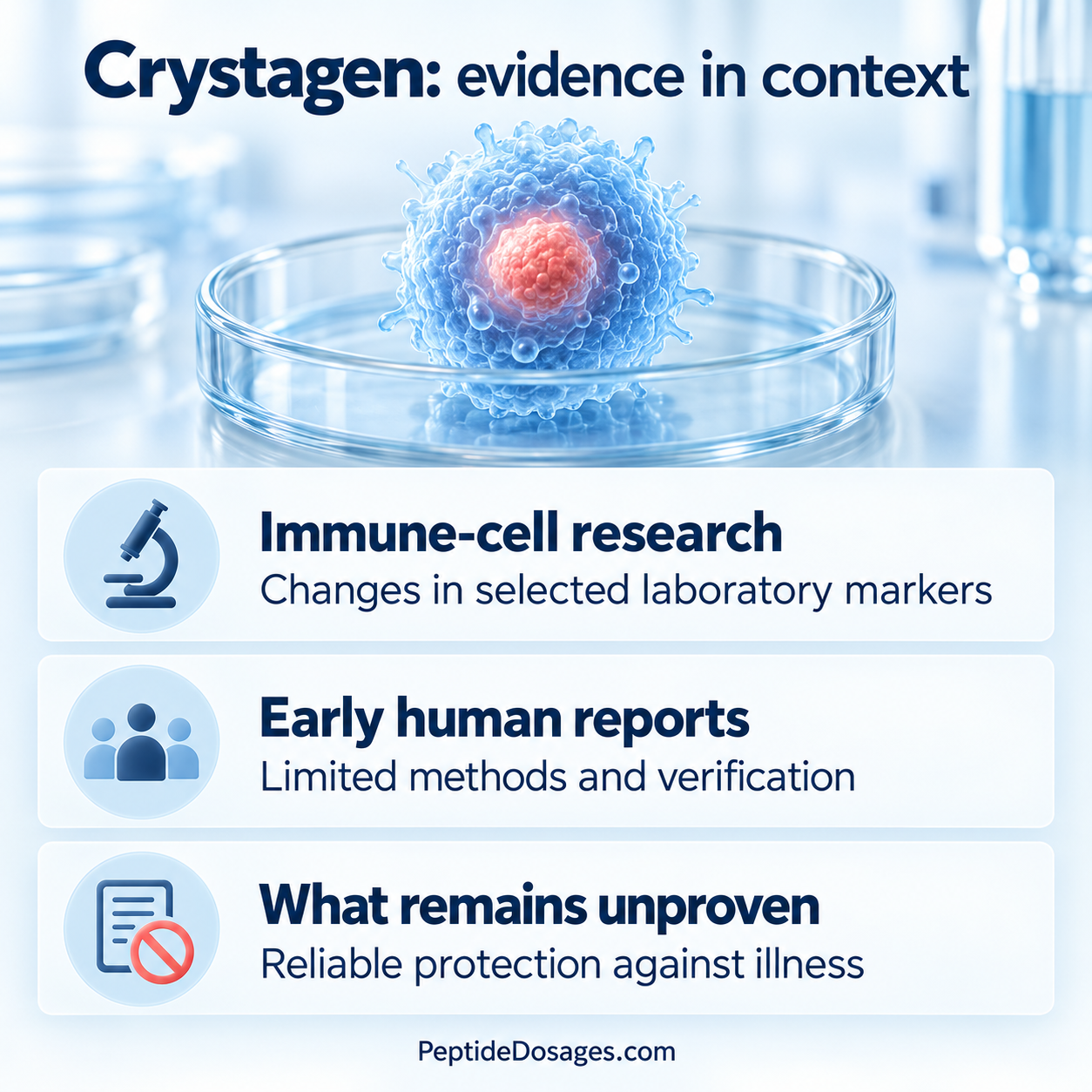
Crystagen is an experimental peptide bioregulator discussed in immune-system research. Studies describe effects on selected cells and immune markers, but they do not establish reliable protection against infections, reversal of immune aging or a treatment for cancer-related immune suppression.
Laboratory studies and early human claims are part of this research record. A change in an immune measurement, though, isn’t necessarily better health.
What is Crystagen peptide?
A 2022 paper from the Khavinson research group identifies Crystagen as EDP, the three-amino-acid sequence Glu-Asp-Pro: glutamic acid, aspartic acid and proline.1 The related patent describes the synthetic peptide H-Glu-Asp-Pro-OH.2
Crystagen is often discussed alongside thymus-related peptide research. That does not make it identical to a thymus extract or to every other short peptide in that field. Exact ingredients, chemical form and route matter when comparing a capsule, a lingual product or a research vial.
What does the immune-system research show?
Spleen-aging research
A 2014 paper compared Vilon, Timogen, Crystagen and another short peptide in research on the aging spleen. The authors described Crystagen as activating the B-cell part of the immune system, but reported that it did not cause cellular renewal in the aging spleen.3
That second finding is important. The paper cannot reasonably be summarized as “Crystagen rejuvenates immune tissue.” Its accessible abstract also does not provide the detailed methods needed to translate the observation into a clinical recommendation.
Cell experiments with mixed results
A 2011 laboratory paper examined T-36, identified in the study methods as Glu-Asp-Pro, alongside another tripeptide. The researchers reported a small-concentration effect on spontaneous proliferation of normal lymphocytes. Several other measured immune-cell functions, including lymphocyte survival and induced proliferation, did not change.4
This is more specific than a general claim of “boosted immunity.” A response in cells outside the body does not tell us whether people will have fewer infections, recover faster or respond better to vaccination.
Have there been human studies?
A patent example describes 38 older adults receiving the peptide alongside conventional treatment and 32 comparison patients receiving conventional treatment alone. It reports normalization of immune-test results in 82% versus 56%, respectively.2
Those are inventor-reported patent results, not an independently reviewed randomized-trial publication. The example describes intramuscular administration, so it should not be presented as proof that an oral capsule works. Nor does a change in an immunogram, a set of immune laboratory tests, establish fewer serious infections or longer life.
In short: it is inaccurate to say that the literature contains no human reports at all. It is equally inaccurate to call those reports decisive evidence of benefit.
| What you may read | A more accurate interpretation |
|---|---|
| Supports immune function | Selected laboratory findings and preliminary reports warrant further study. |
| Renews aging immune tissue | The cited spleen paper did not show cellular renewal from Crystagen. |
| Clinically proven in 82% of patients | A patent reported an immune-test outcome, not an 82% protection rate against illness. |
| Safe for every formulation | Different routes and products cannot share a safety conclusion without supporting evidence. |
Crystagen safety and side effects
The sources reviewed here do not establish dependable rates of side effects, long-term safety or interactions with prescription medicines. Early reports of good tolerance cannot rule out uncommon harms. Pregnancy, breastfeeding and pediatric use are not established by this evidence.
People with autoimmune disease, a transplant or treatment that deliberately suppresses immunity should not interpret “immune support” as reassurance. A product proposed to alter immune activity needs assessment in the context of the actual condition and medicines.
During cancer treatment, low white-cell counts and infection risk require the oncology team’s plan. NCI advises patients to report signs of infection promptly; chemotherapy can reduce infection-fighting cells, and some patients need specific preventive or supportive medicines.5 Crystagen is not a substitute for that care.
Dosage and product claims
The cited evidence does not establish a validated general-use Crystagen dose. Patent examples, capsule instructions and injectable-product listings are not interchangeable. A seller’s purity percentage also does not demonstrate a clinical benefit.
For unfamiliar terms, our peptide glossary explains the vocabulary. For another bioregulator research topic, see the separate Epithalon evidence review. Findings about one molecule should not be transferred to another simply because both are described as bioregulators.
Frequently asked questions
Does Crystagen prevent colds?
The studies summarized here do not establish reliable prevention of common respiratory infections. An immune-cell result is not an infection-prevention trial.
Is Crystagen a cancer treatment?
No clinical cancer-treatment benefit is established by this research. Cell experiments and immune-marker claims do not justify replacing or supplementing oncology treatment without the treating team’s advice.
What is the bottom line?
Crystagen’s findings are specific and preliminary. They don’t demonstrate the broad immunity, anti-aging and disease-prevention benefits sometimes claimed for it. Recurrent infections or concerns about immune health warrant clinical evaluation.
References
- Khavinson V, et al. Transport of biologically active ultrashort peptides using POT and LAT carriers. International Journal of Molecular Sciences. 2022. Table 2 identifies Crystagen as EDP.
- Khavinson VK, et al. Peptide substance revealing an immunogeroprotective effect. US8057810B2. Patent, not a clinical-trial publication.
- Chervyakova NA, et al. Molecular aspects of immunoprotective activity of peptides in spleen during the ageing process. Advances in Gerontology. 2014.
- Khavinson VK, et al. Effect of tripeptides on lymphoid and stem cells. Bulletin of Experimental Biology and Medicine. 2011.
- National Cancer Institute. Infection and neutropenia during cancer treatment.