
CJC-1295 without DAC usually refers to modified GRF (1-29), a growth hormone-releasing hormone analogue without the albumin-binding extension used in the longer-acting DAC compound. The names look almost identical, but the evidence is not interchangeable. The widely quoted human CJC-1295 trial studied the longer-acting form, not the no-DAC product. [1][2]
Before weighing claims about muscle, fat loss, sleep or recovery, check the CJC-1295 form. A result for the DAC compound isn’t a result for the no-DAC product.
Related reference: The CJC-1295 no-DAC 5 mg vial page contains the site’s product-specific measurement chart. A concentration calculation is not proof of clinical benefit.
CJC-1295 with DAC vs without DAC
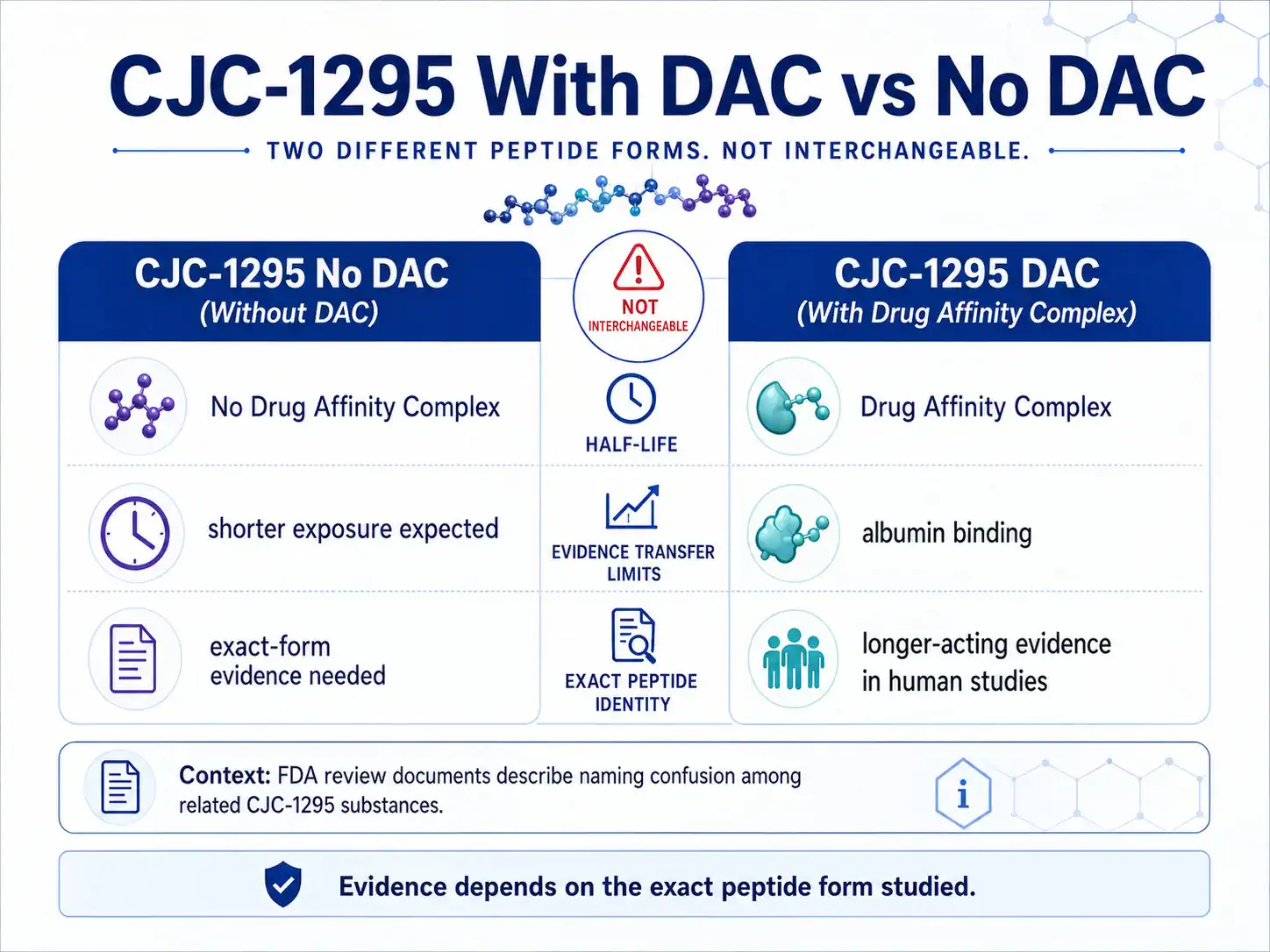
DAC is commonly expanded as drug affinity complex. The added chemical group lets the peptide bind to albumin, a protein in blood. Early laboratory and rat work demonstrated this albumin association and helped identify the long-acting candidate. [3]
| Question | No DAC | With DAC |
|---|---|---|
| Albumin-binding extension? | Absent | Present |
| Does the 2006 human trial apply directly? | No | It studied the long-acting compound |
| Established human half-life here? | The cited trial does not establish it | Estimated 5.8–8.1 days in that trial |
| Proven muscle, sleep or recovery benefit? | Not established by these studies | The hormone trial did not establish those outcomes |
The often-repeated no-DAC half-life of about 30 minutes should not be presented as a measurement from the DAC trial. Nor should a DAC dosing interval be copied onto a differently identified compound. [2]
How does the growth hormone pathway work?
Growth hormone-releasing hormone, or GHRH, signals the pituitary to release growth hormone. Growth hormone acts directly on tissues and also influences IGF-1 production. Somatostatin and feedback from IGF-1 help regulate this system. [4]
This is a regulated network, not a simple “more is better” switch. Growth hormone secretion naturally varies with sleep, age, sex, food and other factors. Its metabolic effects also include increased fat breakdown and reduced insulin sensitivity. Normal physiology does not tell us that deliberately increasing a hormone will improve health in someone without a diagnosed deficiency. [4]
A GHRH analogue is also not the same thing as injecting growth hormone itself. One is intended to influence a signal; the other supplies the hormone. Neither description establishes that a particular research product is effective or safe.
What did the human CJC-1295 study show?
Teichman and colleagues reported two randomized, placebo-controlled trials in healthy adults in 2006. The long-acting compound raised measured growth hormone and IGF-1 concentrations, with effects lasting for days. The trials lasted 28 and 49 days and primarily examined hormone responses, pharmacokinetics and short-term safety. [2]
Those are meaningful pharmacology findings. They are not demonstrations of greater strength, better sleep, faster injury recovery or longer life. The absence of serious adverse reactions in those small studies also does not establish long-term safety.
FDA’s 2024 review distinguished several CJC-1295-related substances and found that the available clinical references appeared to concern the DAC active moiety. It did not establish equivalent clinical evidence for the non-DAC substances. [1]
What about CJC-1295 no DAC with ipamorelin?
The combination is often discussed because the ingredients are associated with different growth hormone-releasing signals. In the original ipamorelin pharmacology paper, researchers studied pituitary cells, rats and pigs and found growth hormone release through a GHRP-like receptor pathway. That was not a clinical trial of a CJC-1295 no-DAC/ipamorelin blend. [5]
A complementary mechanism can justify a research question. It does not establish a safe combination, an optimal ratio or a benefit in people. Claims that a blend is automatically more “natural,” safer or more effective need their own comparative evidence. Our ipamorelin guide covers that ingredient separately.
Side effects and unresolved safety questions
Reliable side-effect rates for a specifically identified no-DAC product are not established by these references. FDA flags immune-reaction and peptide-impurity concerns for CJC-1295 and reports serious events including increased heart rate and systemic vasodilation. Its summary should not be read as a precise risk estimate for every form sold under that name. [6]
Shorter expected exposure does not automatically mean lower risk. Identity, formulation, contaminants, the person’s medical history and the pattern of exposure all matter. A purity percentage cannot replace clinical safety data.
Discuss hormone-related symptoms and any proposed peptide product with a qualified clinician. Fatigue, poor sleep or slow training progress alone do not diagnose growth hormone deficiency. Medical evaluation is especially important when glucose regulation or pituitary disease is a concern.
Common questions about CJC-1295 no DAC
Is no DAC better than DAC?
There is no established head-to-head clinical benefit in the evidence described here. They should be compared as different compounds, not as interchangeable versions selected only for convenience. See the CJC-1295 DAC guide for the longer-acting research.
Does it preserve natural growth hormone pulses?
That claim needs direct measurement for the exact product and regimen. Natural growth hormone release is pulsatile, but describing a product as short-acting does not prove that it reproduces normal physiology. [4]
Can the published DAC trial establish a no-DAC dosage?
No. The trial’s compound and exposure are different. Transferring its numbers to a no-DAC vial would not create a validated regimen.
Why do some descriptions call CJC-1295 discontinued?
That phrase can refer to a particular development program, not every product using the name. It does not establish approval or non-approval of a different formulation, nor does continued online availability establish clinical effectiveness.
Bottom line: For CJC-1295 no DAC, start with exact identity and resist borrowed evidence. A rise in a hormone is not the same as a demonstrated improvement in health or performance.
Related CJC-1295 NO DAC dosage protocols
Continue with the vial-strength-specific research protocol that matches the material being evaluated. Each page keeps its own concentration, reconstitution, and syringe-unit calculations.
Practical measurement and handling guides
References
- FDA. CJC-1295-related bulk drug substances: Pharmacy Compounding Advisory Committee briefing. December 2024.
- Teichman SL, et al. Prolonged stimulation of growth hormone and insulin-like growth factor I secretion by CJC-1295, a long-acting analog of GHRH, in healthy adults. Journal of Clinical Endocrinology & Metabolism. 2006.
- Jetté L, et al. Human growth hormone-releasing factor 1-29-albumin bioconjugates activate the GRF receptor: identification of CJC-1295 as a long-lasting analogue. Endocrinology. 2005.
- Olarescu NC, et al. Normal physiology of growth hormone in normal adults. Endotext. Updated 2025.
- Raun K, et al. Ipamorelin, the first selective growth hormone secretagogue. European Journal of Endocrinology. 1998.
- FDA. Certain bulk drug substances that may present significant safety risks.