
Survodutide is an investigational peptide that activates GLP-1 and glucagon receptors. Researchers are studying it for obesity and metabolic liver disease. Phase 3 weight-loss results are now available, but positive trials are not the same as regulatory approval.1,2
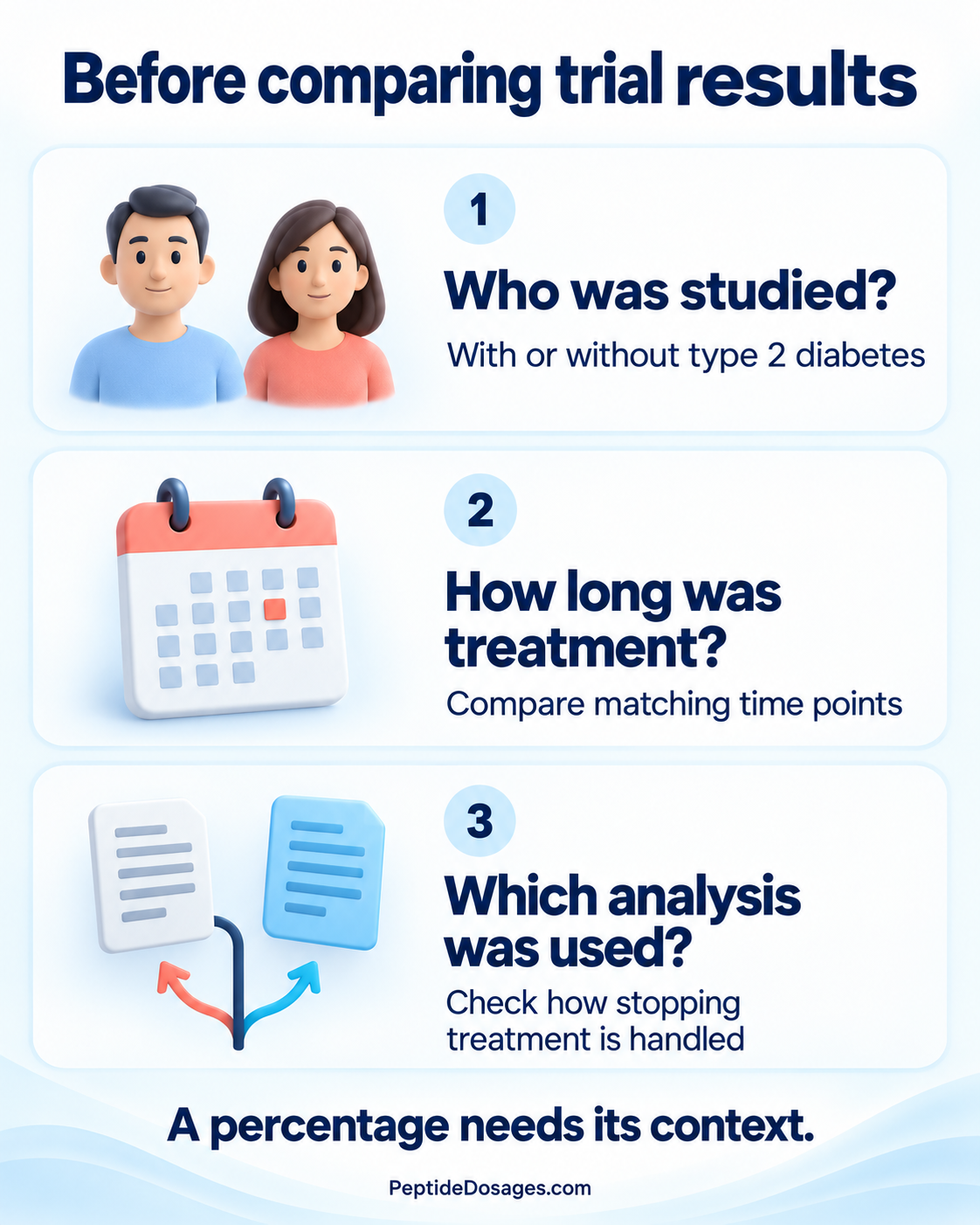
How much weight did participants lose, who took part, and which side effects occurred? Those details help explain why headlines about the same trial can give different percentages.
What is survodutide?
Also called BI 456906, survodutide is a long-acting glucagon/GLP-1 receptor dual agonist developed through a partnership between Zealand Pharma and Boehringer Ingelheim. Boehringer Ingelheim is responsible for its clinical development and commercialization.1
It is being investigated as a once-weekly subcutaneous treatment. Its research programs include obesity, type 2 diabetes-associated obesity, and metabolic dysfunction-associated steatohepatitis, or MASH.1 MASH is a liver condition involving inflammation and injury, not simply another name for having excess body weight.
How does the dual-receptor mechanism work?
The design combines GLP-1 receptor activity with glucagon receptor activity. The development program sought to preserve glucose-lowering effects while adding glucagon-related effects on energy metabolism and the liver. Laboratory receptor tests and mouse experiments helped select survodutide for clinical development.3
That mechanism is a reason to study the drug, not proof of superiority over every GLP-1 medicine. Animal energy-expenditure findings also do not establish exactly how many extra calories a person will burn.
Survodutide weight-loss results: the 2026 phase 3 trials
SYNCHRONIZE-1 studied 725 adults with obesity or overweight and a weight-related complication, without diabetes. SYNCHRONIZE-2 studied 752 adults with overweight or obesity and type 2 diabetes. Both compared two survodutide groups with placebo over 76 weeks.2,4
| Trial population | Average weight reduction | Placebo |
|---|---|---|
| SYNCHRONIZE-1: without diabetes | 12.2% at 3.6 mg; 13.0% at 6.0 mg | 5.4% |
| SYNCHRONIZE-2: with type 2 diabetes | 8.2% at 3.6 mg; 9.8% at 6.0 mg | 3.9% |
Week-76 treatment-regimen analyses from the published trial abstracts. These account for treatment interruptions or discontinuation and other specified events. Amounts identify research groups, not personal prescribing instructions.2,4
The diabetes trial also reported a reduction in glycated hemoglobin, a measure of longer-term blood glucose. Its participants started with an average HbA1c of 7.4%; changes were −0.9 and −0.8 percentage points in the two survodutide groups, versus −0.2 with placebo.4
Why do some headlines say 16.6%?
The sponsor’s initial SYNCHRONIZE-1 announcement reported up to 16.6% average weight reduction, versus 3.2% with placebo, using an efficacy estimand.5 An estimand defines the particular treatment effect an analysis is intended to estimate. Different rules for handling treatment discontinuation and other events can produce different answers.
This is why the table identifies its analysis instead of combining the largest number from one analysis with the placebo result from another. Neither percentage predicts an individual’s result.
What about MASH and liver fat?
A 48-week phase 2 trial included 293 treated participants with biopsy-confirmed MASH and fibrosis stages F1 to F3. In the published abstract, improvement in MASH without worsening fibrosis occurred in 47%, 62% and 43% across the three survodutide groups, versus 14% with placebo.6
That outcome is not identical to fibrosis reversal. Improvement by at least one fibrosis stage occurred in 34%, 36% and 34%, versus 22% with placebo. A reduction in liver fat is another, separate measure.6 Keeping those outcomes separate avoids turning “less liver fat” into an unsupported claim that scarring has disappeared.
The development program includes larger liver-disease trials, including LIVERAGE and LIVERAGE-Cirrhosis.1 Results in one population should not automatically be applied to people with a different stage of liver disease.
Common side effects and remaining safety questions
Gastrointestinal symptoms were the most common adverse events in the phase 3 trials. In SYNCHRONIZE-1 they occurred in 80.9% and 89.7% of the survodutide groups, versus 47.9% with placebo; symptoms were generally mild to moderate.2
Nausea, diarrhea and vomiting were also more frequent with survodutide in the MASH trial.6 “Generally mild to moderate” does not mean symptoms are irrelevant to everyday use or that everyone tolerates treatment.
The earlier phase 2 obesity study used a dose-escalation period followed by maintenance, illustrating why tolerability and study design matter when interpreting results.7 Trial supervision, participant selection and the exact investigational formulation cannot be assumed for a research vial purchased online.
Is survodutide approved or available by prescription?
As of this October 2026 review, the developer describes survodutide as investigational and not approved for marketing. Its FDA development designations for MASH are not marketing approvals.1 There is therefore no approved U.S. survodutide prescribing label to use as a routine treatment guide.
Likewise, prices advertised for research materials should not be presented as the price of an approved prescription medicine. For legitimate trial access, check the current ClinicalTrials.gov listings and discuss eligibility with the study team.
Survodutide dosage: study amounts are not a prescription
The trial amounts above describe assigned treatment groups. They do not establish a safe starting dose, a self-directed escalation schedule or interchangeability with another medicine. The site’s Survodutide 10 mg dosage reference is a separate research resource, not an approved product label.
If you are considering treatment for obesity, diabetes or liver disease, ask a qualified clinician about approved options, eligibility and monitoring rather than using a trial summary to self-prescribe.
Frequently asked questions
Is survodutide the same as semaglutide or tirzepatide?
No. These are different molecules. Read the separate semaglutide and tirzepatide guides for their evidence. Comparing headline percentages from unrelated trials cannot establish that one treatment is best for a particular person.
Does a lower result in diabetes mean it failed?
No. SYNCHRONIZE-2 met its weight-loss endpoints against placebo.4 It studied a different population from SYNCHRONIZE-1, so the two percentages answer different questions.
What should readers take away?
Survodutide has human clinical evidence, including phase 3 obesity results. Read the headline alongside the comparison group, tolerability findings and analysis method. These trials do not validate unsupervised use of research products.
Related Survodutide dosage protocols
Continue with the vial-strength-specific research protocol that matches the material being evaluated. Each page keeps its own concentration, reconstitution, and syringe-unit calculations.
Practical measurement and handling guides
References
- Zealand Pharma. Survodutide development program and regulatory status. Checked October 2026.
- le Roux CW, et al. Survodutide Once Weekly for the Treatment of Adults with Obesity. New England Journal of Medicine. 2026.
- Thomas L, et al. The dual GCGR/GLP-1R agonist survodutide: Biomarkers and pharmacological profiling for clinical candidate selection. Diabetes, Obesity and Metabolism. 2024.
- Wharton S, et al. Survodutide Once Weekly in Adults with Obesity and Type 2 Diabetes. New England Journal of Medicine. Published October 1, 2026.
- Boehringer Ingelheim. SYNCHRONIZE-1 topline results. Sponsor announcement, April 28, 2026; efficacy-estimand results.
- Sanyal AJ, et al. A Phase 2 Randomized Trial of Survodutide in MASH and Fibrosis. New England Journal of Medicine. 2024.
- le Roux CW, et al. Glucagon and GLP-1 receptor dual agonist survodutide for obesity: a randomized, double-blind, placebo-controlled, dose-finding phase 2 trial. Lancet Diabetes & Endocrinology. 2024.