
Abaloparatide is a bone-building prescription medicine used for osteoporosis. In the United States, it is sold as Tymlos for selected adults at high fracture risk. It is not a general-purpose recovery supplement, and an online research vial is not the approved pen.1
The main studies address three questions: does abaloparatide increase bone density, does it prevent fractures, and what happens after treatment ends? These are related outcomes, but they aren’t the same.
What is abaloparatide, and how does it work?
Abaloparatide is a synthetic analog of parathyroid hormone-related peptide (PTHrP). It activates the PTH1 receptor to stimulate bone formation. In osteoporosis care, “anabolic” means bone-building, rather than primarily slowing bone breakdown. 1
That distinction matters when reading about osteoporosis drugs. “Builds bone” describes a biological action. It does not mean every person with a low bone-density result needs this particular treatment.
Who is Tymlos approved for?
The U.S. label covers postmenopausal women with osteoporosis at high fracture risk and men with osteoporosis at high fracture risk. It also covers these populations when other osteoporosis treatments have failed or cannot be tolerated. The men’s indication specifically concerns increasing bone density.1
The Endocrine Society places abaloparatide among options for postmenopausal women at very high fracture risk, such as those with severe or multiple vertebral fractures.5 The decision therefore involves fracture history and overall risk, not simply finding the strongest-sounding peptide.
What benefits did the clinical trials show?
| Study | Who and how long? | Main takeaway |
|---|---|---|
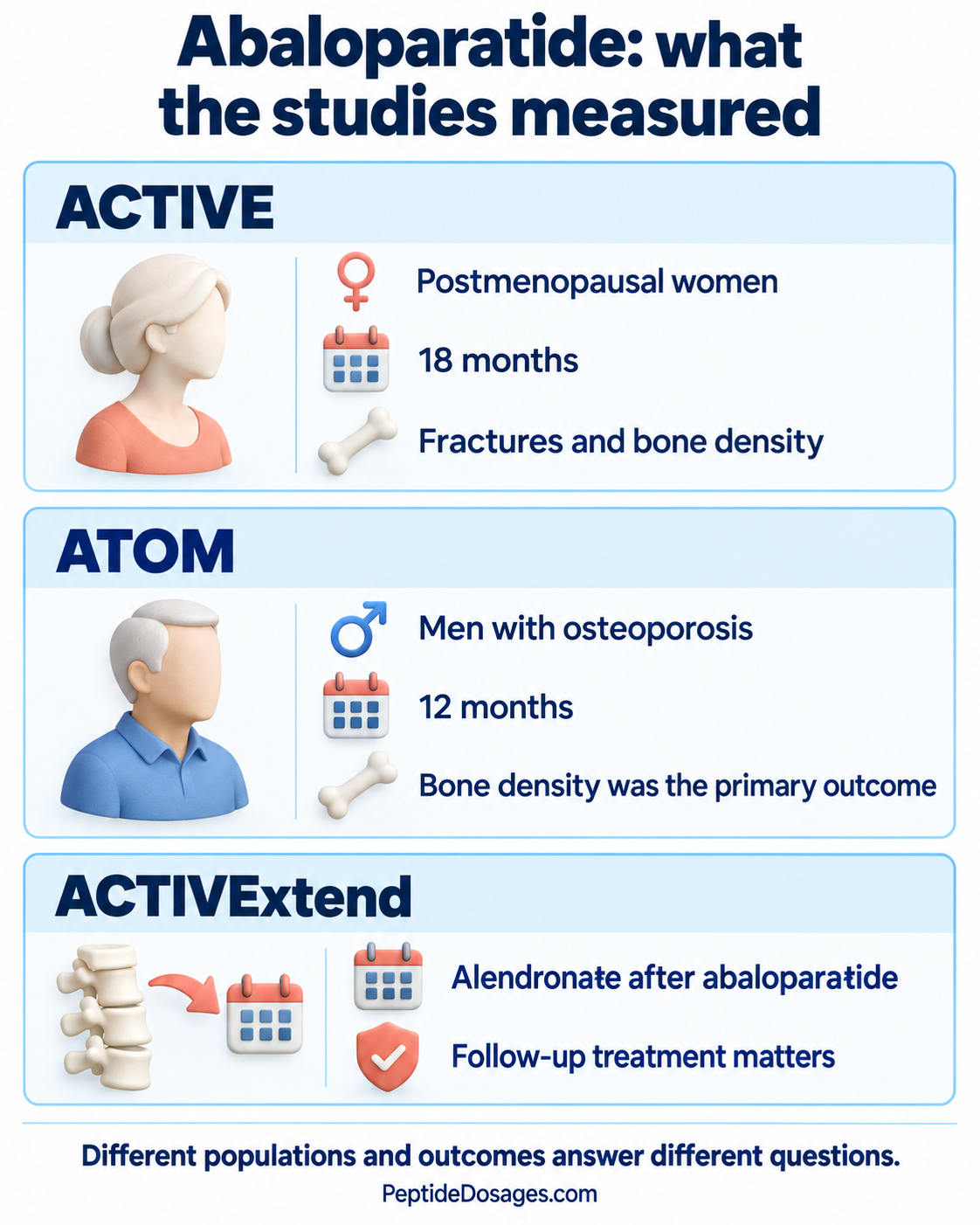
| ACTIVE | 2,463 postmenopausal women; 18 months | Fewer new vertebral and nonvertebral fractures versus placebo |
| ATOM | 228 men with osteoporosis; 12 months | Greater increases in spine and hip bone density versus placebo |
| ACTIVExtend | Eligible ACTIVE completers; 24 additional months of alendronate | Benefits persisted during a planned follow-on treatment sequence |
The studies measured different outcomes in different populations. They are not three interchangeable estimates of fracture prevention.2,3,4
ACTIVE: fracture prevention in postmenopausal women
ACTIVE compared daily abaloparatide with placebo and an open-label teriparatide group. The primary comparison was abaloparatide versus placebo for new vertebral fractures. Bone-density improvements also favored abaloparatide over placebo.2
The trial included a teriparatide comparison, but it should not be reduced to “one is always better.” Treatment choice still depends on the individual, the outcome being compared and tolerability. Hypercalcemia occurred in 3.4% with abaloparatide and 6.4% with teriparatide in this study.2
ATOM: evidence in men
At 12 months, lumbar-spine bone mineral density rose by an adjusted average of 8.48% with abaloparatide versus 1.17% with placebo. Improvements also favored abaloparatide at the hip and femoral neck.3
Those are bone-density results, not an 8.48% reduction in fractures. A scan measures one important part of bone health; a fracture endpoint measures whether fractures actually occurred. Keeping the two separate makes the evidence much easier to interpret.
How long is treatment, and what comes afterward?
Tymlos use beyond two years over a person’s lifetime is not recommended in the current label.1 Planning the next treatment matters as much as choosing the first one.
In ACTIVExtend, women who had received abaloparatide or placebo went on to receive alendronate. Across the full 43-month observation period, new radiographic vertebral fractures occurred in 0.9% of evaluable women in the abaloparatide-to-alendronate group versus 5.6% in the placebo-to-alendronate group.4
This was not 43 months of abaloparatide. It tested a sequence. Clinical guidance similarly recommends an antiresorptive medicine after completing abaloparatide to maintain bone-density gains.5
Abaloparatide side effects and safety
Dizziness, nausea, headache, tiredness and injection-site discomfort can occur. Early injections may cause lightheadedness or faintness when standing. Patients should receive instruction on pen use and discuss persistent symptoms with their clinician.6
Important screening issues include high blood calcium, kidney stones and factors that raise baseline osteosarcoma risk, including certain bone diseases, bone cancer or radiation involving bone. Abaloparatide caused osteosarcoma in rats; whether it causes it in humans is unknown. Breathing difficulty or swelling of the face or throat needs urgent medical attention.6
The August 2026 Tymlos label also specifically addresses severe hypersensitivity reactions.1 Bring a complete medication and supplement list to the prescribing appointment rather than assuming “peptide” means there are no meaningful risks.
Prescription pen, storage and research references
Tymlos is supplied as a ready-to-use liquid pen. Before first use it is refrigerated; after first use, it is stored at room temperature and discarded after 30 days. Do not freeze it, share the pen or transfer its contents into another syringe. Follow the instructions supplied with the dispensed product.6
The site’s Abaloparatide 3 mg research reference concerns a different presentation. A matching compound name does not establish that a research product has the same manufacturing controls, delivery device or clinical evidence as a prescription medicine.
Questions worth asking at an appointment
- What makes my fracture risk high enough to consider a bone-building medicine?
- Which outcomes will we monitor, and when?
- What symptoms should prompt a call?
- What is the plan after this course ends?
- What will the actual out-of-pocket cost be under my coverage?
These questions are more useful than choosing from headline percentages. Treatment should fit your fracture history, other medical conditions and ability to use the prescribed product consistently.
Frequently asked questions
Is abaloparatide the same as teriparatide?
No. Both are bone-building medicines that act through the PTH1 pathway, but they are distinct molecules. ACTIVE studied both, with different adverse-event findings; they are not simply two names for the same drug.1,2
Will I feel it working?
Feeling different is not the outcome these studies were designed to establish. Follow-up should focus on the agreed clinical assessment, including bone-density monitoring and fracture history, rather than day-to-day sensations.5
Does stronger bone density mean osteoporosis is cured?
No. Improvement is a treatment benefit, not a reason to stop care without a plan. The follow-on treatment evidence is one reason the conversation should extend beyond the last injection.4
Related Abaloparatide dosage protocols
Continue with the vial-strength-specific research protocol that matches the material being evaluated. Each page keeps its own concentration, reconstitution, and syringe-unit calculations.
Practical measurement and handling guides
References
- DailyMed. Tymlos prescribing information. Revised August 2026.
- Miller PD, et al. Effect of Abaloparatide vs Placebo on New Vertebral Fractures in Postmenopausal Women With Osteoporosis. JAMA. 2016.
- Czerwinski E, et al. The Efficacy and Safety of Abaloparatide-SC in Men With Osteoporosis. Journal of Bone and Mineral Research. 2022.
- Bone HG, et al. ACTIVExtend: 24 Months of Alendronate After 18 Months of Abaloparatide or Placebo. Journal of Clinical Endocrinology & Metabolism. 2018.
- Endocrine Society. Pharmacological Management of Osteoporosis in Postmenopausal Women. Clinical practice guideline resources.
- MedlinePlus / ASHP. Abaloparatide injection: patient medication information.