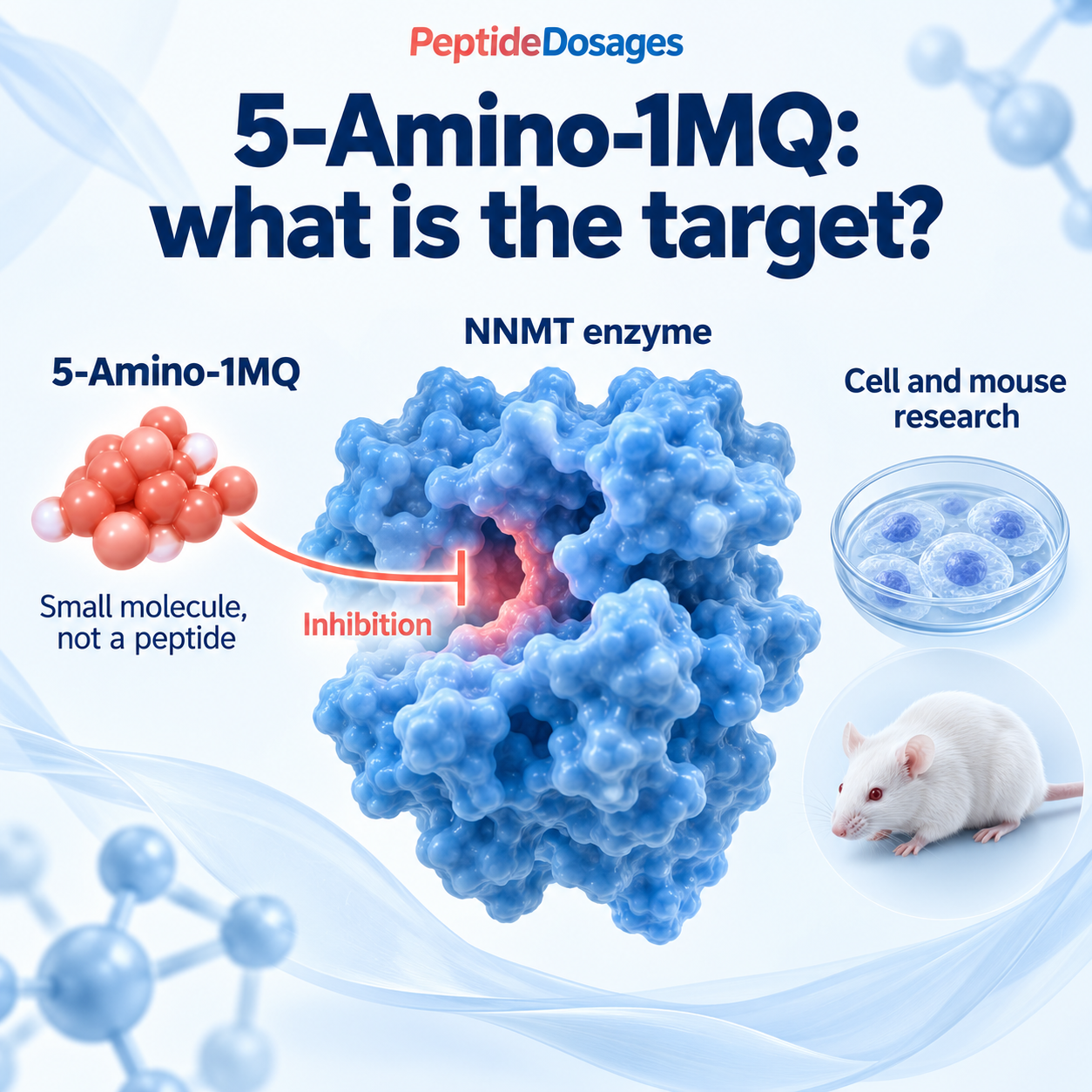
5-Amino-1MQ is an experimental small-molecule inhibitor of nicotinamide N-methyltransferase, usually shortened to NNMT. It is not a peptide, despite often appearing under that label online. Cell and animal research has explored effects on fat tissue, metabolism and aging muscle. Those findings do not yet establish a weight-loss benefit, safe dose or long-term safety profile in people. [1][3]
Related dosage pages: For vial-specific concentration, reconstitution, and measurement examples, see 5-Amino-1MQ (10 mg Vial) Dosage Protocol and 5-Amino-1MQ (50 mg Vial) Dosage Protocol. Each linked protocol remains a separate reference because vial strength changes concentration and syringe-unit calculations.
The full chemical name is 5-amino-1-methylquinolinium. Papers may shorten it to 5A-1MQ or 5-AMQ. Check the compound’s name: a study of the NNMT enzyme isn’t necessarily a study of 5-Amino-1MQ.
How does 5-Amino-1MQ work?
NNMT helps process nicotinamide, a form of vitamin B3. Its activity connects with pathways involving NAD and S-adenosylmethionine (SAM), a methyl donor. Researchers are testing whether blocking NNMT changes how cells handle energy and store fat.
In an early study, NNMT inhibitors reduced fat production in cultured fat cells and altered intracellular NAD and SAM levels. These are mechanistic findings: they help explain a research hypothesis. They do not show that taking 5-Amino-1MQ raises NAD throughout a person’s body, increases daily energy or slows aging. [1]
Why is it called a peptide if it is not one?
That is a marketing and search-language overlap, not its chemical identity. Peptides are short chains of linked amino acids. 5-Amino-1MQ is a small molecule, not such a chain. Its presence on a peptide website or beside peptide products does not change that distinction. [5]
What do the animal studies show?
| Study | What it shows, and what it does not |
|---|---|
| Obese mice, 11 days | An early experiment found lower body weight and white fat measures, without a difference in food intake. [1] Not established: A comparable amount of weight loss or preserved appetite in people. |
| Obese mice with a diet change, 2021 | NNMT inhibition plus a lean-diet switch improved body-composition and liver-fat measures more than the diet switch alone. [2] Not established: The same result from a product used alone in humans. |
| Aged mice with or without exercise, 2024 | Eight weeks of treatment produced favorable grip-strength findings. Some other muscle-function measures did not improve significantly. [3] Not established: Human bodybuilding results or treatment of sarcopenia. |
| Rat pharmacokinetics, 2021 | Researchers measured the compound in blood after oral and intravenous administration. [4] Not established: Human absorption, effective capsule doses or a safe dosing interval. |
Does it help with fat loss?
The mouse findings justify further investigation, not a promise. The early experiment was short and involved nine mice per group. A result in diet-induced obese mice cannot tell a person how much weight they will lose, whether a change will last, or whether benefits outweigh harms. [1]
The later study also changed the animals’ diet. That matters when interpreting claims about the compound’s independent effects. It reported improved body composition and liver adiposity relative to the diet-only group, but it was still an animal experiment, not a clinical weight-management program. The authors disclosed relationships with a company developing NNMT-targeted therapies. [2]
What about muscle, strength and aging?
A 2024 experiment followed mice from 22 to 24 months of age, with groups receiving exercise, 5A-1MQ, both or neither. Grip strength improved, and the combined group had favorable findings. But peak plantarflexor torque, another measure of muscle performance, did not change significantly. [3]
That mixed result is more informative than saying it “reverses muscle aging.” It shows why each outcome needs to be read separately. An aged-mouse study is also not evidence that healthy adults will gain muscle from an online product.
Quick check: is a human cell study a human treatment trial?
No. Researchers can study human cells or tissue outside the body without giving the compound to a person. Such work can identify a biological target, but it cannot measure the benefits and harms of treatment in patients.
Does oral 5-Amino-1MQ work?
A 2021 pharmacokinetic study reported oral absorption in rats, with estimated bioavailability of 38.4% under its experimental conditions. This was a study of how the compound moved through an animal’s body, not a trial of human weight loss. [4]
There are several separate questions behind “does it work?” Can it be absorbed? Does the exposure affect a biological target? Does that lead to a meaningful benefit? Is the exposure safe? One positive answer does not settle the others.
The rat half-life reported in that paper should not be used as a human dosing interval. Nor does the paper verify the contents, formulation or clinical performance of every capsule sold with the same ingredient name. [4]
5-Amino-1MQ side effects and unresolved risks
The evidence reviewed here does not establish a dependable human side-effect profile. That includes the frequency of common symptoms, serious reactions, interactions with medicines and consequences of prolonged use.
The short early mouse experiment reported no observable adverse effects. That is worth noting accurately, but it is not equivalent to a human safety assessment. The absence of an obvious problem in a small animal study cannot rule out uncommon, delayed or species-specific harms. [1]
Be cautious with both extremes: “it has no side effects” and a confident list of human side-effect percentages unsupported by a trial. Neither follows from the studies above.
Product quality and approval are different questions
A certificate of analysis may describe a tested sample, but it is not a clinical trial. A purity figure does not answer whether a treatment is effective or appropriate for a particular person.
The FDA explains that compounded drugs are not FDA-approved and that contamination or excessive active-ingredient strength can cause serious harm. This is general guidance about compounded products, not evidence that the FDA has established a specific adverse-event rate for 5-Amino-1MQ. Do not confuse availability, a professional-sounding label or a research-use designation with an approval finding. [6]
Common questions
How long does 5-Amino-1MQ take to work?
A reliable human timeline has not been established by the studies discussed here. An 11-day mouse experiment does not mean a person should expect a visible result after 11 days.
Is there a validated human dosage or cycle?
Not in the evidence reviewed for this guide. An animal amount, a capsule strength and a clinician-established human regimen are different things. A vial’s mass or a reconstitution calculation cannot resolve whether an exposure is medically suitable.
Is it an alternative to GLP-1 medicines?
It should not be treated as an interchangeable substitute. NNMT inhibition concerns a different biological target, and the preclinical studies above do not provide a head-to-head human comparison. Do not replace prescribed treatment based on a shared “fat loss” label.
Can it be combined with NAD products or other research compounds?
A connection between biochemical pathways is not evidence that a combination is safe or beneficial. The papers discussed here do not establish a validated human combination regimen. More ingredients can add uncertainty rather than resolve it.
Bottom line: 5-Amino-1MQ is a research tool with promising animal findings and substantial unanswered human questions. Keep the experimental setting attached to the result. If weight, fatigue or declining strength is the concern, discuss evaluation and established treatment options with a qualified healthcare professional.
References
- Neelakantan H, et al. Selective and membrane-permeable small molecule inhibitors of nicotinamide N-methyltransferase reverse high fat diet-induced obesity in mice. Biochemical Pharmacology. 2018. Cell and mouse research.
- Sampson CM, et al. Combined nicotinamide N-methyltransferase inhibition and reduced-calorie diet normalizes body composition and enhances metabolic benefits in obese mice. Scientific Reports. 2021.
- Dimet-Wiley AL, et al. Nicotinamide N-methyltransferase inhibition mimics and boosts exercise-mediated improvements in muscle function in aged mice. Scientific Reports. 2024.
- Awosemo O, et al. Development and validation of an LC-MS/MS assay for 5-amino-1-methyl quinolinium in rat plasma: application to pharmacokinetic and oral bioavailability studies. Journal of Pharmaceutical and Biomedical Analysis. 2021.
- National Human Genome Research Institute. Peptide. Genetics glossary.
- U.S. Food and Drug Administration. Understanding the risks of compounded drugs. General product-quality guidance.
Related dosage protocols and research
Explore related research, dosage references and guides below. Vial strengths have separate references because concentration and syringe-unit calculations differ. A comparison does not mean the compounds are interchangeable.
Matching dosage protocols
Further research context