

Semaglutide is the active ingredient in several prescription medicines, not one interchangeable product. It belongs to the GLP-1 receptor agonist class. Depending on the brand and formulation, approved uses include type 2 diabetes, weight management and certain cardiovascular, kidney or liver conditions. Choosing the right product means matching its specific label to the person and the condition being treated.[1][2][3]
Related dosage pages: For vial-specific concentration, reconstitution, and measurement examples, see Semaglutide (5 mg Vial) Dosage Protocol, Semaglutide (10 mg Vial) Dosage Protocol, and Semaglutide (20 mg Vial) Dosage Protocol. Each linked protocol remains a separate reference because vial strength changes concentration and syringe-unit calculations.
What does semaglutide do?
Semaglutide helps the pancreas release insulin when blood glucose is elevated. It also slows stomach emptying and can reduce appetite. Those effects help explain its use in diabetes and weight management. They do not mean that every semaglutide product has the same approved purpose.[8]
Check the brand and whether it’s a tablet or injection. The ingredient name alone doesn’t explain how that particular medicine is used.
Ozempic, Wegovy and oral semaglutide: what is the difference?
U.S. prescribing information now includes more formulations than many older summaries describe. This comparison identifies the main distinctions, not every eligibility requirement.
| Product | Main distinction |
|---|---|
| Wegovy injection | Weight management for eligible adults and adolescents aged 12 or older; cardiovascular risk reduction in eligible adults with established cardiovascular disease. Also approved through the accelerated pathway for adults with noncirrhotic MASH and moderate to advanced liver fibrosis.[1] |
| Wegovy tablets | Adult weight-management and cardiovascular indications. The tablet label does not include the adolescent or MASH indications of the injection.[1] |
| Ozempic injection | Adult type 2 diabetes treatment, cardiovascular risk reduction in adults with type 2 diabetes and established cardiovascular disease, and specified kidney and cardiovascular risk reduction in adults with type 2 diabetes and chronic kidney disease.[2] |
| Rybelsus and Ozempic tablets | Oral formulations for adult type 2 diabetes and cardiovascular risk reduction in adults with type 2 diabetes at high risk. Their strengths are not interchangeable milligram for milligram.[3] |
MASH means metabolic dysfunction-associated steatohepatitis, a liver condition involving inflammation and damage. The Wegovy indication is for fibrosis stages F2 to F3, not any finding of liver fat. Continued approval for that use depends on confirmation of clinical benefit.[1]
How much weight loss does the research show?
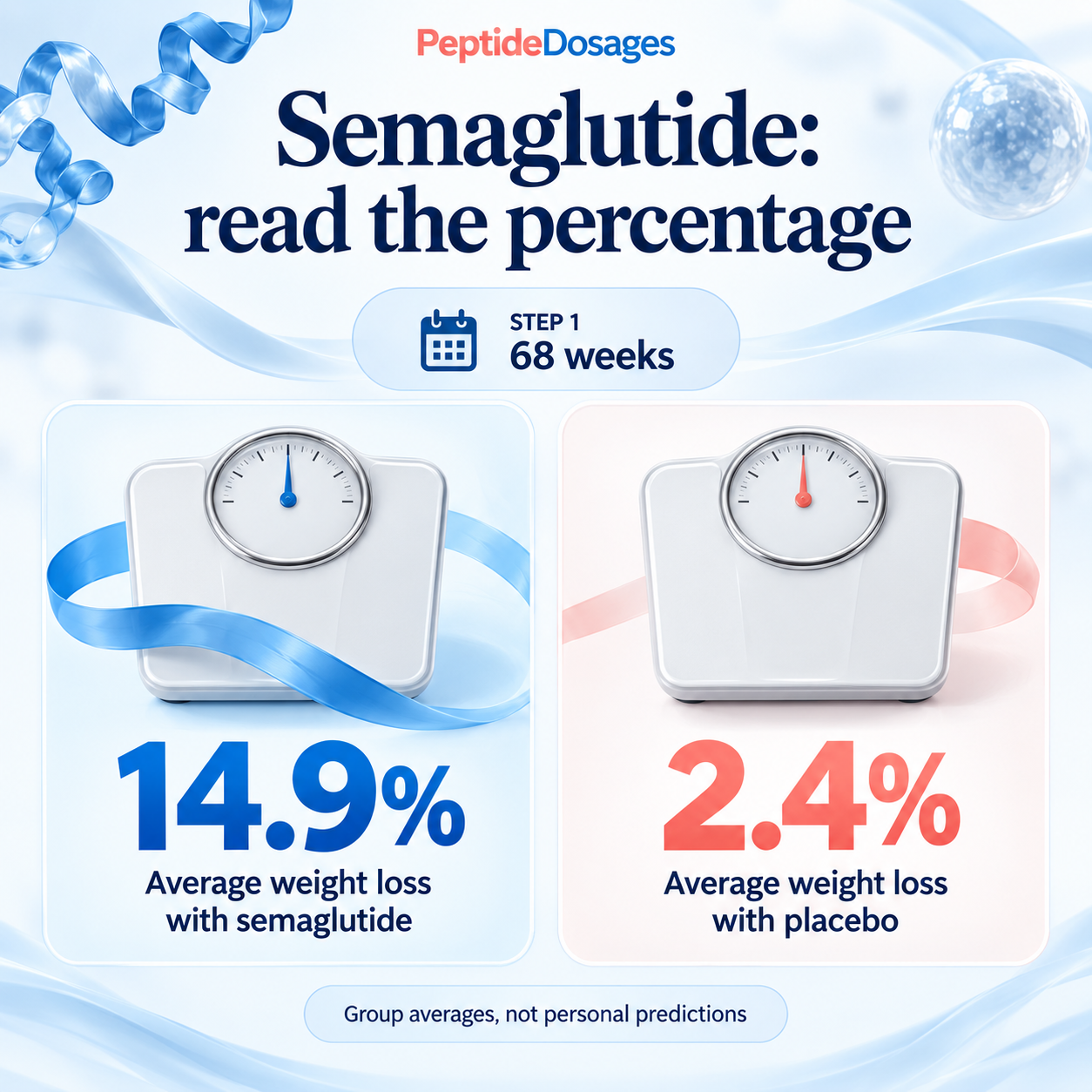
The best-known result comes from STEP 1, a randomized trial of 1,961 adults with obesity, or overweight plus a weight-related condition, without diabetes. Participants received lifestyle support and either once-weekly semaglutide 2.4 mg or placebo for 68 weeks.[4]
| Study question | Finding and limitation |
|---|---|
| Weight loss in STEP 1 | Average body-weight change was −14.9% with semaglutide versus −2.4% with placebo at 68 weeks. These are group averages, not a promise of a particular weekly loss.[4] |
| Cardiovascular events in SELECT | Among 17,604 adults with established cardiovascular disease and overweight or obesity but no diabetes, a major cardiovascular event occurred in 6.5% versus 8.0% with placebo over an average 39.8 months of follow-up.[5] |
| After stopping in the STEP 1 extension | In an exploratory subset of 327 people, participants previously receiving semaglutide regained about two-thirds of their lost weight over the following year. Both study medication and the lifestyle intervention had stopped.[6] |
For SELECT, the often-quoted “20% reduction” describes the relative hazard of the combined cardiovascular outcome. It does not mean 20 fewer events per 100 people. The observed event proportions differed by 1.5 percentage points, and the study involved people who already had cardiovascular disease.[5]
The weight-regain finding is also easy to overread. It supports planning for long-term care; it does not prove that every person will regain exactly two-thirds or that one particular maintenance strategy works for everyone.[6]
Quick check: does a 14.9% average predict your result?
No. It describes one trial population, formulation and follow-up period. A person’s response may be different. Before comparing two headline percentages, check who participated, how long treatment lasted and whether both groups received the same support.
Semaglutide versus tirzepatide
In the open-label SURMOUNT-5 trial, 751 adults with obesity and no diabetes received tirzepatide or injectable semaglutide. At 72 weeks, average weight reduction was 20.2% versus 13.7%, respectively. The semaglutide maintenance doses studied were 1.7 or 2.4 mg weekly. This was not a comparison of every currently available formulation or strength, and the medicines cannot be converted milligram for milligram.[7]
A larger average weight change does not settle an individual treatment decision. The relevant question is which option fits the diagnosis, medical history, tolerability and practical ability to continue care.
Semaglutide side effects and important precautions
Nausea, vomiting, constipation, diarrhea and abdominal discomfort can occur. Persistent vomiting or diarrhea deserves medical attention because dehydration can affect kidney function. Severe, ongoing abdominal pain, new vision problems or signs of an allergic reaction should not be treated as ordinary adjustment symptoms. Difficulty breathing or swelling of the mouth or throat requires emergency help.[8]
The boxed warning concerns thyroid C-cell tumors seen in rodents; relevance to humans remains uncertain. The products are contraindicated with a personal or family history of medullary thyroid carcinoma or MEN2. Other important concerns include pancreatitis, gallbladder disease, severe gastrointestinal reactions and worsening diabetic retinopathy in susceptible patients. Low blood sugar risk is greater when combined with insulin or a sulfonylurea.[2]
Tell the prescribing team about pregnancy plans, severe stomach-emptying problems and upcoming procedures. Labeling advises stopping semaglutide at least two months before a planned pregnancy. The anesthesia team also needs to know about its use because retained stomach contents can increase aspiration risk during anesthesia or deep sedation.[2]
Why there is no single semaglutide dosage chart
The appropriate dose depends on the actual prescription product, indication, treatment stage and tolerance. A tablet dose is not equivalent to the same number of milligrams injected. Even the Rybelsus and Ozempic tablet formulations are not interchangeable on a milligram-for-milligram basis.[3]
Use the instructions supplied with the prescribed medicine, not a generic vial chart. When changing formulation, ask the prescriber or pharmacist to confirm the product name, strength and transition instructions in writing.
Prescription products versus compounded or research products
FDA has reported dosing errors with compounded semaglutide, including confusion between milligrams, milliliters and syringe markings. Compounded medicines are not FDA-approved. Semaglutide sodium and semaglutide acetate are also different active ingredients from the semaglutide used in approved medicines. A powder labeled for research is not established as an interchangeable substitute for a prescription product.[9]
Before accepting a product, confirm the dispensing pharmacy, exact ingredient, concentration and written directions with a qualified healthcare professional. A familiar brand name in an advertisement is not enough to identify what is actually supplied.
Questions worth taking to your appointment
- Which condition is this specific product being prescribed to treat?
- Which benefits are realistic for my situation, and how will we measure them?
- What symptoms should prompt a call, urgent assessment or emergency care?
- What is the plan if side effects, cost or supply interrupt treatment?
- If the formulation changes, who will confirm the new instructions?
Bottom line: Semaglutide has substantial clinical evidence, but product identity and patient selection matter. Trial averages help frame a discussion; they do not replace an individualized prescription or follow-up plan.
References
- Wegovy prescribing information: injection and tablets.
- Ozempic injection prescribing information.
- Rybelsus and Ozempic tablets prescribing information.
- Wilding et al. Once-weekly semaglutide in adults with overweight or obesity. 2021.
- Lincoff et al. Semaglutide and cardiovascular outcomes in obesity without diabetes. 2023.
- Wilding et al. Weight regain after withdrawal: STEP 1 extension. 2022.
- Aronne et al. Tirzepatide as compared with semaglutide for obesity. 2025.
- MedlinePlus: semaglutide injection drug information.
- FDA: concerns with unapproved GLP-1 drugs used for weight loss.
Related dosage protocols and research
Explore related research, dosage references and guides below. Vial strengths have separate references because concentration and syringe-unit calculations differ. A comparison does not mean the compounds are interchangeable.
Matching dosage protocols
Related protocols and comparisons
Further research context