
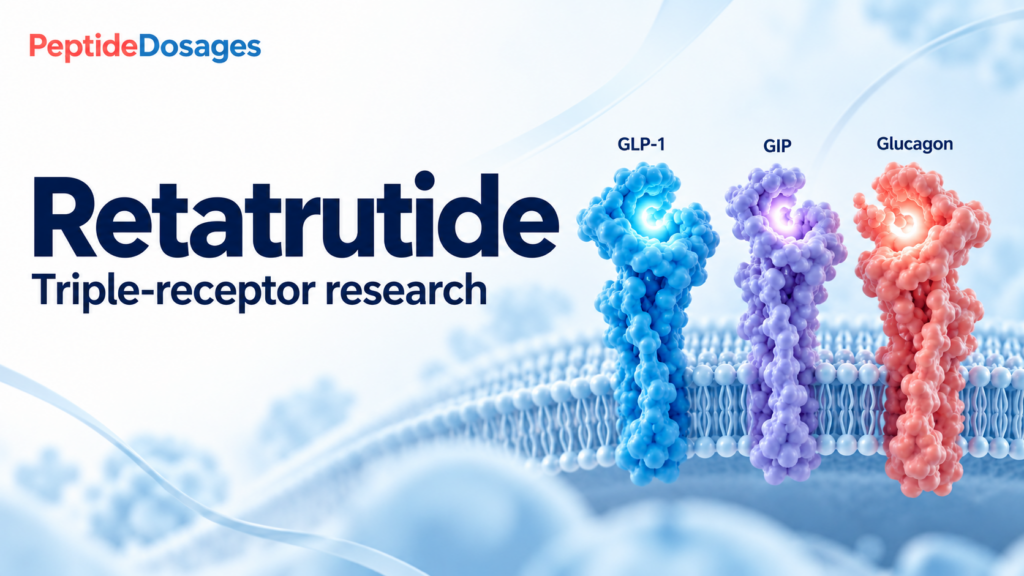
Retatrutide is an investigational weight-loss medicine that activates three hormone receptors: GIP, GLP-1 and glucagon. Large Phase 3 trials now report substantial weight loss, including in people with type 2 diabetes. It is still not FDA-approved as of October 6, 2026. Trial results do not establish the safety of products sold online under the same name. [1] [2] [3]
The larger studies now let us look beyond early-trial promise: what did they find, why do their headline numbers differ, and which questions remain unanswered?
Retatrutide at a glance
- What it is: Eli Lilly’s investigational triple-receptor agonist, also called LY3437943.
- What is new: TRIUMPH-1 and TRIUMPH-2 Phase 3 papers were published in September 2026.
- Main safety issue in the trials: gastrointestinal side effects, with other signals that also need attention.
- Availability: research development is not the same as an approved prescription option. [1] [2] [3]
Related dosage pages: For vial-specific concentration, reconstitution, and measurement examples, see Retatrutide (5 mg Vial) Dosage Protocol, Retatrutide (10 mg Vial) Dosage Protocol, Retatrutide (20 mg Vial) Dosage Protocol, and Retatrutide (30 mg Vial) Dosage Protocol. Each linked protocol remains a separate reference because vial strength changes concentration and syringe-unit calculations.
How does retatrutide work?
Retatrutide combines activity at three receptors in one molecule. GLP-1 and GIP are involved in the body’s response to food and glucose; glucagon signaling adds another metabolic pathway. Researchers are testing the combined effects on body weight and related conditions. It is a peptide, not a steroid, and it is not a mixture of semaglutide and tirzepatide. [4]
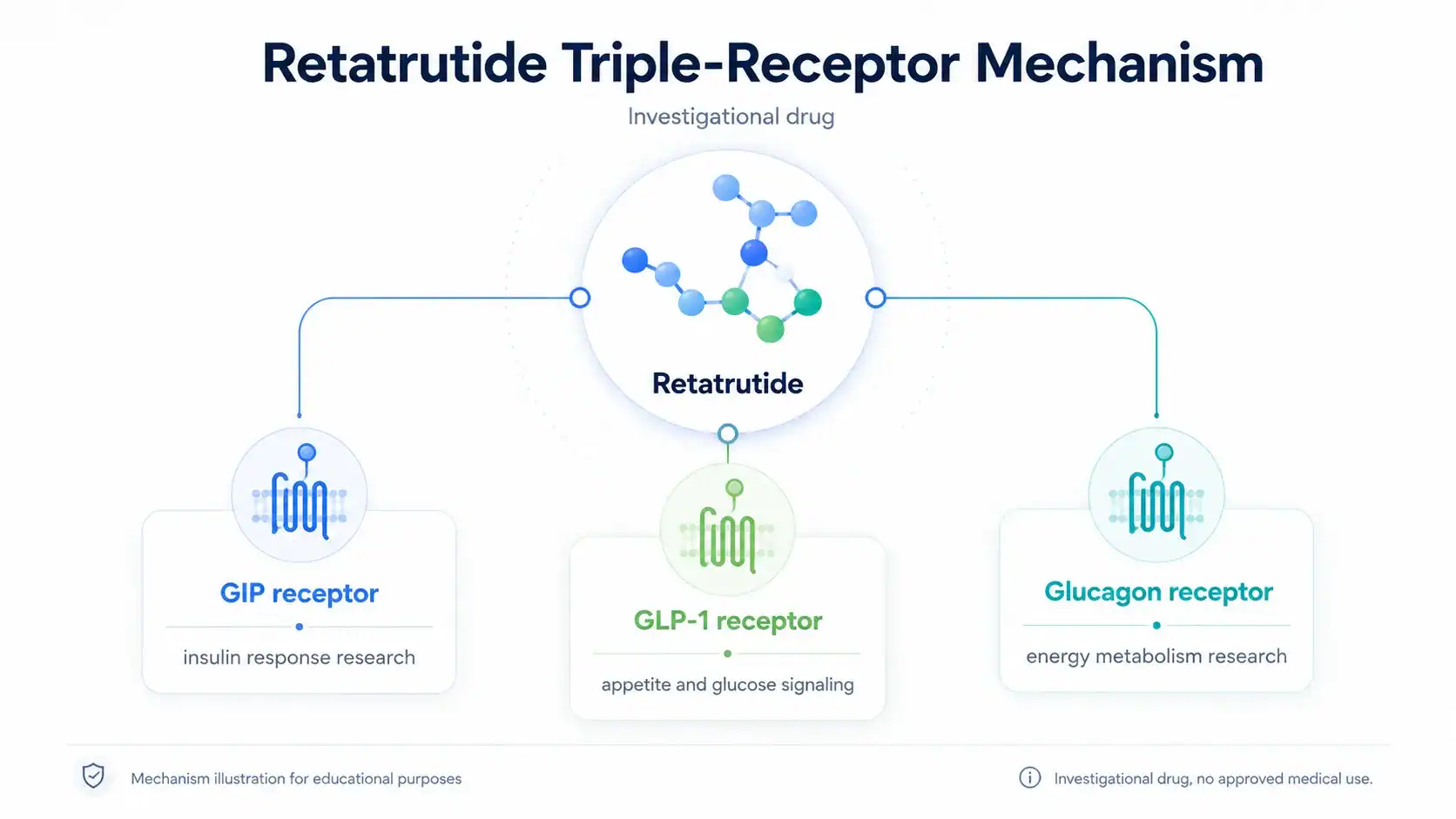
More receptor targets do not automatically mean a better treatment for every person. The useful test is what happens in well-designed trials, including adverse effects and treatment discontinuation.
What do the weight-loss trials show?
The table separates the populations and study lengths. Numbers are average changes from starting body weight, not promises for an individual. The doses identify research groups; they are not a self-treatment schedule.
| Study and population | Average weight change | How to read it |
|---|---|---|
| 2023 Phase 2: 338 adults with obesity, without diabetes; 48 weeks | 12 mg group: −24.2%; placebo: −2.1% | An early dose-ranging study, not the latest Phase 3 result. [4] |
| TRIUMPH-1: 2,339 adults with obesity, without diabetes; 80 weeks | 4 / 9 / 12 mg groups: −17.6% / −23.7% / −25.0%; placebo: −3.9% | Treatment-regimen estimates, accounting for treatment interruptions or discontinuation under the study’s analysis approach. [1] |
| TRIUMPH-2: 1,152 adults with overweight or obesity and type 2 diabetes; 80 weeks | 4 / 9 / 12 mg groups: −11.9% / −16.8% / −18.8%; placebo: −5.1% | A different population. Do not compare its percentages with TRIUMPH-1 as if participants were interchangeable. [2] |
Why do some headlines report a different percentage?
A trial can answer more than one statistical question. A treatment-regimen estimate addresses the assigned treatment strategy, including what happens when people do not remain on treatment. An efficacy estimate asks what would happen under specified assumptions about remaining on treatment and avoiding certain other therapies.
For example, Lilly’s TRIUMPH-2 announcement reports 20.8% weight loss in the highest-dose group under the efficacy approach. The paper’s treatment-regimen result is 18.8%. These are different analyses, not two interchangeable measurements. Check the population, time point, comparison group and analysis before sharing a headline. [2] [5]
Are there benefits beyond weight loss?
TRIUMPH-1 also studied participants with knee osteoarthritis or obstructive sleep apnea and reported improvements in those subgroups. That does not establish an approved indication for either condition, or mean every person with joint pain or sleep apnea would benefit. [1]
Similarly, changes in weight or metabolic measurements are not automatically proof that a medicine prevents heart attacks, kidney failure or early death. Those outcomes need their own evidence.
Retatrutide side effects: what is known?
Digestive symptoms are a consistent finding. In TRIUMPH-2, diarrhea occurred in 34% of participants assigned to 12 mg, versus 13% with placebo; nausea occurred in 28% versus 8%. These figures describe that trial and dose group, not everyone who might eventually receive the drug. [2]
- Low blood pressure: reported in 6% of the 12 mg group versus less than 1% with placebo in TRIUMPH-2.
- Altered skin sensation: dysesthesia, which can include unpleasant or unusual sensations, occurred in 7% versus 1% in those groups. [2]
- Heart rate: the earlier Phase 2 study found dose-related increases that peaked around week 24 and later declined. [4]
Some participants discontinued treatment. A favorable average weight result does not erase tolerability problems, and a clinical trial cannot settle every rare or long-term risk. An unapproved product bought outside a trial adds a separate uncertainty about what is actually in the product. [2] [3]
Retatrutide versus tirzepatide or semaglutide
These are distinct medicines. A comparison of receptor targets can explain the research rationale, but it cannot tell someone which treatment is best for them.
The retatrutide trials above used placebo comparisons, not a direct contest against semaglutide or tirzepatide. Separate trials can differ in diabetes status, starting weight, duration, support provided and statistical methods. Ranking drugs by the largest percentage from unrelated studies is therefore misleading. [1] [2] [4]
Is retatrutide approved or available to prescribe?
Not in the United States as of this review. FDA says retatrutide is not an ingredient in an approved drug and cannot be used in compounding under federal law. A website offering a “research peptide” does not change that status. [3]
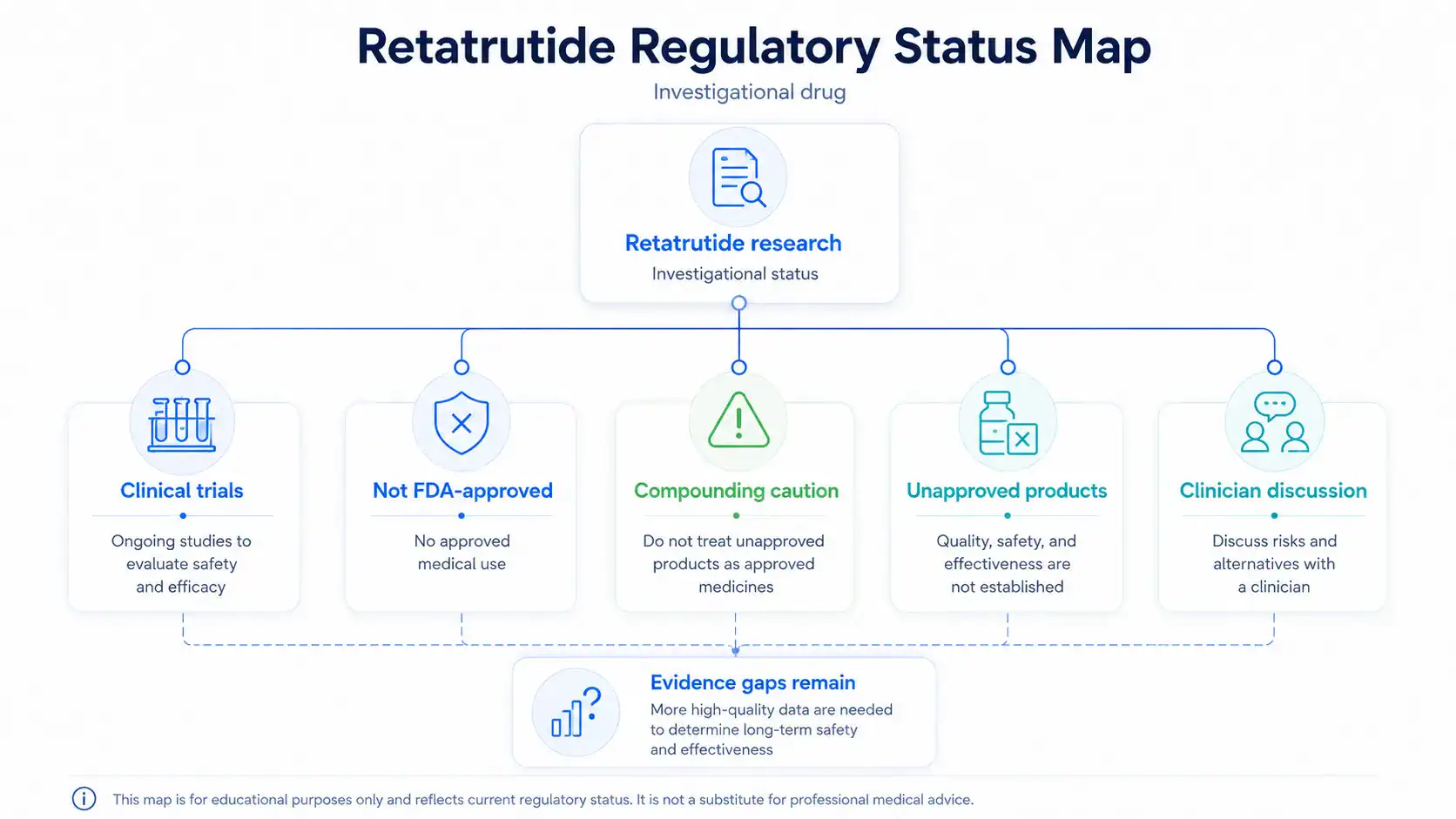
Lilly said in September 2026 that it planned a U.S. regulatory submission in the first quarter of 2027. A planned submission is not an approval date, a guaranteed launch, or confirmation of price or insurance coverage. [5]
Questions to bring to a weight-management appointment
- Which approved options fit my medical history and treatment goals now?
- Am I comparing results from people with a similar health profile?
- What monitoring and support would an appropriate treatment require?
- If I am interested in research, is there a legitimate trial with an identifiable study team and eligibility criteria?
You do not need to wait for an investigational medicine to discuss evidence-based care.
Common questions
Is retatrutide the same as Ozempic?
No. Ozempic contains semaglutide. Retatrutide is a different investigational molecule, not a stronger brand or generic version of Ozempic. [4]
What is the correct retatrutide dose?
There is no FDA-approved prescribing dose. Trials use defined protocols, dose escalation and monitoring. Research-group doses should not be converted into an online vial’s home-use instructions. [3] [4]
Do the results mean retatrutide is safe?
They provide important evidence about benefits and adverse effects in selected study participants. They do not establish safety for every patient, every combination of medicines, or products from unapproved suppliers. [1] [2] [3]
The bottom line
Retatrutide now has substantial Phase 3 evidence, alongside meaningful side effects. It remains investigational and awaits regulatory review. Discuss current treatment options with a qualified healthcare professional; a research product isn’t an approved substitute.
Related dosage protocols and research
Explore related research, dosage references and guides below. Vial strengths have separate references because concentration and syringe-unit calculations differ. A comparison does not mean the compounds are interchangeable.
Matching dosage protocols
Further research context
References
- TRIUMPH-1 Phase 3 trial of retatrutide in adults with obesity without diabetes. New England Journal of Medicine, 2026.
- TRIUMPH-2 Phase 3 trial of retatrutide in adults with overweight or obesity and type 2 diabetes. The Lancet, 2026.
- FDA’s concerns with unapproved GLP-1 drugs used for weight loss. U.S. Food and Drug Administration.
- Triple-hormone-receptor agonist retatrutide for obesity: a Phase 2 trial. New England Journal of Medicine, 2023.
- Lilly’s TRIUMPH-2 results and regulatory-submission announcement. September 29, 2026. Sponsor communication, not independent regulatory approval.