

Gonadorelin is a synthetic version of gonadotropin-releasing hormone (GnRH), the signal that tells the pituitary gland to release LH and FSH. Its established clinical context is reproductive endocrinology, not general hormone optimization. The important distinction is how it is used: a diagnostic injection, a specialist-managed pulsatile pump and an occasional injection alongside testosterone are not interchangeable approaches. [1][2]
Related dosage page: See the Gonadorelin 2 mg vial reference for concentration and measurement examples. A vial calculation does not establish an appropriate treatment schedule.
How gonadorelin works: the signal matters
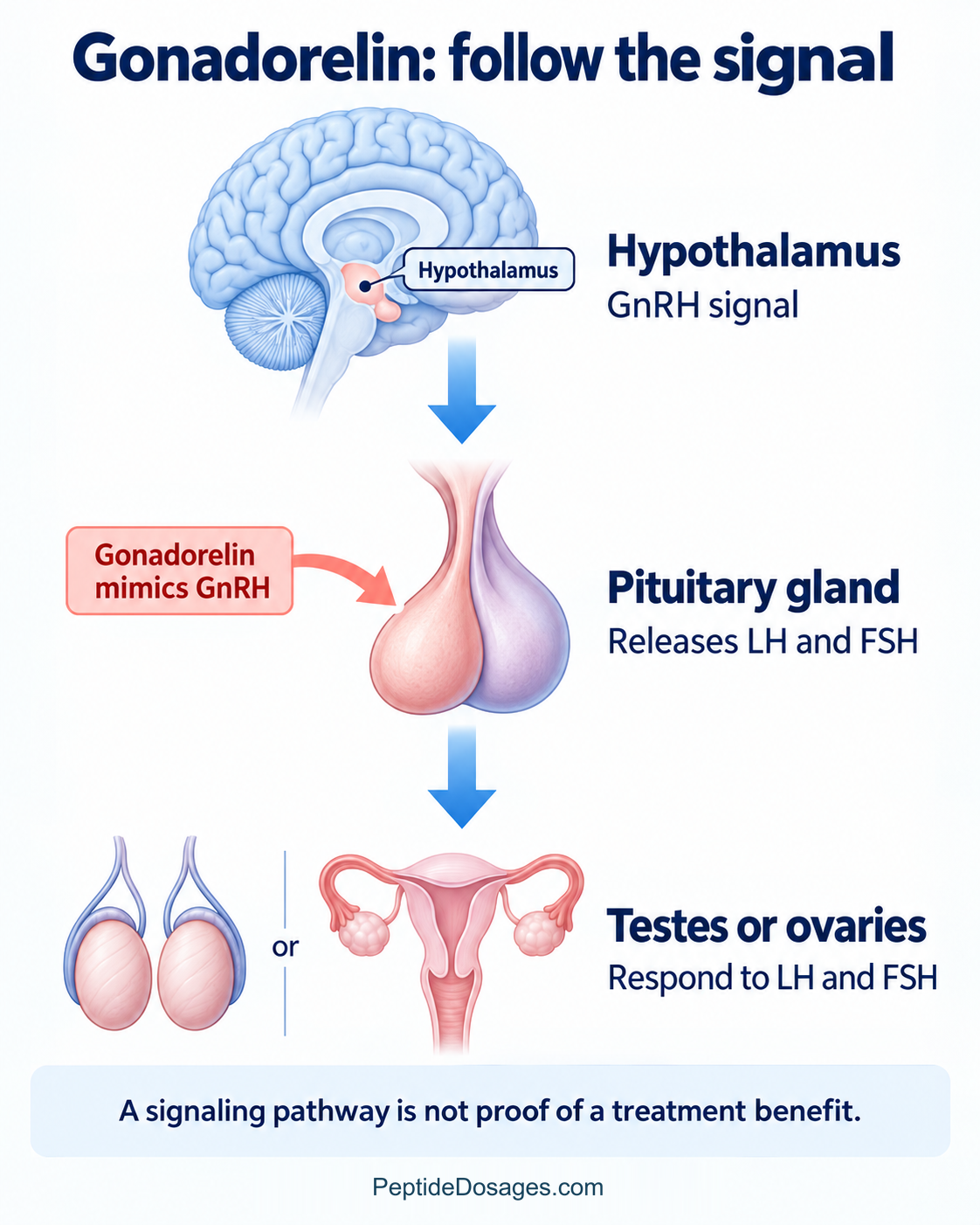
The hypothalamus normally releases GnRH in pulses. That signal reaches the anterior pituitary, which releases luteinizing hormone (LH) and follicle-stimulating hormone (FSH). These hormones act on the testes or ovaries, influencing sex-hormone production and the development of sperm or eggs. [1]
| Step | What happens |
|---|---|
| 1. Hypothalamus | Produces the GnRH signal. |
| 2. Pituitary gland | Responds by releasing LH and FSH. |
| 3. Testes or ovaries | Respond to the gonadotropins. Gonadorelin acts upstream, not as a replacement for every part of this pathway. |
Timing is part of GnRH biology. Sustained exposure and repeated pulses can produce different responses, so a larger amount doesn’t replace the relevant signal. The pituitary and gonads also need to respond for that upstream signal to have its intended effect. [1]
What is gonadorelin used for?
Testing pituitary function
The UK gonadorelin injection label describes a test of the pituitary’s gonadotropin response, with blood sampling around the injection. A response helps establish whether those pituitary cells function; the test alone does not identify every cause of a poor response. This is a diagnostic procedure, not a recurring wellness treatment. [2]
Specialist fertility treatment
For women with functional hypothalamic amenorrhea who wish to conceive, the Endocrine Society guideline suggests pulsatile GnRH after a complete fertility evaluation, when available. The recommendation is specific to that diagnosis and rests on limited-quality evidence. It does not apply to every cause of missed periods or infertility. [3]
The same guideline emphasizes addressing energy imbalance, which may involve nutrition, exercise and psychological support. A hormone intervention does not remove the need to investigate why the menstrual cycle stopped. [3]
Gonadorelin for men with GnRH deficiency
A small study followed 28 men with congenital hypogonadotropic hypogonadism and no sperm in their semen. Ten received pulsatile gonadorelin by pump; 18 received cyclical hCG/HMG treatment. Sperm appeared earlier in the pump group, at a median of six months versus 14 months. However, the proportion who developed sperm did not differ significantly. [4]
This was not a randomized trial, and the groups were small. It supports a specialist treatment option for a defined disorder, not a conclusion that gonadorelin is better for all men with low testosterone. The study did not test occasional injections in otherwise healthy men using testosterone replacement therapy.
Gonadorelin vs. hCG: different points of action
Gonadorelin signals the pituitary; human chorionic gonadotropin (hCG) acts predominantly like LH at the gonads. They are not interchangeable simply because both appear in fertility discussions. Pregnyl’s prescribing information describes hCG stimulating testosterone production in the testes and its distinct role in selected fertility treatments. [5]
| Question | Why it matters |
|---|---|
| Where is the underlying problem? | A hypothalamic signal deficiency differs from pituitary disease or a primary testicular problem. |
| What is the goal? | A higher testosterone result and successful sperm production are different outcomes. |
| What treatment was actually studied? | A monitored pump study cannot validate a different injection pattern. |
Does gonadorelin preserve fertility during TRT?
The research above does not establish that claim. Testosterone therapy can suppress the signals involved in sperm production. The AUA/ASRM male-infertility guideline advises against testosterone monotherapy for men interested in current or future fertility. Adding gonadorelin should not be assumed to cancel that suppression. Fertility goals call for an assessment of the underlying diagnosis and, where relevant, semen testing, not reassurance based only on a testosterone blood result. [6]
Quick check: does a higher testosterone result prove fertility has improved?
No. A hormone measurement is not a sperm count or a pregnancy outcome. The distinction is particularly important when reading treatment advertisements or interpreting results during TRT.
Side effects of gonadorelin
The UK label lists reactions including headache, dizziness, flushing, nausea, injection-site changes and hypersensitivity. It also warns about use in people with pituitary adenomas and says it should not be administered during pregnancy or nursing. Other hormone medicines can affect interpretation of the diagnostic test. [2]
The pump study reported local skin reactions. That observation belongs to its particular treatment setting; it cannot establish the safety of a different formulation, delivery method or long-term use. [4]
Is gonadorelin FDA-approved?
The answer needs a product name. FDA records show that Factrel, containing gonadorelin hydrochloride, was approved in 1982. Its listed strengths are now marked discontinued. That historical approval does not mean every gonadorelin product currently offered online is FDA-approved. [7]
Compounded gonadorelin is a separate issue: compounded drugs do not receive FDA premarket approval for safety, effectiveness or quality. Gonadorelin acetate and hydrochloride names also should not be treated as proof that products share identical labeling or availability. Check the exact formulation, source and intended use with a qualified clinician or pharmacist. [8]
Why there is no single gonadorelin dosage schedule
A pituitary test and a fertility pump answer different clinical questions. The label describes a short-lived signal, with a half-life of about four minutes; that figure is not a stand-alone instruction for injection frequency. [2] Copying a schedule without its diagnosis, delivery system and monitoring loses the information that made the original treatment meaningful.
Before comparing amounts, identify the condition and its evidence. An endocrinologist or reproductive specialist can assess fertility concerns, low testosterone or unexplained menstrual changes and distinguish a signaling problem from other causes. This article doesn’t replace that evaluation.
Related Gonadorelin dosage protocols
Continue with the vial-strength-specific research protocol that matches the material being evaluated. Each page keeps its own concentration, reconstitution, and syringe-unit calculations.
Practical measurement and handling guides
References
- Marques P, et al. Physiology of GnRH and Gonadotrophin Secretion. Endotext. Updated 2024.
- Esteve Pharmaceuticals. Gonadorelin 100 micrograms: Summary of Product Characteristics. UK product information.
- Endocrine Society. Functional Hypothalamic Amenorrhea: Clinical Practice Guideline. 2017.
- Zhang L, et al. The Pulsatile Gonadorelin Pump Induces Earlier Spermatogenesis Than Cyclical Gonadotropin Therapy in Congenital Hypogonadotropic Hypogonadism Men. American Journal of Men’s Health. 2019.
- DailyMed. Pregnyl prescribing information.
- AUA/ASRM. Diagnosis and Treatment of Infertility in Men: Guideline Part II.
- FDA. Factrel, NDA 018123: approval and marketing-status record.
- FDA. Compounding and the FDA: Questions and Answers.