
CJC-1295 DAC can raise growth hormone and IGF-1 in humans. That is not the same as proving it builds muscle, improves recovery or slows aging. The best-known trials measured hormone responses over relatively short periods. They did not establish those broader benefits. [1]
CJC-1295 with DAC and products called CJC-1295 without DAC have different structures. Evidence for one doesn’t automatically apply to the other. [3]
Related dosage pages: See the CJC-1295 DAC 2 mg and 5 mg vial references for concentration calculations. These are not FDA-approved treatment schedules.
What is CJC-1295 DAC?
CJC-1295 DAC is an experimental analog of growth hormone-releasing hormone, or GHRH. Instead of supplying growth hormone directly, it stimulates a signal that prompts the pituitary gland to release it. IGF-1, another hormone involved in growth signaling, can rise downstream. [1]
DAC means drug affinity complex. The added chemical group allows the peptide to attach to albumin, a protein in blood. This helps explain why exposure lasts much longer than that of native GHRH. It is a design feature, not a quality grade or a promise of better results. [2][3]
CJC-1295 with DAC vs without DAC
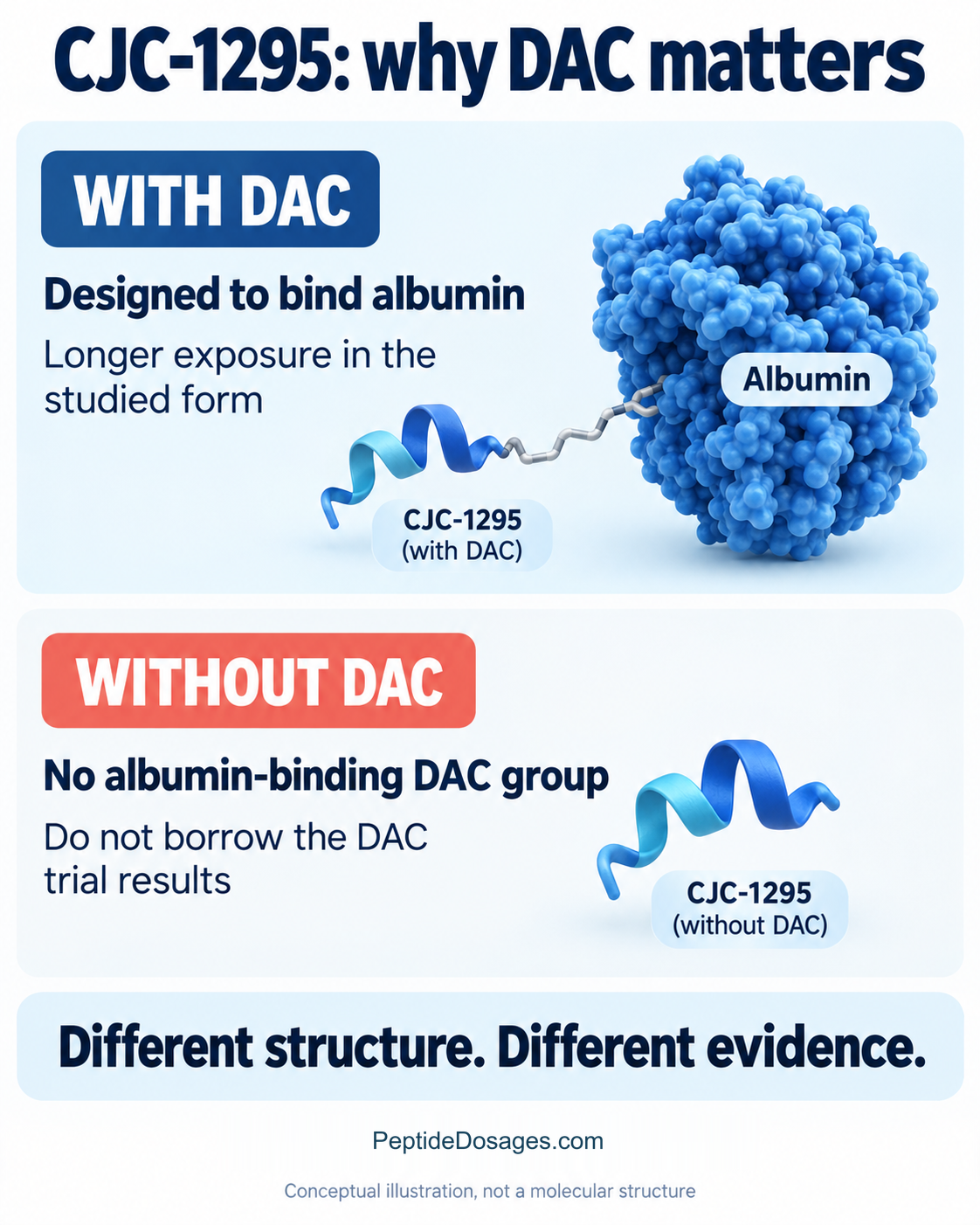
The DAC designation matters more than a similar product name. FDA’s 2024 evaluation separates substances with and without the albumin-binding group and warns against carrying findings from the DAC form over to the no-DAC form. It also notes that direct comparative pharmacokinetic data are lacking. [3]
| Label | What to check |
|---|---|
| CJC-1295 with DAC | Includes the albumin-binding modification. This is the long-acting form associated with the early human hormone studies. |
| CJC-1295 without DAC | Lacks that modification. Do not assign it the DAC studies’ half-life, effects or safety findings merely because the names overlap. |
| CJC-1295 in a blend | Identify which form is present and the amount of each ingredient. A blend’s total mass does not identify its CJC-1295 content. |
The comparison is about substance identity, not a recommendation to choose one. A label should specify the actual form; “CJC” alone leaves too much unresolved.
What did the human studies find?
Two placebo-controlled, ascending-dose studies published in 2006 found sustained increases in growth hormone and IGF-1 in healthy adults. After a single exposure, mean growth hormone rose approximately twofold to tenfold for at least six days, while IGF-1 rose roughly 1.5-fold to threefold for nine to eleven days. The estimated half-life was 5.8 to 8.1 days. [1]
These numbers show biological activity. They do not tell us how much muscle someone would gain, whether an injury would heal faster or whether taking the compound would improve health.
Does it preserve natural growth hormone pulses?
A separate 2006 study sampled blood overnight in healthy men before treatment and one week afterward. Growth hormone pulses persisted, but baseline hormone levels between pulses rose substantially. “Pulses were preserved” therefore does not mean the hormone pattern was unchanged. [2]
Another small study examined serum protein changes in 11 healthy men after CJC-1295. That adds information about biological responses, not proof of a performance or anti-aging benefit. [5]
Benefits for muscle, fat loss, recovery and sleep: what is missing?
Those goals are common reasons people search for CJC-1295 DAC. The problem is the gap between a hormone result and a meaningful health outcome. An increase in IGF-1 is measurable, but it does not by itself demonstrate improved strength, less body fat, better sleep or a longer life.
A convincing answer would require trials measuring those outcomes directly, with appropriate comparison groups and enough follow-up to assess harms. The early human studies discussed here do not provide that answer. Before-and-after photographs and testimonials cannot fill the gap because training, diet, other drugs and expectations can also affect the result.
Side effects and safety concerns
The early ascending-dose trials reported no serious adverse reactions during their observation periods. That limited finding should not be converted into a blanket statement that the compound is safe. [1]
FDA identifies limited clinical data for CJC-1295 and reports serious adverse events associated with its use, including increased heart rate and a systemic vasodilatory reaction. The agency also raises concerns about immune reactions related to peptide impurities and characterization. [4]
Product identity, formulation and quality are separate safety questions from the peptide’s biological effects. A short trial using a defined investigational preparation cannot validate every product sold under the same name. Nor does a purity percentage establish sterility, an effective regimen or long-term safety.
Does the long half-life establish a dosage schedule?
No. A half-life describes how exposure declines; it is not a recommended interval. Repeated administration can produce overlapping exposure, and a hormone response does not identify a safe target for an individual. The published experiments should not be read as a universal weekly protocol.
FDA’s evaluation did not identify the nominated CJC-1295 substances as components of an FDA-approved drug. There is no approved CJC-1295 DAC label to supply a standard dose for muscle gain or anti-aging. [3]
What about combining CJC-1295 DAC with ipamorelin?
A study of CJC-1295 alone can’t establish the benefit or safety of adding ipamorelin. A no-DAC formulation is different again. Check whether the paper tested the named ingredients together; “synergy” isn’t a clinical result by itself.
Athletes also face a separate restriction: USADA identifies CJC-1295 and ipamorelin as prohibited substances. Medical interest or a clinic’s involvement does not remove sport-specific rules. [6]
Does CJC-1295 DAC raise testosterone?
The studies summarized here primarily establish growth hormone and IGF-1 responses, not testosterone replacement or a treatment for low testosterone. These are different hormone systems. Persistent symptoms warrant a proper assessment rather than inferring a benefit from a GH result.
Bottom line: CJC-1295 DAC has human evidence of sustained hormone stimulation. Claims about body composition, recovery and longevity go beyond that evidence. Discuss hormone-related concerns with a qualified clinician, especially before considering an unapproved product.
Related CJC-1295 DAC dosage protocols
Continue with the vial-strength-specific research protocol that matches the material being evaluated. Each page keeps its own concentration, reconstitution, and syringe-unit calculations.
Practical measurement and handling guides
References
- Teichman SL, et al. Prolonged stimulation of growth hormone and insulin-like growth factor I secretion by CJC-1295, a long-acting analog of growth hormone-releasing hormone, in healthy adults. Journal of Clinical Endocrinology & Metabolism. 2006.
- Ionescu M, Frohman LA. Pulsatile secretion of growth hormone persists during continuous stimulation by CJC-1295. Journal of Clinical Endocrinology & Metabolism. 2006.
- FDA. Evaluation of CJC-1295-related bulk drug substances. Pharmacy Compounding Advisory Committee briefing. 2024.
- FDA. Certain bulk drug substances for use in compounding that may present significant safety risks. CJC-1295 entry.
- Sackmann-Sala L, et al. Activation of the GH/IGF-1 axis by CJC-1295 results in serum protein profile changes in normal adult subjects. Growth Hormone & IGF Research. 2009.
- USADA. Anti-doping sanction involving CJC-1295 and ipamorelin. 2025.