

Cortagen is a synthetic four-amino-acid peptide investigated for effects on nerve tissue and gene expression. Its research history includes rat nerve-injury experiments, mouse studies and early patient reports in a patent. That is a more limited foundation than the confident claims about memory, brain fog and “brain repair” often attached to it.
Some Cortagen experiments suggest biological activity. What remains unresolved is whether a particular product improves a meaningful outcome in people at an acceptable level of risk.
Related reference: The Cortagen 20 mg vial page provides separate measurement context. A concentration calculation is not clinical validation of a regimen.
What is Cortagen peptide?
Cortagen’s amino acid sequence is Ala-Glu-Asp-Pro, shortened to AEDP: alanine, glutamic acid, aspartic acid and proline. It was developed through directed synthesis informed by the brain cortex peptide preparation Cortexin, within the Khavinson peptide bioregulator research program. [1]
A tetrapeptide is simply a chain of four amino acids. “Bioregulator” describes the research concept associated with these short peptides; it does not mean that a product has demonstrated whole-body rejuvenation or a proven organ-specific benefit.
Cortagen versus Cortexin
Cortexin is a complex brain-derived polypeptide preparation. Cortagen is a defined synthetic sequence. Their shared research history does not make them interchangeable, and a clinical study using Cortexin cannot establish that an online Cortagen product has the same effects. [1][2]
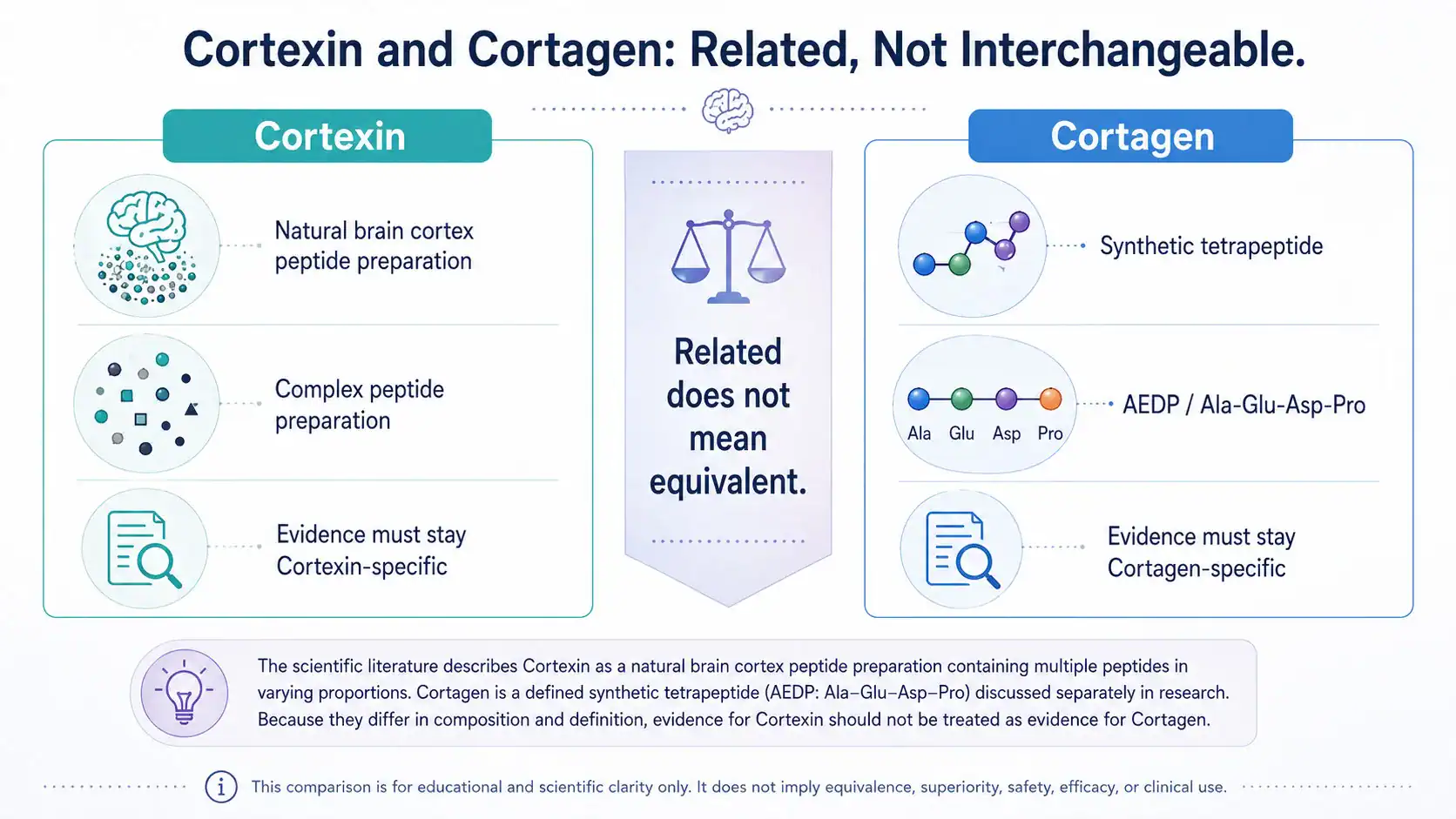
This distinction matters when a benefits list mentions stroke recovery, attention or memory. Before accepting the claim, check which substance the participants actually received. The names are similar enough that summaries can blur an important difference.
What does Cortagen research show?
| Study setting | Finding | Limit |
|---|---|---|
| Injured sciatic nerves in rats | Faster nerve-fiber growth and conduction in an experimental injury model. [3] | Not proof of nerve repair or better memory in people. |
| Mouse heart tissue | Changes in gene expression after Cortagen exposure. [1] | Not a human brain-function outcome. |
| Mouse behavior | Activity and anxiety-related effects varied with the experimental conditions. [2] | Not evidence of reliable anxiety relief. |
| Chronic brain ischemia in rats | Behavioral and oxidative-stress findings in a paper studying Cortexin and Cortagen. [4] | Not a clinical stroke or dementia trial. |
| Early patient reports in a patent | Reported cognitive and neurological changes. [5] | Not independent confirmation from a robust clinical trial. |
Nerve regeneration: a finding worth reading carefully
A 2000 rat study examined recovery after the sciatic nerve had been cut and surgically reconnected. Over ten days, investigators reported a 27% increase in nerve-fiber growth rate and a 40% increase in conduction velocity with Cortagen. [3]
Those percentages describe measurements in a specific animal experiment. They are not percentages of human recovery, and they do not mean that Cortagen makes a person’s brain 40% faster. The sciatic nerve is a peripheral nerve; cognition involves different structures and outcomes.
The result supports further investigation of nerve injury. It does not establish treatment for neuropathy, concussion or age-related cognitive decline.
Gene expression and proposed neuroprotection
A 2004 microarray study measured thousands of transcripts in mouse heart tissue after five days of exposure. It identified changes corresponding to 110 known genes. Despite the paper’s reference to a brain cortex peptide, the experiment was conducted in the heart, not in human brain tissue. [1]
Changes in gene expression can help researchers identify mechanisms to test. They do not, by themselves, establish an anti-aging effect or show that a neuron is healthier. Both increases and decreases can have different consequences depending on the gene and setting.
In a separate rat ischemia study, investigators reported behavioral recovery and changes in lipid peroxidation and antioxidant activity while studying Cortexin and Cortagen. These are preclinical observations about reduced blood supply to the brain, not proof that Cortagen prevents or treats a human stroke. [4]
Does it help memory, anxiety or brain fog?
The evidence does not establish Cortagen as a reliable cognitive enhancer. A 2009 mouse study found that its effects on locomotion and anxiety-related behavior depended on dose and repeated exposure. Some conditions produced anxiety-like findings. That is not the same as a consistent calming effect or better concentration in people. [2]
Human reports do exist in an early patent for the AEDP sequence. One example describes 35 people with long-term consequences of traumatic brain injury, including 15 given the peptide alongside conventional care. Another describes 12 older patients assessed before and after treatment. The patent reports improvements, but these small examples lack the clear randomized, blinded design needed for dependable conclusions. [5]
Calling this “no human history at all” would overlook those reports. Calling it a proven brain-health therapy would overstate them. Patent examples are preliminary developer claims, not a substitute for independently replicated clinical research.
Persistent brain fog or memory changes deserve assessment rather than an assumption that one peptide addresses the cause. Sleep problems, medication effects, mood disorders and other health conditions can affect thinking. A clinician can help distinguish these from conditions requiring different care. [6]
Side effects and safety
There is not enough reliable human evidence to give a meaningful side-effect rate or a well-defined long-term safety profile. Animal tolerability findings do not settle questions about medication interactions, repeated courses or neurological effects in a person.
There are additional uncertainties for pregnancy, breastfeeding, children and people with serious medical conditions. The word “peptide” does not remove the need for product-specific safety testing.
Research-product identity, purity and sterility are separate issues from whether the molecule works. A laboratory report about purity cannot establish that an injected product is safe, that it contains an effective amount, or that a proposed use has been clinically tested.
Cortagen dosage and protocol claims
The studies above do not establish a validated general human dosage. Animal amounts, patent examples and schedules circulated online are not interchangeable sources of dosing evidence.
A vial strength tells you how much material is claimed to be in the container. Reconstitution tells you the resulting concentration. Neither answers how much a person should use, whether they should use it at all, or how long treatment would need to continue.
Be particularly cautious with claims that one short “cycle” resets gene expression or guarantees lasting brain repair. The research reviewed here does not demonstrate those outcomes.
Common questions
Is Cortagen a nootropic?
It is sometimes marketed that way, but the label is not proof that it improves cognition in healthy adults. The strongest identifiable findings discussed here are preclinical, with limited early human reports.
Is Cortagen the same as Cerebrolysin?
No. Cortagen is the defined AEDP sequence. A study of another preparation should not be used to claim Cortagen has equivalent effectiveness or safety.
Does gene regulation mean reversal of brain aging?
No. Measuring altered gene activity is different from demonstrating preserved independence, better memory or reduced dementia risk.
Bottom line: Cortagen has a research rationale and interesting early findings, but the gap between those findings and dependable human benefit remains substantial. For ongoing cognitive symptoms, diagnosis and evidence-based care are more useful starting points than a product label.
Related Cortagen dosage protocols
Continue with the vial-strength-specific research protocol that matches the material being evaluated. Each page keeps its own concentration, reconstitution, and syringe-unit calculations.
Practical measurement and handling guides
References
- Anisimov SV, Khavinson VKh, Anisimov VN. Elucidation of the effect of brain cortex tetrapeptide Cortagen on gene expression in mouse heart by microarray. Neuro Endocrinology Letters. 2004.
- Adriani W, et al. Modulatory effects of Cortexin and Cortagen on locomotor activity and anxiety-related behavior in mice. The Open Neuropsychopharmacology Journal. 2009;2:22–29.
- Turchaninova LN, et al. Effect of tetrapeptide cortagen on regeneration of sciatic nerve. Bulletin of Experimental Biology and Medicine. 2000.
- Zarubina IV, Shabanov PD. Cortexin and cortagen as correcting agents in functional and metabolic disorders in the brain in chronic ischemia. Experimental and Clinical Pharmacology. 2011.
- Khavinson VKh, et al. Tetrapeptide stimulating functional activity of neurons, pharmacological agent based on thereof and method of its use. Russian patent RU2155063C1. 2000. Patent evidence, not a peer-reviewed clinical trial.
- National Institute on Aging. Memory problems, forgetfulness, and aging.